lock DODGE AVENGER 2008 Owners Manual
[x] Cancel search | Manufacturer: DODGE, Model Year: 2008, Model line: AVENGER, Model: DODGE AVENGER 2008Pages: 467, PDF Size: 7.16 MB
Page 283 of 467
² the clicking sound of solenoid valves,
² brake pedal pulsations,
² and a slight drop or fall away of the brake pedal at the
end of the stop.
These are all normal characteristics of ABS.
WARNING!The Anti-Lock Brake System contains sophisticated
electronic equipment that may be susceptible to
interference caused by improperly installed or high
output radio transmitting equipment. This interfer-
ence can cause possible loss of anti-lock braking
capability. Installation of such equipment should be
performed by qualified professionals. All vehicle wheels and tires must be the same size and
type and tires must be properly inflated to produce
accurate signals for the computer.
ELECTRONIC BRAKE CONTROL SYSTEMS ±
ABS/TCS/BAS/ESP
Your vehicle may be equipped with an optional ad-
vanced electronic brake control system that includes
Anti-Lock Brake System (ABS), Traction Control System
(TCS), Brake Assist System (BAS), and Electronic Stability
Program (ESP). All systems work together to enhance
vehicle stability and control in various driving conditions
and are commonly referred to as ESP.
ANTI-LOCK BRAKE SYSTEM (ABS)
This system aids the driver in maintaining vehicle control
under adverse braking conditions. The system controls
hydraulic brake pressure to prevent wheel lock-up and STARTING AND OPERATING 281
5
Page 284 of 467
help avoid skidding on slippery surfaces during braking.
Refer to ªAnti-Lock Brake Systemº in this Section of the
manual for more information about ABS.
TRACTION CONTROL SYSTEM (TCS)
This system monitors the amount of wheel spin
of each of the driven wheels. If wheel spin is
detected, brake pressure is applied to the slip-
ping wheel(s) and engine power is reduced to
provide enhanced acceleration and stability. A feature of
the TCS system functions similar to a limited slip differ-
ential and controls the wheel spin across a driven axle. If
one wheel on a driven axle is spinning faster than the
other, the system will apply the brake of the spinning
wheel. This will allow more engine torque to be applied
to the wheel that is not spinning. This feature remains
active even if TCS and ESP are in the ªPartial Offº mode.
Refer to ªElectronic Stability Program (ESP)º in this
Section of this manual. BRAKE ASSIST SYSTEM (BAS)
The BAS is designed to optimize the vehicle's braking
capability during emergency braking maneuvers. The
system detects an emergency braking situation by sens-
ing the rate and amount of brake application and then
applies optimum pressure to the brakes. This can help
reduce braking distances. The BAS complements the
Anti-Lock Brake System (ABS). Applying the brakes very
quickly results in the best BAS assistance. To receive the
benefit of the system, you must apply continuous brak-
ing pressure during the stopping sequence. Do not
reduce brake pedal pressure unless braking is no longer
desired. Once the brake pedal is released, the BAS is
deactivated.282 STARTING AND OPERATING
Page 292 of 467
CAUTION!² Driving through standing water may cause dam-
age to your vehicle's drivetrain components. Al-
ways inspect your vehicle's fluids (i.e., engine oil,
transmission, axle, etc.) for signs of contamination
(i.e., fluid that is milky or foamy in appearance)
after driving through standing water. Do not con-
tinue to operate the vehicle if any fluid appears
contaminated, as this may result in further dam-
age. Such damage is not covered by the New
Vehicle Limited Warranty.
² Getting water inside your vehicle's engine can
cause it to lock up and stall out, and cause serious
internal damage to the engine. Such damage is not
covered by the New Vehicle Limited Warranty. WARNING!² Driving through standing water limits your vehi-
cle's traction capabilities. Do not exceed 5 mph (8
km/h) when driving through standing water.
² Driving through standing water limits your vehi-
cle's braking capabilities, which increases stop-
ping distances. Therefore, after driving through
standing water, drive slowly and lightly press on
the brake pedal several times to dry the brakes.
² Getting water inside your vehicle's engine can
cause it to lock up and stall out, and leave you
stranded.
² Failure to follow these warnings may result in
injuries that are serious or fatal to you, your
passengers, and others around you.290 STARTING AND OPERATING
Page 342 of 467
WARNING!Improper towing can lead to an injury accident.
Follow these guidelines to make your trailer towing
as safe as possible:
Make certain that the load is secured in the trailer
and that it will not shift during travel. When traile-
ring cargo that is not fully secured, dynamic load
shifts can occur that may be difficult for the driver to
control. You could lose control of your vehicle and
have an accident.
² When hauling cargo, or towing a trailer, do not
overload your vehicle or trailer. Overloading can cause
a loss of control, poor performance, or damage to
brakes, axle, engine, transaxle, steering, suspension,
chassis structure, or tires. ² Safety chains must always be used between your
vehicle and trailer. Always connect the chains to the
frame or hook retainers of the vehicle hitch. Cross the
chains under the trailer tongue and allow enough
slack for turning corners.
² Vehicles with trailers should not be parked on a grade.
When parking, apply the parking brake on the tow
vehicle. Put the tow vehicle automatic transaxle in
PARK. Always, block or 9 chock 9 the trailer wheels.
² GCWR must not be exceeded.
² Total weight must be distributed between the tow
vehicle and the trailer such that the following four
ratings are not exceeded:
1. GVWR
2. GTW
3. GAWR340 STARTING AND OPERATING
Page 349 of 467
WHAT TO DO IN EMERGENCIESCONTENTS m Hazard Warning Flasher ..................348
m If Your Engine Overheats .................348
N Engine Oil Overheating (2.4L Engine Only) Ð
If Equipped .........................350
m Jacking And Tire Changing ................350
N Jack Location ........................351
N Spare Tire Stowage ....................351
N Preparations For Jacking ................352
N Jacking Instructions ....................352 m Jump-Starting Procedures Due To A Low Battery . . 358
m Freeing A Stuck Vehicle ..................361
m Towing A Disabled Vehicle ................362
N Towing With The Ignition Key ............362
N Towing Without The Ignition Key ..........363
N Towing This Vehicle Behind Another Vehicle . . 363
N Towing This Vehicle Behind Another Vehicle
With A Tow Dolly .....................363
N Towing Without Power Ð Override Transaxle
Interlock System ......................364
6
Page 350 of 467
HAZARD WARNING FLASHER
The flasher switch is located on the instrument
panel, below the radio. Depress the switch and
both cluster indicators and all front and rear direc-
tional signals will flash. Depress the switch again to turn
Hazard Warning Flashers off.
Do not use this emergency warning system when the
vehicle is in motion. Use it when your vehicle is disabled
and it is creating a safety hazard for other motorists.
If it is necessary to leave the vehicle to go for service, the
flasher system will continue to operate with the ignition
key removed and the vehicle locked.
NOTE: With extended use, the flasher may wear down
your battery. IF YOUR ENGINE OVERHEATS
In any of the following situations, you can reduce the
potential for overheating by taking the appropriate ac-
tion.
² On the highways Ð Slow down.
² In city traffic Ð While stopped, put transaxle in
NEUTRAL, but do not increase engine idle speed.
If the pointer rises to the H (red) mark, the instrument
cluster will sound a chime. Pull over and stop the vehicle
with the engine at idle, when safe. Turn off the air
conditioning and wait until the pointer drops back into
the normal range. If the pointer remains on the H (red)
mark for more than a minute, turn the engine off imme-
diately and call for service.348 WHAT TO DO IN EMERGENCIES
Page 354 of 467
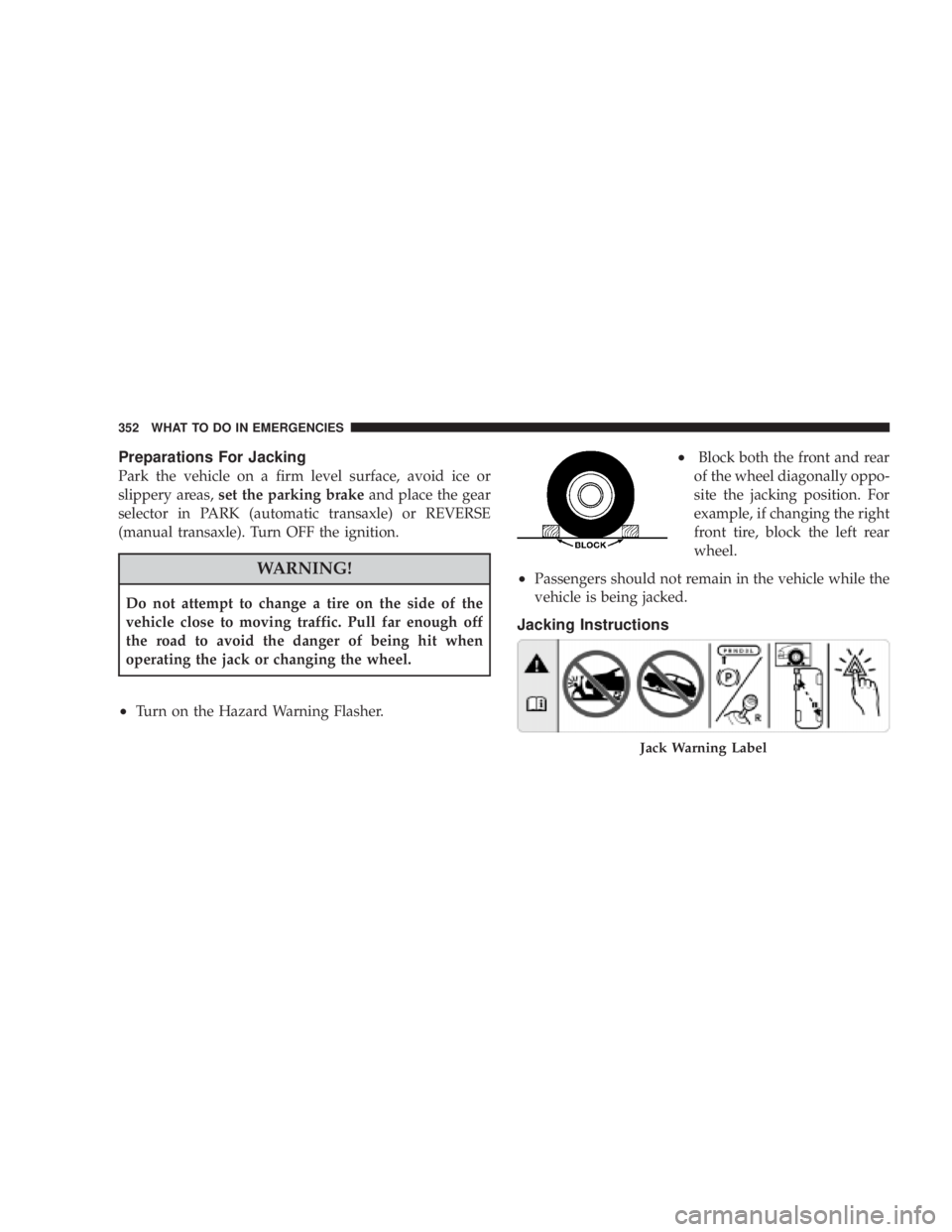
Preparations For Jacking
Park the vehicle on a firm level surface, avoid ice or
slippery areas, set the parking brake and place the gear
selector in PARK (automatic transaxle) or REVERSE
(manual transaxle). Turn OFF the ignition.
WARNING!Do not attempt to change a tire on the side of the
vehicle close to moving traffic. Pull far enough off
the road to avoid the danger of being hit when
operating the jack or changing the wheel.
² Turn on the Hazard Warning Flasher. ² Block both the front and rear
of the wheel diagonally oppo-
site the jacking position. For
example, if changing the right
front tire, block the left rear
wheel.
² Passengers should not remain in the vehicle while the
vehicle is being jacked.
Jacking Instructions
Jack Warning Label352 WHAT TO DO IN EMERGENCIES
Page 355 of 467
WARNING!Carefully follow these tire changing warnings to
help prevent personal injury or damage to your
vehicle:
² Always park on a firm, level surface as far from
the edge of the roadway as possible before raising
the vehicle.
² Block the wheel diagonally opposite the wheel to
be raised.
² Set the parking brake firmly and set an automatic
transmission in park; a manual transmission in
reverse.
² Do not let anyone sit in the vehicle when it is on a
jack. 1. Remove the scissors jack and lug wrench from the
spare wheel as an assembly. Turn the jack screw to the left
to loosen the lug wrench, and remove the wrench from
the jack assembly. WHAT TO DO IN EMERGENCIES 353
6
Page 359 of 467
WARNING!To avoid possible personal injury, handle the wheel
covers with care to avoid contact with any sharp
edges.
7. Lower the vehicle by turning the jack screw to the left.
8. Finish tightening the nuts. Push down on the wrench
while tightening the wheel nuts. Alternate nuts, until
each nut has been tightened twice. Correct wheel nut
torque is 100 ft. lbs (135 N´m). If you doubt that you have
tightened the nuts correctly, have them checked with a
torque wrench by your dealer or at a service station.
9. Remove the wheel blocks and lower the jack until it is
free. Reassemble the lug wrench to the jack assembly and
stow it in the spare tire area. Secure the assembly using
the means provided. WARNING!A loose tire or jack thrown forward in a collision or
hard stop could endanger the occupants of the ve-
hicle. Always stow the jack parts and the spare tire in
the places provided.
10. Place the deflated (flat) tire in the cargo area and have
the tire repaired or replaced as soon as possible.
WARNING!A loose tire thrown forward in a collision or hard
stop could injure the occupants in the vehicle. Have
the deflated (flat) tire repaired or replaced
immediately. WHAT TO DO IN EMERGENCIES 357
6
Page 361 of 467
1. Wear eye protection and remove any metal jewelry
such as watchbands or bracelets that might make an
inadvertent electrical contact.
2. When boosting from a battery in another vehicle, park
that vehicle within booster cable reach, but without
allowing the vehicles to touch. Set parking brake, place
automatic transaxle in PARK and turn ignition to LOCK
for both vehicles.
WARNING!Do not permit vehicles to touch each other as this
could establish a ground connection and personal
injury could result.
3. Turn off the heater, radio, and all unnecessary electri-
cal loads. 4. Remove the protective cover over the remote jump-
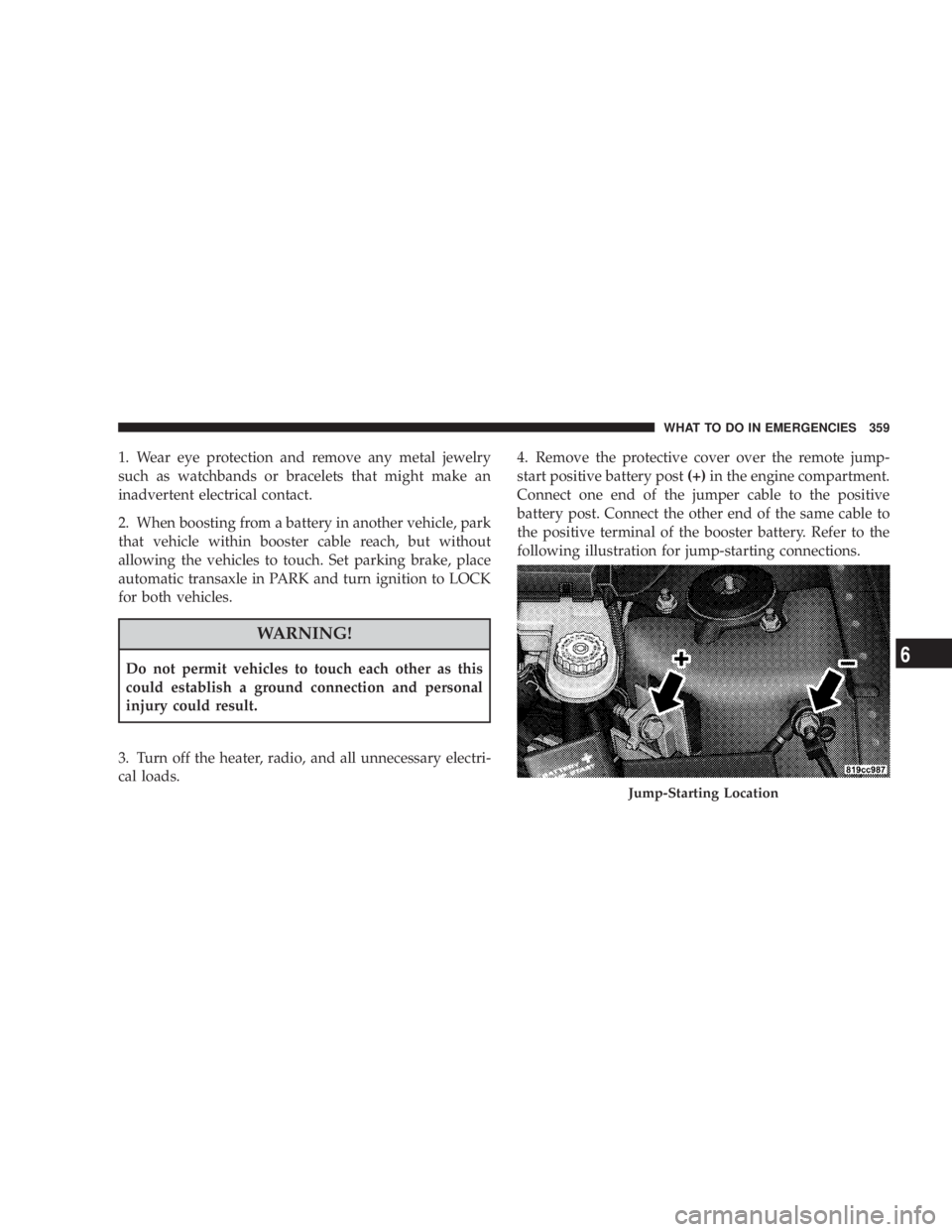
start positive battery post (+) in the engine compartment.
Connect one end of the jumper cable to the positive
battery post. Connect the other end of the same cable to
the positive terminal of the booster battery. Refer to the
following illustration for jump-starting connections.
Jump-Starting Location WHAT TO DO IN EMERGENCIES 359
6