light DODGE AVENGER 2008 Owners Manual
[x] Cancel search | Manufacturer: DODGE, Model Year: 2008, Model line: AVENGER, Model: DODGE AVENGER 2008Pages: 467, PDF Size: 7.16 MB
Page 358 of 467
3. There are two front jacking locations and two rear
jacking locations on each side of the body as shown.
CAUTION!Do not attempt to raise the vehicle by jacking on
locations other than those indicated in step 3.
4. Turn the jack screw to the left until the jack can be
placed under the jacking location. Once the jack is
positioned, turn the jack screw to the right until the jack
head is properly engaged with the lift area closest to the
wheel to be changed. Do not raise the vehicle until you
are sure the jack is securely engaged. WARNING!Raising the vehicle higher than necessary can make
the vehicle less stable. It could slip off the jack and
hurt someone near it. Raise the vehicle only enough
to remove the tire.
5. Raise the vehicle by turning the jack screw to the right,
using the swivel wrench. Raise the vehicle only until the
tire just clears the surface and enough clearance is
obtained to install the spare tire. Minimum tire lift
provides maximum stability.
6. Remove the wheel nuts, and pull the wheel and wheel
covers (where applicable) off the hub. Install the spare
wheel and wheel nuts with the cone shaped end of the
nuts toward the wheel. Lightly tighten the nuts. To avoid
the risk of forcing the vehicle off the jack, do not tighten
the nuts fully until the vehicle has been lowered.356 WHAT TO DO IN EMERGENCIES
Page 360 of 467
11. Check the tire pressure as soon as possible. Correct
pressure as required.
JUMP-STARTING PROCEDURES DUE TO A LOW
BATTERY
Jump-starting remote battery terminals are located under
the hood.
The battery is stored between the left front headlight
assembly and the left front wheel splash shield. Access is
through the splash shield. WARNING! ² Take care to avoid the radiator cooling fan whenever the
hood is raised. It can start anytime the ignition switch is
on. You can be hurt by the fan.
² Do not attempt to push or tow your vehicle to get it
started. Vehicles equipped with an automatic transaxle
cannot be started this way. Unburned fuel could enter
the catalytic converter and once the engine has started,
ignite and damage the converter and vehicle. If the
vehicle has a discharged battery, booster cables may be
used to obtain a start from another vehicle. This type of
start can be dangerous if done improperly, so follow this
procedure carefully.
² Do not use a booster battery or any other booster source
with an output that exceeds 12 volts.
² During cold weather when temperatures are below
freezing point, electrolyte in a discharged battery may
freeze. Do not attempt jump-starting because the battery
could rupture or explode. The battery temperature must
be brought up above freezing point before attempting
jump-start.358 WHAT TO DO IN EMERGENCIES
Page 368 of 467
N A/C Air Filter Ð If Equipped ............383
N Power Steering .......................385
N Front Suspension .....................385
N Steering Linkage ......................386
N Body Lubrication .....................386
N Windshield Wiper Blades ................386
N Windshield Washers ...................387
N Exhaust System ......................387
N Cooling System .......................388
N Hoses And Vacuum/Vapor Harnesses .......394
N Fuel System .........................394
N Brake System ........................394
N Automatic Transaxle ...................397 N Front And Rear Wheel Bearings ...........400
N Appearance Care And Protection From
Corrosion ...........................400
N Cleaning Center Console Cupholders .......405
m Fuses Ð Totally Integrated Power Module
(TIPM) ..............................406
m Vehicle Storage ........................411
m Replacement Bulbs ......................411
m Bulb Replacement ......................412
N Headlight Bulb Replacement .............412
N Fog Lights ..........................415
N Taillights, Rear Turn Signals And Backup Lights Ð
Replacement .........................416
N License Plate Light Ð Rear ..............418366 MAINTAINING YOUR VEHICLE
Page 369 of 467
N Center High-Mounted Stop Light ..........418
m Fluids And Capacities ...................420 m Fluids, Lubricants, And Genuine Parts ........422
N Engine .............................422 MAINTAINING YOUR VEHICLE 367
7
Page 373 of 467
ONBOARD DIAGNOSTIC SYSTEM Ð OBD II
Your vehicle is equipped with a sophisticated Onboard
Diagnostic system called OBD II. This system monitors
the performance of the emissions, engine, and automatic
transaxle control systems. When these systems are oper-
ating properly, your vehicle will provide excellent per-
formance and fuel economy, as well as maintaining
engine emissions well within current government regu-
lations.
If any of these systems require service, the OBD II
system will turn on the Malfunction Indicator
Light (MIL). It will also store diagnostic codes
and other information to assist an authorized service
technician in making repairs. Although your vehicle will
usually be drivable and not need towing, see your
authorized dealer for service as soon as possible. CAUTION!² Prolonged driving with the MIL on could cause
further damage to the emission control system. It
could also affect fuel economy and drivability. The
vehicle must be serviced before any emissions
tests can be performed.
² If the MIL is flashing while the engine is running,
severe catalytic converter damage and power loss
will soon occur. Immediate service is required.
LOOSE FUEL FILLER CAP MESSAGE
After fuel is added, the vehicle diagnostic system can
determine if the fuel filler cap is possibly loose or
improperly installed. A ªgASCAPº message will be dis-
played in the instrument cluster. Tighten the gas cap until
a 9 clicking 9 sound is heard. This is an indication that the
gas cap is properly tightened. Press the Trip Odometer MAINTAINING YOUR VEHICLE 371
7
Page 374 of 467
RESET button to turn off the message. If the problem
persists, the message will appear the next time the
vehicle is started. This might indicate a damaged cap. If
the problem is detected twice in a row, the system will
turn on the MIL. Resolving the problem will turn the MIL
light off.
EMISSIONS INSPECTION AND MAINTENANCE
PROGRAMS
In some localities, it may be a legal requirement to pass
an inspection of this vehicle's emissions control system.
Failure to pass could prevent vehicle registration.
For states that require an Inspection and Mainte-
nance (I/M), this check verifies the Malfunction
Indicator Light (MIL) is functioning and is not on
when the engine is running, and that the OBD II system
is ready for testing. Normally, the OBD II system will be ready. The OBD II
system may not be ready if the vehicle was recently
serviced, recently had a dead battery, or a battery replace-
ment. If the OBD II system should be determined not
ready for the I/M test, the vehicle may fail the test.
This vehicle has a simple ignition key-actuated test,
which you can use prior to going to the test station. To
check if this vehicle's OBD II system is ready, you must
do the following:
1. Insert the ignition key into the ignition switch.
2. Turn the ignition to the ON position, but do not crank
or start the engine.
3. If you crank or start the engine, you will have to start
this test over.
4. As soon as you turn the ignition key to the ON
position, you will see the MIL symbol come on as part of
a normal bulb check.372 MAINTAINING YOUR VEHICLE
Page 386 of 467
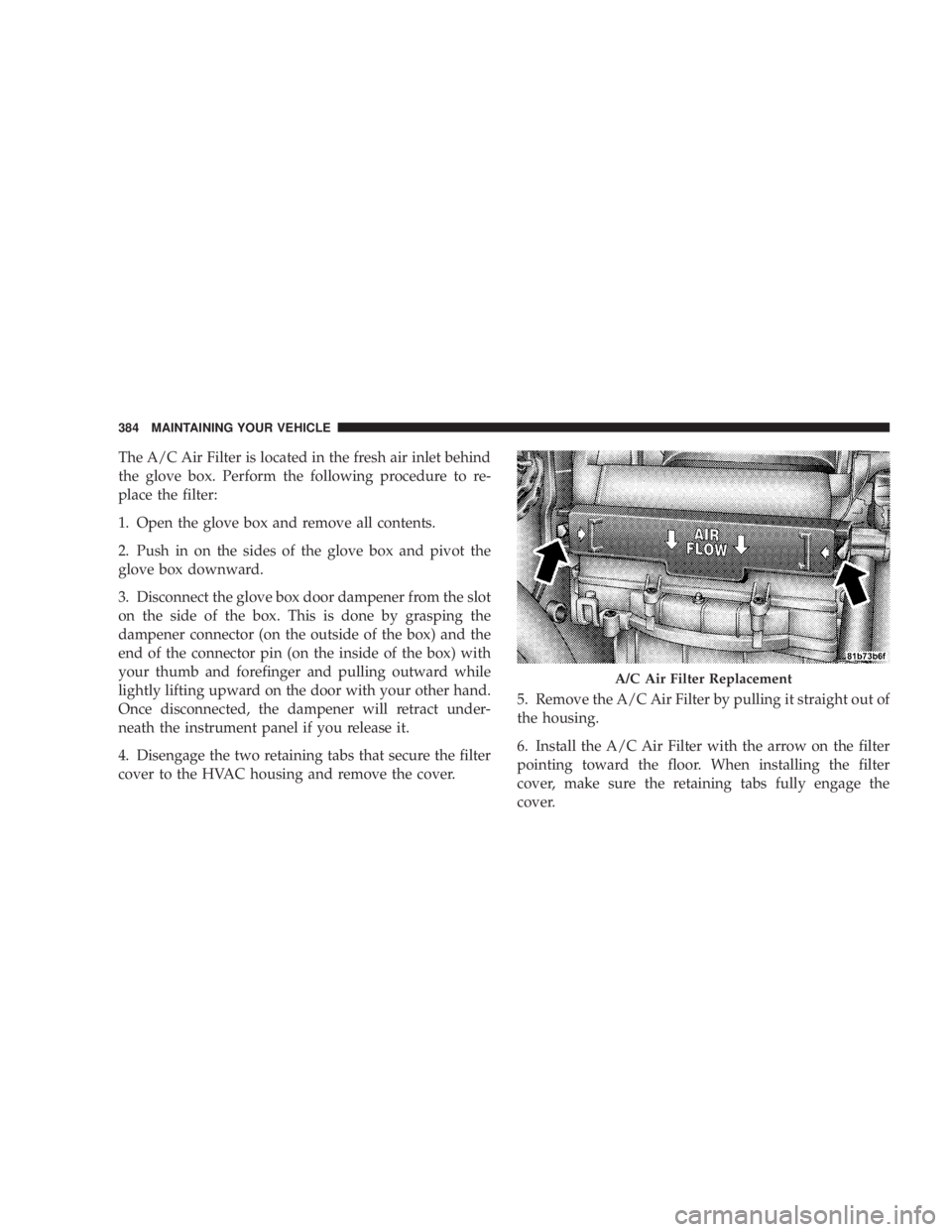
The A/C Air Filter is located in the fresh air inlet behind
the glove box. Perform the following procedure to re-
place the filter:
1. Open the glove box and remove all contents.
2. Push in on the sides of the glove box and pivot the
glove box downward.
3. Disconnect the glove box door dampener from the slot
on the side of the box. This is done by grasping the
dampener connector (on the outside of the box) and the
end of the connector pin (on the inside of the box) with
your thumb and forefinger and pulling outward while
lightly lifting upward on the door with your other hand.
Once disconnected, the dampener will retract under-
neath the instrument panel if you release it.
4. Disengage the two retaining tabs that secure the filter
cover to the HVAC housing and remove the cover. 5. Remove the A/C Air Filter by pulling it straight out of
the housing.
6. Install the A/C Air Filter with the arrow on the filter
pointing toward the floor. When installing the filter
cover, make sure the retaining tabs fully engage the
cover. A/C Air Filter Replacement384 MAINTAINING YOUR VEHICLE
Page 398 of 467
immediately! Eventual deterioration of the hose can
take place resulting in a possibility of a burst failure.
WARNING!Worn brake hoses can burst and cause brake failure.
You could have an accident. If you see any signs of
cracking, scuffing, or worn spots, have the brake
hoses replaced immediately.
Master Cylinder - Brake Fluid Level Check
Check the fluid level in the master cylinder immediately
if the brake system warning light indicates system fail-
ure.
Check the fluid level in the master cylinder when per-
forming underhood services. Clean the top of the master cylinder area before removing
the cap. If necessary, add fluid to bring the fluid level up
to the requirements described on the brake fluid reser-
voir.
Overfilling of fluid is not recommended because it may
cause leaking in the system.
Fluid level can be expected to fall as the brake pads wear.
Brake fluid level should be checked when pads are
replaced. However, low fluid level may be caused by a
leak and a checkup may be needed.
Use only manufacturers recommended brake fluid. Refer
to ªFluids, Lubricants, and Genuine Partsº for the correct
fluid type.396 MAINTAINING YOUR VEHICLE
Page 404 of 467
² If your vehicle is damaged due to an accident or
similar cause which destroys the paint and protective
coating, have your vehicle repaired as soon as pos-
sible. The cost of such repairs is considered the respon-
sibility of the owner.
² If you carry special cargo such as chemicals, fertilizers,
de-icer salt, etc., be sure that such materials are well
packaged and sealed.
² If a lot of driving is done on gravel roads, consider
mud or stone shields behind each wheel.
² Use Mopar t touch up paint on scratches as soon as
possible. Your authorized dealer has touch up paint to
match the color of your vehicle.
Wheel and Wheel Trim Care
All wheels and wheel trim, especially aluminum and
chrome plated wheels, should be cleaned regularly with
a mild soap and water to prevent corrosion. To remove heavy soil and/or excessive brake dust, use Mopar t
Wheel Cleaner (05066247AB) or equivalent or select a
nonabrasive, non-acidic cleaner. Do not use scouring
pads, steel wool, a bristle brush, or metal polishes. Only
Mopar t or equivalent is recommended. Do not use oven
cleaner. Avoid automatic car washes that use acidic
solutions or harsh brushes that may damage the wheels'
protective finish.
Cleaning Headlights
Your vehicle has plastic headlights that are lighter and
less susceptible to stone breakage than glass headlights.
Plastic is not as scratch resistant as glass and therefore
different lens cleaning procedures must be followed.
To minimize the possibility of scratching the lenses and
reducing light output, avoid wiping with a dry cloth. To
remove road dirt, wash with a mild soap solution fol-
lowed by rinsing.402 MAINTAINING YOUR VEHICLE
Page 409 of 467
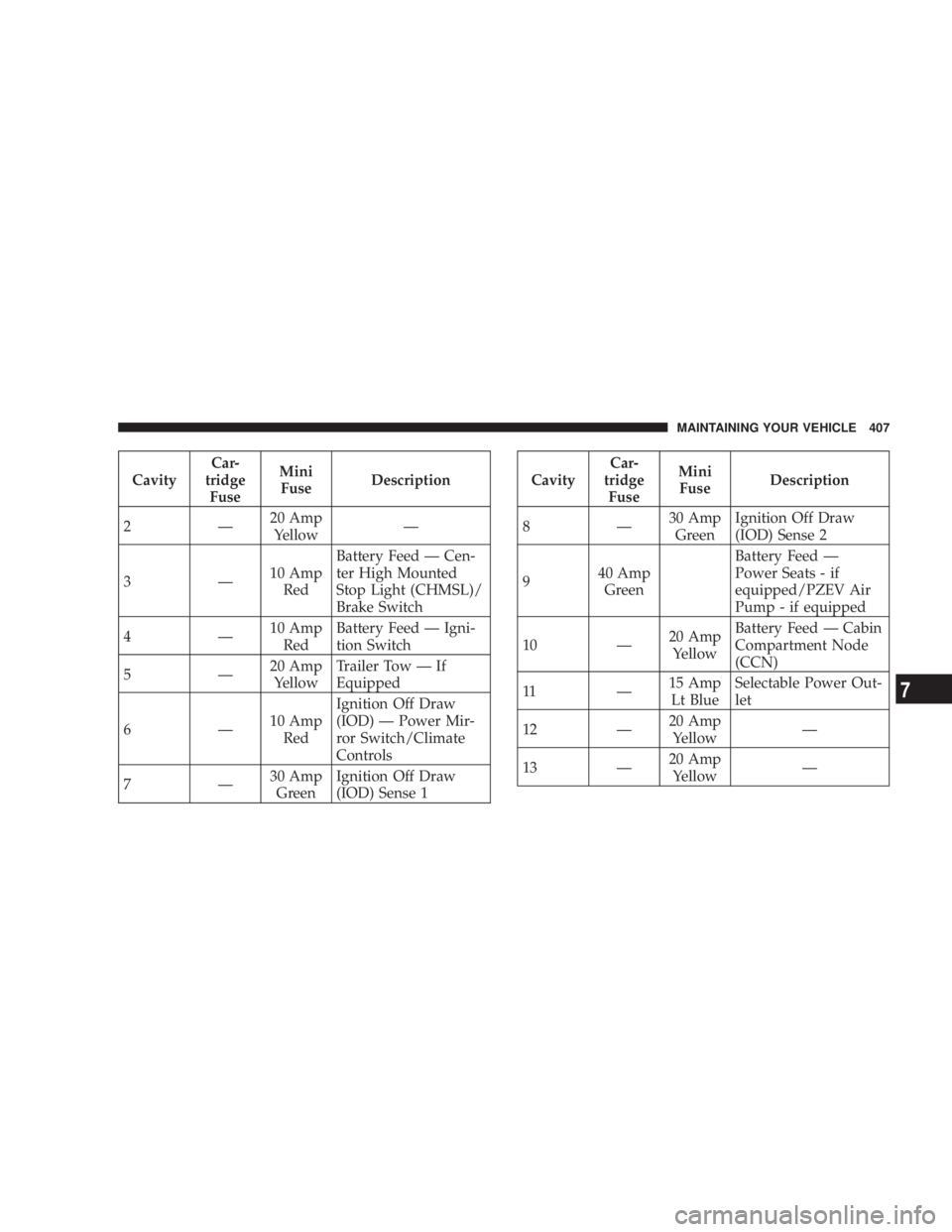
Cavity Car-
tridge
Fuse Mini
Fuse Description
2Ð 20 Amp
Yellow Ð
3Ð 10 Amp
Red Battery Feed Ð Cen-
ter High Mounted
Stop Light (CHMSL)/
Brake Switch
4Ð 10 Amp
Red Battery Feed Ð Igni-
tion Switch
5Ð 20 Amp
Yellow Trailer Tow Ð If
Equipped
6Ð 10 Amp
Red Ignition Off Draw
(IOD) Ð Power Mir-
ror Switch/Climate
Controls
7Ð 30 Amp
Green Ignition Off Draw
(IOD) Sense 1 Cavity Car-
tridge
Fuse Mini
Fuse Description
8Ð 30 Amp
Green Ignition Off Draw
(IOD) Sense 2
9 40 Amp
Green Battery Feed Ð
Power Seats - if
equipped/PZEV Air
Pump - if equipped
10 Ð 20 Amp
Yellow Battery Feed Ð Cabin
Compartment Node
(CCN)
11 Ð 15 Amp
Lt Blue Selectable Power Out-
let
12 Ð 20 Amp
Yellow Ð
13 Ð 20 Amp
Yellow Ð MAINTAINING YOUR VEHICLE 407
7