brakes DODGE AVENGER 2008 User Guide
[x] Cancel search | Manufacturer: DODGE, Model Year: 2008, Model line: AVENGER, Model: DODGE AVENGER 2008Pages: 467, PDF Size: 7.16 MB
Page 335 of 467
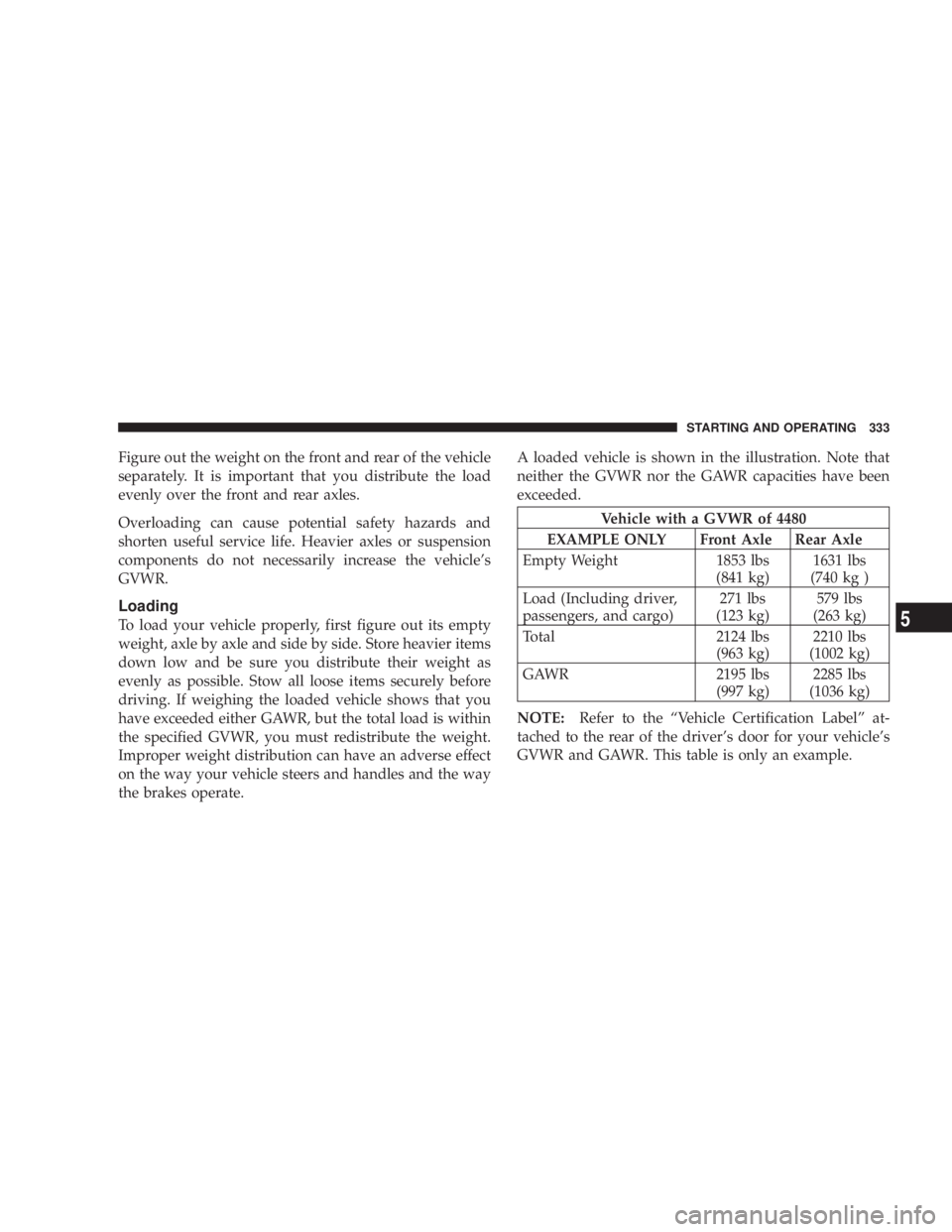
Figure out the weight on the front and rear of the vehicle
separately. It is important that you distribute the load
evenly over the front and rear axles.
Overloading can cause potential safety hazards and
shorten useful service life. Heavier axles or suspension
components do not necessarily increase the vehicle's
GVWR.
Loading
To load your vehicle properly, first figure out its empty
weight, axle by axle and side by side. Store heavier items
down low and be sure you distribute their weight as
evenly as possible. Stow all loose items securely before
driving. If weighing the loaded vehicle shows that you
have exceeded either GAWR, but the total load is within
the specified GVWR, you must redistribute the weight.
Improper weight distribution can have an adverse effect
on the way your vehicle steers and handles and the way
the brakes operate. A loaded vehicle is shown in the illustration. Note that
neither the GVWR nor the GAWR capacities have been
exceeded.
Vehicle with a GVWR of 4480
EXAMPLE ONLY Front Axle Rear Axle
Empty Weight 1853 lbs
(841 kg) 1631 lbs
(740 kg )
Load (Including driver,
passengers, and cargo) 271 lbs
(123 kg) 579 lbs
(263 kg)
Total 2124 lbs
(963 kg) 2210 lbs
(1002 kg)
GAWR 2195 lbs
(997 kg) 2285 lbs
(1036 kg)
NOTE: Refer to the ªVehicle Certification Labelº at-
tached to the rear of the driver's door for your vehicle's
GVWR and GAWR. This table is only an example. STARTING AND OPERATING 333
5
Page 342 of 467
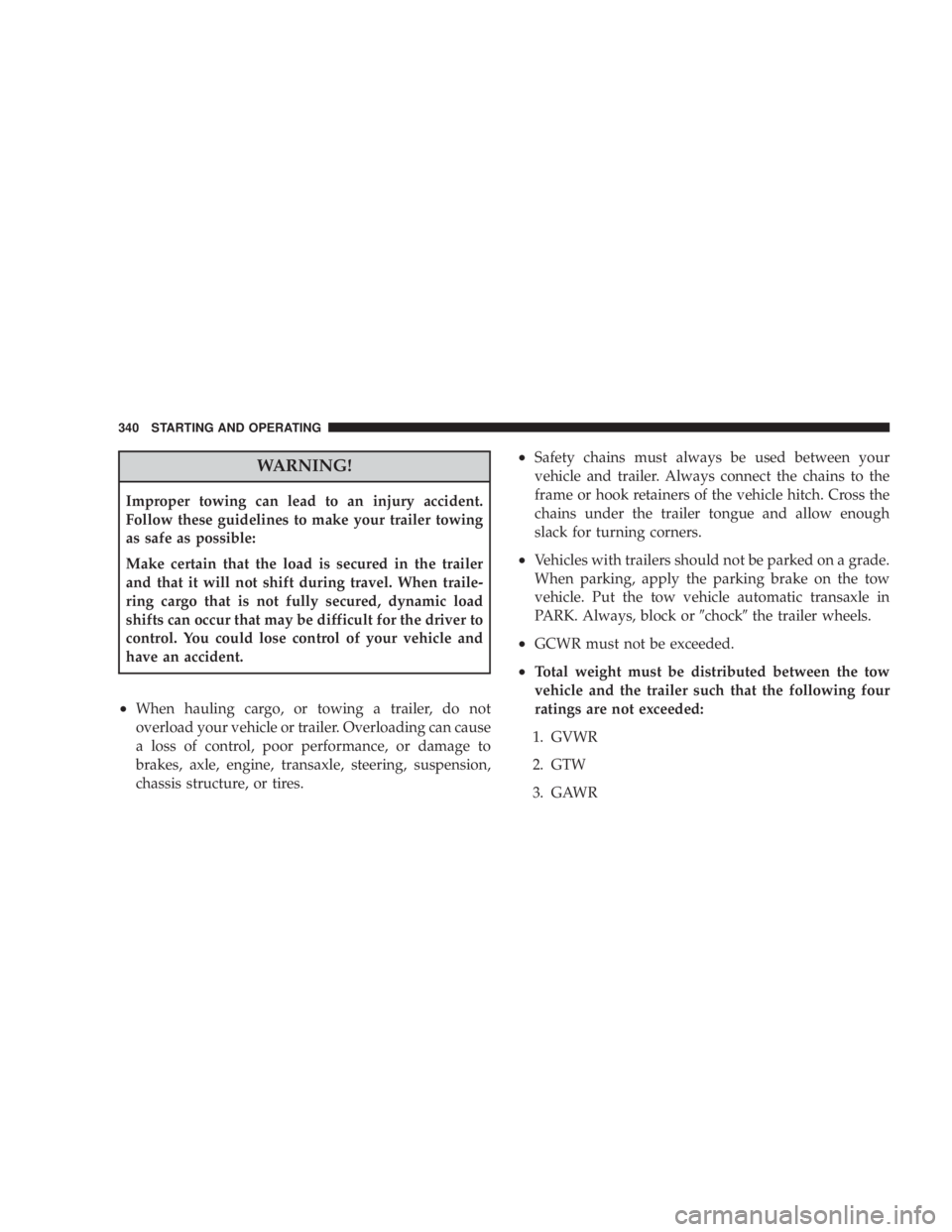
WARNING!Improper towing can lead to an injury accident.
Follow these guidelines to make your trailer towing
as safe as possible:
Make certain that the load is secured in the trailer
and that it will not shift during travel. When traile-
ring cargo that is not fully secured, dynamic load
shifts can occur that may be difficult for the driver to
control. You could lose control of your vehicle and
have an accident.
² When hauling cargo, or towing a trailer, do not
overload your vehicle or trailer. Overloading can cause
a loss of control, poor performance, or damage to
brakes, axle, engine, transaxle, steering, suspension,
chassis structure, or tires. ² Safety chains must always be used between your
vehicle and trailer. Always connect the chains to the
frame or hook retainers of the vehicle hitch. Cross the
chains under the trailer tongue and allow enough
slack for turning corners.
² Vehicles with trailers should not be parked on a grade.
When parking, apply the parking brake on the tow
vehicle. Put the tow vehicle automatic transaxle in
PARK. Always, block or 9 chock 9 the trailer wheels.
² GCWR must not be exceeded.
² Total weight must be distributed between the tow
vehicle and the trailer such that the following four
ratings are not exceeded:
1. GVWR
2. GTW
3. GAWR340 STARTING AND OPERATING
Page 343 of 467
4. Trailer tongue weight rating for the trailer hitch
utilized (This requirement may limit the ability to
always achieve 10% of trailer tongue weight as a
percentage of total trailer weight).
Towing Requirements Ð Tires
² Do not attempt to tow a trailer while using a compact
spare tire.
² Proper tire inflation pressures are essential to the safe
and satisfactory operation of your vehicle. Refer to the
ªTires Ð General Informationº in this section for
information on tire pressures and for proper tire
inflation procedures.
² Also, check the trailer tires for proper tire inflation
pressures before trailer usage.
² Check for signs of tire wear or visible tire damage
before towing a trailer. Refer to ªTires Ð General Informationº in this section for information on tread
wear indicators and for proper inspection procedure.
² When replacing tires, refer to ªTires Ð General Infor-
mationº in this section for information on replacement
tires and for proper tire replacement procedures. Re-
placing tires with a higher load carrying capacity will
not increase the vehicle's GVWR and GAWR limits.
Towing Requirements Ð Trailer Brakes
² Do not interconnect the hydraulic brake system or
vacuum system of your vehicle with that of the trailer.
This could cause inadequate braking and possible
personal injury.
² An electronically actuated trailer brake controller is
required when towing a trailer with electronically
actuated brakes. When towing a trailer equipped with
a hydraulic surge actuated brake system, an electronic
brake controller is not required. STARTING AND OPERATING 341
5
Page 344 of 467
² Trailer brakes are recommended for trailers over 1,000
lbs (450 kg) and required for trailers in excess of 2,000
lbs (907 kg).
CAUTION!If the trailer weighs more than 1,000 lbs (450 kg)
loaded, it should have its own brakes with adequate
braking capacity. Failure to do this could lead to
accelerated brake lining wear, higher brake pedal
effort, and longer stopping distances. WARNING!Do not connect trailer brakes to your vehicle's hy-
draulic brake lines. It can overload your brake sys-
tem and cause it to fail. You might not have brakes
when you need them and could have an accident.
Towing any trailer will increase your stopping dis-
tance. When towing, you should allow for additional
space between your vehicle and the vehicle in front
of you. Failure to do so could result in an accident.
Towing Requirements Ð Trailer Lights and Wiring
Whenever you pull a trailer, regardless of the trailer size,
stoplights and turn signals on the trailer are required for
motoring safety.
Use a factory approved trailer harness and connector.342 STARTING AND OPERATING
Page 397 of 467
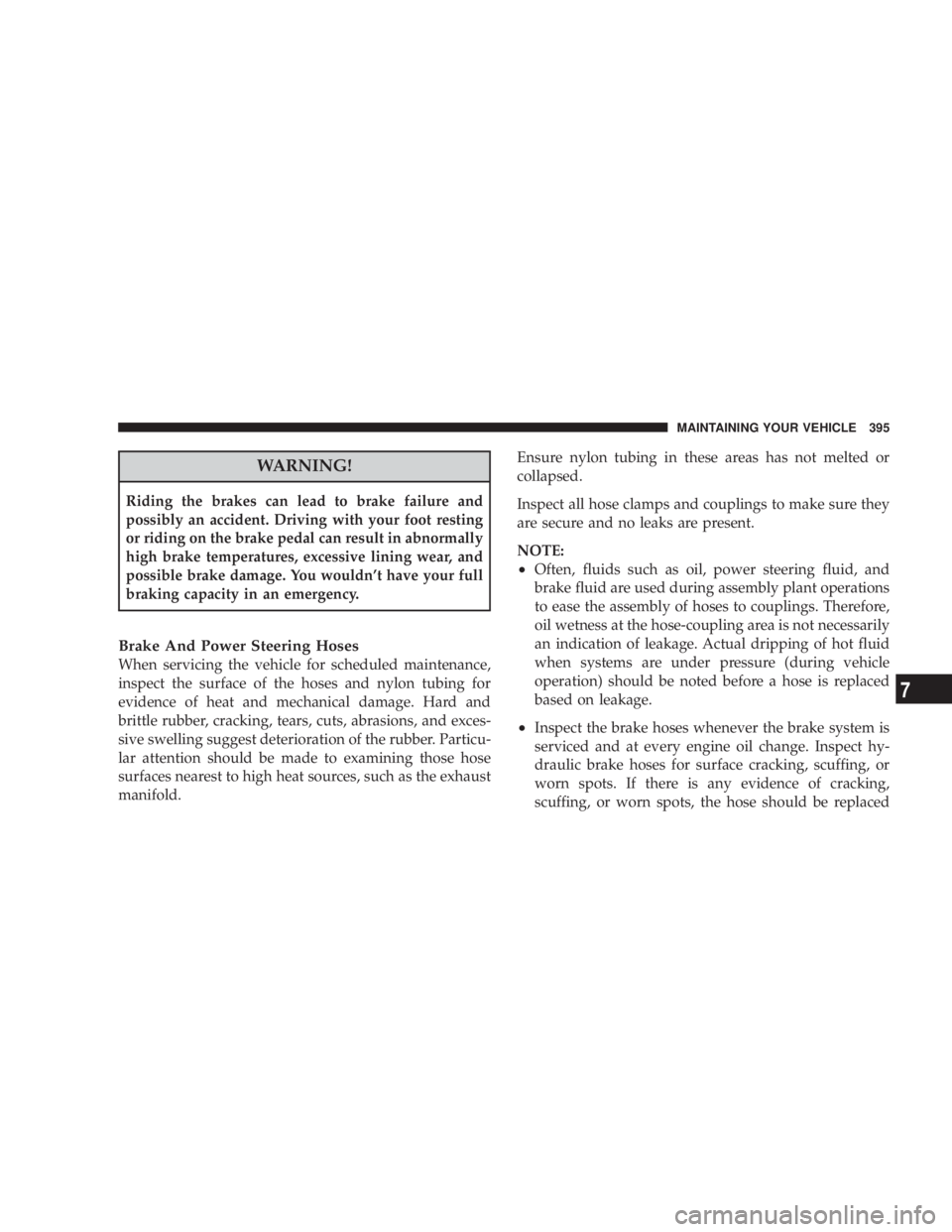
WARNING!Riding the brakes can lead to brake failure and
possibly an accident. Driving with your foot resting
or riding on the brake pedal can result in abnormally
high brake temperatures, excessive lining wear, and
possible brake damage. You wouldn't have your full
braking capacity in an emergency.
Brake And Power Steering Hoses
When servicing the vehicle for scheduled maintenance,
inspect the surface of the hoses and nylon tubing for
evidence of heat and mechanical damage. Hard and
brittle rubber, cracking, tears, cuts, abrasions, and exces-
sive swelling suggest deterioration of the rubber. Particu-
lar attention should be made to examining those hose
surfaces nearest to high heat sources, such as the exhaust
manifold. Ensure nylon tubing in these areas has not melted or
collapsed.
Inspect all hose clamps and couplings to make sure they
are secure and no leaks are present.
NOTE:
² Often, fluids such as oil, power steering fluid, and
brake fluid are used during assembly plant operations
to ease the assembly of hoses to couplings. Therefore,
oil wetness at the hose-coupling area is not necessarily
an indication of leakage. Actual dripping of hot fluid
when systems are under pressure (during vehicle
operation) should be noted before a hose is replaced
based on leakage.
² Inspect the brake hoses whenever the brake system is
serviced and at every engine oil change. Inspect hy-
draulic brake hoses for surface cracking, scuffing, or
worn spots. If there is any evidence of cracking,
scuffing, or worn spots, the hose should be replaced MAINTAINING YOUR VEHICLE 395
7
Page 412 of 467
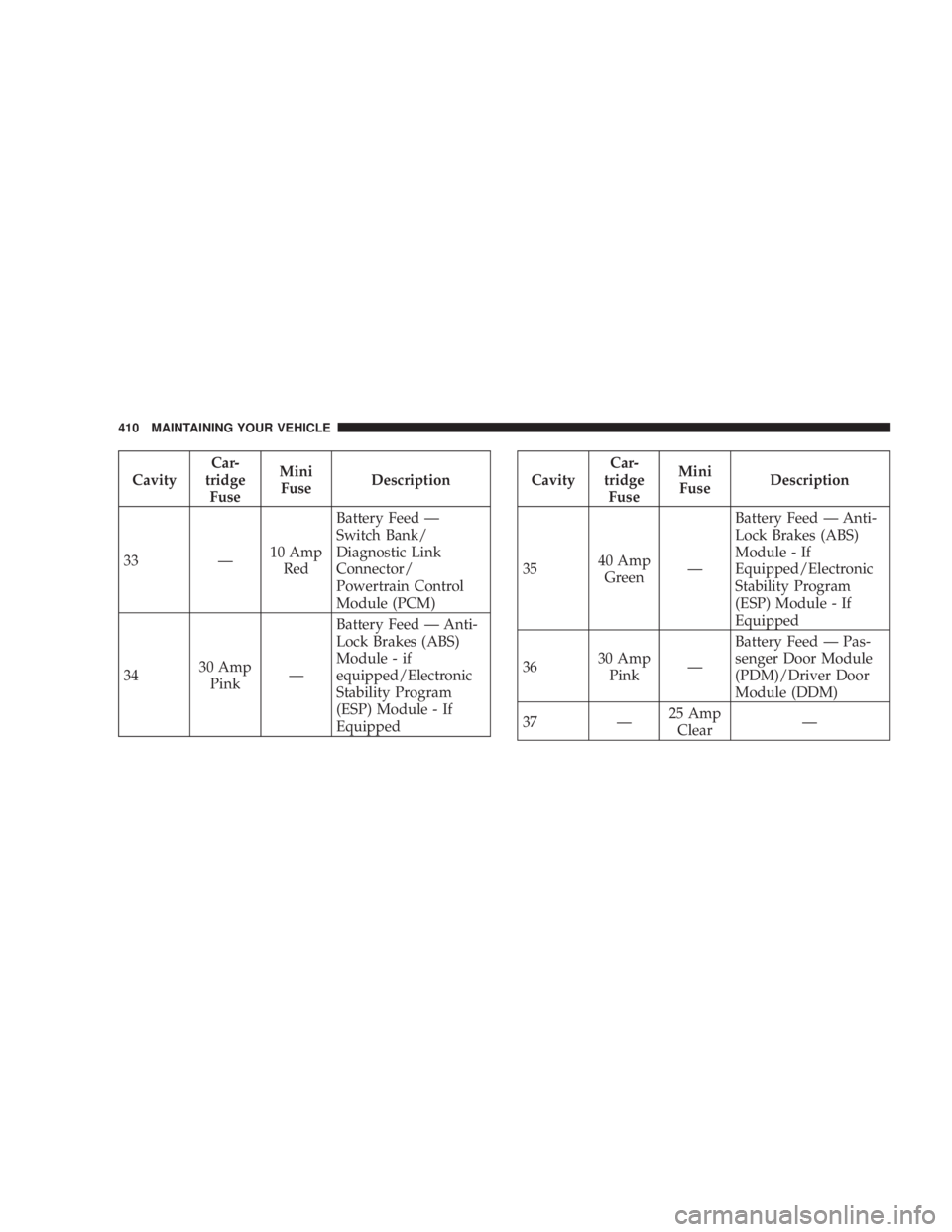
Cavity Car-
tridge
Fuse Mini
Fuse Description
33 Ð 10 Amp
Red Battery Feed Ð
Switch Bank/
Diagnostic Link
Connector/
Powertrain Control
Module (PCM)
34 30 Amp
Pink Ð Battery Feed Ð Anti-
Lock Brakes (ABS)
Module - if
equipped/Electronic
Stability Program
(ESP) Module - If
Equipped Cavity Car-
tridge
Fuse Mini
Fuse Description
35 40 Amp
Green Ð Battery Feed Ð Anti-
Lock Brakes (ABS)
Module - If
Equipped/Electronic
Stability Program
(ESP) Module - If
Equipped
36 30 Amp
Pink Ð Battery Feed Ð Pas-
senger Door Module
(PDM)/Driver Door
Module (DDM)
37 Ð 25 Amp
Clear Ð410 MAINTAINING YOUR VEHICLE
Page 447 of 467
Automatic Door Locks ..................... 32
Automatic Oil Change Indicator ........ 173,184,426
Automatic Temperature Control (ATC) ......... 246
Automatic Transaxle .............. 12,261,267,397
Adding Fluid ................... 397,398,424
Filter ............................... 399
Fluid and Filter Changes ................. 399
Fluid Level Check ................... 397,398
Interlock System ....................... 269
Reset Mode .......................... 273
Selection Of Lubricant ................... 424
Shifting ............................. 270
Special Additives ...................... 399
Autostick ............................. 274
Ball Joints ............................. 385
Battery ............................... 381
Gas Caution .......................... 381
Keyless Transmitter Replacement (RKE) ....... 26 Location ............................ 381
Bearings .............................. 400
Belts, Drive ............................ 378
Beverage Cooler ........................ 161
Body Mechanism Lubrication ............... 386
B-Pillar Location ........................ 295
Brake Assist System ...................... 282
Brake, Parking .......................... 276
Brake System ........................ 278,394
Anti-Lock (ABS) ....................... 279
Fluid Check ....................... 396,424
Hoses .............................. 395
Master Cylinder ....................... 396
Parking ............................. 276
Warning Light ........................ 179
Brakes ............................. 278,394
Brake/Transmission Interlock ............... 269
Break-In Recommendations, New Vehicle ........ 78
Bulb Replacement ..................... 41 1,412 INDEX 445
10
Page 456 of 467
Security Alarm (Theft Alarm) .............. 18
Theft Alarm (Security Alarm) .............. 171
Tire Pressure Monitoring (TPMS) ........... 310
Traction Control ....................... 284
Turn Signal .................. 130,133,176,416
Voltage ............................. 171
Warning (Instrument Cluster Description) ..... 170
Loading Vehicle ...................... 331,333
Capacities ........................... 333
Tires ............................... 295
Locks
Auto Unlock .......................... 32
Child Protection ........................ 34
Door ................................ 30
Power Door ........................... 32
Low Tire Pressure System .................. 310
Lower Anchors and Tether for CHildren (LATCH) .. 73
Lubrication, Body ....................... 386
Lumbar Support ........................ 122 Maintenance Free Battery .................. 381
Maintenance, General ..................... 374
Maintenance Procedures ................... 374
Maintenance Schedule .................... 426
Malfunction Indicator Light (Check Engine) . . 178,372
Manual, Service ......................... 440
Map/Reading Lights ..................... 129
Master Cylinder (Brakes) .................. 396
Methanol ............................. 321
Mini-Trip Computer ...................... 184
Mirrors ................................ 85
Automatic Dimming ..................... 86
Electric Powered ....................... 86
Outside .............................. 87
Rearview ............................. 85
Vanity ............................... 88
Modifications/Alterations, Vehicle ............. 7
Monitor, Tire Pressure System ............... 310
Mopar Parts ......................... 373,439454 INDEX