light DODGE AVENGER 2008 User Guide
[x] Cancel search | Manufacturer: DODGE, Model Year: 2008, Model line: AVENGER, Model: DODGE AVENGER 2008Pages: 467, PDF Size: 7.16 MB
Page 39 of 467
AUTO WINDOW UP Ð IF EQUIPPED
Lift the window switch to the second detent, release, and
the window will go up automatically.
To cancel the Auto Up movement, operate the switch
either in the up or down direction and release the switch.
To close the window part way, lift the window switch to
the first detent and release it when you want the window
to stop.
NOTE: ANTI-PINCH PROTECTION
² If the window runs into an obstacle during auto-
closure, it will reverse direction and then stop. Remove
the obstacle and use the window switch again to close
the window.
² Any impact due to rough road conditions may trigger
the auto reverse function unexpectedly during auto-
closure. If this happens, pull the switch lightly to the
first detent and hold to close window manually. WARNING!When the window is almost closed, there is no
anti-pinch protection. To avoid personal injury, be
sure to clear your arms, hands, fingers and all objects
from the window path before closing.
RESET AUTO UP
Any time the vehicle battery goes dead, the auto-up
function will be disabled. To reactivate the auto-up
feature, pull the window switch up to close the window
completely and continue to hold the switch up for an
additional two seconds after the window is closed. THINGS TO KNOW BEFORE STARTING YOUR VEHICLE 37
2
Page 50 of 467

REAR SEAT BELTS
Three point belts are nonadjustable for outboard and
center rear passengers on sedans. The center belt is
mounted to the rear shelf panel and exits through a bezel
in the panel.
SEAT BELT PRETENSIONERS
The seat belts for both front seating positions are
equipped with pretensioning devices that are designed to
remove slack from the seat belt in the event of a collision.
These devices improve the performance of the seat belt
by assuring that the belt is tight about the occupant early
in a collision. Pretensioners work for all size occupants,
including those in child restraints.
In addition, the front passenger seat belt includes a
two-stage load-limiting feature to enhance occupant pro-
tection for the same reason. NOTE: These devices are not a substitute for proper seat
belt placement by the occupant. The seat belt still must be
worn snugly and positioned properly.
The pretensioners are triggered by the Occupant Re-
straint Controller (ORC) (see Airbag Section). Like the
front airbags, the pretensioners are single use items. After
a collision that is severe enough to deploy the airbags and
pretensioners, both must be replaced.
ENHANCED SEAT BELT REMINDER SYSTEM
(BELTALERT T )
If the occupied driver's seat belt has not been buckled
within 60 seconds of starting the vehicle and if the vehicle
speed is greater than 5 mph (8 km/h), BeltAlert t will
alert the driver to buckle their seat belt. The driver
should also instruct all other occupants to buckle their
seat belts. Once the warning is triggered, BeltAlert t will
continue to chime and flash the Seat Belt Warning Light
for 96 seconds or until the driver's seat belt is buckled.48 THINGS TO KNOW BEFORE STARTING YOUR VEHICLE
Page 51 of 467
BeltAlert t will be reactivated if the driver's seat belt is
unbuckled for more than 10 seconds and the vehicle
speed is greater than 5 mph (8 km/h).
BELTALERT T PROGRAMMING
BeltAlert t can be enabled or disabled by your authorized
dealer or by following these steps:
NOTE: The following steps must occur within the first
60 seconds of the ignition switch being turned to the ON
or START position. DaimlerChrysler does not recom-
mend deactivating BeltAlert t .
1. Turn the ignition switch to the LOCK position and
buckle the driver's seat belt.
2. Turn the ignition switch to the ON position and wait
for the Seat Belt Warning Light to turn off. 3. Within 60 seconds of turning the ignition switch to the
ON position, unbuckle and then re-buckle the driver's
seat belt at least three times within 10 seconds, ending
with the seat belt buckled.
NOTE: Watch for the Seat Belt Warning Light to turn on
while unbuckling and off while re-buckling the seat belt.
It may be necessary to retract the seat belt partially each
time when unbuckling.
4. Turn the ignition switch to the LOCK position. A
single chime will sound to signify that you have success-
fully completed the programming.
BeltAlert t can be reactivated by repeating this procedure.
NOTE: Although BeltAlert t has been deactivated, the
Seat Belt Warning Light will continue to illuminate while
the driver's seat belt remains unbuckled. THINGS TO KNOW BEFORE STARTING YOUR VEHICLE 49
2
Page 54 of 467
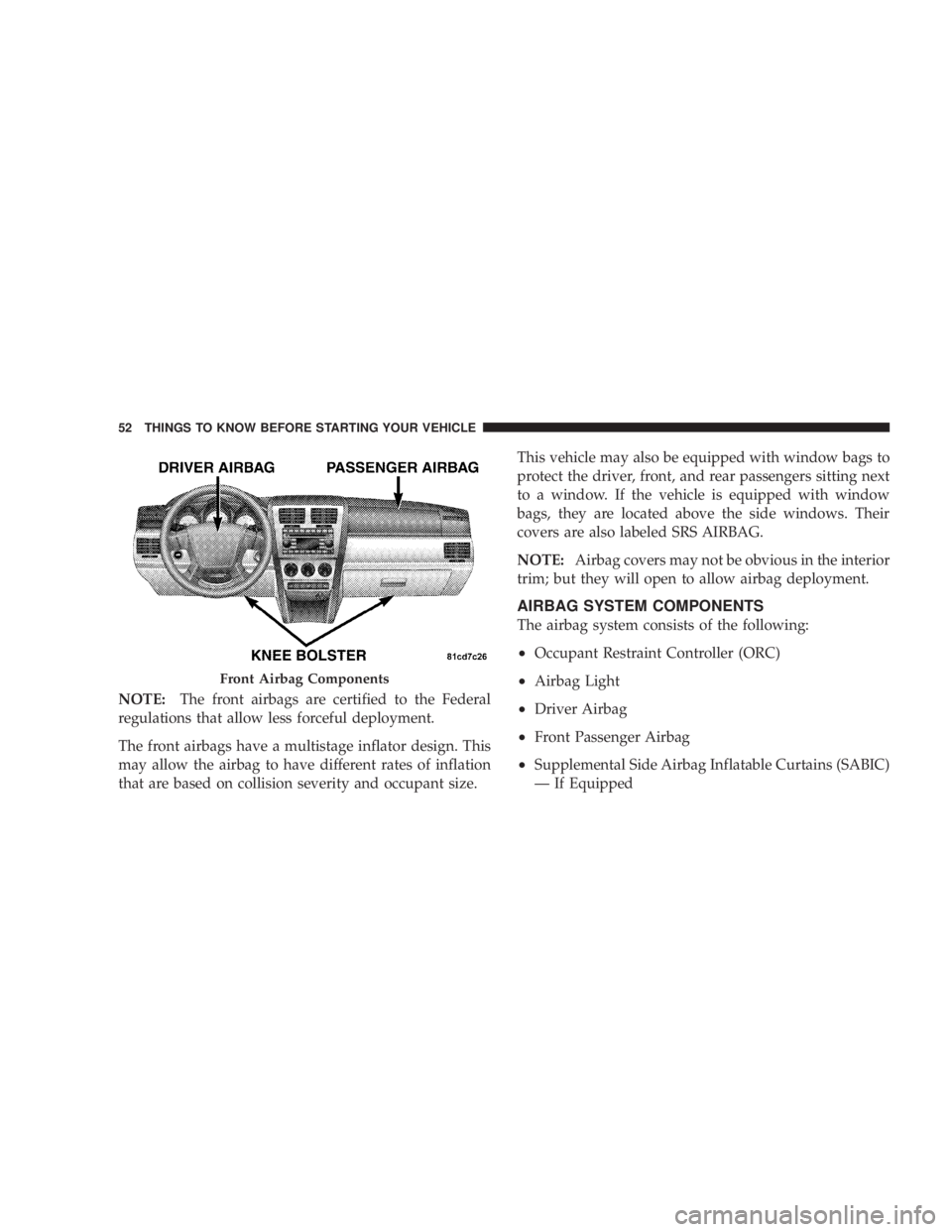
NOTE: The front airbags are certified to the Federal
regulations that allow less forceful deployment.
The front airbags have a multistage inflator design. This
may allow the airbag to have different rates of inflation
that are based on collision severity and occupant size. This vehicle may also be equipped with window bags to
protect the driver, front, and rear passengers sitting next
to a window. If the vehicle is equipped with window
bags, they are located above the side windows. Their
covers are also labeled SRS AIRBAG.
NOTE: Airbag covers may not be obvious in the interior
trim; but they will open to allow airbag deployment.
AIRBAG SYSTEM COMPONENTS
The airbag system consists of the following:
² Occupant Restraint Controller (ORC)
² Airbag Light
² Driver Airbag
² Front Passenger Airbag
² Supplemental Side Airbag Inflatable Curtains (SABIC)
Ð If EquippedFront Airbag Components52 THINGS TO KNOW BEFORE STARTING YOUR VEHICLE
Page 55 of 467
² Front SeatÐ side mounted (Thorax) Airbags Ð If
Equipped
² Front Impact Sensors
² Side Impact Sensors (If Equipped)
² Steering Wheel and Column
² Instrument Panel
² Seat Belt Reminder Light
² Knee Impact Bolster
² Front Seat Belt Pretensioners
FRONT SEAT AIRBAG FEATURES
The front airbag system has dual-stage driver and front
passenger airbags. This system provides output appro-
priate to the level of crash severity as determined by the
Occupant Restraint Controller (ORC) and the impact
sensors at the front of the car. The first stage inflator is triggered immediately during an
impact that requires airbag deployment. The timing of
the second stage determines whether the output force is
low, medium, or high. If a low output is sufficient to meet
the need, the second stage is expended later in the crash
event.
Driver Airbag Special Features
Driver airbag deployment and force level is controlled by
the driver's seat position as well as impact severity. Use
of special inflators, result in a very compact driver's side
airbag.
In addition to the small size, the inflating gasses exit
through strategically placed vents, which direct the gas
away from the occupant. THINGS TO KNOW BEFORE STARTING YOUR VEHICLE 53
2
Page 61 of 467
AIRBAG DEPLOYMENT SENSORS AND
CONTROLS
Occupant Restraint Controller (ORC)
The Occupant Restraint Controller System (ORC) is
part of a Federally regulated safety system required for
this vehicle.
The ORC determines if a frontal collision is severe
enough to require the airbags to inflate. Based on the
sensor signals, a central electronic Occupant Restraint
Controller (ORC) deploys the front airbags, side inflat-
able airbag curtains (if equipped), seat-mounted side
(Thorax) airbags (if equipped), and front seat belt preten-
sioners as required for each type of impact.
The ORC monitors the readiness of the electronic parts of
the system whenever the ignition switch is in the START
or RUN positions. These include all of the items listed
above except the steering wheel and column, instrument
panel, and passenger knee bolsters. If the key is in the OFF position, in the ACC position, or not in the ignition,
the airbags are not on and will not inflate.
The ORC contains a backup power supply system that
will deploy the airbags even if the battery loses power or
it becomes disconnected prior to deployment.
Also, the ORC turns on the Airbag Warning
Light in the instrument panel for 6 to 8 seconds
for a self-check when the ignition is first turned
on. After the self-check, the Airbag Warning
Light will turn off. If the ORC detects a malfunction in
any part of the system, it turns on the Airbag Warning
Light either momentarily or continuously. A single chime
will sound if the light comes on again after initial start
up.
It also includes diagnostics that will illuminate the instru-
ment cluster Airbag Warning Light if a malfunction is
noted. The diagnostics also record the nature of the
malfunction. THINGS TO KNOW BEFORE STARTING YOUR VEHICLE 59
2
Page 62 of 467
WARNING!Ignoring the AIRBAG light in your instrument panel
could mean you won't have the airbags to protect you
in a collision. If the light does not come on, stays on
after you start the vehicle, or if it comes on as you
drive, have the airbag system checked right away.
Impact Sensors
Two sensors, located on the front body structure, trigger
airbag deployment in direct frontal impacts and aid the
Occupant Restraint Controller (ORC) in determining
appropriate response to frontal impact events. Additional
sensors in the ORC determine the level of airbag deploy-
ment and provide deployment verification. Side Inflatable Curtain and Front Seat Mounted
Airbags Ð If equipped
The Occupant Restraint Controller System (ORC) de-
ploys the side inflatable curtain and seat mounted thorax
side airbags during collision with other vehicles and
during collisions where the impact is confined to a
particular area of the vehicle Ð such as collisions with
poles, trees or similar objects.
It will deploy the side inflatable curtains and front seat
thorax mounted airbags only on the impact side of the
vehicle.
The front driver and passenger seat contain inflatable
side airbags to protect the occupant from impact injuries.
Correctly functioning front passenger seat components
are critical for the Occupant Restraint Controller System60 THINGS TO KNOW BEFORE STARTING YOUR VEHICLE
Page 64 of 467
Enhanced Accident Response System
In the event of an impact that causes airbag deployment,
with the vehicle stopped, and the vehicle communication
network intact, and the power intact, the Enhanced
Accident Response System performs the following func-
tions:
² Cuts off fuel to the engine
² Flashes hazard lights
² Turns on the interior lights which remain on as long as
the battery has power or until the ignition key is
removed
² Unlocks the doors automatically
If A Deployment Occurs
The airbag systems are designed to deploy when the
Occupant Restraint Controller (ORC) detect a moderate-
to-severe collision, to help restrain the driver and front
passenger, and then immediately deflate. NOTE: A frontal collision that is not severe enough to
need airbag protection will not activate the system. This
does not mean something is wrong with the airbag
system.
If you do have a collision, which deploys the airbags, any
or all of the following may occur:
² The nylon airbag material may sometimes cause abra-
sions and/or skin reddening to the driver and front
passenger as the airbags deploy and unfold. The
abrasions are similar to friction rope burns or those
you might get sliding along a carpet or gymnasium
floor. They are not caused by contact with chemicals.
They are not permanent and normally heal quickly.
However, if you haven't healed significantly within a
few days, or if you have any blistering, see your doctor
immediately.
² As the airbags deflate, you may see some smoke-like
particles. The particles are a normal by-product of the62 THINGS TO KNOW BEFORE STARTING YOUR VEHICLE
Page 67 of 467
Airbag Light
You will want to have the airbags ready to
inflate for your protection in a collision. While
the airbag system is designed to be mainte-
nance free, if any of the following occurs, have
an authorized dealer service the system immediately.
² The AIRBAG light does not come on during the 6 to 8
seconds when the ignition switch is first turned on.
² The light remains on after the 6 to 8 second interval.
² The light comes on and remains on while driving.
NOTE: If the speedometer, tachometer, or any engine
related gauges are not working, the Occupant Restraint
Controller (ORC) may also be disabled. The airbags may
not be ready to inflate for your protection. Promptly
check fuse block for blown fuses. Refer to the label
located on the inside of the fuse block cover for the
proper airbag fuses. See your dealer if the fuse is good. EVENT DATA RECORDER (EDR)
In the event of an accident, your vehicle is designed to
record up to 5 seconds of specific vehicle data parameters
(see the following list) in an event data recorder prior to
the moment of airbag deployment, or near deployment,
and up to a quarter second of high-speed deceleration
data during and/or after airbag deployment. EDR data
are ONLY recorded if an airbag deploys, or nearly
deploys, and are otherwise unavailable.
NOTE:
1. A near-deployment event occurs when the airbag
sensor detects severe vehicle deceleration usually indica-
tive of a crash, but not severe enough to warrant airbag
deployment.
2. Under certain circumstances, EDR data may not be
recorded (e.g., loss of battery power).
In conjunction with other data gathered during a com-
plete accident investigation, the electronic data may be THINGS TO KNOW BEFORE STARTING YOUR VEHICLE 65
2
Page 69 of 467
Data Parameters that May Be Recorded:
² Diagnostic trouble code(s) and warning light status for
electronically-controlled safety systems, including the
airbag system
² Airbag disable light status (if equipped)
² 9 Time 9 of airbag deployment (in terms of ignition
cycles and vehicle mileage)
² Airbag deployment level (if applicable)
² Impact acceleration and angle
² Seatbelt status
² Brake status (service and parking brakes)
² Accelerator status (including vehicle speed)
² Engine control status (including engine speed) ² Transmission gear selection
² Cruise control status
² Traction/Stability Control status
² Tire Pressure Monitoring System status ± If Equipped
CHILD RESTRAINT
Everyone in your vehicle needs to be buckled up at all
times Ð babies and children, too. Every state in the
United States and all Canadian provinces require that
small children ride in proper restraint systems. This is the
law, and you can be prosecuted for ignoring it.
Children 12 years and under should ride properly buck-
led up in a rear seat, if available. According to crash
statistics, children are safer when properly restrained in
the rear seats, rather than in the front. THINGS TO KNOW BEFORE STARTING YOUR VEHICLE 67
2