maintenance DODGE AVENGER 2008 User Guide
[x] Cancel search | Manufacturer: DODGE, Model Year: 2008, Model line: AVENGER, Model: DODGE AVENGER 2008Pages: 467, PDF Size: 7.16 MB
Page 254 of 467
² Extended use of recirculation may cause the windows
to fog. If the interior of the windows begins to fog,
press the RECIRCULATION button to return to out-
side air. Some temp/humidity conditions will cause
captured interior air to condense on windows and
hamper visibility. For this reason, the system will not
allow Recirculation to be selected while in floor, de-
frost, or defrost/floor mode. Attempting to use the
Recirculation while in these modes will cause the LED
in the CONTROL button to blink and then turn off.
² Most of the time, when in Automatic Operation, you
can temporarily put the system into Recirculation
mode by pressing the RECIRCULATION button.
However, under certain conditions, while in Auto-
matic Mode, the system is blowing air out the defrost
vents. When these conditions are present, and the
RECIRCULATION button is pressed, the indicator will
flash and then turn off. This tells you that you are
unable to go into recirculation mode at this time. If you would like the system to go into Recirculation mode,
you must first move the Mode Knob to Panel, Panel/
Floor and then press the RECIRCULATION button.
This feature reduces the possibility of window fog-
ging.
Operating Tips
NOTE: Refer to the chart at the end of this section for
suggested control settings for various weather condi-
tions.
Summer Operation
The engine cooling system in air-conditioned vehicles
must be protected with a high-quality antifreeze coolant
to provide proper corrosion protection and to protect
against engine overheating. A 50% solution of ethylene
glycol antifreeze coolant in water is recommended. Refer
to ªMaintenance Proceduresº in Section 7 of this manual
for proper coolant selection.252 UNDERSTANDING YOUR INSTRUMENT PANEL
Page 256 of 467
Outside Air Intake
Make sure the air intake, located directly in front of the
windshield, is free of obstructions such as leaves. Leaves
collected in the air intake may reduce airflow, and if they
enter the plenum, they could plug the water drains. In
winter months, make sure the air intake is clear of ice,
slush, and snow. A/C Air Filter Ð If Equipped
The A/C Air Filter will reduce, but not eliminate, diesel
and agricultural smells. The filter acts on air coming from
outside the vehicle and recirculated air within the pas-
senger compartment. Refer to ªMaintenance Proceduresº
in Section 7 of this manual for A/C Air Filter service
information or see your authorized dealer for service.
Refer to the ªMaintenance Schedulesº in Section 8 of this
manual for filter service intervals.254 UNDERSTANDING YOUR INSTRUMENT PANEL
Page 262 of 467
N Selection Of Engine Oil For Flexible Fuel
Vehicles (E-85) And Gasoline Vehicles .......326
N Starting ............................327
N Cruising Range .......................327
N Replacement Parts .....................327
N Maintenance .........................327
m Adding Fuel ..........................328
N Fuel Filler Cap (Gas Cap) ...............328
N Loose Filler Cap Message ...............330
m Vehicle Loading ........................331
N Vehicle Certification Label ...............331
N Gross Vehicle Weight Rating (GVWR) .......332
N Gross Axle Weight Rating (GAWR) .........332 N Overloading .........................332
N Loading ............................333
m Trailer Towing .........................334
N Common Towing Definitions .............334
N Trailer Hitch Classifications ..............336
N Trailer Towing Weights
(Maximum Trailer Weight Ratings) .........337
N Trailer And Trailer Tongue Weight .........338
N Towing Requirements ..................339
N Towing Tips .........................343
m Recreational Towing (Behind Motorhome, Etc.) . . 345
N Towing This Vehicle Behind Another Vehicle
(Flat Towing With All Four Wheels On The
Ground) ............................345260 STARTING AND OPERATING
Page 312 of 467
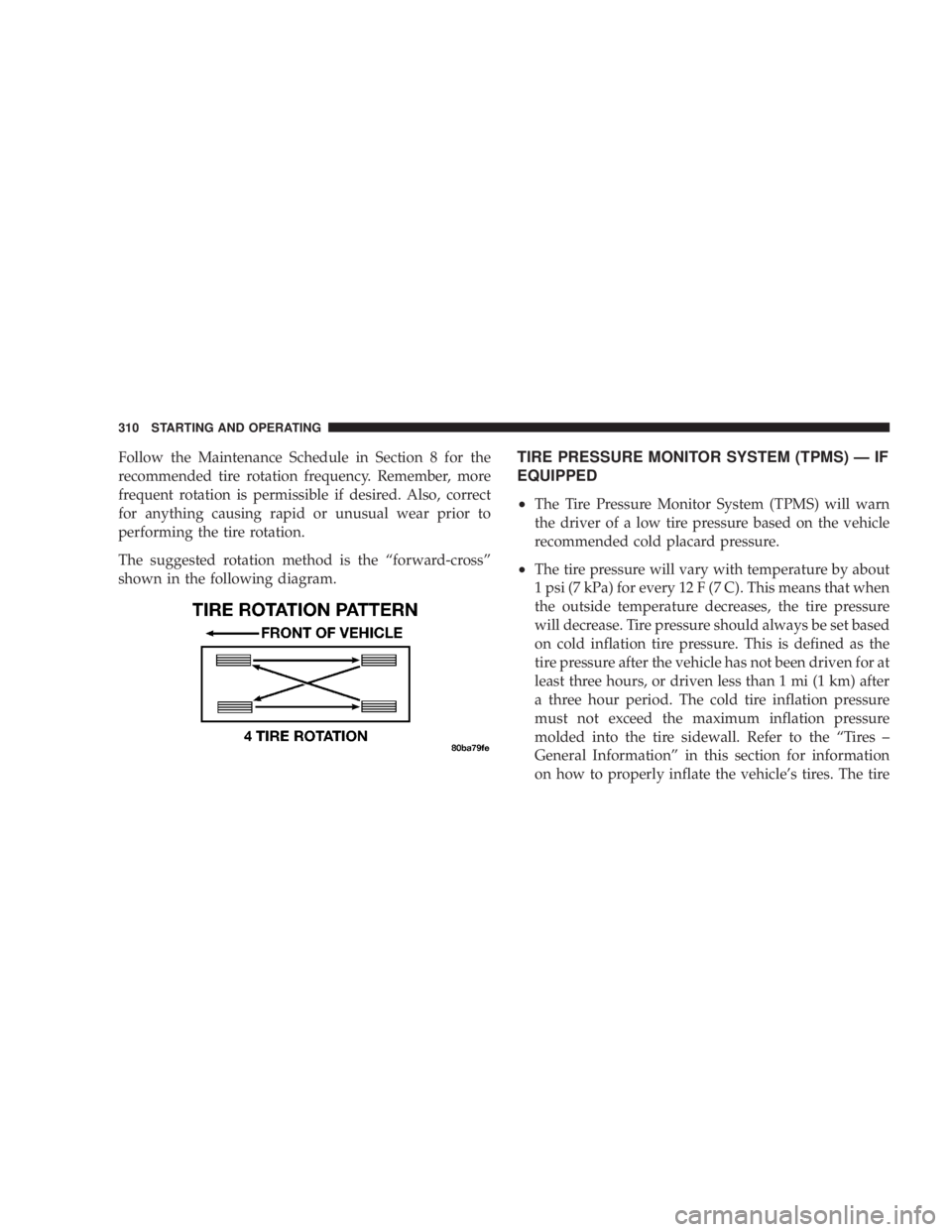
Follow the Maintenance Schedule in Section 8 for the
recommended tire rotation frequency. Remember, more
frequent rotation is permissible if desired. Also, correct
for anything causing rapid or unusual wear prior to
performing the tire rotation.
The suggested rotation method is the ªforward-crossº
shown in the following diagram. TIRE PRESSURE MONITOR SYSTEM (TPMS) Ð IF
EQUIPPED
² The Tire Pressure Monitor System (TPMS) will warn
the driver of a low tire pressure based on the vehicle
recommended cold placard pressure.
² The tire pressure will vary with temperature by about
1 psi (7 kPa) for every 12 F (7 C). This means that when
the outside temperature decreases, the tire pressure
will decrease. Tire pressure should always be set based
on cold inflation tire pressure. This is defined as the
tire pressure after the vehicle has not been driven for at
least three hours, or driven less than 1 mi (1 km) after
a three hour period. The cold tire inflation pressure
must not exceed the maximum inflation pressure
molded into the tire sidewall. Refer to the ªTires ±
General Informationº in this section for information
on how to properly inflate the vehicle's tires. The tire310 STARTING AND OPERATING
Page 314 of 467
CAUTION!² The TPMS has been optimized for the original
equipment tires and wheels. TPMS pressures and
warning have been established for the tire size
equipped on your vehicle. Undesirable system
operation or sensor damage may result when us-
ing replacement equipment that is not of the same
size, type, and/or style. Aftermarket wheels can
cause sensor damage. Do not use aftermarket tire
sealants or balance beads if your vehicle is
equipped with a TPMS, as damage to the sensors
may result.
² After inspecting or adjusting the tire pressure,
always reinstall the valve stem cap. This will
prevent moisture and dirt from entering the valve
stem, which could damage the Tire Pressure Moni-
toring Sensor. NOTE:
² The TPMS is not intended to replace normal tire care
and maintenance, or to provide warning of a tire
failure or condition.
² The TPMS should not be used as a tire pressure gauge
while adjusting your tire pressure.
² Driving on a significantly under-inflated tire causes
the tire to overheat and can lead to tire failure.
Under-inflation also reduces fuel efficiency and tire
tread life, and may affect the vehicle's handling and
stopping ability.
² The TPMS is not a substitute for proper tire mainte-
nance, and it is the driver 's responsibility to maintain
correct tire pressure using an accurate tire pressure
gauge, even if under-inflation has not reached the
level to trigger illumination of the Tire Pressure Moni-
toring Telltale light.312 STARTING AND OPERATING
Page 329 of 467
STARTING
The characteristics of E-85 fuel make it unsuitable for use
when ambient temperatures fall below 0ÉF (-18ÉC). In the
range of 0ÉF (-18ÉC) to 32ÉF (0ÉC), you may experience an
increase in the time it takes for your engine to start, and
a deterioration in driveability (sags and/or hesitations)
until the engine is fully warmed up.
CRUISING RANGE
Because E-85 fuel contains less energy per gallon than
gasoline, you will experience an increase in fuel con-
sumption. You can expect your fuel economy and driving
range to decrease by about 30% compared to gasoline
operation.
REPLACEMENT PARTS
Many components in your Flexible Fuel Vehicle (FFV) are
designed to be compatible with ethanol. Always be sure
that your vehicle is serviced with correct ethanol com-
patible parts. CAUTION!Replacing fuel system components with non-ethanol
compatible components can damage your vehicle.
MAINTENANCE
CAUTION!Do not use ethanol mixture greater than 85% in your
vehicle. It will cause difficulty in cold starting and
may affect driveability. STARTING AND OPERATING 327
5
Page 341 of 467
NOTE: Remember that everything put into or on the
trailer adds to the load on your vehicle. Also, additional
factory-installed options, or authorized dealer-installed
options, must be considered as part of the total load on
your vehicle. Refer to the Tire and Loading Information
placard in the Tire Safety Information Section of this
manual for the maximum combined weight of occupants
and cargo for your vehicle.
CAUTION!Incorrect trailer tongue weight could result in in-
creased yaw or vehicle instability. A negative trailer
tongue weight could unload the rear suspension of
the tow vehicle decreasing vehicle stability. Negative
trailer tongue weight could cause the trailer to squat
and potentially become disengaged from the tow
vehicle resulting in a runaway trailer condition. Towing Requirements
To promote proper break-in of your new vehicle driv-
etrain components the following guidelines are recom-
mended:
CAUTION!² Avoid towing a trailer for the first 500 mi (805 km)
of vehicle operation. Doing so may damage your
vehicle.
² During the first 500 mi (805 km) of trailer towing,
limit your speed to 50 mph (80 km/h).
Perform the maintenance listed in Section 8 of this
manual. When towing a trailer, never exceed the GAWR,
or GCWR, ratings. STARTING AND OPERATING 339
5
Page 346 of 467
Automatic Transaxle
The DRIVE range can be selected when towing. How-
ever, if frequent shifting occurs while in this range, third
gear for a four-speed automatic and the fifth gear for a
six-speed AutoStick t should be selected.
NOTE: Using third or fifth instead of DRIVE while
operating the vehicle under heavy operating conditions,
will improve performance and extend transaxle life by
reducing excessive shifting and heat build-up. This ac-
tion will also provide better engine braking.
If you REGULARLY TOW a trailer for more than 45
minutes of continuous operation, then change the auto-
matic transaxle fluid and filter according to the interval
specified for ªpolice, taxi, fleet, or frequent trailer tow-
ingº in the ªMaintenance Scheduleº in this manual.
NOTE: Check the four-speed automatic transaxle fluid
level before towing. AutoStick t sixÐspeed transmission is sealed and the fluid level cannot be checked. See your
authorized dealership service center for assistance.
Electronic Speed Control Ð (If Equipped)
² Don't use in hilly terrain or with heavy loads.
² When using the speed control, if you experience speed
drops greater than 10 mph (16 km/h), disengage until
you can get back to cruising speed.
² Use speed control in flat terrain and with light loads to
maximize fuel efficiency.
Cooling System
To reduce potential for engine and transaxle overheating,
take the following actions:
² City Driving
When stopped for short periods of time, put transaxle in
neutral and increase engine idle speed.344 STARTING AND OPERATING
Page 347 of 467
² Highway Driving
Reduce speed.
² Air Conditioning
Turn off temporarily.
² Refer to Cooling System Operating information in the
Maintenance section of this manual for more informa-
tion.
If you have any questions or concerns after reviewing
this section, please consult your authorized dealer to for
full details on the towing capabilities of the vehicle. RECREATIONAL TOWING (BEHIND
MOTORHOME, ETC.)
Towing This Vehicle Behind Another Vehicle (Flat
towing with all four wheels on the ground)
CAUTION!DO NOT flat tow this vehicle. Damage to the driv-
etrain will result.
NOTE: If the vehicle requires towing make sure all four
wheels are off the ground. STARTING AND OPERATING 345
5
Page 352 of 467
WARNING!A hot engine cooling system is dangerous. You or
others could be badly burned by steam or boiling
coolant. You may want to call a service center if your
vehicle overheats. If you decide to look under the
hood yourself, refer to Section 7, Maintenance, of this
manual. Follow the warnings under the Cooling
System Pressure Cap paragraph.
ENGINE OIL OVERHEATING (2.4L ENGINE ONLY)
Ð IF EQUIPPED
During sustained high-speed driving or trailer tow up
long grades on a hot day, the engine oil temperature may
become too hot. If this happens, the ªHOTOILº message
flashes in the odometer and the vehicle speed will be
reduced to 53 mph (85 km/h) until the engine oil
temperature is reduced. NOTE: The vehicle speed is reduced to a maximum of
53 mph (85 km/h). You may of course, reduce your
vehicle speed further if needed.
JACKING AND TIRE CHANGING
WARNING!² Getting under a jacked-up vehicle is dangerous.
The vehicle could slip off the jack and fall on you.
You could be crushed. Never get any part of your
body under a vehicle that is on a jack. If you need
to get under a raised vehicle, take it to a service
center where it can be raised on a lift.
² The jack is designed to use as a tool for changing
tires only. The jack should not be used to lift the
vehicle for service purposes. The vehicle should
be jacked on a firm level surface only. Avoid ice or
slippery areas.350 WHAT TO DO IN EMERGENCIES