air condition DODGE AVENGER 2008 Owner's Manual
[x] Cancel search | Manufacturer: DODGE, Model Year: 2008, Model line: AVENGER, Model: DODGE AVENGER 2008Pages: 467, PDF Size: 7.16 MB
Page 324 of 467
MMT IN GASOLINE
MMT is a manganese containing metallic additive that is
blended into some gasoline to increase octane. Gasoline
blended with MMT provides no performance advantage
beyond gasoline of the same octane number without
MMT. Gasoline blended with MMT reduces spark plug
life and reduces emission system performance in some
vehicles. The manufacturer recommends that gasoline
without MMT be used in your vehicle. The MMT content
of gasoline may not be indicated on the gasoline pump,
therefore, you should ask your gasoline retailer whether
or not his/her gasoline contains MMT.
It is even more important to look for gasolines without
MMT in Canada, because MMT can be used at levels
higher than those allowed in the United States.
MMT is prohibited in Federal and California reformu-
lated gasolines. MATERIALS ADDED TO FUEL
All gasoline sold in the United States is required to
contain effective detergent additives. Use of additional
detergents or other additives is not needed under normal
conditions and they would result in additional cost.
Therefore, you should not have to add anything to the
fuel.
FUEL SYSTEM CAUTIONS
CAUTION!Follow these guidelines to maintain your vehicle's
performance:
² The use of leaded gas is prohibited by Federal law.
Using leaded gasoline can impair engine performance
and damage the emission control system.322 STARTING AND OPERATING
Page 326 of 467
² Guard against carbon monoxide with proper mainte-
nance. Have the exhaust system inspected every time
the vehicle is raised. Have any abnormal conditions
repaired promptly. Until repaired, drive with all side
windows fully open.
² Keep the trunk closed when driving your vehicle to
prevent carbon monoxide and other poisonous ex-
haust gases from entering the vehicle.
FLEXIBLE FUELÐ 2.7L ENGINES ONLY (EXCEPT
CALIFORNIA EMISSION STATES)
E-85 GENERAL INFORMATION
The information in this section is for Flexible Fuel ve-
hicles only. This section only covers those subjects that
are unique to these vehicles. Please refer to the other
sections of this manual for information on features that
are common between Flexible Fuel and gasoline only
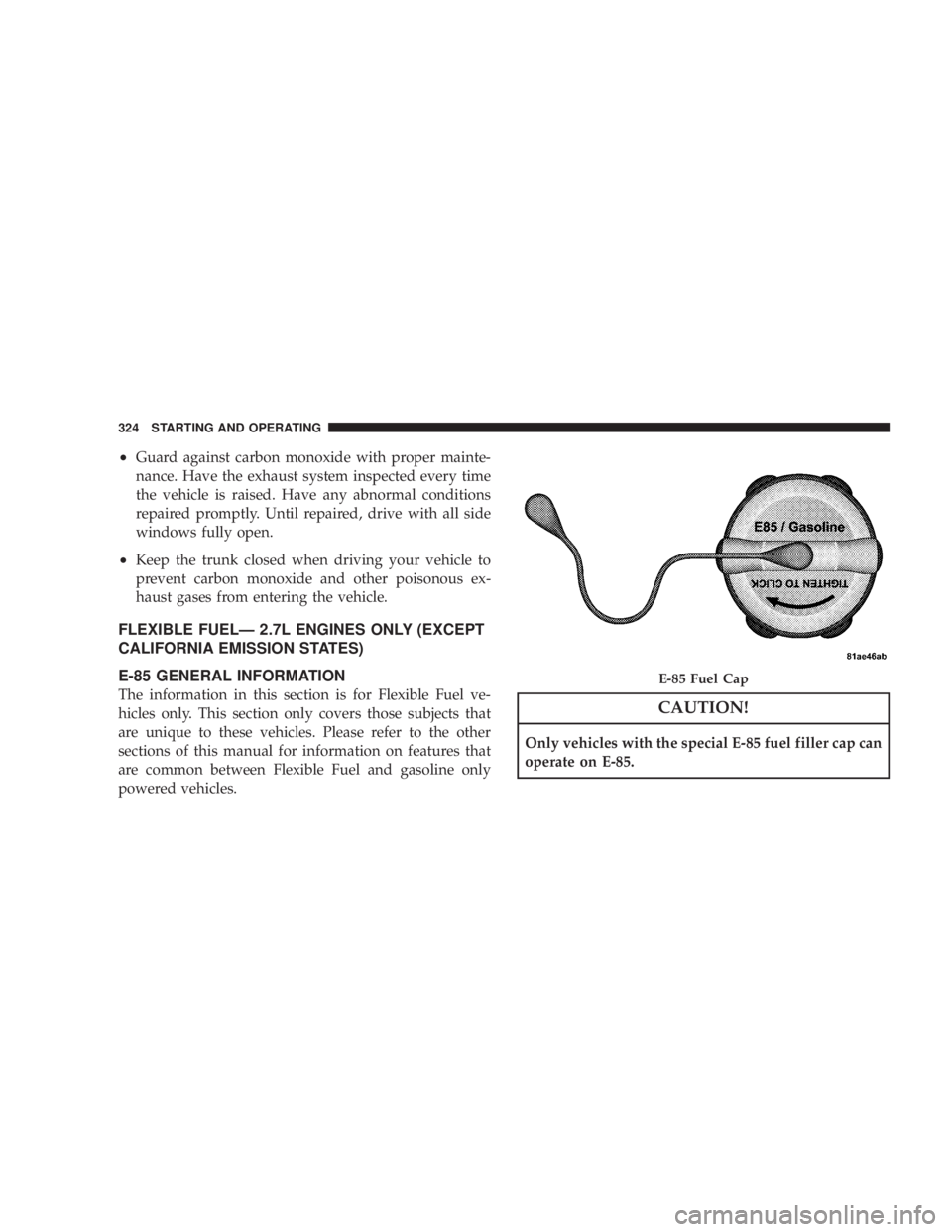
powered vehicles. CAUTION!Only vehicles with the special E-85 fuel filler cap can
operate on E-85. E-85 Fuel Cap324 STARTING AND OPERATING
Page 347 of 467
² Highway Driving
Reduce speed.
² Air Conditioning
Turn off temporarily.
² Refer to Cooling System Operating information in the
Maintenance section of this manual for more informa-
tion.
If you have any questions or concerns after reviewing
this section, please consult your authorized dealer to for
full details on the towing capabilities of the vehicle. RECREATIONAL TOWING (BEHIND
MOTORHOME, ETC.)
Towing This Vehicle Behind Another Vehicle (Flat
towing with all four wheels on the ground)
CAUTION!DO NOT flat tow this vehicle. Damage to the driv-
etrain will result.
NOTE: If the vehicle requires towing make sure all four
wheels are off the ground. STARTING AND OPERATING 345
5
Page 350 of 467
HAZARD WARNING FLASHER
The flasher switch is located on the instrument
panel, below the radio. Depress the switch and
both cluster indicators and all front and rear direc-
tional signals will flash. Depress the switch again to turn
Hazard Warning Flashers off.
Do not use this emergency warning system when the
vehicle is in motion. Use it when your vehicle is disabled
and it is creating a safety hazard for other motorists.
If it is necessary to leave the vehicle to go for service, the
flasher system will continue to operate with the ignition
key removed and the vehicle locked.
NOTE: With extended use, the flasher may wear down
your battery. IF YOUR ENGINE OVERHEATS
In any of the following situations, you can reduce the
potential for overheating by taking the appropriate ac-
tion.
² On the highways Ð Slow down.
² In city traffic Ð While stopped, put transaxle in
NEUTRAL, but do not increase engine idle speed.
If the pointer rises to the H (red) mark, the instrument
cluster will sound a chime. Pull over and stop the vehicle
with the engine at idle, when safe. Turn off the air
conditioning and wait until the pointer drops back into
the normal range. If the pointer remains on the H (red)
mark for more than a minute, turn the engine off imme-
diately and call for service.348 WHAT TO DO IN EMERGENCIES
Page 351 of 467
NOTE: There are steps that you can take to slow down
an impending overheat condition. If your air conditioner
is on, turn it off. The air conditioning system adds heat to
the engine cooling system and turning off the A/C
removes this heat. You can also turn the Temperature
control to maximum heat, the Mode control to floor, and
the fan control to High. This allows the heater core to act
as a supplement to the radiator and aids in removing heat
from the engine cooling system. CAUTION!Driving with a hot cooling system could damage
your vehicle. If temperature gauge reads ªHº, pull
over and stop the vehicle with the engine at idle,
when safe. Turn the air conditioner off and wait until
the pointer drops back into the normal range. After
appropriate action has been taken, if the pointer
remains on the ªHº, turn the engine off immediately,
and call for service. WHAT TO DO IN EMERGENCIES 349
6
Page 367 of 467
MAINTAINING YOUR VEHICLECONTENTS m 2.4L Engine Compartment ................368
m 2.7L Engine Compartment ................369
m 3.5L Engine Compartment ................370
m Onboard Diagnostic System Ð OBD II ........371
N Loose Fuel Filler Cap Message ............371
m Emissions Inspection And Maintenance
Programs .............................372
m Replacement Parts ......................373
m Authorized Dealer Service ................374 m Maintenance Procedures ..................374
N Engine Oil ..........................374
N Engine Oil Filter ......................378
N Drive Belt ...........................378
N Spark Plugs .........................379
N Engine Air Cleaner Filter ................379
N Catalytic Converter ....................379
N Maintenance-Free Battery ................381
N Air Conditioner Maintenance .............382
7
Page 384 of 467
CAUTION!² It is essential when replacing the cables on the
battery that the positive cable is attached to the
positive post and the negative cable is attached to
the negative post. Battery posts are marked posi-
tive (+) and negative (-) and identified on the
battery case. Cable clamps should be tight on the
terminal posts and free of corrosion. Apply grease
to posts and clamps after tightening.
² If a ªfast chargerº is used while the battery is in
the vehicle, disconnect both vehicle battery cables
before connecting the charger to battery. Do not
use a ªfast chargerº to provide starting voltage as
battery damage can result. AIR CONDITIONER MAINTENANCE
For best possible performance, your air conditioner
should be checked and serviced by an authorized dealer
at the start of each warm season. This service should
include cleaning of the condenser fins and a performance
test. Drive belt tension should also be checked at this
time.382 MAINTAINING YOUR VEHICLE
Page 385 of 467
WARNING!² Use only refrigerants and compressor lubricants
approved by the manufacturer for your air condi-
tioning system. Some unapproved refrigerants are
flammable and can explode, injuring you. Other
unapproved refrigerants or lubricants can cause
the system to fail, requiring costly repairs. Refer to
Section 3 of the Warranty Information book for
further warranty information.
² The air conditioning system contains refrigerant
under high pressure. To avoid risk of personal
injury or damage to the system, adding refrigerant
or any repair requiring lines to be disconnected
should be done by an experienced technician. Refrigerant Recovery and Recycling
R-134a Air Conditioning Refrigerant is a hydrofluoro-
carbon (HFC) that is endorsed by the Environmental
Protection Agency and is an ozone-saving product. How-
ever, the manufacturer recommends that air conditioning
service be performed by authorized dealers or other
service facilities using recovery and recycling equipment.
NOTE: Use only manufacturer approved A/C System
Sealers, Stop Leak Products, Seal Conditioners, Compres-
sor Oil, and Refrigerants.
A/C AIR FILTER Ð IF EQUIPPED
Refer to the ªMaintenance Scheduleº in Section 8 of this
manual for A/C Air Filter service intervals.
WARNING!Do not remove the A/C Air Filter while the blower is
operating or personal injury may result. MAINTAINING YOUR VEHICLE 383
7
Page 395 of 467
humidity accumulating on the radiator and being vapor-
ized when the thermostat opens, allowing hot coolant to
enter the radiator.
If an examination of your engine compartment shows no
evidence of radiator or hose leaks, the vehicle may be
safely driven. The vapor will soon dissipate.
² Do not overfill the coolant recovery bottle.
² Check coolant freeze point in the radiator and in the
coolant recovery bottle. If antifreeze needs to be
added, contents of coolant recovery bottle must also be
protected against freezing.
² If frequent coolant additions are required, or if the
level in the coolant recovery bottle does not drop when
the engine cools, the cooling system should be pres-
sure tested for leaks. ² Maintain coolant concentration at 50% HOAT engine
coolant (minimum) and distilled water for proper
corrosion protection of your engine, which contains
aluminum components.
² Make sure that the radiator and coolant recovery
bottle overflow hoses are not kinked or obstructed.
² Keep the front of the radiator clean. If your vehicle is
equipped with air conditioning, keep the front of the
condenser clean, also.
² Do not change the thermostat for summer or winter
operation. If replacement is ever necessary, install
ONLY the correct type thermostat. Other designs may
result in unsatisfactory coolant performance, poor gas
mileage, and increased emissions. MAINTAINING YOUR VEHICLE 393
7
Page 402 of 467
FRONT AND REAR WHEEL BEARINGS
Front and rear wheel bearings are permanently sealed.
No regular maintenance is required for these compo-
nents.
APPEARANCE CARE AND PROTECTION FROM
CORROSION
Protection of Body and Paint from Corrosion
Vehicle body care requirements vary according to geo-
graphic locations and usage. Chemicals that make roads
passable in snow and ice and those that are sprayed on
trees and road surfaces during other seasons are highly
corrosive to the metal in your vehicle. Outside parking,
which exposes your vehicle to airborne contaminants,
road surfaces on which the vehicle is operated, extreme
hot or cold weather and other extreme conditions will
have an adverse effect on paint, metal trim, and under-
body protection. The following maintenance recommendations will enable
you to obtain maximum benefit from the corrosion
resistance built into your vehicle.
What Causes Corrosion?
Corrosion is the result of deterioration or removal of
paint and protective coatings from your vehicle.
The most common causes are:
² Road salt, dirt, and moisture accumulation.
² Stone and gravel impact.
² Insects, tree sap, and tar.
² Salt in the air near seacoast localities.
² Atmospheric fallout/industrial pollutants.400 MAINTAINING YOUR VEHICLE