radio DODGE CALIBER 2009 1.G Repair Manual
[x] Cancel search | Manufacturer: DODGE, Model Year: 2009, Model line: CALIBER, Model: DODGE CALIBER 2009 1.GPages: 431, PDF Size: 3.12 MB
Page 237 of 431
The button located in the center of the right-hand control
will switch modes to Radio or CD.
The left-hand control is a rocker type switch with a
pushbutton in the center. The function of the left-hand
control is different depending on which mode you are in.
The following describes the left-hand control operation in
each mode.
Radio Operation
Press the top of the switch to SEEK up for the next
listenable station. Press the bottom of the switch to SEEK
down for the next listenable station.
The button located in the center of the left-hand control
will tune to the next preset station that you have pro-
grammed in the radio preset pushbuttons.
CD Player
Press the top of the switch once to go to the next track on
the CD. Press the bottom of the switch once to go to thebeginning of the current track or to the beginning of the
previous track, if it is within one second after the current
track begins to play.
If you press the switch up or down twice it plays the
second track, three times, it will play the third, etc.
The button in the center of the left-hand switch changes
CD’s on the 6–Disc in-dash CD changer radio. This
button does not function for all other radios.
CD/DVD MAINTENANCE
To keep a CD/DVD in good condition, take the following
precautions:
1. Handle the disc by its edge; avoid touching the
surface.
2. If the disc is stained, clean the surface with a soft cloth,
wiping from center to edge.
UNDERSTANDING YOUR INSTRUMENT PANEL 235
4
Page 238 of 431
3. Do not apply paper or tape to the disc; avoid scratch-
ing the disc.
4. Do not use solvents such as benzene, thinner, cleaners,
or antistatic sprays.
5. Store the disc in its case after playing.
6. Do not expose the disc to direct sunlight.
7. Do not store the disc where temperatures may become
too high.
NOTE:If you experience difficulty in playing a particu-
lar disc, it may be damaged (i.e. scratched, reflective
coating removed, a hair, moisture or dew on the disc)
oversized, or have protection encoding. Try a known
good disc before considering disc player service.
RADIO OPERATION AND CELLULAR PHONES
Under certain conditions, the cellular phone being on in
your vehicle can cause erratic or noisy performance from
your radio. This condition may be lessened or eliminated
by relocating the cellular phone antenna. This condition
is not harmful to the radio. If your radio performance
does not satisfactorily “clear” by the repositioning of the
antenna, it is recommended that the radio volume be
turned down or off during cellular phone operation.
CLIMATE CONTROLS
Manual Heating and Air Conditioning System
The Manual Heating and Air Conditioning system allows
you to balance the temperature, amount, and direction of
air circulating throughout the vehicle. The controls are
located on the instrument panel, below the radio.
236 UNDERSTANDING YOUR INSTRUMENT PANEL
Page 270 of 431
ABS is activated during braking under certain road or
stopping conditions. ABS-inducing conditions can in-
clude ice, snow, gravel, bumps, railroad tracks, loose
debris, or panic stops.
You may also experience the following when the brake
system goes into Anti-Lock mode:
•the ABS motor running (it may continue to run for a
short time after the stop)
•the clicking sound of solenoid valves
•brake pedal pulsations
•a slight drop or fall away of the brake pedal at the end
of the stop
These are all normal characteristics of ABS.
WARNING!
The Anti-Lock Brake System (ABS) contains sophis-
ticated electronic equipment that may be susceptible
to interference caused by improperly installed or
high output radio transmitting equipment. This in-
terference can cause possible loss of Anti-Lock brak-
ing capability. Installation of such equipment should
be performed by qualified professionals.
All vehicle wheels and tires must be the same size and
type and tires must be properly inflated to produce
accurate signals for the computer.
ELECTRONIC BRAKE CONTROL SYSTEM
Your vehicle may be equipped with an optional ad-
vanced electronic brake control system that includes
Anti-Lock Brake System (ABS), Brake Assist System
(BAS), Traction Control System (TCS), and Electronic
Stability Program (ESP). All systems work together to
268 STARTING AND OPERATING
Page 298 of 431
•Four Tire Pressure Monitoring Sensors
•Tire Pressure Monitoring Telltale Light
Tire Pressure Monitoring Low Pressure Warnings
The Tire Pressure Monitoring Telltale Light will illumi-
nate in the instrument cluster, and an audible chime will
be activated when one or more of the four active road tire
pressures are low. Should this occur, you should stop as
soon as possible, check the inflation pressure of each tire
on your vehicle, and inflate each tire to the vehicle’s
recommended cold placard pressure value. The system
will automatically update and the Tire Pressure Monitor-
ing Light will extinguish once the updated tire pressures
have been received. The vehicle may need to be driven
for up to 20 minutes above 15 mph (25 km/h) to receive
this information.
Check TPMS Warnings
The Tire Pressure Monitoring Telltale Light will flash on
and off for 75 seconds and remain on solid when a systemfault is detected. The system fault will also sound a
chime. If the ignition key is cycled, this sequence will
repeat providing the system fault still exists. The Tire
Pressure Monitoring Telltale Light will turn off when the
fault condition no longer exists. A system fault can occur
with any of the following scenarios:
1. Jamming due to electronic devices or driving next to
facilities emitting the same radio frequencies as the TPM
sensors.
2. Installing some form of aftermarket window tinting
that affects radio wave signals.
3. Snow or ice around the wheels or wheel housings.
4. Using tire chains on the vehicle.
5. Using wheels/tires not equipped with TPM sensors.
NOTE:
Your vehicle is equipped with a compact spare
wheel and tire assembly.
296 STARTING AND OPERATING
Page 302 of 431
will be displayed instead of dashes. A system fault can
occur with any of the following scenarios:
1. Jamming due to electronic devices or driving next to
facilities emitting the same radio frequencies as the TPM
sensors.
2. Installing some form of aftermarket window tinting
that affects radio wave signals.
3. Snow or ice around the wheels or wheel housings.
4. Using tire chains on the vehicle.
5. Using wheels/tires not equipped with TPM sensors.
NOTE:Your vehicle is equipped with a compact spare
wheel and tire assembly.
1. The compact spare tire does not have a tire pressure
monitoring sensor. Therefore, the TPMS will not monitor
the tire pressure in the compact spare tire. 2. If you install the compact spare tire in place of a road
tire that has a pressure below the low-pressure warning
limit, upon the next ignition key cycle, a chime will
sound and the Tire Pressure Monitoring Telltale Light
will still turn ON due to the low tire.
3. However, after driving the vehicle for up to 20 min-
utes above 15 mph (25 km/h), the Tire Pressure Moni-
toring Telltale Light will flash on and off for 75 seconds
and then remain on solid.
4. For each subsequent ignition key cycle, a chime will
sound and the Tire Pressure Monitoring Telltale Light
will flash on and off for 75 seconds and then remain on
solid.
5. Once you repair or replace the original road tire and
reinstall it on the vehicle in place of the compact spare
tire, the TPMS will update automatically and the Tire
Pressure Monitoring Telltale Light will turn OFF, as long
as no tire pressure is below the low-pressure warning
300 STARTING AND OPERATING
Page 326 of 431
HAZARD WARNING FLASHER
The Hazard Warning flasher switch is located on the
instrument panel, below the radio.Press the switch to turn on the Hazard Warning
flashers. When the Hazard Warning flasher switch
is activated, all directional turn signals will flash
on and off to warn oncoming traffic of an emergency.
Press the switch a second time to turn off flashers.
Do not use this emergency warning system when the
vehicle is in motion. Use it when your vehicle is disabled
and is creating a safety hazard for other motorists.
If it is necessary to leave the vehicle to go for service, the
Hazard Warning flasher will continue to operate with the
ignition key removed and the vehicle locked.
NOTE: With extended use, the Hazard Warning flasher
may wear down your battery.IF YOUR ENGINE OVERHEATS
In any of the following situations, you can reduce the
potential for overheating by taking the appropriate ac-
tion.
•On the highways — Slow down.
•In city traffic — While stopped, put the transmission in
NEUTRAL, but do not increase engine idle speed.
If the pointer rises to the H(red) mark, the instrument
cluster will sound a chime. When safe, pull over and stop
the vehicle with the engine at idle. Turn off the air
conditioning and wait until the pointer drops back into
the normal range. If the pointer remains on the H(red)
mark for more than a minute, turn the engine off imme-
diately and call for service.
NOTE: There are steps that you can take to slow down
an impending overheat condition. If your air conditioner
is on, turn it off. The air conditioning system adds heat to
324 WHAT TO DO IN EMERGENCIES
Page 334 of 431
WARNING! (Continued)
•Do not attempt to push or tow your vehicle to get
it started. Vehicles equipped with an automatic
transaxle cannot be started this way and may be
damaged. Unburned fuel could enter the catalytic
converter and once the engine has started, ignite
and damage the converter and vehicle. If the
vehicle has a discharged battery, booster cables
may be used to obtain a start from another vehicle.
This type of start can be dangerous if done im-
properly, so follow this procedure carefully.
•Wear eye protection and remove any metal jewelry
such as watch bands or bracelets that might make
an inadvertent electrical contact. You could be
seriously injured.
NOTE: Disconnecting the battery with the ignition in
the ON position will cause vehicles with an automatic transaxle (CVT2) to go into “default mode” and turn on
the Malfunction Indicator Light (MIL). See your autho-
rized dealer to correct this condition.
1. When boosting from a battery in another vehicle, park
that vehicle within booster cable reach but without
letting the vehicles touch. Set the parking brake, place the
automatic transmission in PARK (the manual transmis-
sion in NEUTRAL) and turn the ignition to OFF for both
vehicles.
2. Turn off the heater, radio and all unnecessary electrical
loads.
3. Using the two finger screws on the cover, remove the
air intake duct covering the battery.
4. Connect one end of a jumper cable to the positive
terminal of the booster battery. Connect the other end of
the jumper cable to the positive terminal of the dis-
charged battery.
332 WHAT TO DO IN EMERGENCIES
Page 369 of 431
quarter window equipped with the radio antenna. Do
not use scrapers or other sharp instruments which may
scratch the elements. When cleaning the rearview mirror,
spray cleaner on the towel or rag that you are using. Do
not spray cleaner directly on the mirror.
Instrument Panel Cover
The instrument panel cover has a low glare surface which
minimizes reflections on the windshield. Do not use
protectants or other products which may cause undesir-
able reflections. Use soap and warm water to restore the
low glare surface.
Instrument Panel Bezels
CAUTION!
When installing hanging air fresheners in your ve-
hicle, read the installation instructions carefully.
Some air fresheners will damage the finish of
painted or decorated parts if allowed to directly
contact any surface.
Cleaning Plastic Instrument Cluster Lenses
The lenses in front of the instruments in this vehicle are
molded in clear plastic. When cleaning the lenses, care
must be taken to avoid scratching the plastic.
1. Clean with a wet, soft rag. A mild soap solution may
be used, but do not use high alcohol content or abrasive
cleaners. If soap is used, wipe clean with a clean, damp
rag.
2. Dry with a soft cloth.
MAINTAINING YOUR VEHICLE 367
7
Page 371 of 431
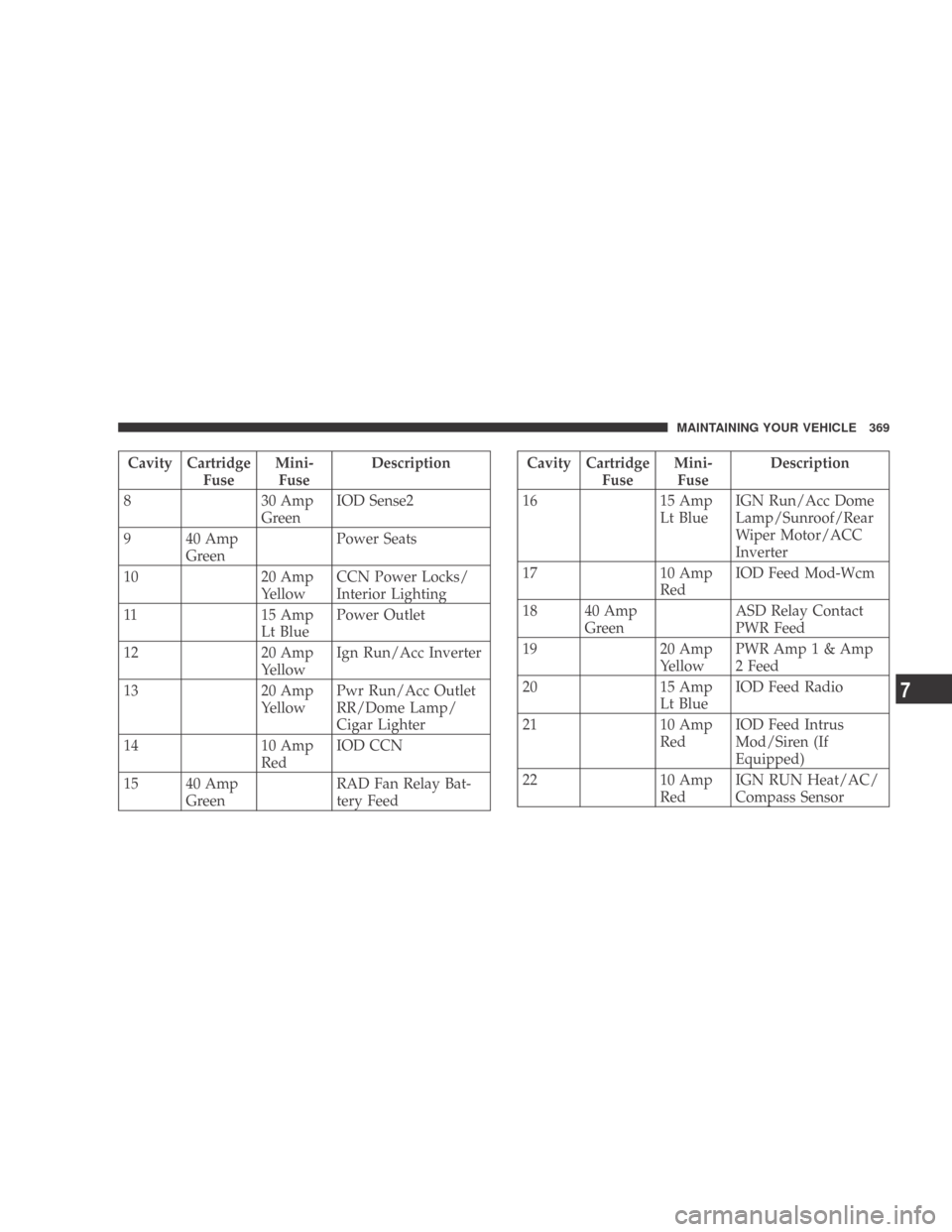
Cavity CartridgeFuseMini-
Fuse Description
8 30 Amp
Green IOD Sense2
9 40 Amp Green Power Seats
10 20 Amp
Yellow CCN Power Locks/
Interior Lighting
11 15 Amp
Lt Blue Power Outlet
12 20 Amp
Yellow Ign Run/Acc Inverter
13 20 Amp
Yellow Pwr Run/Acc Outlet
RR/Dome Lamp/
Cigar Lighter
14 10 Amp
Red IOD CCN
15 40 Amp Green RAD Fan Relay Bat-
tery FeedCavity Cartridge
FuseMini-
Fuse Description
16 15 Amp
Lt Blue IGN Run/Acc Dome
Lamp/Sunroof/Rear
Wiper Motor/ACC
Inverter
17 10 Amp
Red IOD Feed Mod-Wcm
18 40 Amp Green ASD Relay Contact
PWR Feed
19 20 Amp
Yellow PWR Amp 1 & Amp
2 Feed
20 15 Amp
Lt Blue IOD Feed Radio
21 10 Amp
Red IOD Feed Intrus
Mod/Siren (If
Equipped)
22 10 Amp
Red IGN RUN Heat/AC/
Compass Sensor
MAINTAINING YOUR VEHICLE 369
7
Page 412 of 431
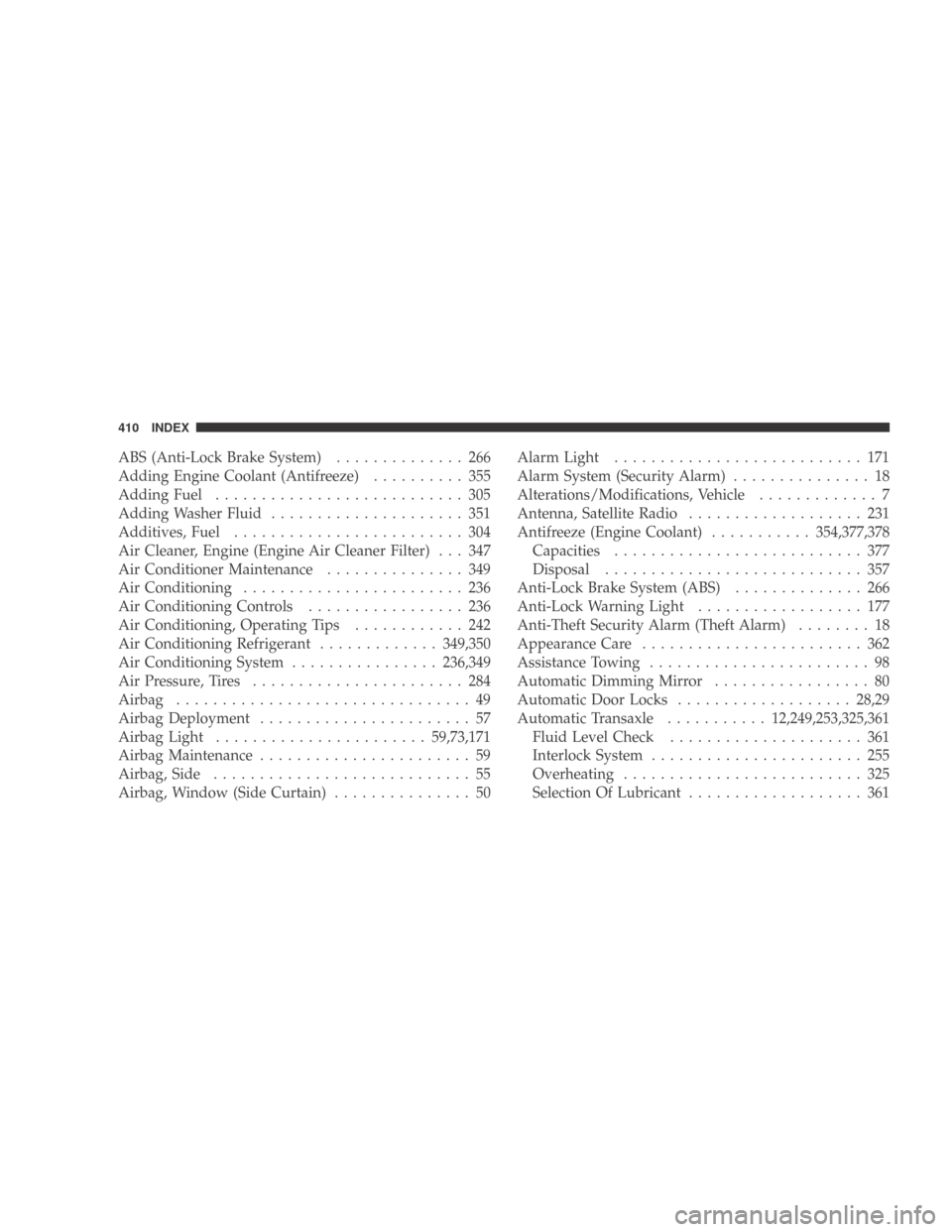
ABS (Anti-Lock Brake System).............. 266
Adding Engine Coolant (Antifreeze) .......... 355
Adding Fuel ........................... 305
Adding Washer Fluid ..................... 351
Additives, Fuel ......................... 304
Air Cleaner, Engine (Engine Air Cleaner Filter) . . . 347
Air Conditioner Maintenance ............... 349
Air Conditioning ........................ 236
Air Conditioning Controls ................. 236
Air Conditioning, Operating Tips ............ 242
Air Conditioning Refrigerant .............349,350
Air Conditioning System ................236,349
Air Pressure, Tires ....................... 284
Airbag ................................ 49
Airbag Deployment ....................... 57
Airbag Light ....................... 59,73,171
Airbag Maintenance ....................... 59
Airbag, Side ............................ 55
Airbag, Window (Side Curtain) ............... 50AlarmLight ........................... 171
Alarm System (Security Alarm)
............... 18
Alterations/Modifications, Vehicle ............. 7
Antenna, Satellite Radio ................... 231
Antifreeze (Engine Coolant) ...........354,377,378
Capacities ........................... 377
Disposal ............................ 357
Anti-Lock Brake System (ABS) .............. 266
Anti-Lock Warning Light .................. 177
Anti-Theft Security Alarm (Theft Alarm) ........ 18
Appearance Care ........................ 362
Assistance Towing ........................ 98
AutomaticDimmingMirror ................. 80
Automatic Door Locks ................... 28,29
Automatic Transaxle ........... 12,249,253,325,361
Fluid Level Check ..................... 361
Interlock System ....................... 255
Overheating .......................... 325
Selection Of Lubricant ................... 361
410 INDEX