brake DODGE CALIBER SRT 2008 1.G User Guide
[x] Cancel search | Manufacturer: DODGE, Model Year: 2008, Model line: CALIBER SRT, Model: DODGE CALIBER SRT 2008 1.GPages: 373, PDF Size: 3 MB
Page 163 of 373
bulb check. If the bulb does not come on during starting,
see your authorized dealer for service. If the light stays
on, it may be an indication that the parking brake has not
been released, or there is a low brake fluid level. If the
light remains on when the parking brake has been
disengaged, and the fluid level is at the full mark on the
master cylinder reservoir, it indicates a possible brake
hydraulic system malfunction or a problem with the
Brake Booster. In this case, the light will remain on until
the condition has been corrected. If the problem is related
to the brake Booster the ABS pump will run when
applying the brake.
The ªBRAKEº warning light will flash whether or not it
is in gear, if the park brake is applied, and the engine is
running.
If brake failure is indicated, immediate repair is neces-
sary. Operating the vehicle in this condition is danger-
ous!19. Turn Signal Indicators
The arrows will flash in unison with the exterior
turn signal, when using the turn signal lever.
20. Front Fog Light Indicator Ð If Equipped
This light shows when the front fog lights are ON.
21. Electronic Stability Program (ESP) Indicator Light
The malfunction lamp for the ESP is combined
with BAS. The yellow ªESP/BAS Warning
Lampº comes on when the ignition switch is
turned to the ªONº position. They should go
out with the engine running. If the ªESP/BAS Warning
Lampº comes on continuously with the engine running,
a malfunction has been detected in either the ESP or the
BAS system. If this light remains on after several ignition
cycles, and the vehicle has been driven several miles at
speeds greater than 30 mph (48 km/h), see your autho-
rized dealer as soon as possible.
162 UNDERSTANDING YOUR INSTRUMENT PANEL
Page 166 of 373
24. Anti-Lock Warning Light (ABS) Ð If Equipped
This light monitors the Anti-Lock Brake System
(ABS) described elsewhere in this manual. This
light will come on when the ignition key is
turned to the ON position and may stay on for
as long as four seconds.
If the ABS light remains on or comes on during driving,
it indicates that the Anti-Lock portion of the brake system
is not functioning and that service is required, however,
the conventional brake system will continue to operate
normally provided that the BRAKE warning light is not
on.
If the ABS light is on, the brake system should be serviced
as soon as possible to restore the benefit of Anti-Lock
Brakes.
The warning light should be checked frequently to assure
that it is operating properly. Turn the ignition key to theon position, but do not start the vehicle. The light should
come on. If the light does not come on, have the system
checked by an authorized dealer.
25. High Beam Indicator
This light shows that the headlights are on high
beam. Push the turn signal lever away from the
steering wheel to switch the headlights from high or low
beam.
26. Electronic Vehicle Information Center (EVIC)
ButtonÐIf Equipped
Pushing this button will switch between the different
EVIC functions.
27. Electronic Vehicle Information Center DisplayÐIf
Equipped
When the appropriate conditions exist, this display
shows the Electronic Vehicle Information Center (EVIC)
messages.
UNDERSTANDING YOUR INSTRUMENT PANEL 165
4
Page 171 of 373
²The feature will ªreadyº when the vehicle is at 0 mph.
The mph (kph) and SEC text will flash, indicating that
conditions are met for the event to begin.
²If the vehicle does not reach 1/8 (1/4) mile distance in
less then 30 seconds, the EVIC will display dashes.
²After a completed 1/8 (1/4) mile event, the speed and
time will be displayed on the EVIC. The speed and
time will remain on the screen until a new perfor-
mance screen is selected, or the vehicle speed drops to
0 mph and climbs past 30 mph (48 kp/h).
²Pressing the trip button will display the vehicle best
1/8 mile or 1/4 mile run.
²To clear the current and vehicle best time and distance,
hold the trip button, then press and release the EVIC
button.
Braking Distance
When the braking distance EVIC screen is active, the
vehicle braking distance and speed at which the brake
was depressed will be displayed. This feature is available
for braking that begins at a speed over 30 MPH (48
kp/h).
²The mph (kph) and Ft. (m). text will flash when the
conditions are met to begin a braking event. While a
braking event is taking place, the starting speed and
current distance will be shown.
²The feature will be disabled if the park brake is
engaged.
²The braking distance measurement will be aborted if
the brake is released before the vehicle comes to a
complete stop.
170 UNDERSTANDING YOUR INSTRUMENT PANEL
Page 222 of 373
STARTING AND OPERATING
CONTENTS
mStarting Procedures.....................224
NManual Transaxle.....................224
NNormal Starting......................224
NExtremely Cold Weather
(Below220ÉF Or229ÉC)................225
NIf Engine Fails To Start.................225
NAfter Starting........................226
NTurbocharger ªCool Downº..............226
mManual Transaxle Operation...............226NDownshifting........................227
mParking Brake.........................228
mBrake System..........................230
NAnti-Lock Brake System (ABS) Ð
If Equipped.........................231
mPower Steering........................233
mDriving On Slippery Surfaces..............234
NAcceleration.........................234
NTraction............................235
5
Page 225 of 373
STARTING PROCEDURES
Before starting your vehicle, adjust your seat, adjust both
inside and outside mirrors, and fasten your seat belts.
WARNING!
Never leave children alone in a vehicle. Leaving
children in a vehicle unattended is dangerous for a
number of reasons. A child or others could be seri-
ously or fatally injured. Don't leave the keys in the
ignition. A child could operate power windows,
other controls, or move the vehicle.
Manual Transaxle
Before starting the engine fully apply the parking brake,
press the clutch pedal to the floor, and place the gear
selector in NEUTRAL.NOTE:The engine will not start unless the clutch pedal
is pressed to the floor.
NOTE:If key won't turn and steering wheel is locked,
rotate the wheel in either direction to relieve pressure on
the locking mechanism and then turn the key.
Normal Starting
Normal starting of either a cold or a warm engine does
not require pumping or depressing the accelerator pedal.
Simply turn the ignition switch to the ªSTART'º position
and release when the engine starts. If the engine fails to
start within 15 seconds, turn the ignition switch to the
ªOFFº position, wait 10 to 15 seconds, then repeat the
normal starting procedure.
224 STARTING AND OPERATING
Page 227 of 373
CAUTION!
To prevent damage to the starter, do not crank the
engine for more than 15 seconds at a time. Wait 10 to
15 seconds before trying again.
After Starting
The idle speed will automatically decrease as the engine
warms up.
Turbocharger ªCool Downº
This vehicle is equipped with an after-run pump to cool
the turbocharger after the engine is shut off. Depending
on the type of driving and the amount of cargo, the pump
will run for up to 10 minutes after the engine has been
shut off to circulate coolant through the turbocharger.
Although the pump is rubber mounted for quiet opera-
tion, it is normal to hear it running during this time.
MANUAL TRANSAXLE OPERATION
WARNING!
You or others could be injured if you leave the
vehicle unattended without having the parking
brake fully applied. The parking brake should al-
ways be applied when the driver is not in the vehicle,
especially on an incline.
Fully depress the clutch pedal before you shift gears. As
you release the clutch pedal, lightly depress the accelera-
tor pedal.
226 STARTING AND OPERATING
Page 229 of 373
CAUTION!
If you skip more than one gear while downshifting
or downshift at too high a vehicle speed, you could
damage the engine, transmission, or clutch.
To maintain a safe speed and prolong brake life, shift
down to 2nd or 1st when descending a steep grade.
When turning a corner, or driving up a steep grade,
downshift early so that the engine will not be overbur-
dened.
PARKING BRAKE
When the parking brake is applied with the
ignition on, the Brake Light in the instrument
cluster will come on.
NOTE:This light only shows that the parking brake is
on. It does not show the degree of brake application.
If the parking brake is applied while the vehicle is
moving, a chime will sound to alert the driver. The chime
will sound up to 10 times or until the vehicle has
returned to a stop.
Before leaving the vehicle, make sure that the parking
brake is set. To set the parking brake, pull up firmly on
the lever. Also place the gear selector in Reverse. To
release the parking brake, apply the brake pedal, pull up
slightly on the lever, then depress the button on the end
of the lever and push the lever fully down toward the
floor.
228 STARTING AND OPERATING
Page 230 of 373
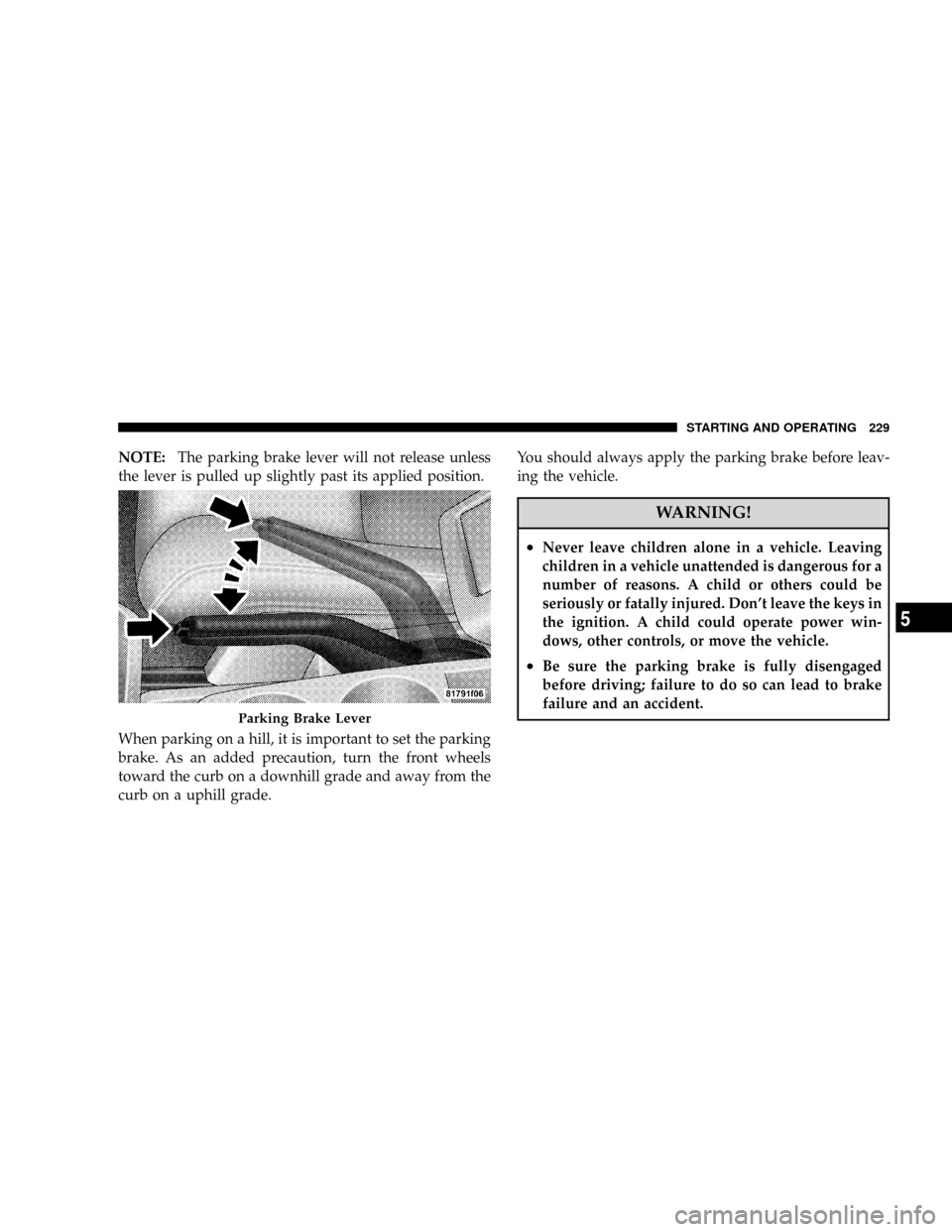
NOTE:The parking brake lever will not release unless
the lever is pulled up slightly past its applied position.
When parking on a hill, it is important to set the parking
brake. As an added precaution, turn the front wheels
toward the curb on a downhill grade and away from the
curb on a uphill grade.You should always apply the parking brake before leav-
ing the vehicle.
WARNING!
²Never leave children alone in a vehicle. Leaving
children in a vehicle unattended is dangerous for a
number of reasons. A child or others could be
seriously or fatally injured. Don't leave the keys in
the ignition. A child could operate power win-
dows, other controls, or move the vehicle.
²Be sure the parking brake is fully disengaged
before driving; failure to do so can lead to brake
failure and an accident.
Parking Brake Lever
STARTING AND OPERATING 229
5
Page 231 of 373
BRAKE SYSTEM
Your vehicle is equipped with power assisted brakes as
standard equipment. In the event power assist is lost for
any reason (for example, repeated brake applications
with the engine off), the brakes will still function. How-
ever, the effort required to brake the vehicle will be much
greater than that required with the power system oper-
ating.
WARNING!
Riding the brakes can lead to brake failure and
possibly an accident. Driving with your foot resting
or riding on the brake pedal can result in abnormally
high brake temperatures, excessive lining wear, and
possible brake damage. You wouldn't have your full
braking capacity in an emergency.If either of the two hydraulic systems lose normal capa-
bility, the remaining system will still function with some
loss of overall braking effectiveness. This will be evident
by increased pedal travel during application and greater
pedal force required to slow or stop. In addition, if the
malfunction is caused by an internal leak, as the brake
fluid in the master cylinder drops, the brake warning
indicator will light.
WARNING!
Driving a vehicle with the brake light on is danger-
ous. A significant decrease in braking performance or
vehicle stability during braking may occur. It will
take you longer to stop the vehicle or will make your
vehicle harder to control. You could have an accident.
Have the vehicle checked immediately.
230 STARTING AND OPERATING
Page 232 of 373
Anti-Lock Brake System (ABS) Ð If Equipped
The Anti-Lock Brake System provides increased vehicle
stability and brake performance under most braking
conditions. The system automatically ªpumpsº the
brakes during severe braking conditions to prevent
wheel lock-up.
WARNING!
Pumping of the Anti-Lock Brakes will diminish their
effectiveness and may lead to an accident. Pumping
makes the stopping distance longer. Just press firmly
on your brake pedal when you need to slow down or
stop.
WARNING!
²Anti-lock system (ABS) cannot prevent the natural
laws of physics from acting on the vehicle, nor can
it increase braking or steering efficiency beyond
that afforded by the condition of the vehicle
brakes and tires or the traction afforded.
²The ABS cannot prevent accidents, including
those resulting from excessive speed in turns,
following another vehicle too closely, or hydro-
planing. Only a safe, attentive, and skillful driver
can prevent accidents.
²The capabilities of an ABS equipped vehicle must
never be exploited in a reckless or dangerous
manner which could jeopardize the user's safety
or the safety of others.
STARTING AND OPERATING 231
5