fuel DODGE CALIBER SRT 2008 1.G User Guide
[x] Cancel search | Manufacturer: DODGE, Model Year: 2008, Model line: CALIBER SRT, Model: DODGE CALIBER SRT 2008 1.GPages: 373, PDF Size: 3 MB
Page 215 of 373
Bi-Level
Air is directed through the panel and floor outlets.
NOTE:There is a difference in temperature between the
upper and lower outlets for added comfort. The warmer
air goes to the floor outlets. This feature gives improved
comfort during sunny but cool conditions.
Floor
Air is directed through the floor outlets and side
window demister outlets with a small amount
through the defrost outlet.
Mix
Air is directed through the floor, defrost and side
window demister outlets. This setting works best in
cold or snowy conditions that require extra heat at
the windshield. This setting is good for maintaining
comfort while reducing moisture on the windshield.Defrost
Air is directed through the windshield and side
window demister outlets. Use this mode with
maximum fan and temperature settings for best wind-
shield and side window defrosting.
NOTE:The air conditioning compressor operates in
both Mix and Defrost or a blend of these modes even if
the Air Conditioning Snowflake button is not pressed.
This dehumidifies the air to help dry the windshield. To
improve fuel economy, use these modes only when
necessary.
Air Outlets
The airflow from each of the instrument panel outlets can
be adjusted for direction and turned on or off to control
air flow.
214 UNDERSTANDING YOUR INSTRUMENT PANEL
Page 223 of 373
mDriving Through Water..................235
NFlowing/Rising Water..................235
NShallow Standing Water.................236
mTire Safety Information...................237
NTire Markings........................237
NTire Identification Number (TIN)..........241
NTire Loading And Tire Pressure...........242
mTires Ð General Information...............246
NTire Pressure.........................246
NTire Inflation Pressures.................247
NRadial-Ply Tires......................249
NTire Spinning........................250
NTread Wear Indicators..................250NLife Of Tire.........................251
NReplacement Tires.....................251
NAlignment And Balance.................253
mTire Chains...........................253
mSnow Tires...........................254
mTire Rotation Recommendations............254
mTire Pressure Monitoring System (TPMS) Ð
If Equipped...........................255
NBase System ± If Equipped...............258
NPremium System ± If Equipped...........260
NGeneral Information...................263
mFuel Requirements......................264
N2.4L Turbo Engine.....................264
222 STARTING AND OPERATING
Page 224 of 373
NReformulated Gasoline.................264
NGasoline/Oxygenate Blends..............265
NMMT In Gasoline.....................265
NMaterials Added To Fuel................266
NFuel System Cautions..................266
NCarbon Monoxide Warnings..............267
mAdding Fuel..........................268
NFuel Filler Cap (Gas Cap)...............268NLoose Fuel Filler Cap Message............269
mVehicle Loading........................270
NGross Vehicle Weight Rating (GVWR).......270
mRecreational Towing (Behind Motorhome, Etc.) . . 271
NTowing This Vehicle Behind Another Vehicle
(Flat Towing With All Four Wheels On The
Ground)............................271
STARTING AND OPERATING 223
5
Page 226 of 373
WARNING!
Do not attempt to push or tow your vehicle to get it
started. Vehicles equipped with an automatic trans-
axle cannot be started this way. Unburned fuel could
enter the catalytic converter and once the engine has
started, ignite and damage the converter and vehicle.
If the vehicle has a discharged battery, booster cables
may be used to obtain a start from another vehicle.
This type of start can be dangerous if done improp-
erly, so follow the procedure carefully. See section 6
of this manual for jump starting instructions.
Extremely Cold Weather (below220ÉF or229ÉC)
To insure reliable starting at these temperatures, use of an
externally powered electric engine block heater (available
from your dealer) is recommended.
If Engine Fails to Start
If the engine fails to start after you have followed the
ªNORMAL STARTINGº procedure, it may be flooded.
Push the accelerator pedal all the way to the floor and
hold it there. Crank the engine for no more than 15
seconds. This should clear any excess fuel in case the
engine is flooded. Leave the ignition key in the ON
position, release the accelerator pedal and repeat the
ªNORMAL STARTINGº procedure.
WARNING!
Never pour fuel or other flammable liquid into the
throttle body air inlet opening in an attempt to start
the vehicle. This could result in flash fire causing
serious personal injury.
STARTING AND OPERATING 225
5
Page 228 of 373
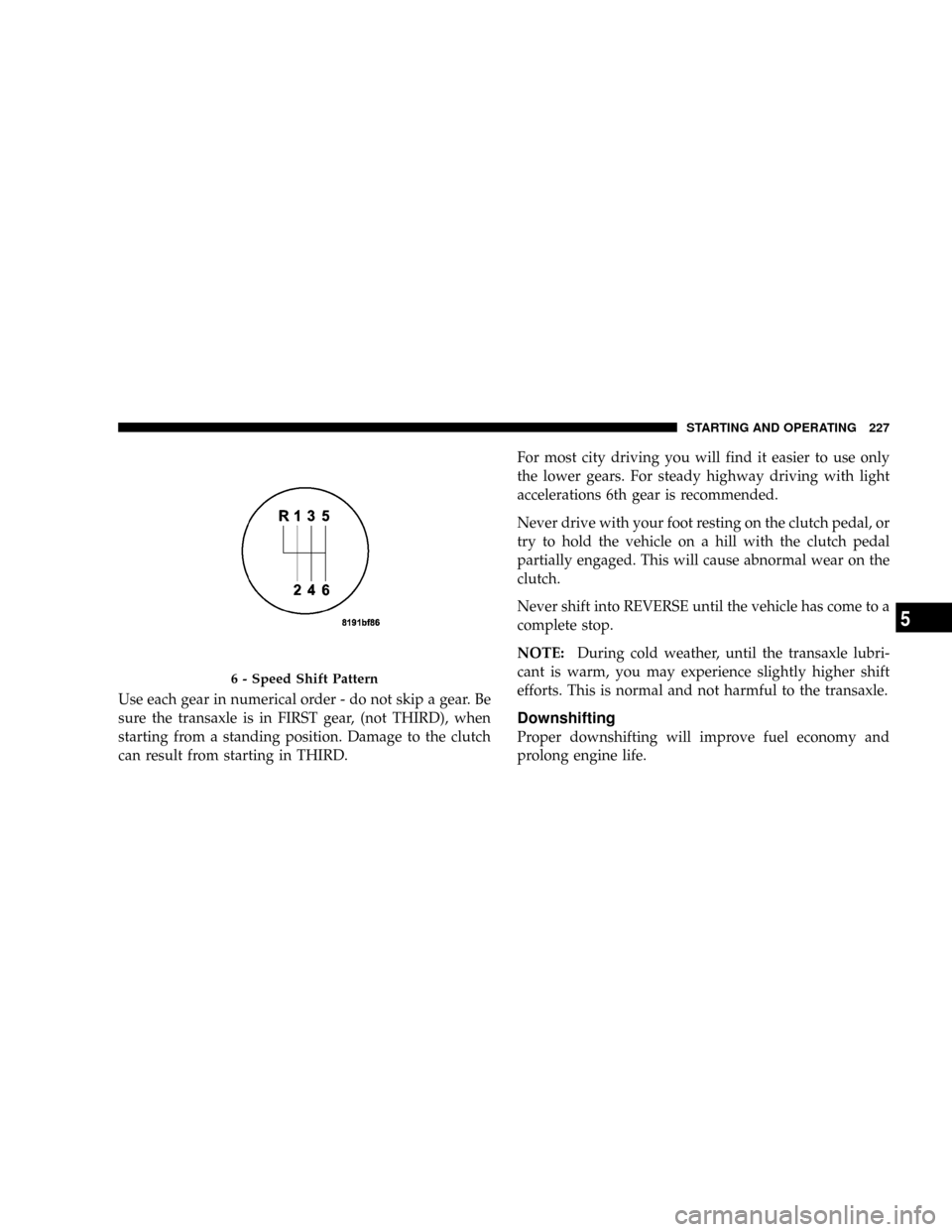
Use each gear in numerical order - do not skip a gear. Be
sure the transaxle is in FIRST gear, (not THIRD), when
starting from a standing position. Damage to the clutch
can result from starting in THIRD.For most city driving you will find it easier to use only
the lower gears. For steady highway driving with light
accelerations 6th gear is recommended.
Never drive with your foot resting on the clutch pedal, or
try to hold the vehicle on a hill with the clutch pedal
partially engaged. This will cause abnormal wear on the
clutch.
Never shift into REVERSE until the vehicle has come to a
complete stop.
NOTE:During cold weather, until the transaxle lubri-
cant is warm, you may experience slightly higher shift
efforts. This is normal and not harmful to the transaxle.
Downshifting
Proper downshifting will improve fuel economy and
prolong engine life.
6 - Speed Shift Pattern
STARTING AND OPERATING 227
5
Page 248 of 373
2. EconomyÐ
Improper inflation pressures can cause uneven wear
patterns to develop across the tire tread. These abnormal
wear patterns will reduce tread life resulting in a need for
earlier tire replacement. Under inflation, also increases
tire rolling resistance and results in higher fuel consump-
tion.
3. Ride Comfort and Vehicle StabilityÐ
Proper tire inflation contributes to a comfortable ride.
Over inflation produces a jarring and uncomfortable ride.
Tire Inflation Pressures
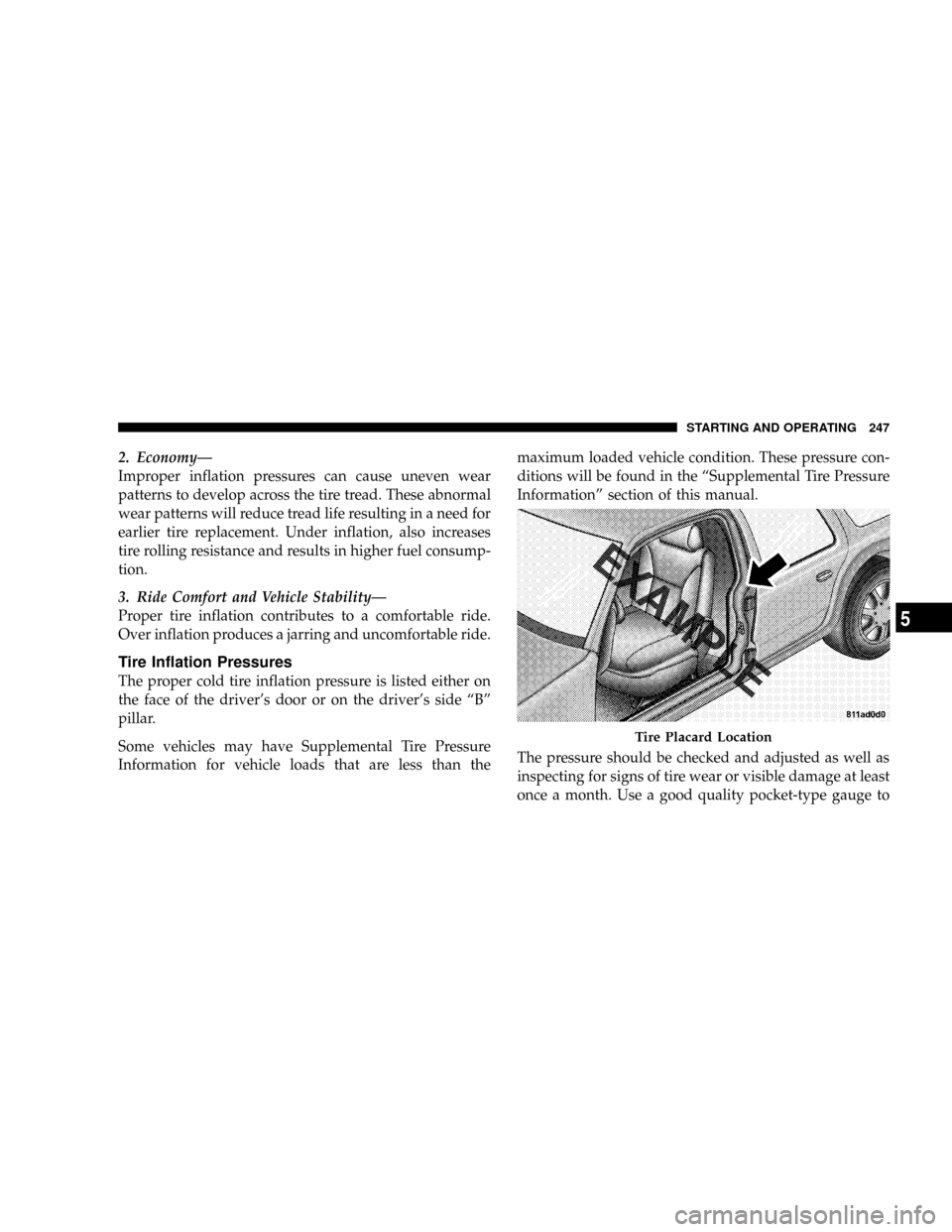
The proper cold tire inflation pressure is listed either on
the face of the driver's door or on the driver's side ªBº
pillar.
Some vehicles may have Supplemental Tire Pressure
Information for vehicle loads that are less than themaximum loaded vehicle condition. These pressure con-
ditions will be found in the ªSupplemental Tire Pressure
Informationº section of this manual.
The pressure should be checked and adjusted as well as
inspecting for signs of tire wear or visible damage at least
once a month. Use a good quality pocket-type gauge to
Tire Placard Location
STARTING AND OPERATING 247
5
Page 258 of 373
CAUTION!
²The TPMS has been optimized for the original
equipment tires and wheels. TPMS pressures and
warning have been established for the tire size
equipped on your vehicle. Undesirable system
operation or sensor damage may result when us-
ing replacement equipment that is not of the same
size, type, and/or style. Aftermarket wheels can
cause sensor damage. Do not use aftermarket tire
sealants or balance beads if your vehicle is
equipped with a TPMS, as damage to the sensors
may result.
²After inspecting or adjusting the tire pressure,
always reinstall the valve stem cap. This will
prevent moisture and dirt from entering the valve
stem, which could damage the Tire Pressure Moni-
toring Sensor.NOTE:
²The TPMS is not intended to replace normal tire care
and maintenance, or to provide warning of a tire
failure or condition.
²The TPMS should not be used as a tire pressure gauge
while adjusting your tire pressure.
²Driving on a significantly under-inflated tire causes
the tire to overheat and can lead to tire failure.
Under-inflation also reduces fuel efficiency and tire
tread life, and may affect the vehicle's handling and
stopping ability.
²The TPMS is not a substitute for proper tire mainte-
nance, and it is the driver 's responsibility to maintain
correct tire pressure using an accurate tire gauge, even
if under-inflation has not reached the level to trigger
illumination of the Tire Pressure Monitoring Telltale
light.
STARTING AND OPERATING 257
5
Page 265 of 373
FUEL REQUIREMENTS
2.4L Turbo Engine
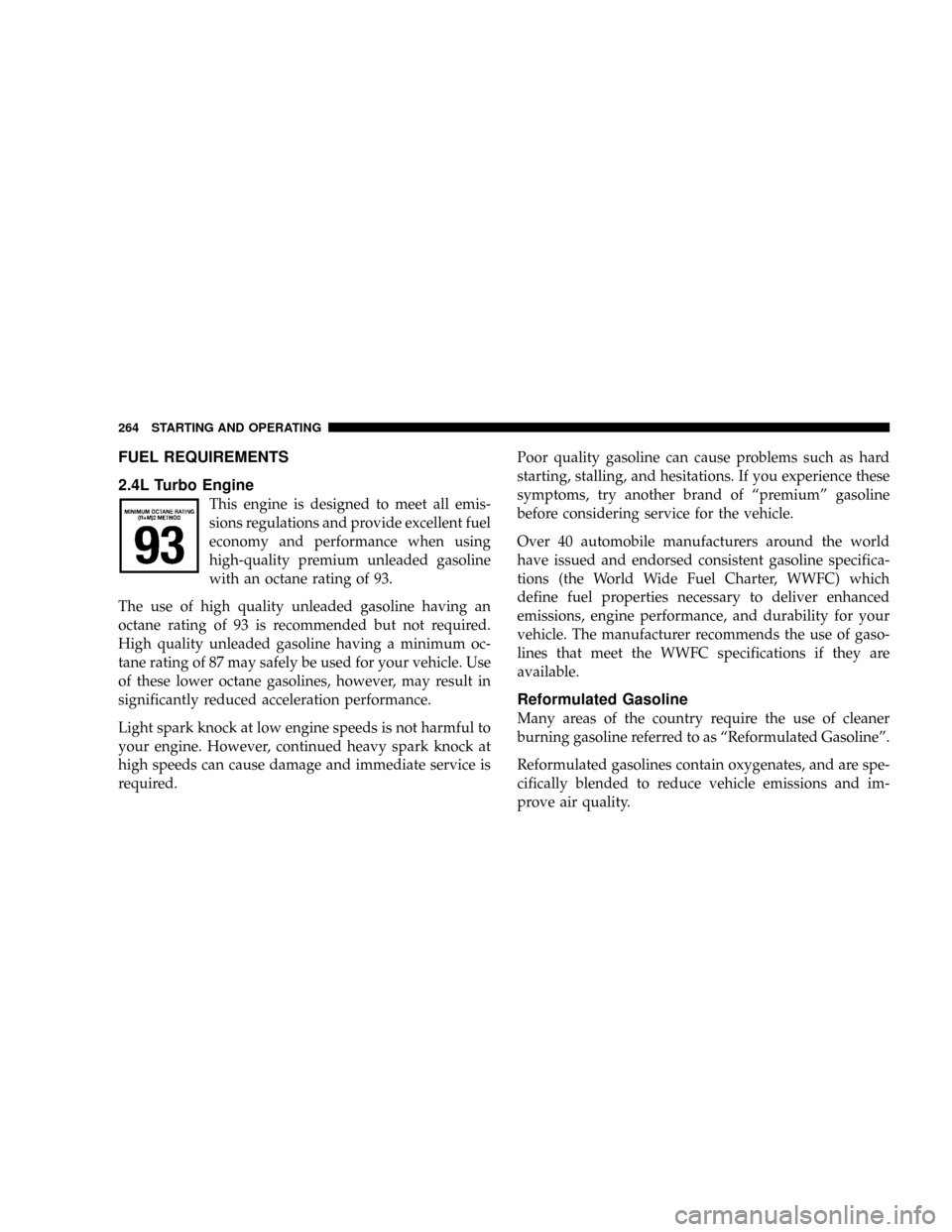
This engine is designed to meet all emis-
sions regulations and provide excellent fuel
economy and performance when using
high-quality premium unleaded gasoline
with an octane rating of 93.
The use of high quality unleaded gasoline having an
octane rating of 93 is recommended but not required.
High quality unleaded gasoline having a minimum oc-
tane rating of 87 may safely be used for your vehicle. Use
of these lower octane gasolines, however, may result in
significantly reduced acceleration performance.
Light spark knock at low engine speeds is not harmful to
your engine. However, continued heavy spark knock at
high speeds can cause damage and immediate service is
required.Poor quality gasoline can cause problems such as hard
starting, stalling, and hesitations. If you experience these
symptoms, try another brand of ªpremiumº gasoline
before considering service for the vehicle.
Over 40 automobile manufacturers around the world
have issued and endorsed consistent gasoline specifica-
tions (the World Wide Fuel Charter, WWFC) which
define fuel properties necessary to deliver enhanced
emissions, engine performance, and durability for your
vehicle. The manufacturer recommends the use of gaso-
lines that meet the WWFC specifications if they are
available.
Reformulated Gasoline
Many areas of the country require the use of cleaner
burning gasoline referred to as ªReformulated Gasolineº.
Reformulated gasolines contain oxygenates, and are spe-
cifically blended to reduce vehicle emissions and im-
prove air quality.
264 STARTING AND OPERATING
Page 266 of 373
The manufacturer supports the use of reformulated gaso-
lines. Properly blended reformulated gasolines will pro-
vide excellent performance and durability of engine and
fuel system components.
Gasoline/Oxygenate Blends
Some fuel suppliers blend unleaded gasoline with oxy-
genates such as 10% ethanol, MTBE, and ETBE. Oxygen-
ates are required in some areas of the country during the
winter months to reduce carbon monoxide emissions.
Fuels blended with these oxygenates may be used in
your vehicle.
CAUTION!
DO NOT use gasolines containing Methanol or E85
Ethanol. Use of these blends may result in starting
and driveability problems and may damage critical
fuel system components.Problems that result from using methanol/gasoline or
E85 Ethanol blends are not the responsibility of the
manufacturer. While MTBE is an oxygenate made from
Methanol, it does not have the negative effects of Metha-
nol.
MMT In Gasoline
MMT is a manganese containing metallic additive that is
blended into some gasoline to increase the octane num-
ber. Gasolines blended with MMT offer no performance
advantage beyond gasolines of the same octane number
without MMT. Gasolines blended with MMT have shown
to reduce spark plug life and reduce emission system
performance in some vehicles. The manufacturer recom-
mends using gasolines without MMT. Since the MMT
content of gasoline may not be indicated on the pump,
you should ask your gasoline retailer if his/her gasoline
contains MMT.
STARTING AND OPERATING 265
5
Page 267 of 373
It is even more important to look for gasolines without
MMT in Canada, because MMT can be used at levels
higher than allowed in the United States. MMT is pro-
hibited in Federal and California reformulated gasolines.
Materials Added to Fuel
All gasoline sold in the United States is required to
contain effective detergent additives. Use of additional
detergents or other additives are not needed under
normal conditions and they would result in additional
cost. Therefore, you should not have to add anything to
the fuel.
Fuel System Cautions
CAUTION!
Follow these guidelines to maintain your vehicle's
performance:
²The use of leaded gas is prohibited by Federal law.
Using leaded gasoline can impair engine performance,
or damage the emission control system.
²An out-of-tune engine, or certain fuel or ignition
malfunctions, can cause the catalytic converter to
overheat. If you notice a pungent burning odor or
some light smoke, your engine may be out-of-tune or
malfunctioning and may require immediate service.
Contact your dealer for service assistance.
²The use of fuel additives, which are now being sold as
octane enhancers, are not recommended. Most of these
products contain high concentrations of methanol.
Fuel system damage or vehicle performance problems
resulting from the use of such fuels or additives are not
the responsibility of the manufacturer.
NOTE:Intentional tampering with emissions control
systems can result in civil penalties being assessed
against you.
266 STARTING AND OPERATING