oil DODGE CALIBER SRT 2008 1.G User Guide
[x] Cancel search | Manufacturer: DODGE, Model Year: 2008, Model line: CALIBER SRT, Model: DODGE CALIBER SRT 2008 1.GPages: 373, PDF Size: 3 MB
Page 237 of 373
Shallow Standing Water
Although your vehicle is capable of driving through
shallow standing water, consider the following Caution
and Warning before doing so.
CAUTION!
²Always check the depth of the standing water
before driving through it. Never drive through
standing water that is deeper than the bottom of
the tire rims mounted on the vehicle.
²Determine the condition of the road or the path
that is under water, and if there are any obstacles
in the way, before driving through the standing
water.
²Do not exceed 5 mph (8 km/h) when driving
through standing water. This will minimize wave
effects.
CAUTION!
²Driving through standing water may cause dam-
age to your vehicle's drivetrain components. Al-
ways inspect your vehicle's fluids (i.e., engine oil,
transmission, axle, etc.) for signs of contamination
(i.e., fluid that is milky or foamy in appearance)
after driving through standing water. Do not con-
tinue to operate the vehicle if any fluid appears
contaminated, as this may result in further dam-
age. Such damage is not covered by the New
Vehicle Limited Warranty.
²Getting water inside your vehicle's engine can
cause it to lock up and stall out, and cause serious
internal damage to the engine. Such damage is not
covered by the New Vehicle Limited Warranty.
236 STARTING AND OPERATING
Page 252 of 373
These indicators are molded into the bottom of the tread
grooves. They will appear as bands when the tread depth
becomes 1/16 inch (2 mm). When the tread is worn to the
tread wear indicators, the tire should be replaced.
Many states have laws requiring tire replacement at this
point.
Life of Tire
The service life of a tire is dependent upon varying
factors including but not limited to:
²Driving style
²Tire pressure
²Distance driven
WARNING!
Tires and spare tire should be replaced after six years,
regardless of the remaining tread. Failure to follow
this warning can result in sudden tire failure. You
could lose control and have an accident resulting in
serious injury or death.
Keep dismounted tires in a cool, dry place with as little
exposure to light as possible. Protect tires from contact
with oil, grease, and gasoline.
Replacement Tires
The tires on your new vehicle provide a balance of many
characteristics. They should be inspected regularly for
wear and correct cold tire inflation pressure. The manu-
facturer strongly recommends that you use tires equiva-
lent to the originals in size, quality and performance
when replacement is needed (refer to the paragraph on
STARTING AND OPERATING 251
5
Page 277 of 373
WARNING!
A hot engine cooling system is dangerous. You or
others could be badly burned by steam or boiling
coolant. You may want to call a service center if your
vehicle overheats. If you decide to look under the
hood yourself, refer to Section 7, Maintenance, of this
manual. Follow the warnings under the Cooling
System Pressure Cap paragraph.
TIREFIT KIT
Small punctures in the tire tread can be sealed with
TIREFIT. Foreign objects (e.g., screws or nails) should not
be removed from the tire. TIREFIT can be used in outside
temperatures down to approximately -4ÉF (-20ÉC).
TIREFIT Storage
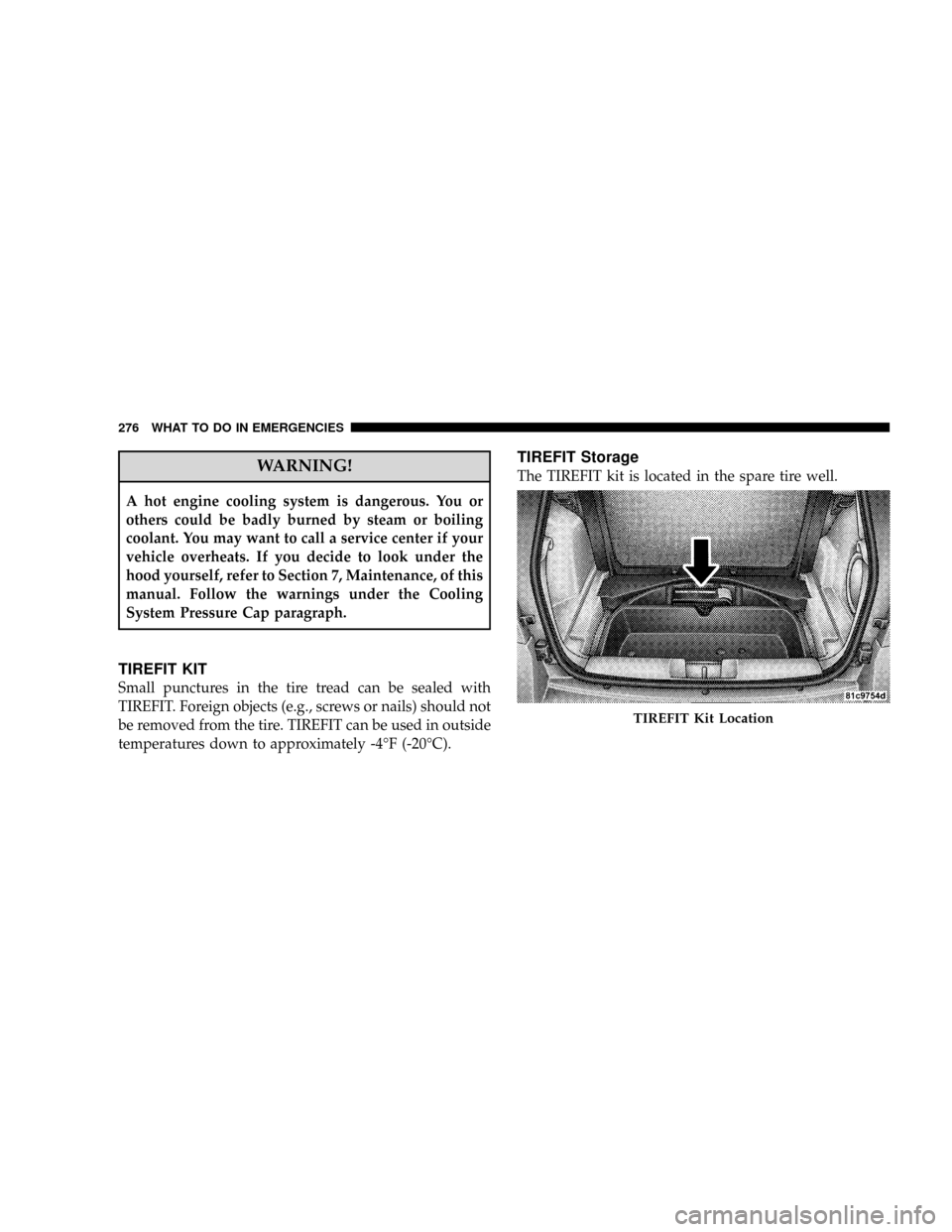
The TIREFIT kit is located in the spare tire well.
TIREFIT Kit Location
276 WHAT TO DO IN EMERGENCIES
Page 281 of 373
Using the Air Pump Power Button
Push and release the button (3) once to turn On
the TIREFIT kit. Push and release the button (3)
again to turn Off the TIREFIT kit.
Sealing a Tire with TIREFIT
(A) Whenever You Stop to Use TIREFIT:
Turn on the vehicle's hazard warning flashers.
1. Verify that the valve stem (on the wheel with the
deflated tire) is in a position that is near to the ground.
This will allow the TIREFIT Hoses (6) and (7) to reach the
valve stem and keep the TIREFIT kit flat on the ground.
This will provide the best positioning of the kit when
injecting the sealant into the deflated tire and running the
air pump. Move the vehicle as necessary to place the
valve stem in this position before proceeding.2. Place the transmission in Neutral and set the parking
brake.
3. Turn off the ignition.
(B) Setting Up to Use TIREFIT:
Turn the Mode Select knob (4) to the Sealant/
Air Mode position.
1. Uncoil the Clear Sealant Hose (7) and then remove the
Yellow Cap from the fitting at the end of the hose.
2. Place the TIREFIT kit flat on the ground next to the
deflated tire.
3. Remove the cap from the valve stem and then screw
the fitting at the end of the Sealant Hose (7) onto the
valve stem.
4. Uncoil the Power Plug and Cable (5) and then insert
the plug into the vehicle's power outlet.
280 WHAT TO DO IN EMERGENCIES
Page 283 of 373
²If the tire inflates to at least 26 psi (1.8 bar) within 15
minutes, proceed to Step 2 of this procedure.
²If tire fails to inflate to 26 psi (1.8 bar) within 15
minutes, perform the procedure steps described
under ª(G) Distributing TIREFIT Sealant to Better
Enable Tire Inflation.º
²Press the Air Pump Power Button (3) to
turn off the TIREFIT kit.
2. Remove the Speed Limit sticker from the top of the
Sealant Bottle (1) and place the sticker on the steering
wheel.
3. Disconnect the TIREFIT kit from the valve stem and
place it in the vehicle.
(E) Securing TIREFIT Sealant in the Tire
Drive the vehicle for approximately 5 miles (8 km) to
ensure distribution of the TIREFIT Sealant within the tire.
WARNING!
TIREFIT is not a permanent flat tire repair. Have the
tire inspected and repaired or replaced after using
TIREFIT. Do not exceed 55 mph (90 km/h) until
having the tire repaired or replaced. Failure to follow
this warning can result in injuries that are serious or
fatal to you, your passengers, and others around you.
(F) After Securing TIREFIT Sealant in the Tire:
Turn the Mode Select knob (4) to the Air Mode
position.
1. Uncoil the Black Air Pump Hose (6) and connect it to
the valve stem.
2. Check the pressure in the tire by reading the Pressure
Gauge (2).
282 WHAT TO DO IN EMERGENCIES
Page 290 of 373
MAINTAINING YOUR VEHICLE
CONTENTS
mEngine Compartment Ð Gasoline Engines.....291
mOnboard Diagnostic System Ð OBD II........292
NLoose Fuel Filler Cap Message............293
mEmissions Inspection And Maintenance
Programs............................293
mReplacement Parts......................295
mAuthorized Dealer Service................295
mMaintenance Procedures..................296
NEngine Oil..........................296NDrive Belt ± Check Condition.............299
NSpark Plugs.........................300
NCatalytic Converter....................300
NCrankcase Emission Control System........301
NFuel Filter..........................302
NAir Cleaner Element (Filter)..............302
NMaintenance-Free Battery................302
NAir Conditioner Maintenance.............304
NPower Steering Ð Fluid Check............305
7
Page 292 of 373
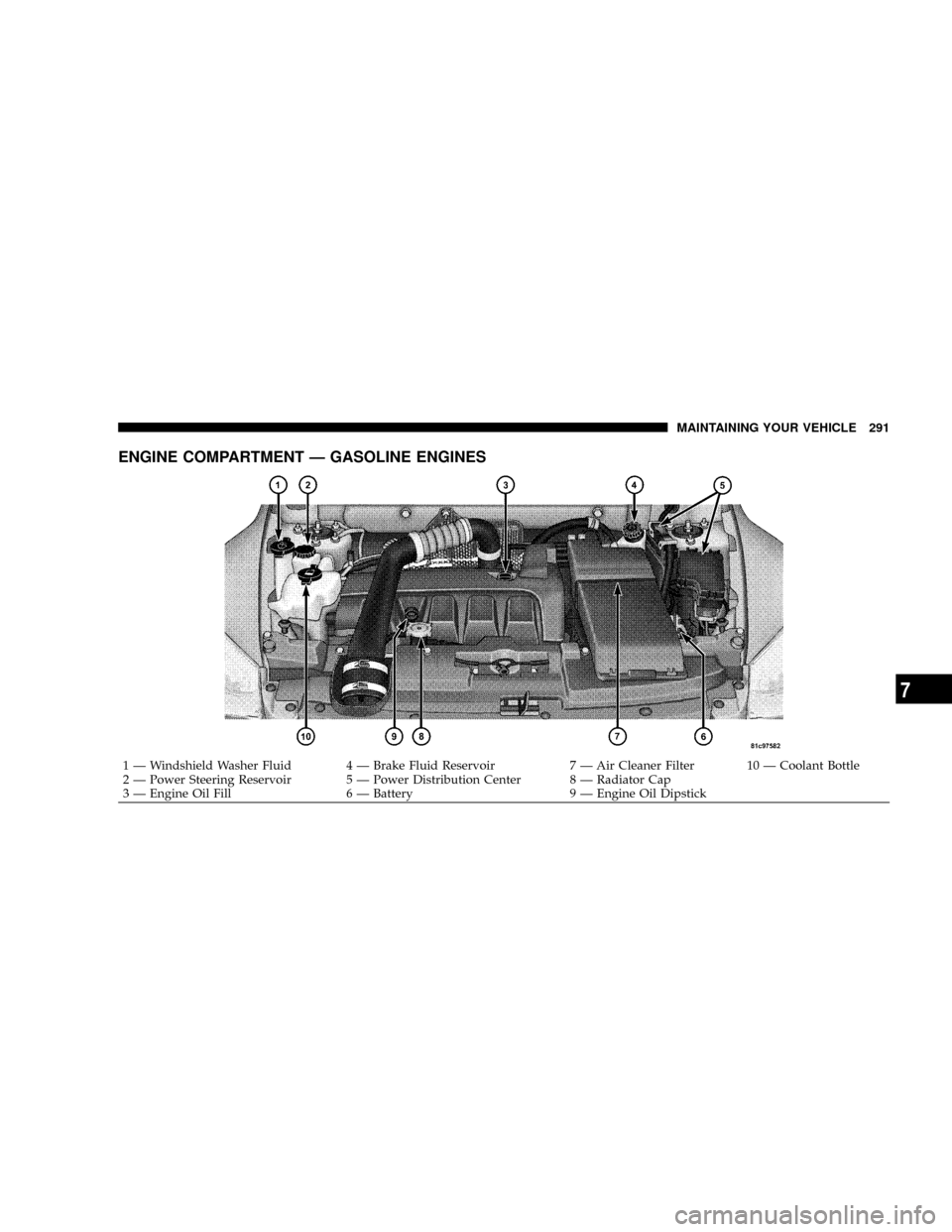
ENGINE COMPARTMENT Ð GASOLINE ENGINES
1 Ð Windshield Washer Fluid 4 Ð Brake Fluid Reservoir 7 Ð Air Cleaner Filter 10 Ð Coolant Bottle
2 Ð Power Steering Reservoir 5 Ð Power Distribution Center 8 Ð Radiator Cap
3 Ð Engine Oil Fill 6 Ð Battery 9 Ð Engine Oil DipstickMAINTAINING YOUR VEHICLE 291
7
Page 297 of 373
MAINTENANCE PROCEDURES
The pages that follow contain therequiredmaintenance
services determined by the engineers who designed your
vehicle.
Besides the maintenance items for which there are fixed
maintenance intervals, there are other items that should
operate satisfactorily without periodic maintenance.
However, if a malfunction of these items does occur, it
could adversely affect the engine or vehicle performance.
These items should be inspected if a malfunction is
observed or suspected.
Engine Oil
Checking Oil Level
To assure proper engine lubrication, the engine oil must
be maintained at the correct level. Check the oil level at
regular intervals, such as every fuel stop.The best time to check the engine oil level is about 5
minutes after a fully warmed engine is shut off. Do not
check oil level before starting the engine after it has sat
overnight. Checking engine oil level when the engine is
cold will give you an incorrect reading.
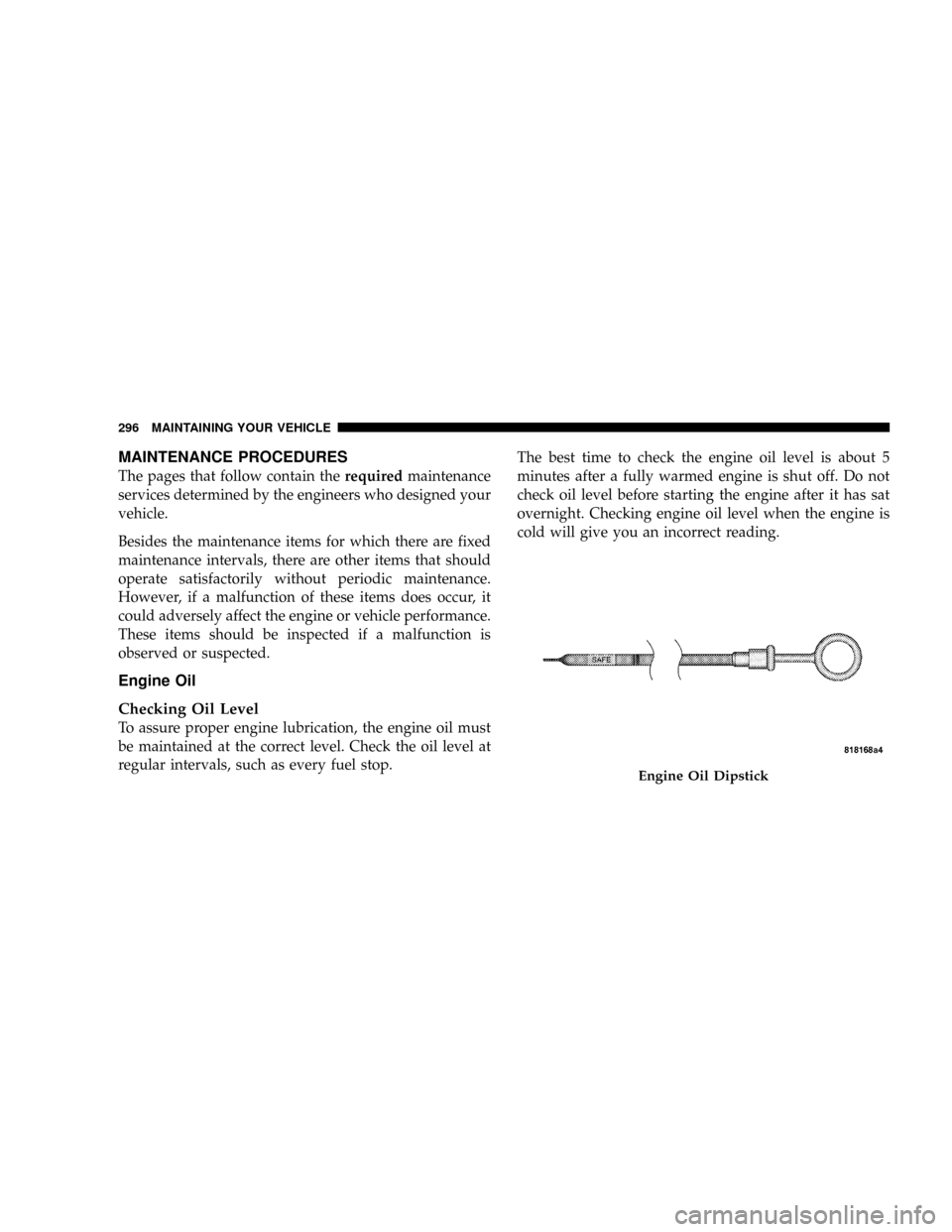
Engine Oil Dipstick
296 MAINTAINING YOUR VEHICLE
Page 298 of 373
Checking the oil while the vehicle is on level ground and
only when the engine is hot, will improve the accuracy of
the oil level readings. Maintain the oil level between the
range markings on the dipstick. The range markings will
consist of a crosshatch zone that says SAFE or a cross-
hatch zone that says MIN at the low end of the range and
MAX at the high end of the range. Adding one quart of
oil when the reading is at the low end of the indicated
range will result in the oil level at the full end of the
indicator range.
CAUTION!
Do not overfill the engine. Overfilling the engine as
indicated by the range markings, as described above,
on the engine oil dipstick will cause oil aeration,
which can lead to loss of oil pressure and an increase
in oil temperature. This could damage your engine.
Change Engine Oil
Refer to the ªMaintenance Scheduleº in Section 8 for
recommended engine oil change intervals.
Engine Oil Selection
For best performance and maximum protection under all
types of operating conditions, the manufacturer only
recommends full synthetic engine oils that meet require-
ments of DaimlerChrysler Material Standard MS-10725.
The manufacturer recommends the use of a full synthetic
engine oil, such as Mobil 1tSAE 0W-40 or equivalent.
MAINTAINING YOUR VEHICLE 297
7
Page 299 of 373
Engine Oil Viscosity (SAE Grade)
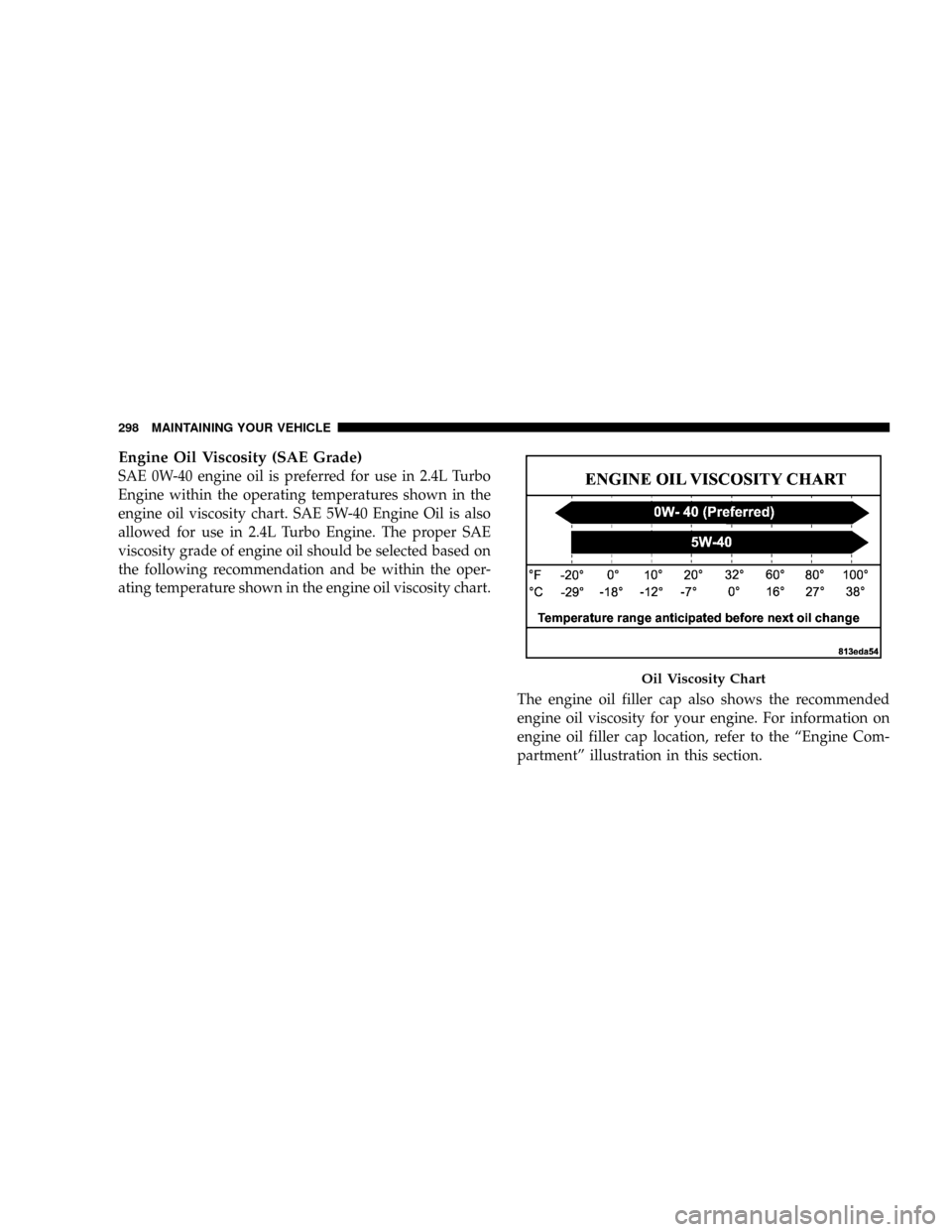
SAE 0W-40 engine oil is preferred for use in 2.4L Turbo
Engine within the operating temperatures shown in the
engine oil viscosity chart. SAE 5W-40 Engine Oil is also
allowed for use in 2.4L Turbo Engine. The proper SAE
viscosity grade of engine oil should be selected based on
the following recommendation and be within the oper-
ating temperature shown in the engine oil viscosity chart.
The engine oil filler cap also shows the recommended
engine oil viscosity for your engine. For information on
engine oil filler cap location, refer to the ªEngine Com-
partmentº illustration in this section.
Oil Viscosity Chart
298 MAINTAINING YOUR VEHICLE