air condition DODGE CALIBER SRT 2008 1.G Owner's Manual
[x] Cancel search | Manufacturer: DODGE, Model Year: 2008, Model line: CALIBER SRT, Model: DODGE CALIBER SRT 2008 1.GPages: 373, PDF Size: 3 MB
Page 276 of 373
the normal range. If the pointer remains on theredmark
(260É) for more than a minute, turn the engine off
immediately and call for service.
NOTE:There are steps that you can take to slow down
an impending overheat condition. If your air conditioner
is on, turn it off. The air conditioning system adds heat to
the engine cooling system and turning off the A/C
removes this heat. You can also turn the Temperature
control to maximum heat, the Mode control to floor, and
the fan control to High. This allows the heater core to act
as a supplement to the radiator and aids in removing heat
from the engine cooling system.CAUTION!
Driving with a hot cooling system could damage
your vehicle. If temperature gauge reads 260É, pull
over and stop the vehicle with the engine at idle,
when safe. Turn the air conditioner off and wait until
the pointer drops back into the normal range. After
appropriate action has been taken, if the pointer
remains on the red mark (260É), turn the engine off
immediately, and call for service.
WHAT TO DO IN EMERGENCIES 275
6
Page 279 of 373
WARNING!
²Do not attempt to seal a tire on the side of the vehicle close to traffic.
Pull far enough off the road to avoid the danger of being hit when
using the TIREFIT kit.
²Do not use TIREFIT or drive the vehicle under the following
circumstances:
þ If the cut or puncture in the tire tread is approximately 0.24 in. (6 mm)
or larger.
þ If the tire has any sidewall damage.
þ If the tire has any damage from driving with extremely low tire
pressure.
þ If the tire has any damage from driving on a flat tire.
þ If the wheel has any damage.
þ If you are unsure of the condition of the tire or the wheel.
²Keep TIREFIT away from open flame or heat source.
²TIREFIT is not a permanent flat tire repair. Have the tire inspected
and repaired or replaced after using TIREFIT. Do not exceed 55 mph
(90 km/h) until having the tire repaired or replaced.
²A loose TIREFIT kit thrown forward in a collision or hard stop could
endanger the occupants of the vehicle. Always stow the TIREFIT kit
in the place provided.
Failure to follow these warnings can result in injuries that are serious or
fatal to you, your passengers, and others around you.
WARNING!
²Take care not to allow the contents of TIREFIT to
come in contact with hair, eyes, or clothing. TIRE-
FIT is harmful if inhaled, swallowed, or absorbed
through the skin: It causes skin, eye, and respira-
tory irritation. Flush immediately with plenty of
water if there is any contact with eyes or skin.
Change clothing as soon as possible, if there is any
contact with clothing.
²TIREFIT Sealant solution contains latex. In case of
allergic reaction or rash, consult a physician imme-
diately. Keep TIREFIT out of reach of children. If
swallowed, rinse mouth immediately with plenty
of water and drink plenty of water. Do not induce
vomiting! Consult a physician immediately.
278 WHAT TO DO IN EMERGENCIES
Page 290 of 373
MAINTAINING YOUR VEHICLE
CONTENTS
mEngine Compartment Ð Gasoline Engines.....291
mOnboard Diagnostic System Ð OBD II........292
NLoose Fuel Filler Cap Message............293
mEmissions Inspection And Maintenance
Programs............................293
mReplacement Parts......................295
mAuthorized Dealer Service................295
mMaintenance Procedures..................296
NEngine Oil..........................296NDrive Belt ± Check Condition.............299
NSpark Plugs.........................300
NCatalytic Converter....................300
NCrankcase Emission Control System........301
NFuel Filter..........................302
NAir Cleaner Element (Filter)..............302
NMaintenance-Free Battery................302
NAir Conditioner Maintenance.............304
NPower Steering Ð Fluid Check............305
7
Page 300 of 373
Materials Added To Engine Oils
The manufacture strongly recommends against the addi-
tion of any additives (other than leak detection dyes) to
the engine oil. Engine oil is an engineered product and
it's performance may be impaired by supplemental ad-
ditives.
Disposing of Used Engine Oil
Care should be taken in disposing of used engine oil from
your vehicle. Used oil, indiscriminately discarded, can
present a problem to the environment. Contact your
dealer, service station, or governmental agency for advice
on how and where used oil can be safely discarded in
your area.
Engine Oil Filter
The engine oil filter should be replaced at every engine
oil change.
Engine Oil Filter Selection
All of this manufacturers engines have a full-flow type
disposable oil filter. Use a filter of this type for replace-
ment. The quality of replacement filters varies consider-
ably. Only high quality filters should be used to assure
most efficient service. Mopar Engine Oil Filters are high
quality oil filters and are recommended.
Drive Belt ± Check Condition
Check the drive belt condition. Refer to the ªMaintenance
Scheduleº in Section 8 of this manual.
Inspect the drive belt for evidence of cuts, cracks, or
glazing and replace belt if any sign of damage which
could result in belt failure.
The belt is self-tensioning and will not need adjustment.
MAINTAINING YOUR VEHICLE 299
7
Page 305 of 373
CAUTION!
It is essential when replacing the cables on the
battery that the positive cable is attached to the
positive post and the negative cable is attached to the
negative post. Battery posts are marked positive (+)
and negative (-) and identified on the battery case.
Cable clamps should be tight on the terminal posts
and free of corrosion. Apply grease to posts and
clamps after tightening.
If a ªfast chargerº is used while the battery is in the
vehicle, disconnect both vehicle battery cables before
connecting the charger to battery. Do not use a ªfast
chargerº to provide starting voltage as battery dam-
age can result.
Air Conditioner Maintenance
For best possible performance, your air conditioner
should be checked and serviced by an Authorized Dealer
at the start of each warm season. This service should
include cleaning of the condenser fins and a performance
test. Drive belt tension should also be checked at this
time.
304 MAINTAINING YOUR VEHICLE
Page 306 of 373
WARNING!
²Use only refrigerants and compressor lubricants
approved by the manufacturer for your air condi-
tioning system. Some unapproved refrigerants are
flammable and can explode, injuring you. Other
unapproved refrigerants or lubricants can cause
the system to fail, requiring costly repairs. Refer to
Section 3 of the Warranty Information book for
further warranty information.
²The air conditioning system contains refrigerant
under high pressure. To avoid risk of personal
injury or damage to the system, adding refrigerant
or any repair requiring lines to be disconnected
should be done by an experienced repairman.
Refrigerant Recovery and Recycling
R-134a Air Conditioning Refrigerant is a hydrofluorocar-
bon (HFC) that is endorsed by the Environmental Pro-
tection Agency and is an ozone-saving product. How-
ever, the manufacturer recommends that air conditioning
service be performed by dealers or other service facilities
using recovery and recycling equipment.
NOTE:Use only manufacturer approved A/C System
Sealers, Stop Leak Products, Seal Conditioners, Compres-
sor Oil, or Refrigerants.
Power Steering Ð Fluid Check
Checking the power steering fluid level at a defined
service interval is not required. The fluid should only be
checked if a leak is suspected, abnormal noises are
apparent, and/or the system is not functioning as antici-
pated. Coordinate inspection efforts through a certified
DaimlerChrysler Dealership.
MAINTAINING YOUR VEHICLE 305
7
Page 314 of 373
When additional coolant is needed to maintain the
proper level, it should be added to the coolant bottle. Do
not overfill.
Points To Remember
NOTE:When the vehicle is stopped after a few miles (a
few kilometers) of operation, you may observe vapor
coming from the front of the engine compartment. This is
normally a result of moisture from rain, snow, or high
humidity accumulating on the radiator and being vapor-
ized when the thermostat opens, allowing hot coolant to
enter the radiator.
If an examination of your engine compartment shows no
evidence of radiator or hose leaks, the vehicle may be
safely driven. The vapor will soon dissipate.
²Do not overfill the coolant recovery bottle.
²Check coolant freeze point in the radiator and in the
coolant recovery bottle. If antifreeze needs to be
added, contents of coolant recovery bottle must also be
protected against freezing.
²If frequent coolant additions are required, or if the
level in the coolant recovery bottle does not drop when
the engine cools, the cooling system should be pres-
sure tested for leaks.
²Maintain coolant concentration at 50% HOAT engine
coolant (minimum) and distilled water for proper
corrosion protection of your engine which contains
aluminum components.
²Make sure that the radiator and coolant recovery
bottle overflow hoses are not kinked or obstructed.
²Keep the front of the radiator clean. If your vehicle is
equipped with air conditioning, keep the front of the
condenser clean, also.
MAINTAINING YOUR VEHICLE 313
7
Page 319 of 373
Fluid Level Check
Check the fluid level by removing the fill plug. The fluid
level should be between the bottom of the fill hole and a
point not more that 3/16º (4.7 mm) below the bottom of
the hole.
Add fluid, if necessary, to maintain the proper level.
Frequency Of Fluid Change
Under normal operating conditions, the fluid installed at
the factory will give satisfactory lubrication for the life of
the vehicle. Fluid changes are not necessary unless the
following conditions exist:
²The lubricant has become contaminated with water. If
contaminated with water, the fluid should be changed
immediately.
Appearance Care And Protection From Corrosion
Protection Of Body And Paint from Corrosion
Vehicle body care requirements vary according to geo-
graphic locations and usage. Chemicals that make roads
passable in snow and ice, and those that are sprayed on
trees and road surfaces during other seasons, are highly
corrosive to the metal in your vehicle. Outside parking,
which exposes your vehicle to airborne contaminants,
road surfaces on which the vehicle is operated, extreme
hot or cold weather and other extreme conditions will
have an adverse effect on paint, metal trim, and under-
body protection.
The following maintenance recommendations will enable
you to obtain maximum benefit from the corrosion
resistance built into your vehicle.
What Causes Corrosion?
Corrosion is the result of deterioration or removal of
paint and protective coatings from your vehicle.
318 MAINTAINING YOUR VEHICLE
Page 339 of 373
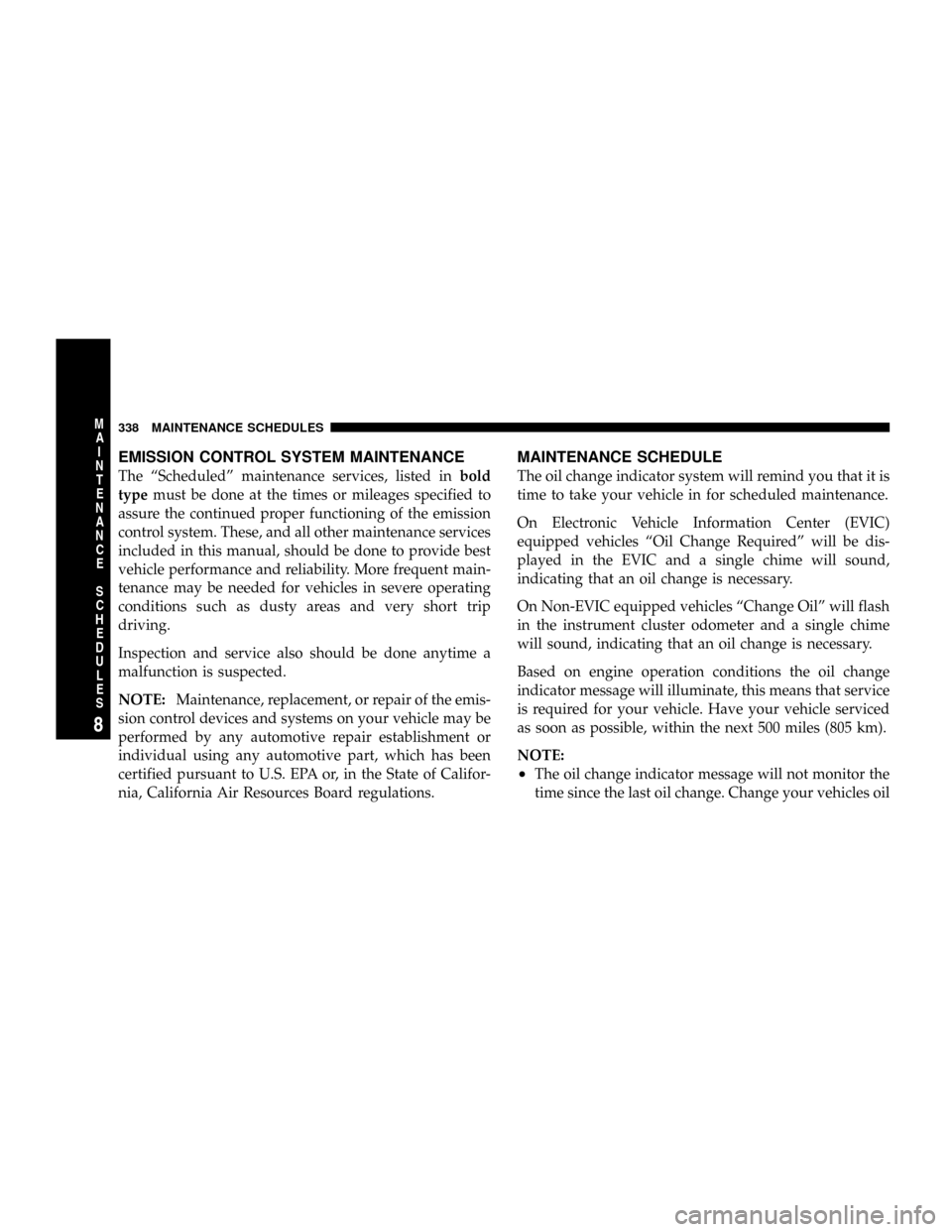
EMISSION CONTROL SYSTEM MAINTENANCE
The ªScheduledº maintenance services, listed inbold
typemust be done at the times or mileages specified to
assure the continued proper functioning of the emission
control system. These, and all other maintenance services
included in this manual, should be done to provide best
vehicle performance and reliability. More frequent main-
tenance may be needed for vehicles in severe operating
conditions such as dusty areas and very short trip
driving.
Inspection and service also should be done anytime a
malfunction is suspected.
NOTE:Maintenance, replacement, or repair of the emis-
sion control devices and systems on your vehicle may be
performed by any automotive repair establishment or
individual using any automotive part, which has been
certified pursuant to U.S. EPA or, in the State of Califor-
nia, California Air Resources Board regulations.
MAINTENANCE SCHEDULE
The oil change indicator system will remind you that it is
time to take your vehicle in for scheduled maintenance.
On Electronic Vehicle Information Center (EVIC)
equipped vehicles ªOil Change Requiredº will be dis-
played in the EVIC and a single chime will sound,
indicating that an oil change is necessary.
On Non-EVIC equipped vehicles ªChange Oilº will flash
in the instrument cluster odometer and a single chime
will sound, indicating that an oil change is necessary.
Based on engine operation conditions the oil change
indicator message will illuminate, this means that service
is required for your vehicle. Have your vehicle serviced
as soon as possible, within the next 500 miles (805 km).
NOTE:
²The oil change indicator message will not monitor the
time since the last oil change. Change your vehicles oil
338 MAINTENANCE SCHEDULES
8
M
A
I
N
T
E
N
A
N
C
E
S
C
H
E
D
U
L
E
S
Page 342 of 373
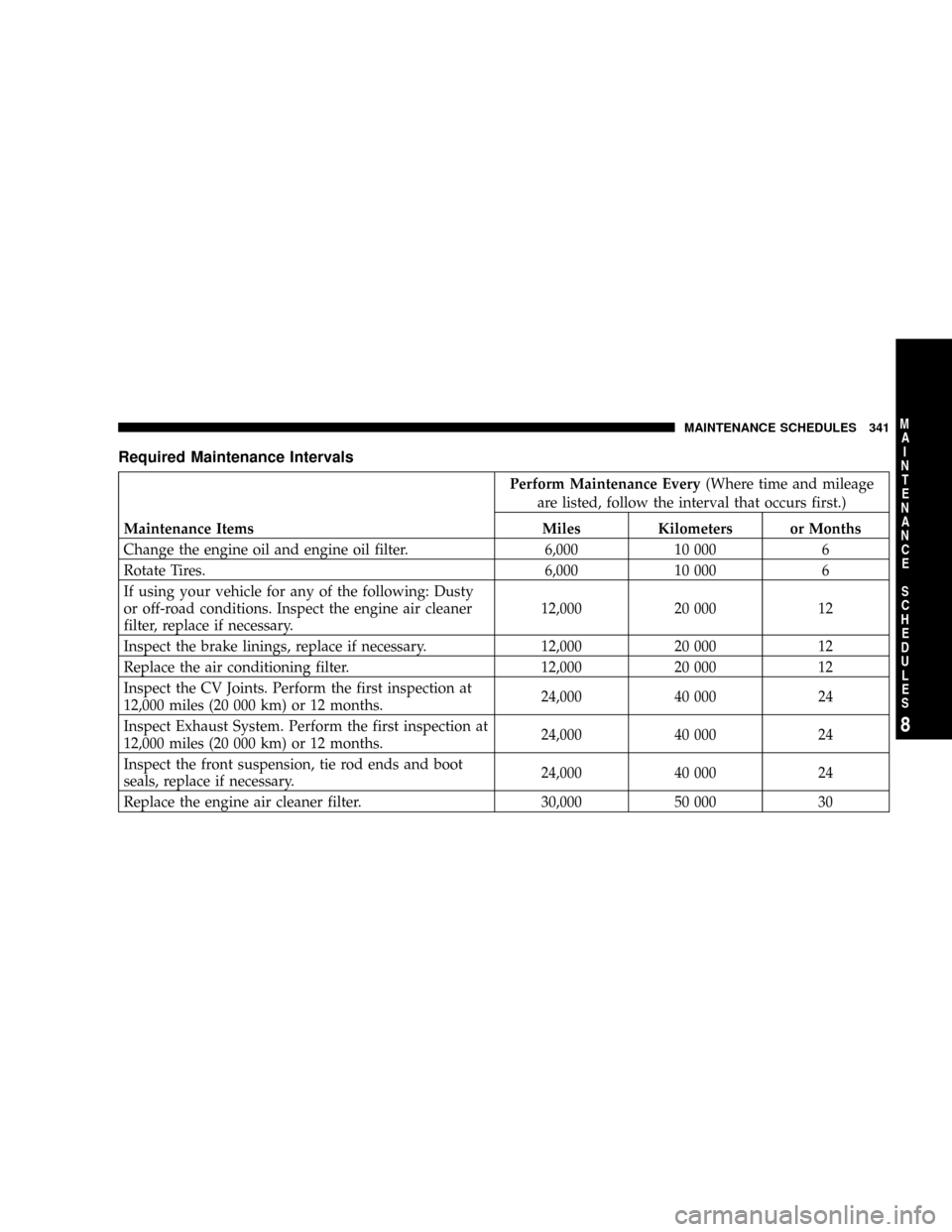
Required Maintenance Intervals
Perform Maintenance Every(Where time and mileage
are listed, follow the interval that occurs first.)
Maintenance Items Miles Kilometers or Months
Change the engine oil and engine oil filter. 6,000 10 000 6
Rotate Tires. 6,000 10 000 6
If using your vehicle for any of the following: Dusty
or off-road conditions. Inspect the engine air cleaner
filter, replace if necessary.12,000 20 000 12
Inspect the brake linings, replace if necessary. 12,000 20 000 12
Replace the air conditioning filter. 12,000 20 000 12
Inspect the CV Joints. Perform the first inspection at
12,000 miles (20 000 km) or 12 months.24,000 40 000 24
Inspect Exhaust System. Perform the first inspection at
12,000 miles (20 000 km) or 12 months.24,000 40 000 24
Inspect the front suspension, tie rod ends and boot
seals, replace if necessary.24,000 40 000 24
Replace the engine air cleaner filter. 30,000 50 000 30
MAINTENANCE SCHEDULES 341
8
M
A
I
N
T
E
N
A
N
C
E
S
C
H
E
D
U
L
E
S