transmission DODGE CALIBER SRT 2009 1.G User Guide
[x] Cancel search | Manufacturer: DODGE, Model Year: 2009, Model line: CALIBER SRT, Model: DODGE CALIBER SRT 2009 1.GPages: 411, PDF Size: 6.36 MB
Page 169 of 411
If the light turns on while driving, safely pull over and
stop the vehicle. If the A/C system is on, turn it off. Also,
shift the transmission into NEUTRAL and idle the ve-
hicle. If the temperature reading does not return to
normal, turn the engine off immediately and call for
service. Refer to “If Your Engine Overheats” in Section 6
for more information.
12. Speedometer
Indicates vehicle speed.
13. Odometer/Trip Odometer
This display indicates the total distance the vehicle has
been driven. Also, the cluster will display, replacing the
odometer/trip odometer, vehicle warning messages such
as: door/gate ajar and gASCAP (loose gas cap) and
Change Oil message.
NOTE:
If the vehicle is equipped with the optional Elec-
tronic Vehicle Information Center (EVIC) in the instrument
cluster, all warnings including “door”, and “gATE” and OilChange Required will only be displayed in the EVIC display.
For additional information, refer to “Electronic Vehicle In-
formation Center — If Equipped” in Section 3.
Change Oil Message
Your vehicle is equipped with an engine oil change
indicator system. The “Change Oil” message will flash in
the instrument cluster odometer for approximately
12 seconds after a single chime has sounded to indicate
the next scheduled oil change interval. The engine oil
change indicator system is duty cycle based, which
means the engine oil change interval may fluctuate
dependent upon your personal driving style.
Unless reset, this message will continue to display each time
you turn the ignition switch to the ON/RUN position. To
turn off the message temporarily, press and release the Trip
Odometer button on the instrument cluster. To reset the oil
change indicator system (after performing the scheduled
maintenance) refer to the following procedure.
UNDERSTANDING YOUR INSTRUMENT PANEL 167
4
Page 188 of 411
several times until “Compass Variance” is highlighted.
The “Compass Variance” message and the current vari-
ance zone number will be displayed. To change the zone,
press and hold (longer than two seconds) the EVIC
button to increment the variance one step. Repeat as
necessary, with individual long (for at least one second)
EVIC button presses for each increment, until the desired
variance is achieved. To exit the Variance Programming,
press the EVIC button with a short (less than one second)
button press.
NOTE:The factory default Zone is 8. During program-
ming, the Zone value will wrap around from Zone 15 to
Zone 1.
Compass Calibration
If the compass appears erratic or inaccurate, and the
variance has been properly set, you may wish to manu-
ally recalibrate the compass. To manually calibrate the
compass:1. Start the engine and leave the transmission in the
PARK position.
2. Using a quick button press (less than one second),
press and release the EVIC button several times until the
EVIC displays the “Personal Settings (Customer-
Programmable Features)” menu.
3. Once in the “Personal Settings (Customer-
Programmable Features)” menu, press and release (less
than one second) the EVIC button several times until
“Calibrate Compass (Yes)” is displayed.
4. Using a long button press (more than one second)
press the EVIC button, this will place the Compass in
calibration mode. The CAL indicator will come on con-
tinuously in the EVIC display to indicate that the com-
pass is now in the calibration mode, and that the vehicle
can now be driven to calibrate.
186 UNDERSTANDING YOUR INSTRUMENT PANEL
Page 256 of 411
CAUTION!
If you skip more than one gear while downshifting
or downshift at too high of a vehicle speed, you could
damage the engine, transmission, or clutch.
To maintain a safe speed and prolong brake life, shift
down to 2nd or 1st when descending a steep grade.
When turning a corner, or driving up a steep grade,
downshift early so that the engine will not be
overburdened.
DRIVING ON SLIPPERY SURFACES
Acceleration
Rapid acceleration on snow covered, wet, or other slip-
pery surfaces may cause the front wheels to pull errati-
cally to the right or left. This phenomenon occurs when
there is a difference in the surface traction under the front
(driving) wheels.
WARNING!
Rapid acceleration on slippery surfaces is dangerous.
Unequal traction can cause sudden pulling of the
front wheels. You could lose control of the vehicle
and possibly have an accident. Accelerate slowly and
carefully whenever there is likely to be poor traction
(ice, snow, wet, mud, loose sand, etc.).
Traction
When driving on wet or slushy roads, it is possible for a
wedge of water to build up between the tire and road
surface. This is hydroplaning and may cause partial or
complete loss of vehicle control and stopping ability. To
reduce this possibility, the following precautions should
be observed:
1. Slow down during rainstorms or when roads are
slushy.
254 STARTING AND OPERATING
Page 258 of 411
CAUTION!
•Always check the depth of the standing water
before driving through it. Never drive through
standing water that is deeper than the bottom of
the tire rims mounted on the vehicle.
•Determine the condition of the road or the path
that is under water and if there are any obstacles in
the way before driving through the standing wa-
ter.
•Do not exceed 5 mph (8 km/h) when driving
through standing water. This will minimize wave
effects.
(Continued)
CAUTION! (Continued)
•Driving through standing water may cause dam-
age to your vehicle’s drivetrain components. Al-
ways inspect your vehicle’s fluids (i.e., engine oil,
transmission/transaxle, axle, etc.) for signs of con-
tamination (i.e., fluid that is milky or foamy in
appearance) after driving through standing water.
Do not continue to operate the vehicle if any fluid
appears contaminated, as this may result in further
damage. Such damage is not covered by the New
Vehicle Limited Warranty.
•Getting water inside your vehicle’s engine can
cause it to lock up and stall out, and cause serious
internal damage to the engine. Such damage is not
covered by the New Vehicle Limited Warranty.
256 STARTING AND OPERATING
Page 305 of 411
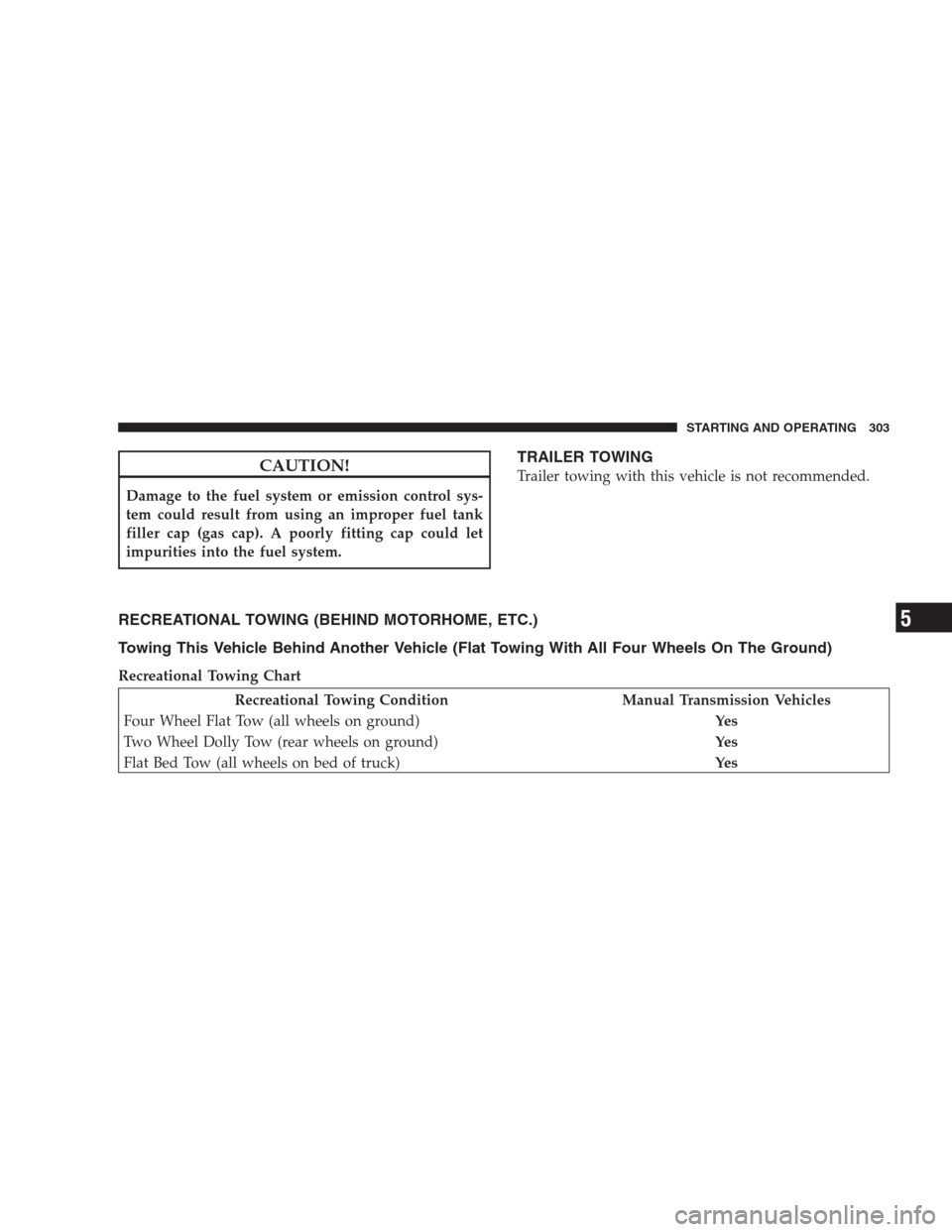
CAUTION!
Damage to the fuel system or emission control sys-
tem could result from using an improper fuel tank
filler cap (gas cap). A poorly fitting cap could let
impurities into the fuel system.
TRAILER TOWING
Trailer towing with this vehicle is not recommended.
RECREATIONAL TOWING (BEHIND MOTORHOME, ETC.)
Towing This Vehicle Behind Another Vehicle (Flat Towing With All Four Wheels On The Ground)
Recreational Towing Chart
Recreational Towing Condition Manual Transmission Vehicles
Four Wheel Flat Tow (all wheels on ground)Ye s
Two Wheel Dolly Tow (rear wheels on ground)Ye s
Flat Bed Tow (all wheels on bed of truck)Ye s
STARTING AND OPERATING 303
5
Page 306 of 411
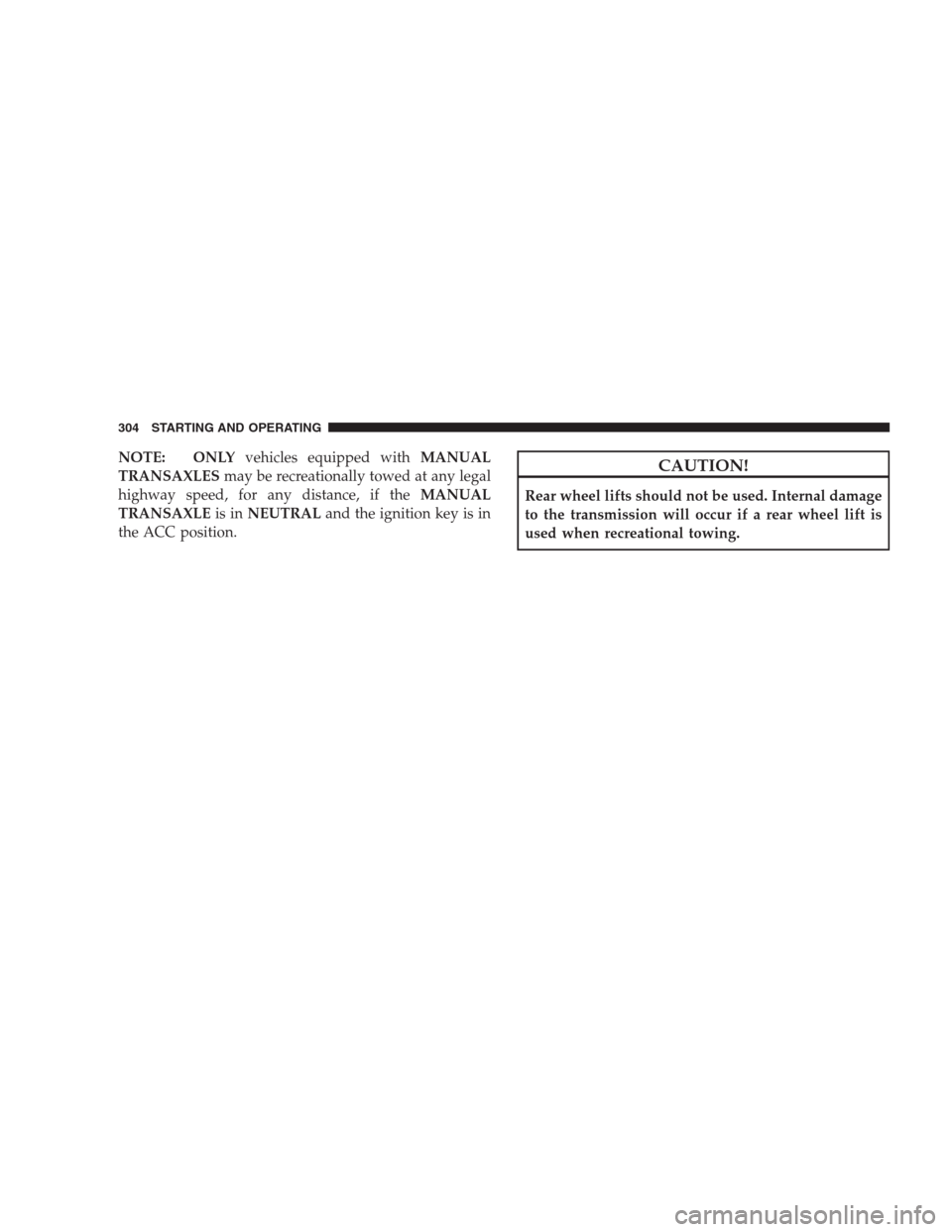
NOTE: ONLYvehicles equipped withMANUAL
TRANSAXLESmay be recreationally towed at any legal
highway speed, for any distance, if theMANUAL
TRANSAXLEis inNEUTRALand the ignition key is in
the ACC position.CAUTION!
Rear wheel lifts should not be used. Internal damage
to the transmission will occur if a rear wheel lift is
used when recreational towing.
304 STARTING AND OPERATING
Page 314 of 411
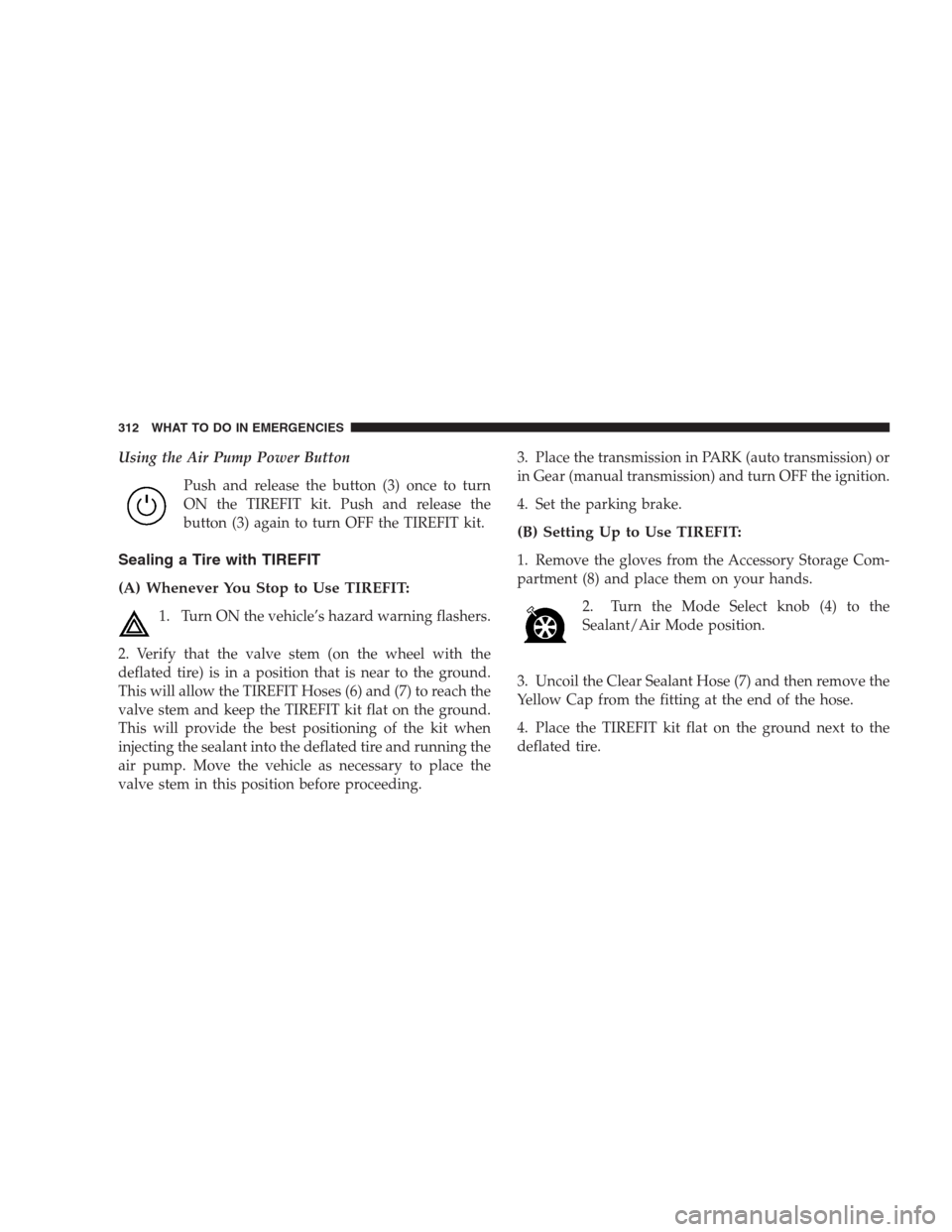
Using the Air Pump Power Button
Push and release the button (3) once to turn
ON the TIREFIT kit. Push and release the
button (3) again to turn OFF the TIREFIT kit.
Sealing a Tire with TIREFIT
(A) Whenever You Stop to Use TIREFIT:
1. Turn ON the vehicle’s hazard warning flashers.
2. Verify that the valve stem (on the wheel with the
deflated tire) is in a position that is near to the ground.
This will allow the TIREFIT Hoses (6) and (7) to reach the
valve stem and keep the TIREFIT kit flat on the ground.
This will provide the best positioning of the kit when
injecting the sealant into the deflated tire and running the
air pump. Move the vehicle as necessary to place the
valve stem in this position before proceeding.3. Place the transmission in PARK (auto transmission) or
in Gear (manual transmission) and turn OFF the ignition.
4. Set the parking brake.
(B) Setting Up to Use TIREFIT:
1. Remove the gloves from the Accessory Storage Com-
partment (8) and place them on your hands.
2. Turn the Mode Select knob (4) to the
Sealant/Air Mode position.
3. Uncoil the Clear Sealant Hose (7) and then remove the
Yellow Cap from the fitting at the end of the hose.
4. Place the TIREFIT kit flat on the ground next to the
deflated tire.
312 WHAT TO DO IN EMERGENCIES
Page 320 of 411
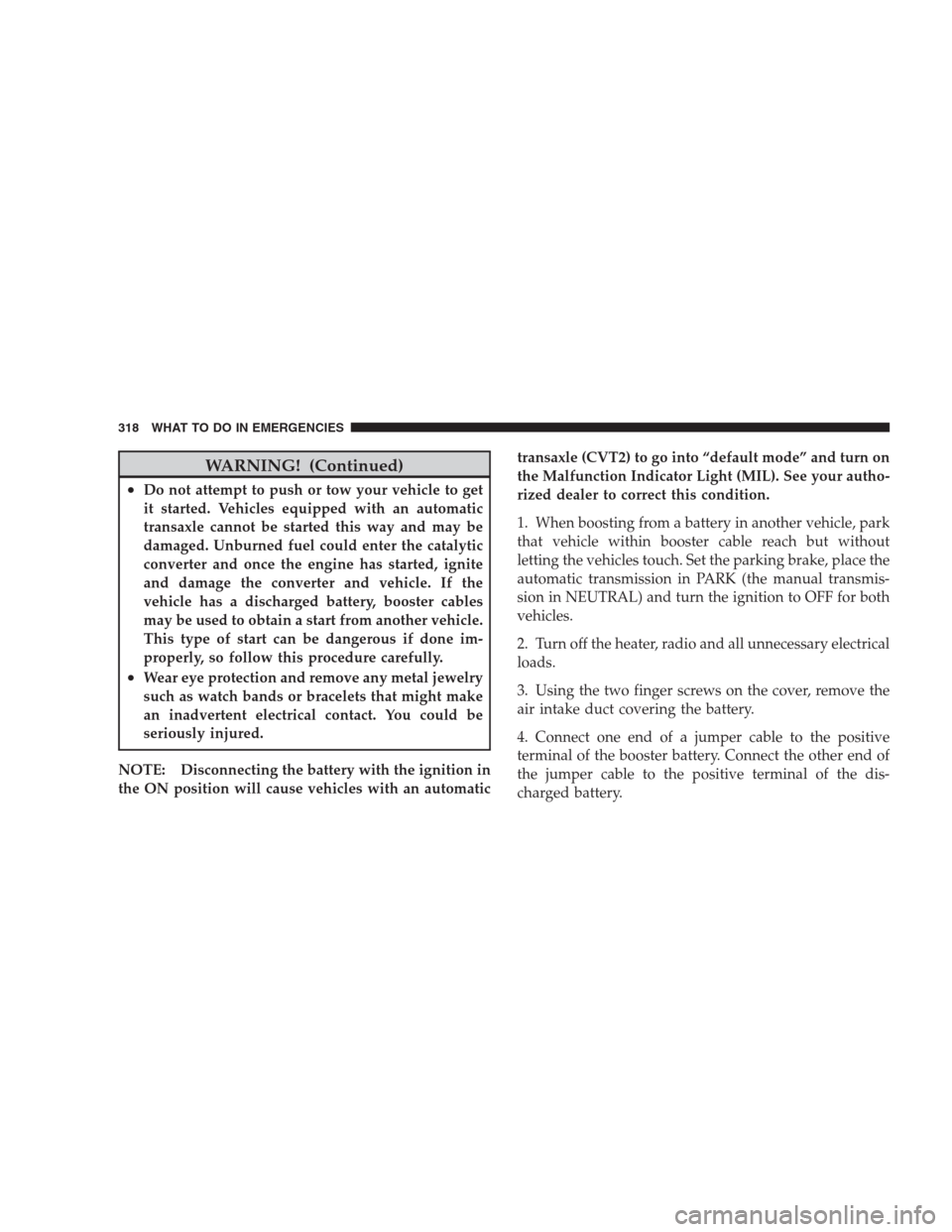
WARNING! (Continued)
•Do not attempt to push or tow your vehicle to get
it started. Vehicles equipped with an automatic
transaxle cannot be started this way and may be
damaged. Unburned fuel could enter the catalytic
converter and once the engine has started, ignite
and damage the converter and vehicle. If the
vehicle has a discharged battery, booster cables
may be used to obtain a start from another vehicle.
This type of start can be dangerous if done im-
properly, so follow this procedure carefully.
•Wear eye protection and remove any metal jewelry
such as watch bands or bracelets that might make
an inadvertent electrical contact. You could be
seriously injured.
NOTE: Disconnecting the battery with the ignition in
the ON position will cause vehicles with an automatictransaxle (CVT2) to go into “default mode” and turn on
the Malfunction Indicator Light (MIL). See your autho-
rized dealer to correct this condition.
1. When boosting from a battery in another vehicle, park
that vehicle within booster cable reach but without
letting the vehicles touch. Set the parking brake, place the
automatic transmission in PARK (the manual transmis-
sion in NEUTRAL) and turn the ignition to OFF for both
vehicles.
2. Turn off the heater, radio and all unnecessary electrical
loads.
3. Using the two finger screws on the cover, remove the
air intake duct covering the battery.
4. Connect one end of a jumper cable to the positive
terminal of the booster battery. Connect the other end of
the jumper cable to the positive terminal of the dis-
charged battery.
318 WHAT TO DO IN EMERGENCIES
Page 323 of 411
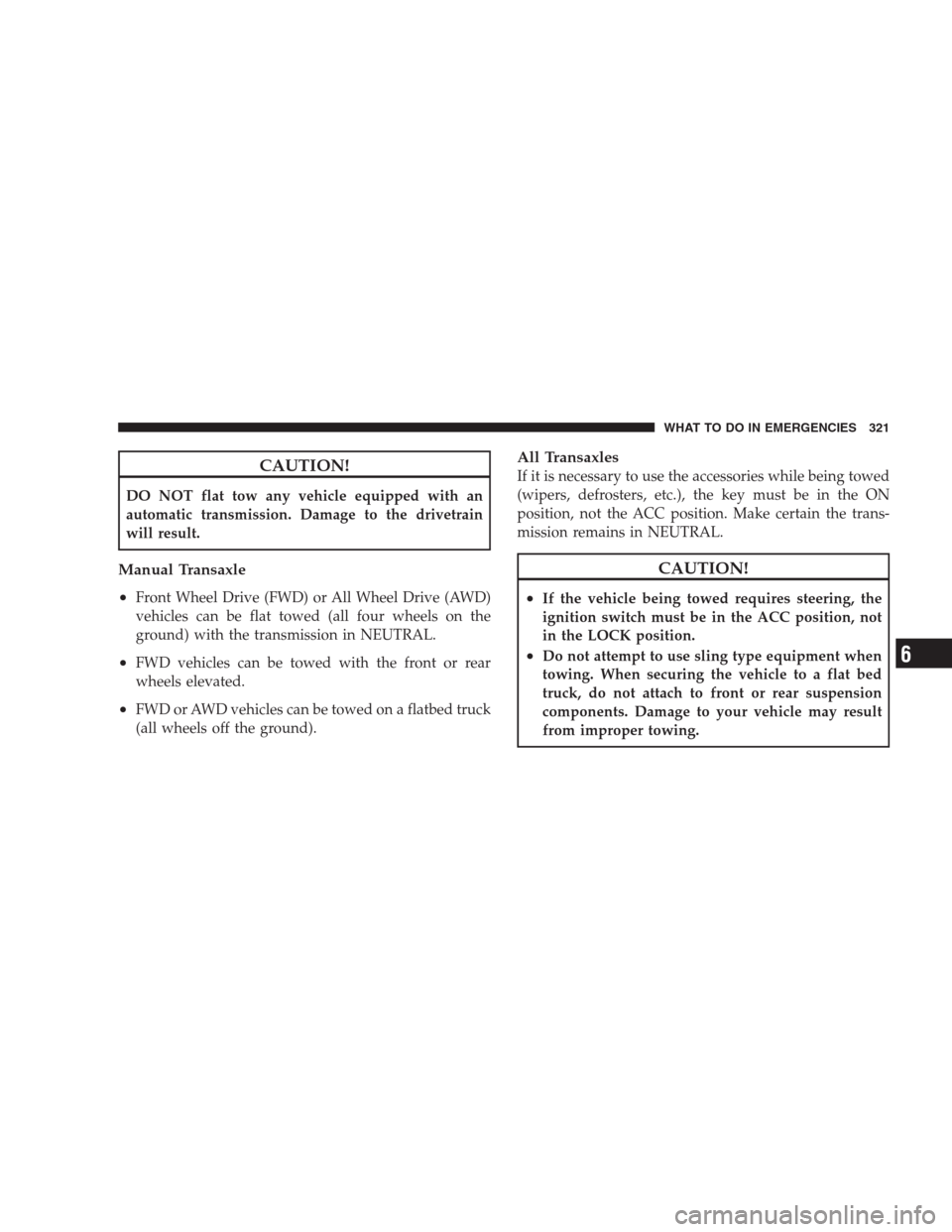
CAUTION!
DO NOT flat tow any vehicle equipped with an
automatic transmission. Damage to the drivetrain
will result.
Manual Transaxle
•
Front Wheel Drive (FWD) or All Wheel Drive (AWD)
vehicles can be flat towed (all four wheels on the
ground) with the transmission in NEUTRAL.
•FWD vehicles can be towed with the front or rear
wheels elevated.
•FWD or AWD vehicles can be towed on a flatbed truck
(all wheels off the ground).
All Transaxles
If it is necessary to use the accessories while being towed
(wipers, defrosters, etc.), the key must be in the ON
position, not the ACC position. Make certain the trans-
mission remains in NEUTRAL.
CAUTION!
•If the vehicle being towed requires steering, the
ignition switch must be in the ACC position, not
in the LOCK position.
•Do not attempt to use sling type equipment when
towing. When securing the vehicle to a flat bed
truck, do not attach to front or rear suspension
components. Damage to your vehicle may result
from improper towing.
WHAT TO DO IN EMERGENCIES 321
6
Page 324 of 411
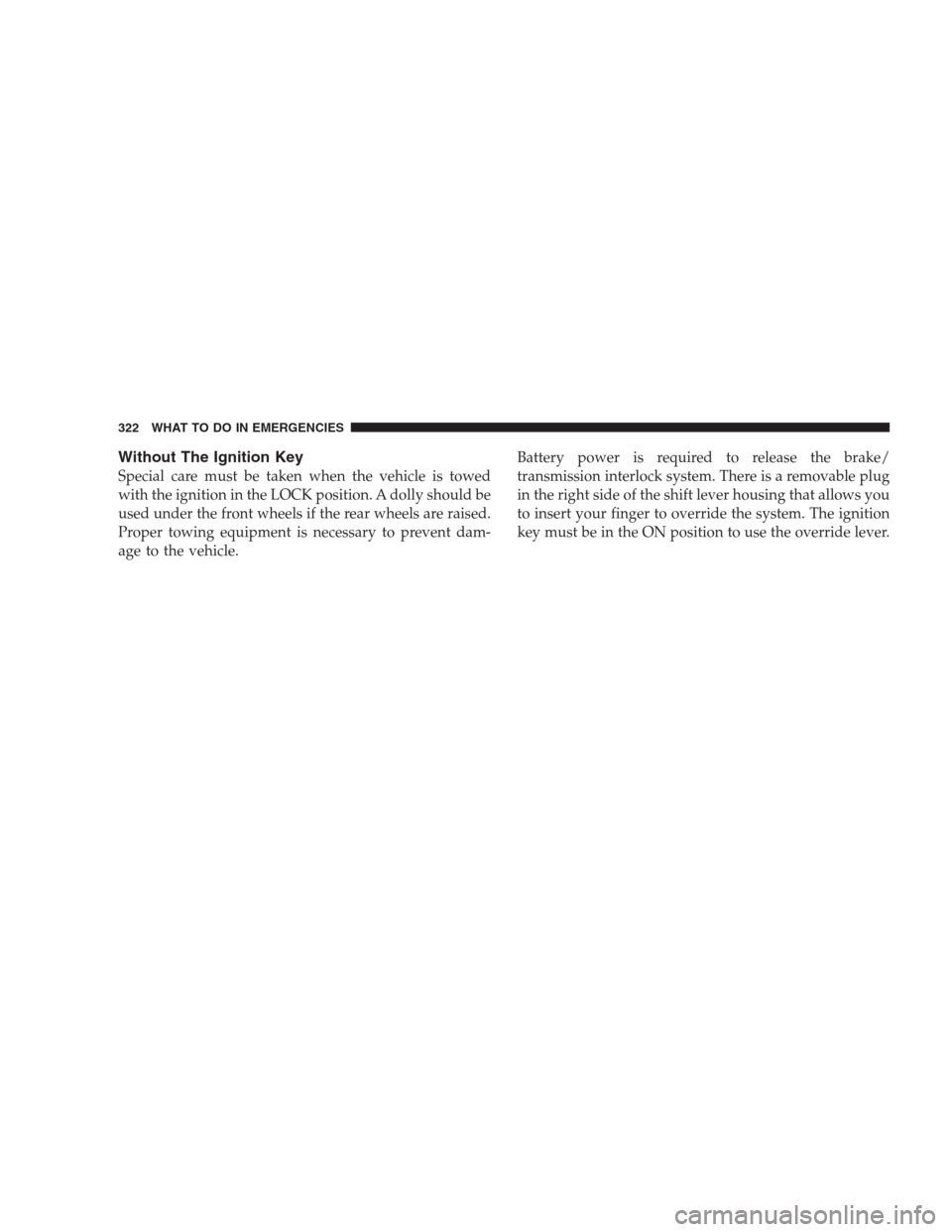
Without The Ignition Key
Special care must be taken when the vehicle is towed
with the ignition in the LOCK position. A dolly should be
used under the front wheels if the rear wheels are raised.
Proper towing equipment is necessary to prevent dam-
age to the vehicle.Battery power is required to release the brake/
transmission interlock system. There is a removable plug
in the right side of the shift lever housing that allows you
to insert your finger to override the system. The ignition
key must be in the ON position to use the override lever.
322 WHAT TO DO IN EMERGENCIES