seats DODGE CARAVAN 2004 4.G User Guide
[x] Cancel search | Manufacturer: DODGE, Model Year: 2004, Model line: CARAVAN, Model: DODGE CARAVAN 2004 4.GPages: 397, PDF Size: 6.83 MB
Page 60 of 397
child restraint anchorage system. Refer to ªLower
Anchors and Tether for CHildren (LATCH)º later in
this section.
²The belt-positioning booster seat is for children weigh-
ing more than 40 lbs (18 kg), but who are still too small
to fit the vehicle's seat belts properly. If the child can
not sit with knees bent over the vehicles seat cushion
while the child's back is against the seat back, they
should use a belt-positioning booster seat. The child
and booster seat are held in the vehicle by the lap/
shoulder belt. (Some booster seats are equipped with a
front shield and are held in the vehicle by the lap
portion.)
NOTE:For additional information refer to
www.seatcheck.org.
WARNING!
²Improper installation can lead to failure of an
infant or child restraint. It could come loose in a
collision. The child could be badly injured or
killed. Follow the manufacturer's directions ex-
actly when installing an infant or child restraint.
²A rearward facing child restraint should only be
used in a rear seat. A rearward facing child re-
straint in the front seat may be struck by a
deploying passenger airbag which may cause se-
vere or fatal injury to the infant.
60 THINGS TO KNOW BEFORE STARTING YOUR VEHICLE
Page 62 of 397

²Buckle the child into the seat according to the child
restraint manufacturer's directions.
²When your child restraint is not in use, secure it in the
vehicle with the seat belt or remove it from the vehicle.
Don't leave it loose in the vehicle. In a sudden stop or
collision, it could strike the occupants or seatbacks and
cause serious personal injury.
Lower Anchors and Tether for CHildren (LATCH)
Each vehicle, except commercial cargo vehicles, is
equipped with the child restraint anchorage system
called LATCH, which stands for Lower Anchors and
Tether for CHildren. Two LATCH child restraint anchor-
age systems are installed on all second-row seats. Second-
row seats also feature tether strap anchorages, located in
the rear surface of the seatback. In addition, all
3-passenger bench seats are equipped with a child re-
straint tether anchor at the center seating position.When using the tether anchorages in the outboard seat-
ing positions, ensure that the strap is routed over the top
of the seatback and under the head restraint between the
head restraint posts. When the tether anchorage is used
in the center seating position, the strap should be posi-
tioned straight over the top of the seatback.
62 THINGS TO KNOW BEFORE STARTING YOUR VEHICLE
Page 65 of 397
In general, you will first loosen the adjusters on the lower
straps and tether straps so that you can more easily attach
the hook or connector to the lower anchorages and tether
anchorages. Then tighten all three straps as you push the
child restraint rearward and downward into the seat.
Not all child restraint systems will be installed as we
have described here. Again, carefully follow the instruc-
tions that come with the child restraint system.
WARNING!
Improper installation of a child restraint to the
LATCH anchorages can lead to failure of an infant or
child restraint. The child could be badly injured or
killed. Follow the manufacturer's directions exactly
when installing an infant or child restraint.
Children Too Large For Booster Seats
Children who are large enough to wear the shoulder belt
comfortably, and whose legs are long enough to bend
over the front of the seat when their back is against the
seatback, should use the lap/shoulder belt in a rear seat.
²Make sure that the child is upright in the seat.
²The lap portion should be low on the hips and as snug
as possible.
²Check belt fit periodically. A child's squirming or
slouching can move the belt out of position.
²If the shoulder belt contacts the face or neck, move the
child closer to the center of the vehicle. If this doesn't
help, move the child to the center rear seating position
and use the lap belt. Never allow a child to put the
shoulder belt under an arm or behind their back.
THINGS TO KNOW BEFORE STARTING YOUR VEHICLE 65
2
Page 66 of 397
Transporting Pets
Airbags deploying in the front seat could harm your pet.
An unrestrained pet could be thrown about and possibly
injured, or injure a passenger during panic braking or in
a collision.
Pets should be restrained in the rear seat in pet harnesses
or pet carriers that are secured by seat belts.
REAR SEAT DELETE FEATURE (COMMERCIAL
VEHICLES ONLY) Ð IF EQUIPPED
Commercial cargo vehicles are not designed for use as a
family vehicle and are not intended for carrying children
in the front passenger seat. However, if you must carry a
child in a vehicle without a rear seat, the passenger seat
should be moved to the full rearward position and the
child must be in a proper restraint system based on it's
age, size and weight. NEVER carry a child in a rear facinginfant carrier in a vehicle without rear seats. In an
accident, serious injury or death may occur from the
deploying passenger air bag.
This vehicle is equipped with a child restraint tether
anchor located on the floor, behind the front passenger
seat.Use this tether anchor to secure only forward
facing child restraints equipped with an upper tether
strap.WARNING!
Rear Facing Infant restraints must never be secured
in the passenger seat of a vehicle with a passenger
airbag. In an accident a passenger airbag may deploy
causing severe injury or death to infants riding in
rear facing infant restraints.
66 THINGS TO KNOW BEFORE STARTING YOUR VEHICLE
Page 67 of 397
Restraining Infants and Small Children with Seat
Delete Feature (Commercial Vehicles Only)
There are different sizes and types of restraints for
children from newborn size to the child almost large
enough for an adult safety belt. Use the restraint that is
correct for your child:
²The rearward-facing infant carrier is for babies weigh-
ing up to about 20 lbs (9 kg), and less than one year
old. THIS TYPE OF SEAT CANNOT BE USED IN A
VEHICLE EQUIPPED WITH THE REAR SEAT DE-
LETE FEATURE (Commercial Vehicles Only).
²The forward-facing child seat is for children from
about 20 to 40 lbs (9 to 18 kg), and more than one year
old.
²A ªconvertibleº child seat, one that is designed to be
used for children who are too heavy for a rear facing
infant seat, may be used IN THE FORWARD FACING
POSITION ONLY, IT MUST NEVER BE INSTALLEDFACING TO THE REAR IN A VEHICLE EQUIPPED
WITH THE REAR SEAT DELETE FEATURE (Com-
mercial Vehicles Only). When a convertible seat is
properly installed forward facing, the vehicle seat
should be adjusted to therear most position.
²Children more than 40 lbs (18 kg) should be secured in
the passenger seat in a child restraint or belt-
positioning booster seat with the seat adjusted to the
rear most position. Older children who do not use
child restraints or belt-positioning booster seats
should ride properly buckled in the passenger seat
with the seat adjusted to the rear most position. Never
allow children to slide the shoulder belt behind them
or under their arm.
Tether Installation For Commercial Vehicles With
Rear Seat Delete
To secure the child restraint upper tether strap to the
vehicle, follow the instructions shown:
THINGS TO KNOW BEFORE STARTING YOUR VEHICLE 67
2
Page 73 of 397

UNDERSTANDING THE FEATURES OF YOUR VEHICLE
CONTENTS
mMirrors...............................77
NInside Day/Night Mirror.................77
NAutomatic Dimming Mirror Ð If Equipped....77
NDriver's Side Outside Mirror Auto
Dimmer Ð If Equipped..................78
NExterior Mirrors Folding Feature...........78
NOutside Mirror Ð Driver's Side............78
NOutside Mirror Ð Passenger's Side..........78
NPower Remote-Control Mirrors Ð If
Equipped............................79NHeated Remote Control Mirrors Ð If
Equipped............................80
NIlluminated Vanity Mirrors Ð If Equipped....80
mSeats.................................80
NManual Front Seat Adjuster...............80
N8±Way Driver's Power Seat Ð If Equipped....81
N4±Way Passenger's Power Seat Ð If Equipped . .81
NAdjustable Head Restraints Ð If Equipped....82
NHeated Seats Ð If Equipped..............82
3
Page 74 of 397

NManual Reclining Seats Ð If Equipped.......83
NManual Lumbar Ð If Equipped............84
NMiddle Rear Bench Seat Recline Ð If
Equipped............................84
NMiddle Quad Fold & Tumble Seating........85
NMiddle Quad Fold & Tumble Seat Removal....86
N50/50 Fold & Tumble Rear Seat Removal.....88
N2 ± Passenger And 3 ± Passenger Bench Seats . .90
NPlastic Grocery Bag Retainer..............91
NRear-Most Bench Seat...................92
NRear Seat Descriptions...................92
NRear Bench Seating Flexibility.............92
NRear Quad And 50/50 Seating Flexibility.....94mTo Open And Close The Hood..............96
mLights................................98
NInterior Lights........................98
NPark Lights...........................99
NHeadlights...........................99
NAutomatic Headlights Ð If Equipped.......100
NDaytime Running Lights (Canada/Fleet
Vehicles Only).......................101
NLights-On Reminder...................101
NBattery Protection.....................101
NHeadlight Time Delay Ð If Equipped.......101
NFront Fog Lights Ð If Equipped...........102
mMultifunction Lever.....................102
74 UNDERSTANDING THE FEATURES OF YOUR VEHICLE
Page 80 of 397

Heated Remote Control Mirrors Ð If Equipped
These mirrors are heated to melt frost or ice. This feature
is activated whenever you turn on the Rear Window
Defrost.
Illuminated Vanity Mirrors Ð If Equipped
An illuminated vanity mirror is on the sun visor. To use
the mirror, rotate the sun visor down and swing the
mirror cover upward. The lights turn on automatically.
Closing the mirror cover turns off the lights.
Sun Visor Extension Ð If Equipped
This feature has a pull out extension on the sun visor for
increased coverage.
SEATS
Manual Front Seat Adjuster
The adjusting bar is located under the front of the seat.
Pull the bar up and move the seat to the desired position.
Release the bar to lock the seat into position.
Using body pressure, move forward and rearward on the
seat to be sure the seat adjusters have latched.
80 UNDERSTANDING THE FEATURES OF YOUR VEHICLE
Page 82 of 397
CAUTION!
Do not place any article under a power seat or
impede its ability to move as it may cause damage to
the seat controls. Seat travel may become limited if
movement is stopped by an obstruction in the seat's
path.
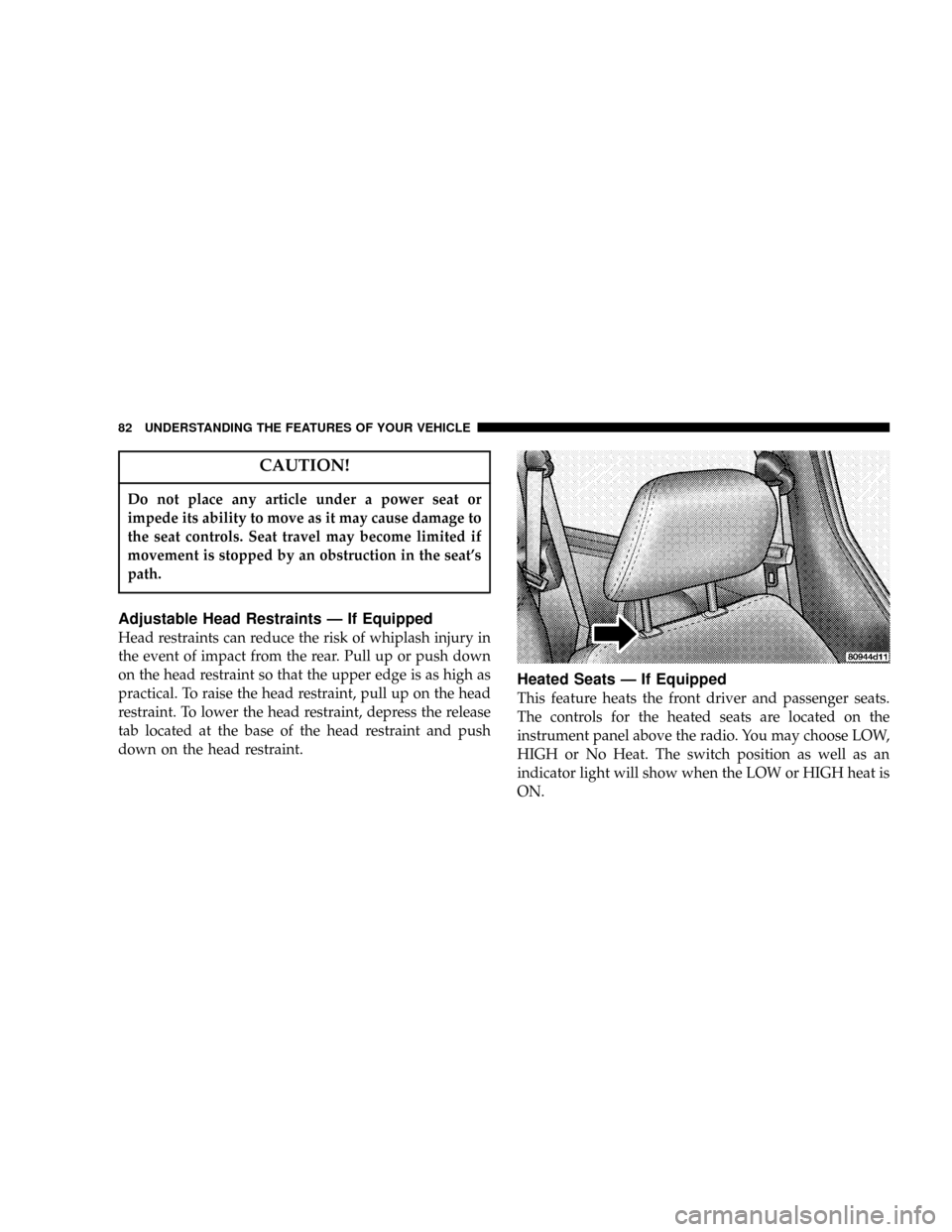
Adjustable Head Restraints Ð If Equipped
Head restraints can reduce the risk of whiplash injury in
the event of impact from the rear. Pull up or push down
on the head restraint so that the upper edge is as high as
practical. To raise the head restraint, pull up on the head
restraint. To lower the head restraint, depress the release
tab located at the base of the head restraint and push
down on the head restraint.
Heated Seats Ð If Equipped
This feature heats the front driver and passenger seats.
The controls for the heated seats are located on the
instrument panel above the radio. You may choose LOW,
HIGH or No Heat. The switch position as well as an
indicator light will show when the LOW or HIGH heat is
ON.
82 UNDERSTANDING THE FEATURES OF YOUR VEHICLE
Page 83 of 397

Manual Reclining Seats Ð If Equipped
The recliner mechanism control is on the outboard side of
the seat. To recline, lean forward slightly, lift the lever,
then push back to the desired position and release the
lever. Lean forward and lift the lever to return theseatback to its normal position. Using body pressure, lean
forward and rearward on the seat to be sure the seatback
has latched.
UNDERSTANDING THE FEATURES OF YOUR VEHICLE 83
3