ECU DODGE CARAVAN 2004 4.G Owner's Manual
[x] Cancel search | Manufacturer: DODGE, Model Year: 2004, Model line: CARAVAN, Model: DODGE CARAVAN 2004 4.GPages: 397, PDF Size: 6.83 MB
Page 274 of 397

Figure out the weight on the front and rear of the vehicle
separately. It is important that you distribute the load
evenly over the front and rear axles.
Overloading can cause potential safety hazards and
shorten useful service life. Heavier axles or suspension
components do not necessarily increase the vehicle's
GVWR.
Loading
To load your vehicle properly, first figure out its empty
weight, axle by axle and side by side. Store heavier items
down low and be sure you distribute their weight as
evenly as possible. Stow all loose items securely before
driving. If weighing the loaded vehicle shows that you
have exceeded either GAWR, but the total load is within
the specified GVWR, you must redistribute the weight.
Improper weight distribution can have an adverse effect
on the way your vehicle steers and handles and the way
the brakes operate.A loaded vehicle is shown in the illustration. Note that
neither the GVWR or the GAWR capacities have been
exceeded.
274 STARTING AND OPERATING
Page 286 of 397
properly engaged in the described location.Do not raise
the vehicle until you are sure the jack is securely
engaged.
5. Raise the vehicle by turning the jack screw to the right,
using the swivel wrench. Raise the vehicle only until the
tire just clears the surface and enough clearance is
obtained to install the spare tire. Minimum tire lift
provides maximum stability.
WARNING!
Raising the vehicle higher than necessary can make
the vehicle less stable. It could slip off the jack and
hurt someone near it. Raise the vehicle only enough
to remove the tire.
6. Remove the wheel lug nuts, for vehicles with wheel
covers, remove the cover from the wheel by hand. Do not
pry the wheel cover off. Then pull the wheel off the hub.7. Install the spare wheel, for vehicles with wheel covers,
align the notch in the wheel cover with the valve stem on
the wheel. Install the cover on the wheel by hand only
and install the wheel lug nuts with the cone shaped end
of the nut toward the wheel. Lightly tighten the nuts. To
avoid the risk of forcing the vehicle off the jack, do not
tighten the lug nuts fully until the vehicle has been
lowered.
NOTE:Do not install the wheel cover on the compact
spare.
Do not use a hammer or force to install the wheel covers.
8. Lower the vehicle by turning the jack screw to the left.
9. Finish tightening the lug nuts. Push down on the
wrench while tightening for increased leverage. Alternate
nuts until each nut has been tightened twice. Correct
wheel nut tightness is 130 N´m (95 ft. lbs). If in doubt
286 WHAT TO DO IN EMERGENCIES
Page 287 of 397
about the correct tightness, have them checked with a
torque wrench by your dealer or at a service station.
10. Lower the jack to its fully closed position.
WARNING!
A loose tire or jack, thrown forward in a collision or
hard stop could endanger the occupants of the ve-
hicle. Always stow the jack parts and the spare tire in
the places provided.
11. Secure the flat or spare tire as follows:
²If your vehicle is equipped with cast aluminum
wheels, the center cap of the wheel must be re-
moved prior to flat tire stowage. Store the center cap
inside the glove box or other storage compartment.
²Turn the wheel so that the valve-stem is down. Slide
the wheel retainer through the center of the wheel
and position it properly across the wheel opening.
²For convenience in checking the spare tire inflation,
stow with the valve-stem toward the rear of the
vehicle.
²Using the jack-handle, rotate the drive nut to the
right until the wheel is drawn into place against the
underside of the vehicle.
²Continue to rotate the nut until you hear the mecha-
nism click three times. It cannot be overtightened.
Push against the tire several times to be sure it is
securely in place.
12. Stow jack and handle.
13. Check the tire pressure as soon as possible. Correct
pressure as required.
WHAT TO DO IN EMERGENCIES 287
6
Page 323 of 397
Insure nylon tubing in these areas has not melted or
collapsed.
Inspect all hose connections such as clamps and cou-
plings to make sure they are secure and no leaks are
present.
Components should be replaced immediately if there is
any evidence of wear or damage that could cause failure.
Brakes
In order to assure brake system performance, all brake
system components should be inspected periodically.
Suggested service intervals can be found in the Mainte-
nance Schedules.
WARNING!
Riding the brakes can lead to brake failure and
possibly an accident. Driving with your foot resting
or riding on the brake pedal can result in abnormally
high brake temperatures, excessive lining wear, and
possible brake damage. You wouldn't have your full
braking capacity in an emergency.
Brake And Power Steering Hoses
When the vehicle is serviced for scheduled maintenance,
inspect surface of hoses and nylon tubing for evidence of
heat and mechanical damage. Hard and brittle rubber,
cracking, tears, cuts, abrasion, and excessive swelling
indicate deterioration of the rubber. Particular attention
should be made to examining those hose surfaces nearest
to high heat sources, such as the exhaust manifold.
MAINTAINING YOUR VEHICLE 323
7
Page 324 of 397
Insure nylon tubing in these areas has not melted or
collapsed.
Inspect all hose connections such as clamps and cou-
plings to make sure they are secure and no leaks are
present.
NOTE:Often, fluid such as oil, power steering fluid,
and brake fluid are used during assembly plant opera-
tions to facilitate the assembly of hoses to couplings.
Therefore, oil wetness at the hose-coupling area is not
necessarily an indication of leakage. Actual dripping of
hot fluid when systems are under pressure (during
vehicle operation), should be noted before hose is re-
placed based on leakage.
NOTE:Inspection of brake hoses should be performed
whenever the brake system is serviced and every engine
oil change. Inspect hydraulic brake hoses for surface
cracking, scuffing, or worn spots. If there is any evidence
of cracking, scuffing, or worn spots, the hose should bereplaced immediately! Eventual deterioration of the hose
can take place resulting in a possibility of a burst failure.
WARNING!
Worn brake hoses can burst and cause brake failure.
You could have an accident. If you see any signs of
cracking, scuffing, or worn spots, have the brake
hoses replaced immediately.
Master Cylinder Ð ABS Brakes Brake Fluid Level
Check
The fluid level in the master cylinder should be checked
when performing underhood services, or immediately if
the brake system warning light indicates system failure.
Clean the top of the master cylinder area before removing
the cap. Add fluid to bring the level up to the top of the
ªFULLº mark on the side of the master cylinder reservoir.
324 MAINTAINING YOUR VEHICLE
Page 339 of 397

BULB REPLACEMENT
Headlights
1. Remove the three screws securing the headlight mod-
ule.
2. Turn the bulb socket retaining ring counterclockwise.3. Disconnect the electrical connector and replace the
bulb.
MAINTAINING YOUR VEHICLE 339
7
Page 340 of 397
CAUTION!
Do not touch the new bulb with your fingers. Oil
contamination will severely shorten bulb life. If the
bulb comes in contact with an oily surface, clean the
bulb with rubbing alcohol.
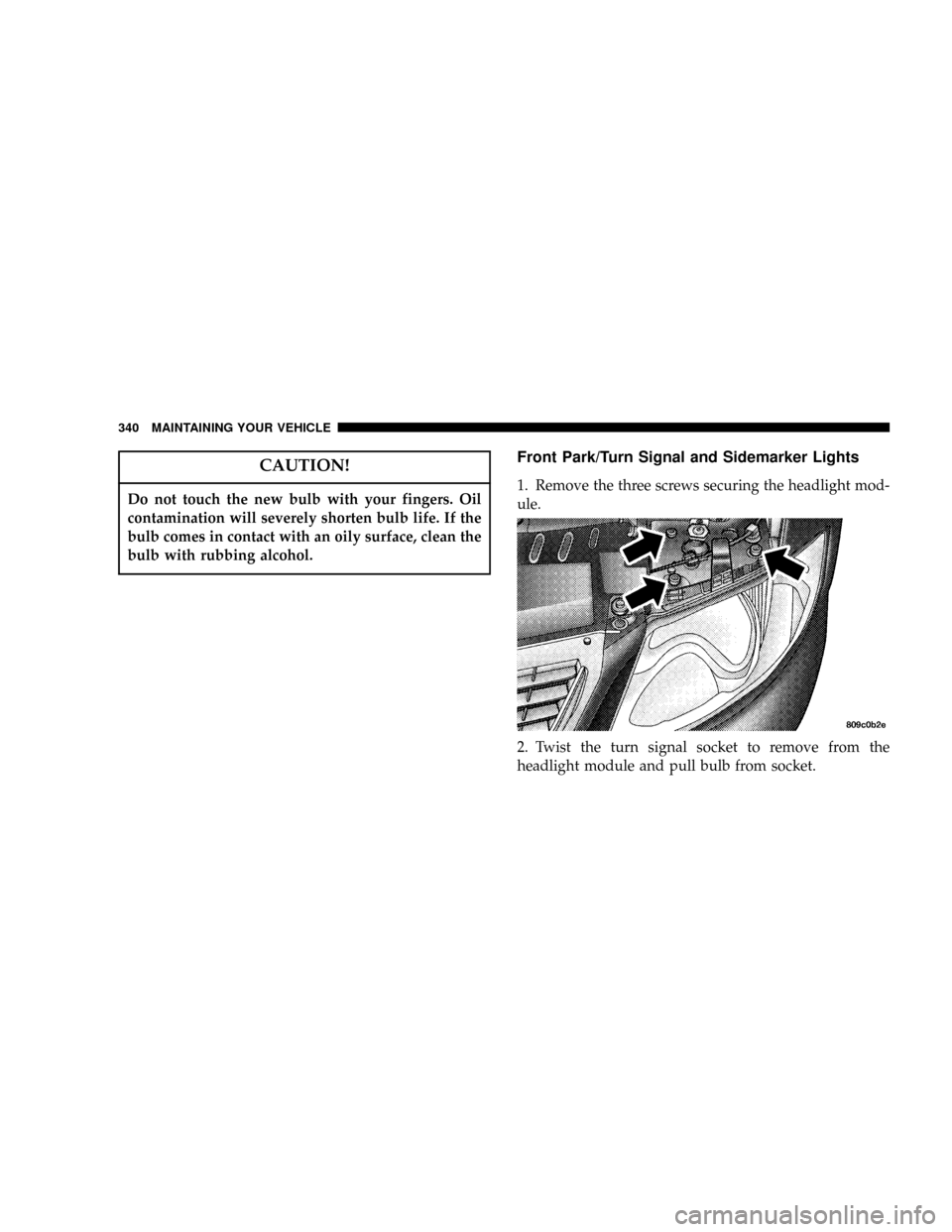
Front Park/Turn Signal and Sidemarker Lights
1. Remove the three screws securing the headlight mod-
ule.
2. Twist the turn signal socket to remove from the
headlight module and pull bulb from socket.
340 MAINTAINING YOUR VEHICLE
Page 343 of 397
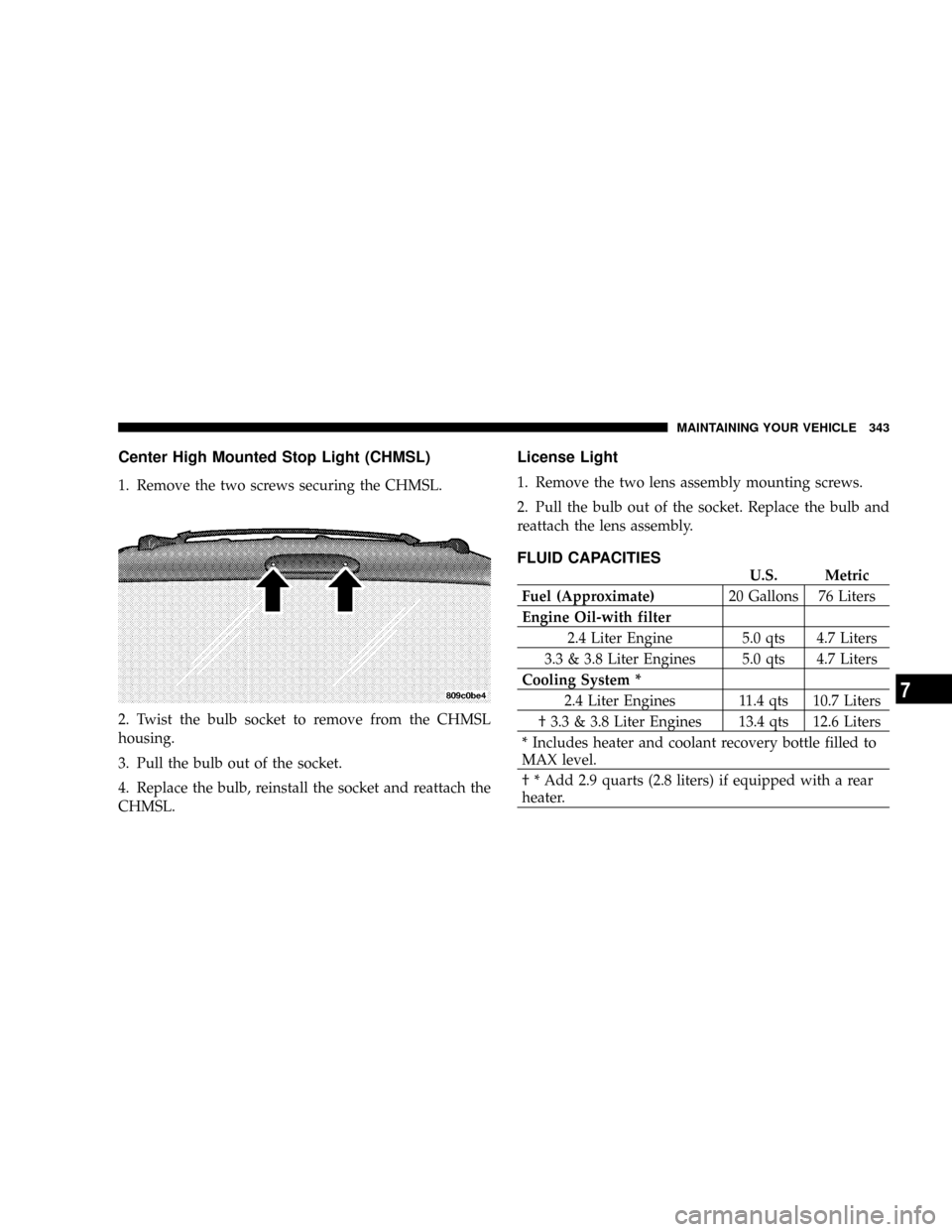
Center High Mounted Stop Light (CHMSL)
1. Remove the two screws securing the CHMSL.
2. Twist the bulb socket to remove from the CHMSL
housing.
3. Pull the bulb out of the socket.
4. Replace the bulb, reinstall the socket and reattach the
CHMSL.
License Light
1. Remove the two lens assembly mounting screws.
2. Pull the bulb out of the socket. Replace the bulb and
reattach the lens assembly.
FLUID CAPACITIES
U.S. Metric
Fuel (Approximate)20 Gallons 76 Liters
Engine Oil-with filter
2.4 Liter Engine 5.0 qts 4.7 Liters
3.3 & 3.8 Liter Engines 5.0 qts 4.7 Liters
Cooling System *
2.4 Liter Engines 11.4 qts 10.7 Liters
² 3.3 & 3.8 Liter Engines 13.4 qts 12.6 Liters
* Includes heater and coolant recovery bottle filled to
MAX level.
² * Add 2.9 quarts (2.8 liters) if equipped with a rear
heater.
MAINTAINING YOUR VEHICLE 343
7
Page 382 of 397

Adding Fuel........................... 270
Adding Washer Fluid..................221,316
Additives, Fuel......................... 268
Adjustable Pedals....................... 106
Air Conditioner Maintenance............... 312
Air Conditioning.....................199,203
Air Conditioning Controls................. 199
Air Conditioning Filter.................219,313
Air Conditioning, Operating Tips............ 218
Air Conditioning, Rear Zone.............206,214
Air Conditioning Refrigerant............... 312
Air Conditioning System..........199,203,208,312
Air Conditioning System, Zone Control........ 200
Air Pressure, Tires....................... 252
Airbag................................ 48
Airbag Deployment....................... 55
Airbag Light.....................52,57,72,152
Airbag Maintenance....................... 57
Airbag, Side............................ 54Alarm Light........................... 154
Alarm System........................... 26
Alignment and Balance................... 258
All Wheel Drive...................235,259,329
Alterations/Modifications, Vehicle............. 7
Antifreeze Disposal...................... 321
Antifreeze (Engine Coolant)..............319,320
Anti-Lock Brake System................... 237
Anti-Lock Warning Light.................. 153
Anti-Theft Security Alarm.................. 26
Appearance Care........................ 330
Ashtray............................... 130
Auto Down Power Windows................ 37
Automatic Dimming Mirror................. 77
Automatic Door Locks..................... 19
Automatic Headlights.................... 100
Automatic Temperature Control............. 208
Automatic Transaxle...................231,326
Adding Fluid......................... 345
382 INDEX
Page 390 of 397

Malfunction Indicator................... 155
Oil Pressure.......................... 155
Park.............................99,340
Passing............................. 103
Reading............................. 110
Rear Servicing........................ 342
Rear Tail............................ 342
Seat Belt Reminder..................... 153
Security Alarm........................ 154
Service...........................338,339
Service Engine Soon.................... 155
Side Marker.......................... 342
Theft Alarm.......................... 154
Turn Signal.....................102,340,342
Voltage............................. 153
Washer Fluid......................... 155
Load Leveling System.................... 141
Loading Vehicle...................135,272,274
Capacities........................... 274Tires ............................... 247
Locks
Door................................ 17
Lower Anchors and Tether for CHildren (LATCH) . 62
Lubrication, Body....................... 315
Luggage Rack.......................... 139
Lumbar Support......................... 84
Maintenance Free Battery.................. 311
Maintenance Procedures................... 303
Maintenance Schedule.................... 348
Light Duty Schedule9A9................. 363
Light Duty Schedule9B9................. 351
Schedule9A9......................... 363
Schedule9B9.......................... 351
Malfunction Indicator Light..............155,301
Manual, Service......................... 376
Mini-Trip Computer...................... 114
Mirrors................................ 77
390 INDEX