ignition DODGE CARAVAN 2008 5.G Owners Manual
[x] Cancel search | Manufacturer: DODGE, Model Year: 2008, Model line: CARAVAN, Model: DODGE CARAVAN 2008 5.GPages: 531, PDF Size: 7.72 MB
Page 377 of 531
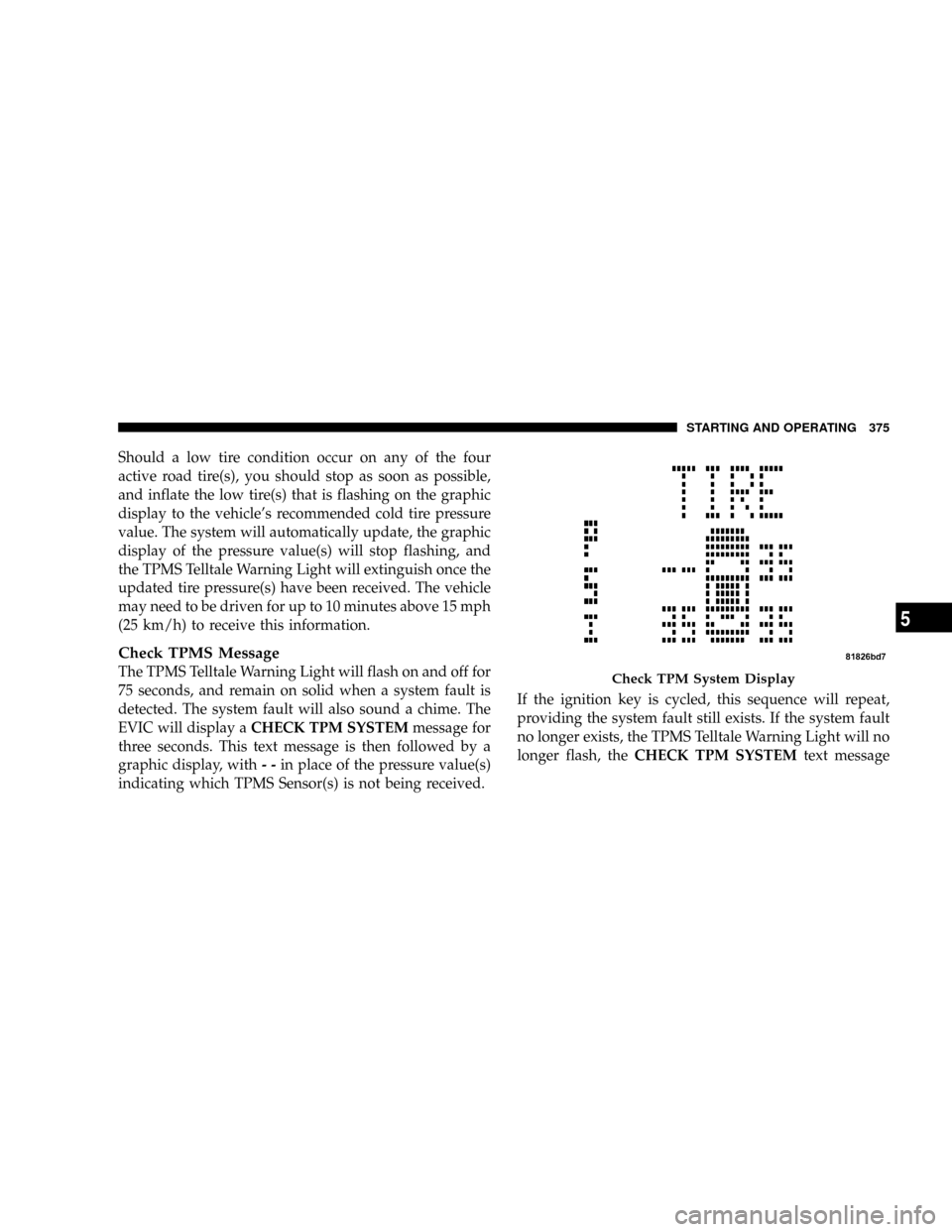
Should a low tire condition occur on any of the four
active road tire(s), you should stop as soon as possible,
and inflate the low tire(s) that is flashing on the graphic
display to the vehicle's recommended cold tire pressure
value. The system will automatically update, the graphic
display of the pressure value(s) will stop flashing, and
the TPMS Telltale Warning Light will extinguish once the
updated tire pressure(s) have been received. The vehicle
may need to be driven for up to 10 minutes above 15 mph
(25 km/h) to receive this information.
Check TPMS Message
The TPMS Telltale Warning Light will flash on and off for
75 seconds, and remain on solid when a system fault is
detected. The system fault will also sound a chime. The
EVIC will display aCHECK TPM SYSTEMmessage for
three seconds. This text message is then followed by a
graphic display, with--in place of the pressure value(s)
indicating which TPMS Sensor(s) is not being received.If the ignition key is cycled, this sequence will repeat,
providing the system fault still exists. If the system fault
no longer exists, the TPMS Telltale Warning Light will no
longer flash, theCHECK TPM SYSTEMtext messageCheck TPM System Display
STARTING AND OPERATING 375
5
Page 378 of 531
will not be present, and a pressure value will be dis-
played instead of dashes. A system fault can occur by any
of the following scenarios:
1. Jamming due to electronic devices or driving next to
facilities emitting the same radio frequencies as the TPMS
sensors.
2. Installing some form of aftermarket window tinting
that affects radio wave signals.
3. Accumulation of excessive snow and/or ice around
the wheels or wheel housings.
4. Using tire chains on the vehicle.
5. Using wheels/tires not equipped with TPMS sensors.
NOTE:
1. The compact spare tire (if equipped) does not have a
TPMS. Therefore, the TPMS will not monitor the pressure
in the compact spare tire.2. If you install the compact spare tire in place of a road
tire that has a pressure below the low-pressure warning
limit, upon the next ignition key cycle, the TPMS Telltale
Warning Light will remain on, a chime will sound, and
the EVIC will still display a flashing pressure value in the
graphic display.
3. After driving the vehicle for up to 10 minutes above 15
mph (25 km/h), the TPMS Telltale Warning Light will
flash on and off for 75 seconds and then remain on solid.
In addition, the EVIC will display a9CHECK TPM
SYSTEM9message for three seconds and then display
dashes (- -) in place of the pressure value.
4. For each subsequent ignition key cycle, a chime will
sound, the TPMS Telltale Warning Light will flash on and
off for 75 seconds and then remain on solid, and the EVIC
will display a CHECK TPM SYSTEM message for three
seconds and then display dashes (- -) in place of the
pressure value.
376 STARTING AND OPERATING
Page 382 of 531
It is even more important to look for gasolines without
MMT in Canada, because MMT can be used at levels
higher than those allowed in the United States.
MMT is prohibited in Federal and California reformu-
lated gasolines.
Materials Added to Fuel
All gasoline sold in the United States is required to
contain effective detergent additives. Use of additional
detergents or other additives are not needed under
normal conditions and would result in additional cost.
Therefore you should not have to add anything to the
fuel.
Fuel System Cautions
CAUTION!
Follow these guidelines to maintain your vehicle's
performance:
²The use of leaded gas is prohibited by Federal law.
Using leaded gasoline can impair engine performance
and damage the emission control system.
²An out-of-tune engine, or certain fuel or ignition
malfunctions, can cause the catalytic converter to
overheat. If you notice a pungent burning odor or
some light smoke, your engine may be out of tune or
malfunctioning and may require immediate service.
Contact your authorized dealer for service assistance.
380 STARTING AND OPERATING
Page 411 of 531
WHAT TO DO IN EMERGENCIES
CONTENTS
mHazard Warning Flasher..................410
mIf Your Engine Overheats.................410
mJacking And Tire Changing................412
NJack Location........................413mJump-Starting Procedure..................425
mFreeing A Stuck Vehicle..................427
mTowing A Disabled Vehicle................428
NTowing With The Ignition Key............428
6
Page 412 of 531
HAZARD WARNING FLASHER
The hazard flasher switch is located in the center of
the instrument panel below the radio.
To engage the Hazard Warning Flashers, depress the
switch on the instrument panel. When the Hazard Warn-
ing Switch is activated, all directional turn signals will
flash on and off to warn oncoming traffic of an emer-
gency. Push the switch a second time to turn off the
flashers.
This is an emergency warning system and should not be
used when the vehicle is in motion. Use it when your
vehicle is disabled and is creating a safety hazard for
other motorists.
When you must leave the vehicle to seek assistance, the
Hazard Warning Flashers will continue to operate even
though the ignition switch is OFF.NOTE:With extended use, the Hazard Warning Flash-
ers may wear down your battery.
IF YOUR ENGINE OVERHEATS
In any of the following situations, you can reduce the
potential for overheating by taking the appropriate ac-
tion.
²On the highways Ð Slow down.
²In city traffic Ð While stopped, shift the transmission
gear selector lever into NEUTRAL, but do not increase
engine idle speed.
NOTE:There are steps that you can take to slow down
an impending overheat condition. If your air conditioner
is on, turn it off. The air conditioning system adds heat to
the engine cooling system and turning off the A/C
removes this heat. You can also turn the Temperature
control to maximum heat, the Mode control to floor, and
410 WHAT TO DO IN EMERGENCIES
Page 417 of 531
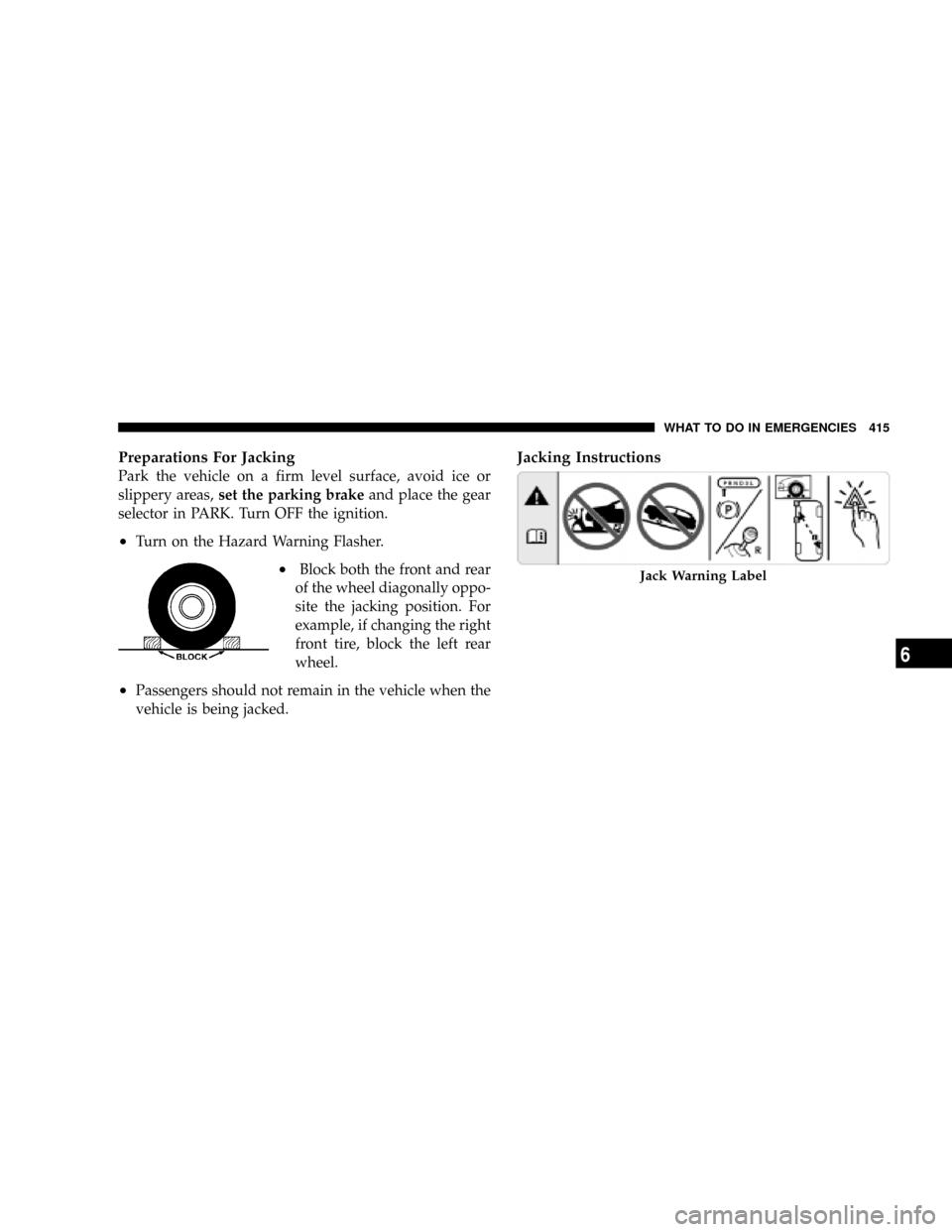
Preparations For Jacking
Park the vehicle on a firm level surface, avoid ice or
slippery areas,set the parking brakeand place the gear
selector in PARK. Turn OFF the ignition.
²Turn on the Hazard Warning Flasher.
²Block both the front and rear
of the wheel diagonally oppo-
site the jacking position. For
example, if changing the right
front tire, block the left rear
wheel.
²Passengers should not remain in the vehicle when the
vehicle is being jacked.
Jacking Instructions
Jack Warning Label
WHAT TO DO IN EMERGENCIES 415
6
Page 427 of 531
CAUTION!
For vehicles equipped with Stow 'n Go seating, the
Winch Mechanism is designed specifically to stow a
COMPACT Spare Tire ONLY. Do not attempt to use
the Winch to stow the Full Size 'Flat' Tire, or any
other Full Size Tire. Vehicle damage may result.
JUMP-STARTING PROCEDURE
WARNING!
²DO NOT attempt to push or tow the vehicle to get it started. Vehicles
equipped with an automatic transmission cannot be started this way.
Unburned fuel could enter the catalytic converter and once the engine has
started, ignite and damage the converter and vehicle.
²If the vehicle has a discharged battery, booster cables may be used to obtain
a start from another vehicle. This type of start can be dangerous if done
improperly, so follow this procedure carefully.
²Battery fluid is a corrosive acid solution; DO NOT allow battery fluid to
contact eyes, skin or clothing. Don't lean over battery when attaching
clamps or allow the clamps to touch each other. If acid splashes in the eyes
or on the skin, flush the contaminated area immediately with large
quantities of water.
²A battery generates hydrogen gas which is flammable and explosive. Keep
all flames or sparks away from the vent holes. DO NOT use a booster
battery or any other booster source with an output that exceeds 12 volts.
²During cold weather when temperatures are below freezing point, electro-
lyte in a discharged battery may freeze. DO NOT attempt jump-starting
because the battery could rupture or explode. The battery temperature must
be brought up above freezing point before attempting jump-start.
²Take special care to avoid the radiator cooling fan whenever the hood is
raised. The cooling fan is electrically operated and can start anytime the
ignition switch is ON. You can be hurt by the fan.
WHAT TO DO IN EMERGENCIES 425
6
Page 428 of 531
When jump-starting, proceed as follows:
1. Wear eye protection and remove any metal jewelry
such as watch bands or bracelets that might make an
inadvertent electrical contact.
2. When a boost is provided by a battery in another
vehicle, park that vehicle within booster cable reach and
without letting the vehicles touch. Set the parking brake,
place the automatic transmission selector lever into
PARK and turn the ignition switch to the OFF position for
both vehicles.
3. Turn OFF the heater, radio and all unnecessary elec-
trical loads.
4. Connect one end of a jumper cable to the positive
terminal of the discharged battery. Connect the other end
of the same cable to the positive terminal of the booster
battery.WARNING!
DO NOT permit vehicles to touch each other as this
could establish a ground connection and personal
injury could result.
5. Connect the other cable, first to the negative terminal
of the booster battery, and then to the engine of the
vehicle with the discharged battery. Make sure there is a
good contact on the engine.
WARNING!
DO NOT connect the cable to the negative post of the
discharge battery. The resulting electrical spark could
cause the battery to explode.
426 WHAT TO DO IN EMERGENCIES
Page 430 of 531
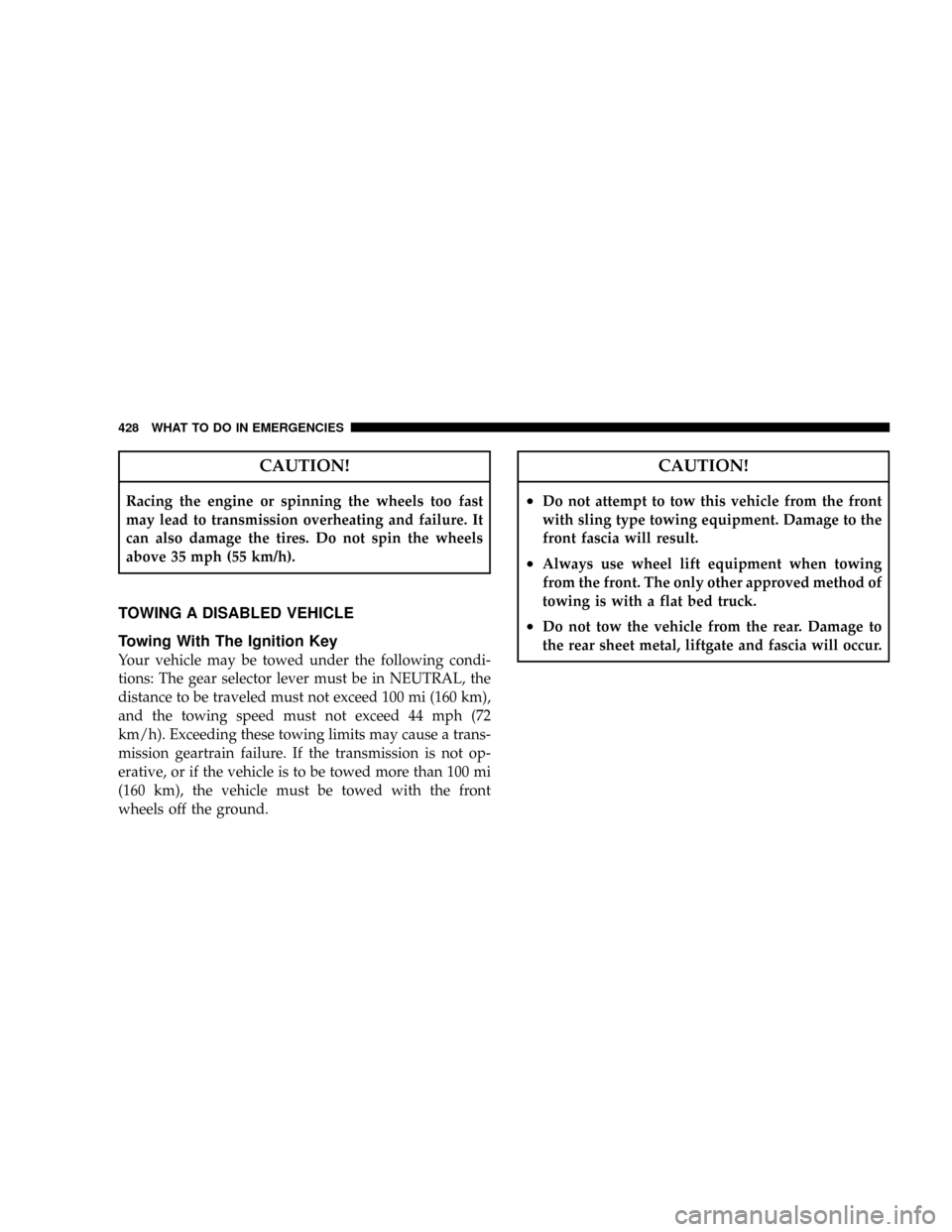
CAUTION!
Racing the engine or spinning the wheels too fast
may lead to transmission overheating and failure. It
can also damage the tires. Do not spin the wheels
above 35 mph (55 km/h).
TOWING A DISABLED VEHICLE
Towing With The Ignition Key
Your vehicle may be towed under the following condi-
tions: The gear selector lever must be in NEUTRAL, the
distance to be traveled must not exceed 100 mi (160 km),
and the towing speed must not exceed 44 mph (72
km/h). Exceeding these towing limits may cause a trans-
mission geartrain failure. If the transmission is not op-
erative, or if the vehicle is to be towed more than 100 mi
(160 km), the vehicle must be towed with the front
wheels off the ground.
CAUTION!
²Do not attempt to tow this vehicle from the front
with sling type towing equipment. Damage to the
front fascia will result.
²Always use wheel lift equipment when towing
from the front. The only other approved method of
towing is with a flat bed truck.
²Do not tow the vehicle from the rear. Damage to
the rear sheet metal, liftgate and fascia will occur.
428 WHAT TO DO IN EMERGENCIES
Page 431 of 531
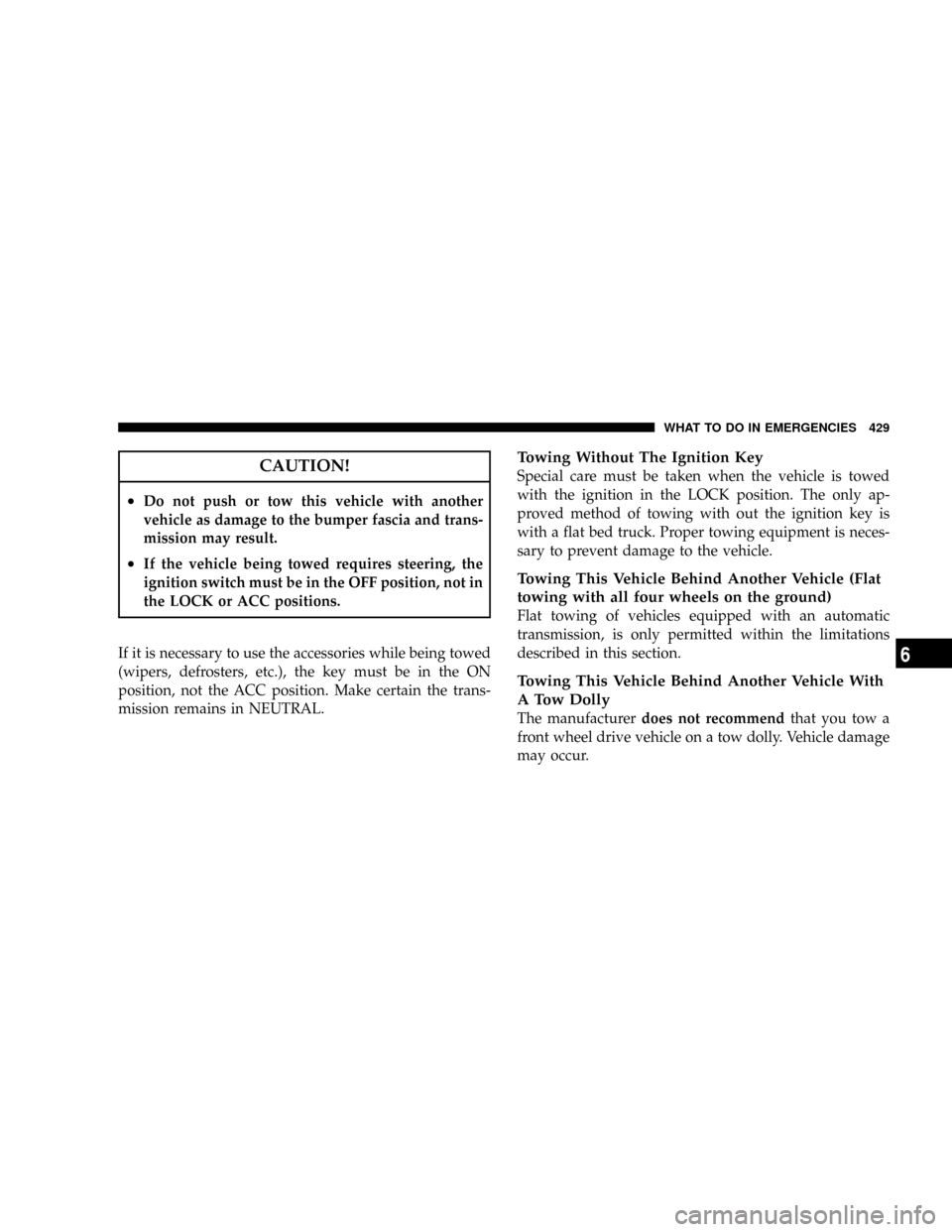
CAUTION!
²Do not push or tow this vehicle with another
vehicle as damage to the bumper fascia and trans-
mission may result.
²If the vehicle being towed requires steering, the
ignition switch must be in the OFF position, not in
the LOCK or ACC positions.
If it is necessary to use the accessories while being towed
(wipers, defrosters, etc.), the key must be in the ON
position, not the ACC position. Make certain the trans-
mission remains in NEUTRAL.
Towing Without The Ignition Key
Special care must be taken when the vehicle is towed
with the ignition in the LOCK position. The only ap-
proved method of towing with out the ignition key is
with a flat bed truck. Proper towing equipment is neces-
sary to prevent damage to the vehicle.
Towing This Vehicle Behind Another Vehicle (Flat
towing with all four wheels on the ground)
Flat towing of vehicles equipped with an automatic
transmission, is only permitted within the limitations
described in this section.
Towing This Vehicle Behind Another Vehicle With
A Tow Dolly
The manufacturerdoes not recommendthat you tow a
front wheel drive vehicle on a tow dolly. Vehicle damage
may occur.
WHAT TO DO IN EMERGENCIES 429
6