warning DODGE CARAVAN 2008 5.G Owners Manual
[x] Cancel search | Manufacturer: DODGE, Model Year: 2008, Model line: CARAVAN, Model: DODGE CARAVAN 2008 5.GPages: 531, PDF Size: 7.72 MB
Page 348 of 531
TRACTION
When driving on wet or slushy roads, it is possible for a
wedge of water to build up between the tire and road
surface. This is known as hydroplaning and may cause
partial or complete loss of vehicle control and stopping
ability. To reduce this possibility, the following precau-
tions should be observed:
1. Slow down during rainstorms or when roads are
slushy.
2. Slow down if the road has standing water or puddles.
3. Replace the tires when tread wear indicators first
become visible.
4. Keep the tires properly inflated.
5. Maintain sufficient distance between your vehicle and
the vehicle in front of you to avoid a collision in a sudden
stop.
DRIVING THROUGH WATER
Driving through water more than a few inches/
centimeters deep will require extra caution to ensure
safety and prevent damage to your vehicle.
Flowing/Rising Water
WARNING!
Do not drive on, or cross, a road or a path where
water is flowing and/or rising (as in storm run-off).
Flowing water can wear away the road or path's
surface and cause your vehicle to sink into deeper
water. Furthermore, flowing and/or rising water can
carry your vehicle away swiftly. Failure to follow this
warning may result in injuries that are serious or
fatal to you, your passengers, and others around you.
346 STARTING AND OPERATING
Page 349 of 531
Shallow Standing Water
Although your vehicle is capable of driving through
shallow standing water, consider the following Caution
and Warning before doing so.
CAUTION!
²Always check the depth of the standing water
before driving through it. Never drive through
standing water that is deeper than the bottom of
the tire rims mounted on the vehicle.
²Determine the condition of the road or the path
that is under water, and if there are any obstacles
in the way, before driving through the standing
water.
²Do not exceed 5 mph (8 km/h) when driving
through standing water. This will minimize wave
effects.
CAUTION!
²Driving through standing water may cause dam-
age to your vehicle's drivetrain components. Al-
ways inspect your vehicle's fluids (i.e., engine oil,
transmission, axle, etc.) for signs of contamination
(i.e., fluid that is milky or foamy in appearance)
after driving through standing water. Do not con-
tinue to operate the vehicle if any fluid appears
contaminated, as this may result in further dam-
age. Such damage is not covered by the New
Vehicle Limited Warranty.
²Getting water inside your vehicle's engine can
cause it to lock up and stall out, and cause serious
internal damage to the engine. Such damage is not
covered by the New Vehicle Limited Warranty.
STARTING AND OPERATING 347
5
Page 350 of 531
WARNING!
²Driving through standing water limits your vehi-
cle's traction capabilities. Do not exceed 5 mph (8
km/h) when driving through standing water.
²Driving through standing water limits your vehi-
cle's braking capabilities, which increases stop-
ping distances. Therefore, after driving through
standing water, drive slowly and lightly press on
the brake pedal several times to dry the brakes.
²Getting water inside your vehicle's engine can
cause it to lock up and stall out, and leave you
stranded.
²Failure to follow these warnings may result in
injuries that are serious or fatal to you, your
passengers, and others around you.
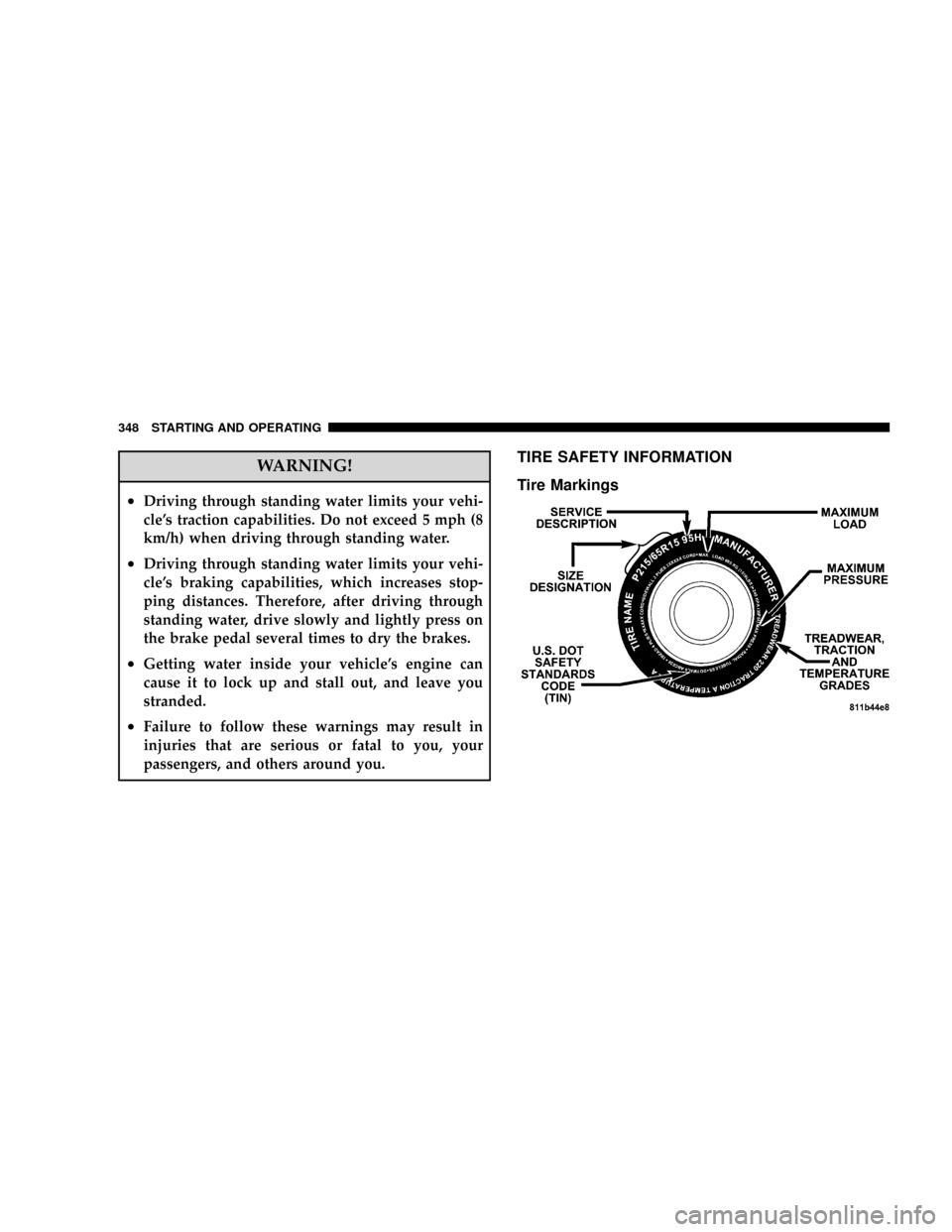
TIRE SAFETY INFORMATION
Tire Markings
348 STARTING AND OPERATING
Page 359 of 531
2WARNING!
Overloading of your tires is dangerous. Overloading
can cause tire failure, affect vehicle handling, and
increase your stopping distance. Use tires of the
recommended load capacity for your vehicle. Never
overload them.
TIRES Ð GENERAL INFORMATION
Tire Pressure
Proper tire inflation pressure is essential to the safe and
satisfactory operation of your vehicle. Three primary
areas are affected by improper tire pressure:1. SafetyÐ
WARNING!
²Improperly inflated tires are dangerous and can
cause accidents.
²Under-inflation increases tire flexing and can result
in tire failure.
WARNING!
²Over-inflation reduces a tire's ability to cushion
shock. Objects on the road and chuckholes can cause
damage that result in tire failure.
²Over-inflated or under-inflated tires can affect ve-
hicle handling and can fail suddenly, resulting in
loss of vehicle control.
STARTING AND OPERATING 357
5
Page 360 of 531
WARNING!
²Unequal tire pressures can cause steering problems.
You could lose control of your vehicle.
²Unequal tire pressures from one side of the vehicle
to the other can cause the vehicle to drift to the right
or left.
²Always drive with each tire inflated to the recom-
mended cold tire inflation pressure.2. EconomyÐ
Improper inflation pressures can cause uneven wear
patterns to develop across the tire tread. These abnormal
wear patterns will reduce tread life resulting in a need for
earlier tire replacement. Under-inflation, also increases
tire rolling resistance and results in higher fuel consump-
tion.
3. Ride Comfort and Vehicle StabilityÐ
Proper tire inflation contributes to a comfortable ride.
Over-inflation produces a jarring and uncomfortable
ride.
Tire Inflation Pressures
The proper cold tire inflation pressure is listed either on
the face of the driver's door or on the driver's side ªBº
pillar.
358 STARTING AND OPERATING
Page 362 of 531
Tire pressures change by approximately 1 psi (7 kPa) per
12 F (7 C) of air temperature change. Keep this in mind
when checking tire pressure inside a garage, especially in
the winter.
Example: If garage temperature = 68ÉF (20ÉC) and the
outside temperature = 32ÉF (0ÉC) then the cold tire
inflation pressure should be increased by 3 psi (21 kPa),
which equals 1 psi (7 kPa) for every 12 F (7 C) for this
outside temperature condition.
Tire pressure may increase from 2 to 6 psi (13 to 40 kPa)
during operation. DO NOT reduce this normal pressure
buildup or your tire pressure will be too low.Tire Pressures for High-Speed Operation
The manufacturer advocates driving at safe speeds
within posted speed limits. Where speed limits or condi-
tions are such that the vehicle can be driven at high
speeds, maintaining correct tire inflation pressure is very
important. Increased tire pressure and reduced vehicle
loading may be required for high-speed vehicle opera-
tion. Refer to original equipment information or an
authorized tire dealer for recommended safe operating
speeds, loading and cold tire inflation pressures.
WARNING!
High-speed driving with your vehicle at or above
maximum load is dangerous. The added strain on
your tires could cause them to fail. You could have a
serious accident. Don't drive a vehicle loaded to the
maximum capacity at continuous speeds above 75
mph (120 km/h).
360 STARTING AND OPERATING
Page 363 of 531
Radial-Ply Tires
WARNING!
Combining radial ply tires with other types of tires
on your vehicle will cause your vehicle to handle
poorly. The instability could cause an accident. Al-
ways use radial ply tires in sets of four (or 6, in case
of trucks with dual rear wheels). NEVER combine
them with other types of tires.
Cuts and punctures in radial tires are repairable only in
the tread area because of sidewall flexing. Consult your
authorized tire dealer for radial tire repairs.
Compact Spare Tire Ð If Equipped
The compact spare is for temporary emergency use with
radial tires. It is engineered to be used on your stylevehicle only. Since this tire has limited tread life, the
original tire should be repaired (or replaced) and rein-
stalled at the first opportunity.
WARNING!
²Temporary use spare tires are for emergency use
only. With these tires, DO NOT drive more than 50
mph (80 km/h).
²Temporary-use spare tires have limited tread life.
When the tread is worn to the tread wear indica-
tors, the temporary use spare tire needs to be
replaced.
²Be sure to follow the warnings, which apply to
your spare. Failure to do so could result in spare
tire failure and loss of vehicle control.
STARTING AND OPERATING 361
5
Page 364 of 531
DO NOT install a wheel cover or attempt to mount a
conventional tire on the compact spare wheel, since the
wheel is designed specifically for the compact spare.
DO NOT install more than one compact spare tire/wheel
on the vehicle at any given time.
CAUTION!
Because of the reduced ground clearance, DO NOT
take your vehicle through an automatic car wash with
the compact spare installed. Damage to the vehicle
may result.
Limited-Use Spare Tire Ð If Equipped
The limited-use spare tire is for temporary emergency
use on your vehicle. This tire is identified by a limited-
use spare tire warning label located on the limited use
spare tire and wheel assembly. This tire may look like theoriginal equipped tire on the front or rear axle of your
vehicle, but it is not. Installation of this limited use spare
tire affects vehicle handling. Since it is not the same tire,
replace (or repair) the original tire and reinstall on the
vehicle at the first opportunity.
WARNING!
²The limited use spare tire is for emergency use
only. Installation of this limited use spare tire
affects vehicle handling.
²DO NOT drive more than 50 mph (80 km/h) with
a limited use spare tire.
362 STARTING AND OPERATING
Page 365 of 531
WARNING!
²Keep the limited use spare tire inflated to the cold
tire inflation pressure listed on either your tire
placard or limited use spare tire and wheel assem-
bly.
²Replace (or repair) the original tire at the first
opportunity and reinstall it on your vehicle. Fail-
ure to do so could result in loss of vehicle control.
Tire Spinning
When stuck in mud, sand, snow, or ice conditions, DO
NOT spin your vehicle's wheels faster than 30 mph (48
km/h) or continuously for longer than 30 seconds with-
out stopping when you are stuck.Refer to ªFreeing A Stuck Vehicleº in Section 6 of this
manual for additional information.
WARNING!
²Fast spinning tires can be dangerous. Forces gen-
erated by excessive wheel speeds may cause tire
damage or failure. A tire could explode and injure
someone.
²DO NOT spin your vehicle's wheels faster than 30
mph (48 km/h) or for more than 30 seconds con-
tinuously when you are stuck, and don't let any-
one near a spinning wheel, no matter what the
speed.
STARTING AND OPERATING 363
5
Page 366 of 531
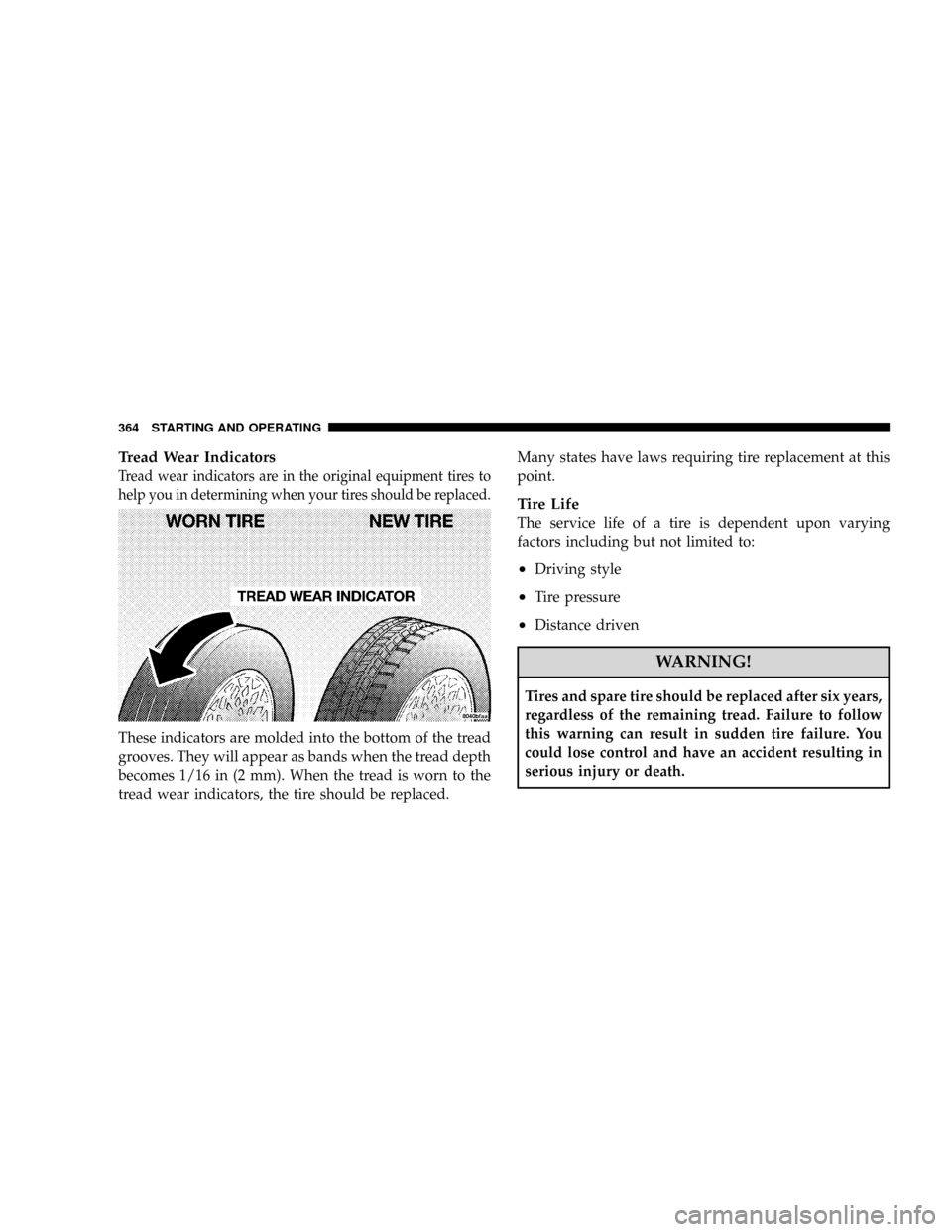
Tread Wear Indicators
Tread wear indicators are in the original equipment tires to
help you in determining when your tires should be replaced.
These indicators are molded into the bottom of the tread
grooves. They will appear as bands when the tread depth
becomes 1/16 in (2 mm). When the tread is worn to the
tread wear indicators, the tire should be replaced.Many states have laws requiring tire replacement at this
point.
Tire Life
The service life of a tire is dependent upon varying
factors including but not limited to:
²Driving style
²Tire pressure
²Distance driven
WARNING!
Tires and spare tire should be replaced after six years,
regardless of the remaining tread. Failure to follow
this warning can result in sudden tire failure. You
could lose control and have an accident resulting in
serious injury or death.
364 STARTING AND OPERATING