brake DODGE CARAVAN 2008 5.G User Guide
[x] Cancel search | Manufacturer: DODGE, Model Year: 2008, Model line: CARAVAN, Model: DODGE CARAVAN 2008 5.GPages: 531, PDF Size: 7.72 MB
Page 229 of 531
WARNING!
A hot engine cooling system is dangerous. You or
others could be badly burned by steam or boiling
coolant. You may want to call an authorized dealer if
your vehicle overheats. If you decide to look under
the hood yourself, see Section 7 of this manual.
Follow the warnings under the Cooling System Pres-
sure Cap paragraph.
4. Speedometer
Indicates vehicle speed.
5. Turn Signal Indicators
The arrow will flash with the exterior turn signal
when the turn signal lever is operated.
If the vehicle electronics sense that the vehicle has
traveled about one mile with the turn signals on, acontinuous chime will sound to alert you to turn the
signals off. If either indicator flashes at a rapid rate, check
for a defective outside light bulb.
6. High Beam Light
This light shows that the headlights are on high
beam. Pull the turn signal lever towards the
steering wheel to switch the headlights from high or low
beam.
7. Anti-Lock Brake System Light
This light monitors the Anti-Lock Brake Sys-
tem. The light will turn on when the ignition
switch is turned to the ON position and may
stay on for as long as four seconds.
If the ABS light remains on or turns on while driving, it
indicates that the Anti-Lock portion of the brake system
is not functioning and that service is required. However,
the conventional brake system will continue to operate
normally if the BRAKE warning light is not on.
UNDERSTANDING YOUR INSTRUMENT PANEL 227
4
Page 230 of 531
If the ABS light is on, the brake system should be serviced
as soon as possible to restore the benefits of Anti-Lock
brakes. If the ABS light does not turn on when the
Ignition switch is turned to the ON position, have the
light inspected by an authorized dealer.
8. Brake System Warning Light
This light monitors various brake functions,
including brake fluid level and parking brake
application. If the brake light turns on, it may
indicate that the parking brake is applied, that
the brake fluid level is low, or that there is a problem with
the anti-lock brake system (if equipped).
The dual brake system provides a reserve braking capac-
ity in the event of a failure to a portion of the hydraulic
system. Failure of either half of the dual brake system is
indicated by the Brake Warning Light which will turn on
when the brake fluid level in the master cylinder has
dropped below a specified level.The light will remain on until the cause is corrected.
NOTE:The light may flash momentarily during sharp
cornering maneuvers which change fluid level condi-
tions. The vehicle should have service performed, and
the brake fluid level checked.
If brake failure is indicated, immediate repair is neces-
sary.
WARNING!
Driving a vehicle with the brake light on is danger-
ous. Part of the brake system may have failed. It will
take longer to stop the vehicle. You could have an
accident. Have the vehicle checked immediately.
Vehicles equipped with the Anti-Lock Brake System
(ABS), are also equipped with Electronic Brake Force
Distribution (EBD). In the event of an EBD failure, the
228 UNDERSTANDING YOUR INSTRUMENT PANEL
Page 231 of 531
Brake Warning Light will turn on along with the ABS
Light. Immediate repair to the ABS system is required.
The operation of the Brake Warning Light can be checked
by turning the ignition switch from the OFF position to
the ON position. The light should illuminate for approxi-
mately two seconds. The light should then turn off unless
the parking brake is applied or a brake fault is detected.
If the light does not illuminate, have the light inspected
by an authorized dealer.
The light also will turn on when the parking brake is
applied with the ignition switch in the ON position.
NOTE:This light shows only that the parking brake is
applied. It does not show the degree of brake application.9.Tachometer Ð Premium Instrument Cluster Only
The white area of the scale shows the permissible engine
revolutions-per-minute (RPM x 1000) for each gear range.
Before reaching the red area, ease up on the accelerator to
prevent engine damage.
10. Transmission Range Indicator
This display indicator shows the automatic transaxle gear
selection.
NOTE:You must apply the brakes before shifting from
Park.
11. Odometer/Trip Odometer Ð If Equipped
The odometer shows the total distance the vehicle has
been driven.
U.S. federal regulations require that upon transfer of
vehicle ownership, the seller certify to the purchaser the
correct mileage that the vehicle has been driven. There-
fore, if the odometer reading is changed during repair or
UNDERSTANDING YOUR INSTRUMENT PANEL 229
4
Page 323 of 531
STARTING AND OPERATING
CONTENTS
mStarting Procedures.....................324
NAutomatic Transmission................325
mEngine Block Heater Ð If Equipped.........327
mAutomatic Transmission..................328
NBrake/Transmission Interlock System.......328
NFour-Speed Or Six-Speed Automatic
Transmission........................329
NReset Mode - Electronic Transmission.......334
mParking Brake.........................335mBrake System..........................337
NAnti-Lock Brake System (ABS)............338
mElectronic Brake Control Systems............340
NTraction Control System (TCS)............340
mPower Steering........................344
mDriving On Slippery Surfaces..............345
NAcceleration.........................345
NTraction............................346
mDriving Through Water..................346
5
Page 327 of 531
Automatic Transmission
The gear selector lever must be in the NEUTRAL or
PARK position before you can start the engine. Depress
the brake pedal before shifting into any driving gear.
Normal Starting (Above 32ÉF/0ÉC)
1. DO NOT depress the accelerator.
2. Use the Fob with Integrated Key to briefly turn the
ignition switch to the START position and release it as
soon as the starter engages. The starter motor will
continue to run, and it will disengage automatically
when the engine is running.
3. If the engine fails to start, the starter will disengage
automatically in 10 seconds. If this occurs, turn the
ignition switch to the OFF position, wait 10 to 15 seconds,
then repeat the normal starting procedure (Steps 1±3
above).NOTE: This vehicle is equipped with a transmission
shift interlocking system. The brake pedal must be
depressed to shift out of PARK.
Extremely Cold Weather Starting Ð Below220ÉF
(±29ÉC)
Follow the same instructions in the ªNormal Startingº
procedure.
To ensure reliable starting at these temperatures, use of
an externally powered electric engine block heater (avail-
able from your authorized dealer) is recommended.
High Altitude Starting Ð Above 4,000 ft (1 219 m)
Follow the same instructions in the ªNormal Startingº
procedure.
To ensure reliable starting at these temperatures, use of
an externally powered electric engine block heater (avail-
able from your authorized dealer) is recommended.
STARTING AND OPERATING 325
5
Page 330 of 531
AUTOMATIC TRANSMISSION
CAUTION!
Damage to the transmission may occur if the follow-
ing precautions are not observed:
²Shift the gear selector lever into PARK only after
the vehicle has come to a complete stop.
²Do not shift the gear selector lever from RE-
VERSE, PARK, or NEUTRAL into any forward
gear when the engine is above idle speed.
²Before shifting the gear selector lever into any
gear, make sure your foot is firmly on the brake
pedal.
NOTE:You MUST press and hold the brake pedal down
while shifting out of PARK.
WARNING!
It is dangerous to shift the gear selector lever out of
PARK or NEUTRAL if the engine speed is higher
than idle speed. If your foot is not firmly on the
brake pedal, the vehicle could accelerate quickly
forward or in reverse. You could lose control of the
vehicle and hit someone or something. Only shift
into gear when the engine is idling normally and
when your right foot is firmly on the brake pedal.
Brake/Transmission Interlock System
This system holds the shift lever in the PARK position
when the ignition switch is in the LOCK position. It also
prevents you, once the engine is started, from moving the
gear selector lever out of PARK and into any gear unless
the brake pedal is pressed. This system is active only
328 STARTING AND OPERATING
Page 331 of 531
while the ignition switch is in the ON position. Always
press the brake pedal first before moving the gear selec-
tor lever out of PARK.
Automatic Transmission Ignition Interlock System
For electrical system malfunctions, there is an override
for the interlock system. In order to override this system,
remove the cover located to the top right of the gear
selector lever in the instrument panel. The override can
be activated by pressing the white-colored tab, which can
be accessed through the hole in the instrument panel.
While the override is pressed, the gear selector lever can
be moved out of the PARK position without pressing the
brake pedal. After operation, return the cover to its
original position.
This system prevents the key from being removed unless
the gear selector lever is in PARK. It also prevents shifting
the gear selector lever out of PARK unless the key is in
the LOCK/OFF or ON positions.NOTE:If a malfunction occurs, the system will trap the
key in the ignition cylinder to warn you that this safety
feature is inoperable. The engine can be started and
stopped but the key cannot be removed until you obtain
service.
Four-Speed or Six-Speed Automatic
Transmission
The electronically controlled transmission provides a
precise shift schedule. The transmission electronics are
self-calibrating; therefore, the first few shifts on a new
vehicle may be somewhat abrupt. This is a normal
condition, and precision shifts will develop within a few
hundred miles (kilometers).
The transmission has only PRND shift positions. Down-
shifts are carried out by an Electronic Range Select (ERS)
by moving the leverÐ/+while in the DRIVE position,
STARTING AND OPERATING 329
5
Page 332 of 531
the instrument cluster will display transmission gear
selection as 6, 5, 4, 3, 2, 1 for six-speed and 4, 3, 2, 1 for
four-speed transmissions.
Gear Ranges
DO NOT race the engine when shifting the gear selector
lever from PARK or NEUTRAL positions into another
gear range.
PARK
Shifting the gear selector lever in PARK supplements the
parking brake by locking the transmission. The engine
can be started in this gear. Never attempt to use PARK
while vehicle is in motion. Apply the parking brake when
leaving the vehicle in this gear.
When parking on a flat surface, place the shift lever in the
PARK position first, and then apply the parking brake.When parking on a hill, it is important to set the parking
brake before placing the shift lever in PARK, otherwise
the load on the transmission locking mechanism may
make it difficult to move the shift lever out of PARK. As
an added precaution, turn the front wheels toward the
curb on a downhill grade and away from the curb on an
uphill grade.
WARNING!
Never use PARK position on an automatic transmis-
sion as a substitute for the parking brake. Always
apply parking brake fully when parked to guard
against vehicle movement and possible injury or
damage.
330 STARTING AND OPERATING
Page 333 of 531
WARNING!
Unintended movement of a vehicle could injure
those in and near the vehicle. As with all vehicles,
you should never exit a vehicle while the engine is
running. Before exiting a vehicle, you should always
shift the gear selector lever into PARK, remove the
key from the ignition, and apply the parking brake.
Once the key is removed from the ignition, the
transmission gear selector lever is locked in the
PARK position, securing the vehicle against un-
wanted movement. Furthermore, you should never
leave unattended children or pets inside a vehicle.
The following indicators should be used to ensure that
you have engaged the transmission gear selector lever
into the PARK position:
²When shifting the gear selector lever into PARK,
depress the button on the gear selector lever and
firmly move the lever all the way forward until it
stops.
²Look at the shift indicator window on the console to
ensure gear selector lever is in the PARK position.
²When engaged in PARK, you will not be able to move
the gear selector lever rearward without depressing
the gear selector lever button.
CAUTION!
Before moving the gear selector lever out of PARK,
you must turn the ignition from LOCK/OFF to ON so
the steering wheel and gear selector lever are re-
leased. Otherwise, damage to the steering column or
gear selector lever could result.
STARTING AND OPERATING 331
5
Page 337 of 531
5. Shift into the desired gear range and resume driving.
NOTE:Even if the transmission can be reset, it is
recommended that you visit an authorized dealer at your
earliest possible convenience. Your authorized dealer has
diagnostic equipment to determine if the problem could
recur.
If the transmission cannot be reset, authorized dealer
service is required.
PARKING BRAKE
When the parking brake is applied with the ignition
switch ON, the brake light in the instrument cluster will
turn on.
NOTE:This light only shows that the parking brake is
applied. It does not show the degree of brake application.
Before leaving the vehicle, make sure that the parking
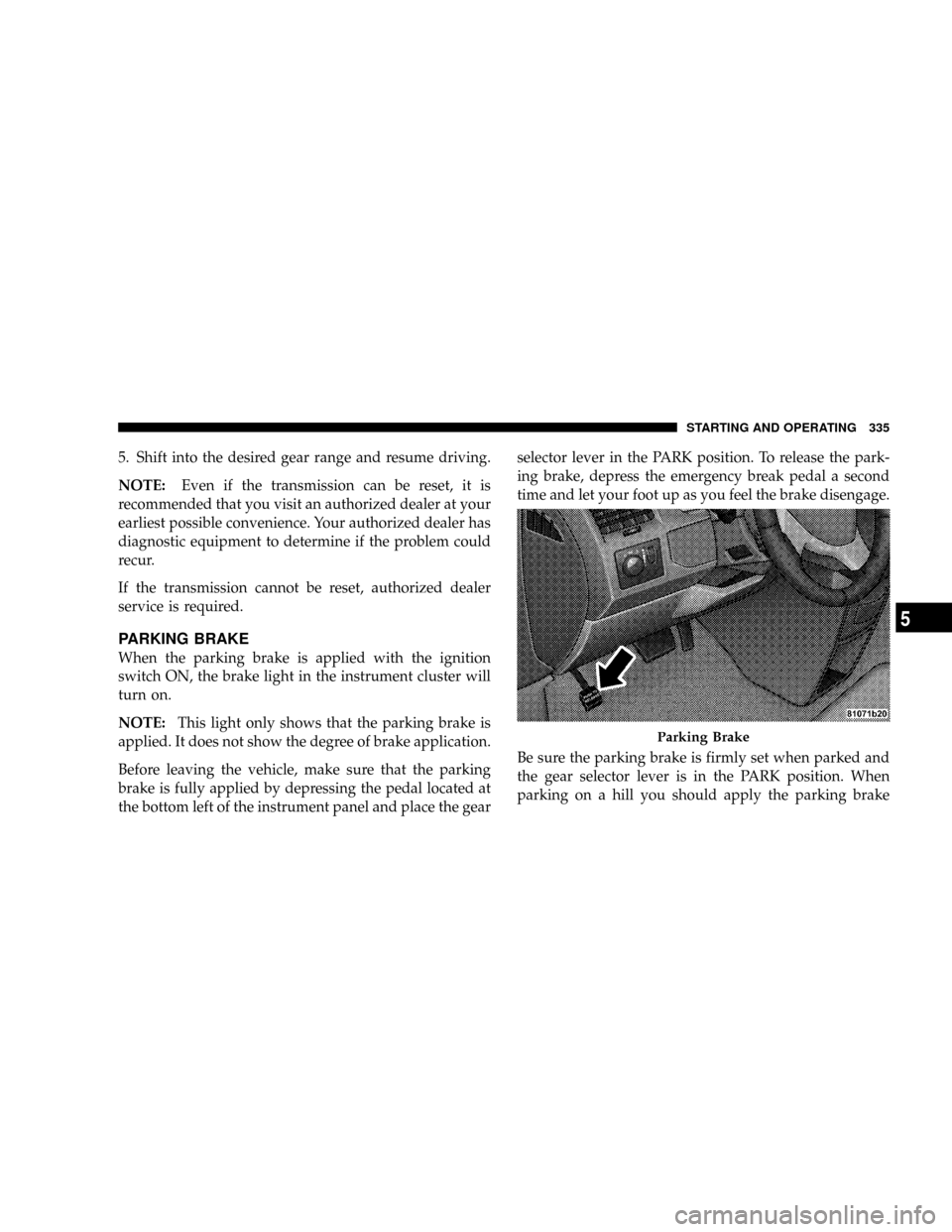
brake is fully applied by depressing the pedal located at
the bottom left of the instrument panel and place the gearselector lever in the PARK position. To release the park-
ing brake, depress the emergency break pedal a second
time and let your foot up as you feel the brake disengage.
Be sure the parking brake is firmly set when parked and
the gear selector lever is in the PARK position. When
parking on a hill you should apply the parking brake
Parking Brake
STARTING AND OPERATING 335
5