towing DODGE CARAVAN 2008 5.G Owner's Manual
[x] Cancel search | Manufacturer: DODGE, Model Year: 2008, Model line: CARAVAN, Model: DODGE CARAVAN 2008 5.GPages: 531, PDF Size: 7.72 MB
Page 406 of 531
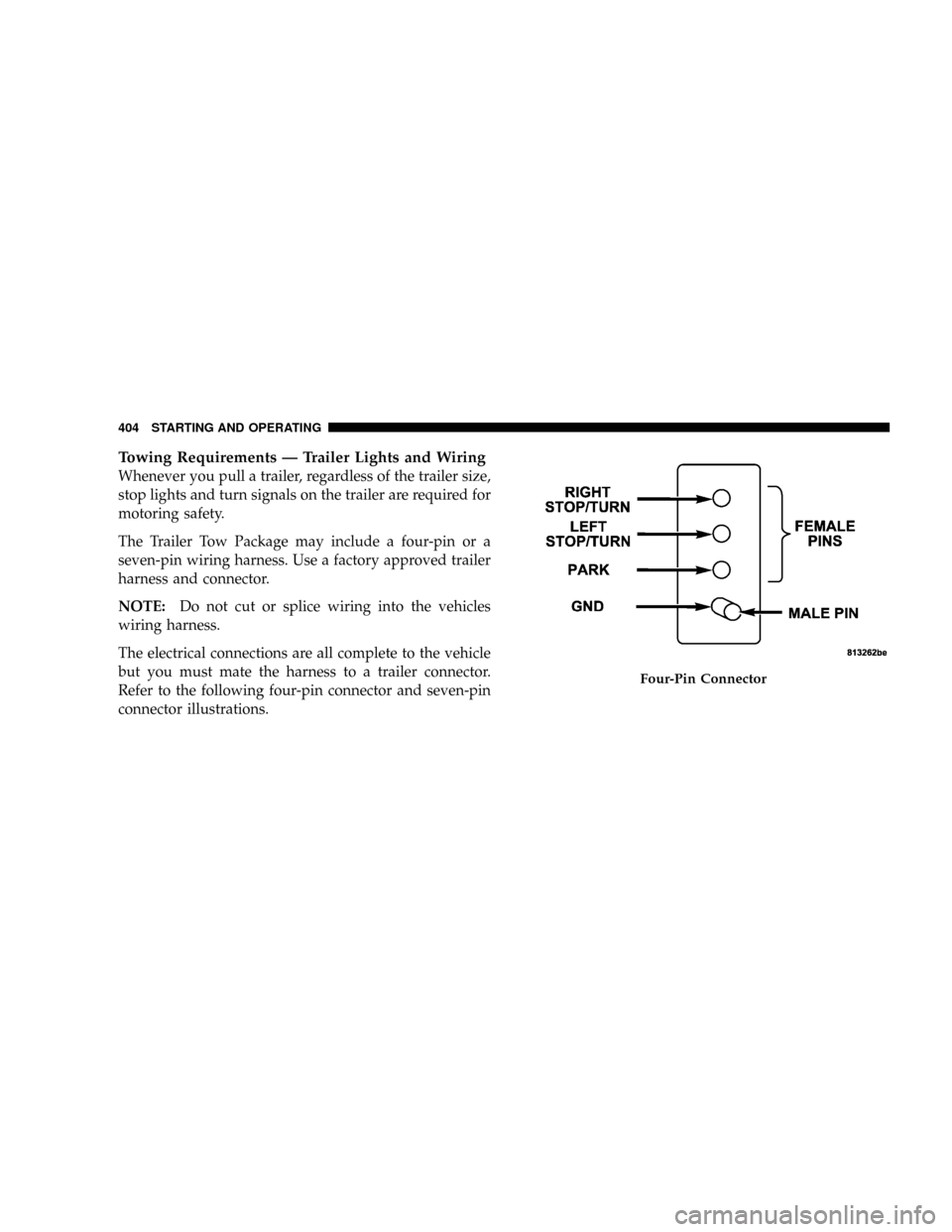
Towing Requirements Ð Trailer Lights and Wiring
Whenever you pull a trailer, regardless of the trailer size,
stop lights and turn signals on the trailer are required for
motoring safety.
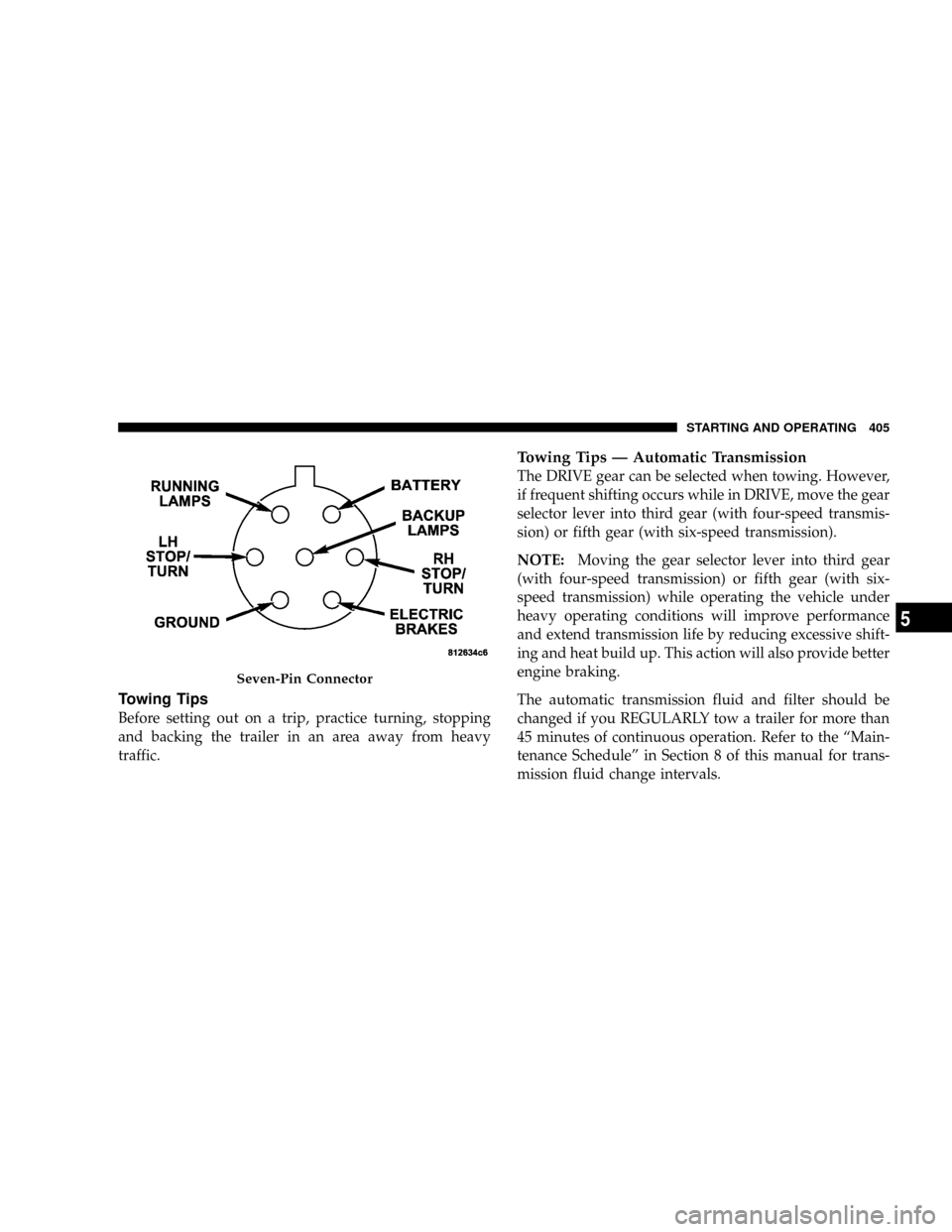
The Trailer Tow Package may include a four-pin or a
seven-pin wiring harness. Use a factory approved trailer
harness and connector.
NOTE:Do not cut or splice wiring into the vehicles
wiring harness.
The electrical connections are all complete to the vehicle
but you must mate the harness to a trailer connector.
Refer to the following four-pin connector and seven-pin
connector illustrations.
Four-Pin Connector
404 STARTING AND OPERATING
Page 407 of 531
Towing Tips
Before setting out on a trip, practice turning, stopping
and backing the trailer in an area away from heavy
traffic.
Towing Tips Ð Automatic Transmission
The DRIVE gear can be selected when towing. However,
if frequent shifting occurs while in DRIVE, move the gear
selector lever into third gear (with four-speed transmis-
sion) or fifth gear (with six-speed transmission).
NOTE:Moving the gear selector lever into third gear
(with four-speed transmission) or fifth gear (with six-
speed transmission) while operating the vehicle under
heavy operating conditions will improve performance
and extend transmission life by reducing excessive shift-
ing and heat build up. This action will also provide better
engine braking.
The automatic transmission fluid and filter should be
changed if you REGULARLY tow a trailer for more than
45 minutes of continuous operation. Refer to the ªMain-
tenance Scheduleº in Section 8 of this manual for trans-
mission fluid change intervals.
Seven-Pin Connector
STARTING AND OPERATING 405
5
Page 408 of 531
NOTE:
²Check the automatic transmission fluid level before
towing.
²The six-speed automatic transmission is sealed and
requires an authorized dealer service center to check
the transmission fluid.
Towing Tips Ð Electronic Speed Control (If
Equipped)
²
Don't use in hilly terrain or with heavy loads.
²When using the speed control, if you experience speed
drops greater than 10 mph (16 km/h), disengage until
you can get back to cruising speed.
²Use speed control in flat terrain and with light loads to
maximize fuel efficiency.
Towing Tips Ð Cooling System
To reduce potential for engine and transmission over-
heating, take the following actions:
²City Driving
When stopped for short periods of time, put transmission
gear selector lever in NEUTRAL but do not increase
engine idle speed.
²Highway Driving
Reduce speed.
²Air Conditioning
Turn off temporarily.
²Refer to Cooling System Operating information in the
Maintenance section of this manual for more informa-
tion.
406 STARTING AND OPERATING
Page 409 of 531
RECREATIONAL TOWING (BEHIND
MOTORHOME, ETC.)
CAUTION!
Towing this vehicle behind another vehicle (flat-
towing with all four wheels on the ground) IS NOT
RECOMMENDED.NOTE:If the vehicle requires towing make sure all four
wheels are off the ground.
STARTING AND OPERATING 407
5
Page 411 of 531
WHAT TO DO IN EMERGENCIES
CONTENTS
mHazard Warning Flasher..................410
mIf Your Engine Overheats.................410
mJacking And Tire Changing................412
NJack Location........................413mJump-Starting Procedure..................425
mFreeing A Stuck Vehicle..................427
mTowing A Disabled Vehicle................428
NTowing With The Ignition Key............428
6
Page 430 of 531
CAUTION!
Racing the engine or spinning the wheels too fast
may lead to transmission overheating and failure. It
can also damage the tires. Do not spin the wheels
above 35 mph (55 km/h).
TOWING A DISABLED VEHICLE
Towing With The Ignition Key
Your vehicle may be towed under the following condi-
tions: The gear selector lever must be in NEUTRAL, the
distance to be traveled must not exceed 100 mi (160 km),
and the towing speed must not exceed 44 mph (72
km/h). Exceeding these towing limits may cause a trans-
mission geartrain failure. If the transmission is not op-
erative, or if the vehicle is to be towed more than 100 mi
(160 km), the vehicle must be towed with the front
wheels off the ground.
CAUTION!
²Do not attempt to tow this vehicle from the front
with sling type towing equipment. Damage to the
front fascia will result.
²Always use wheel lift equipment when towing
from the front. The only other approved method of
towing is with a flat bed truck.
²Do not tow the vehicle from the rear. Damage to
the rear sheet metal, liftgate and fascia will occur.
428 WHAT TO DO IN EMERGENCIES
Page 431 of 531
CAUTION!
²Do not push or tow this vehicle with another
vehicle as damage to the bumper fascia and trans-
mission may result.
²If the vehicle being towed requires steering, the
ignition switch must be in the OFF position, not in
the LOCK or ACC positions.
If it is necessary to use the accessories while being towed
(wipers, defrosters, etc.), the key must be in the ON
position, not the ACC position. Make certain the trans-
mission remains in NEUTRAL.
Towing Without The Ignition Key
Special care must be taken when the vehicle is towed
with the ignition in the LOCK position. The only ap-
proved method of towing with out the ignition key is
with a flat bed truck. Proper towing equipment is neces-
sary to prevent damage to the vehicle.
Towing This Vehicle Behind Another Vehicle (Flat
towing with all four wheels on the ground)
Flat towing of vehicles equipped with an automatic
transmission, is only permitted within the limitations
described in this section.
Towing This Vehicle Behind Another Vehicle With
A Tow Dolly
The manufacturerdoes not recommendthat you tow a
front wheel drive vehicle on a tow dolly. Vehicle damage
may occur.
WHAT TO DO IN EMERGENCIES 429
6
Page 439 of 531
ONBOARD DIAGNOSTIC SYSTEM Ð OBD II
Your vehicle is equipped with a sophisticated onboard
diagnostic system called OBD II. This system monitors
the performance of the emissions, engine, and automatic
transmission control systems. When these systems are
operating properly, your vehicle will provide excellent
performance and fuel economy, as well as engine emis-
sions well within current government regulations.
If any of these systems require service, the OBD II system
will turn on the ªMalfunction Indicator Light.º It will
also store diagnostic codes and other information to
assist your service technician in making repairs. Al-
though your vehicle will usually be drivable and not
need towing, see your authorized dealer for service as
soon as possible.CAUTION!
²Prolonged driving with the ªMalfunction Indica-
tor Lightº on could cause further damage to the
emission control system. It could also affect fuel
economy and driveability. The vehicle must be
serviced before any emissions tests can be per-
formed.
²If the ªMalfunction Indicator Lightº is flashing
while the engine is running, severe catalytic con-
verter damage and power loss will soon occur.
Immediate service is required.
MAINTAINING YOUR VEHICLE 437
7
Page 449 of 531
WARNING!
A hot exhaust system can start a fire if you park over
materials that can burn. Such materials might be
grass or leaves coming into contact with your exhaust
system. Do not park or operate your vehicle in areas
where your exhaust system can contact anything that
can burn.
In unusual situations involving grossly malfunctioning
engine operation, a scorching odor may indicate severe
and abnormal catalyst overheating. If this occurs, the
vehicle should be stopped, the engine shut off and the
vehicle allowed to cool. Thereafter, service, including a
tune-up to manufacturer's specifications, should be ob-
tained immediately.To minimize the possibility of catalyst damage:²Do not shut off the engine or interrupt the ignition
when the transaxle is in gear and the vehicle is in
motion.
²Do not try to start engine by pushing or towing the
vehicle.
²Do not idle the engine with any spark plug wires
disconnected or removed, such as when diagnostic
testing, or for prolonged periods during very rough
idling or malfunctioning operating conditions.
Exhaust System
The best protection against carbon monoxide entry into
the vehicle body is a properly maintained engine exhaust
system.
MAINTAINING YOUR VEHICLE 447
7
Page 496 of 531
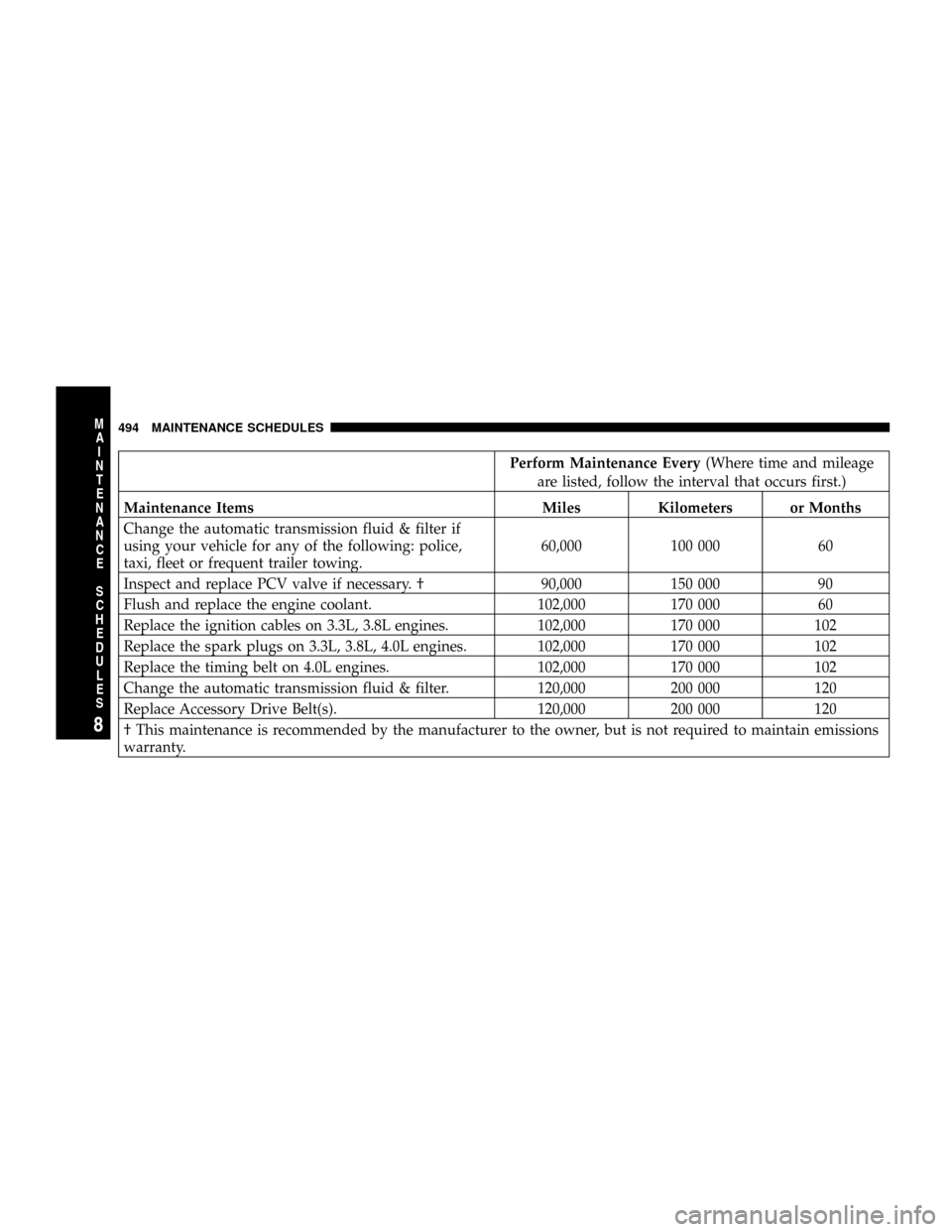
Perform Maintenance Every(Where time and mileage
are listed, follow the interval that occurs first.)
Maintenance Items Miles Kilometers or Months
Change the automatic transmission fluid & filter if
using your vehicle for any of the following: police,
taxi, fleet or frequent trailer towing.60,000 100 000 60
Inspect and replace PCV valve if necessary. ² 90,000 150 000 90
Flush and replace the engine coolant. 102,000 170 000 60
Replace the ignition cables on 3.3L, 3.8L engines. 102,000 170 000 102
Replace the spark plugs on 3.3L, 3.8L, 4.0L engines. 102,000 170 000 102
Replace the timing belt on 4.0L engines. 102,000 170 000 102
Change the automatic transmission fluid & filter. 120,000 200 000 120
Replace Accessory Drive Belt(s). 120,000 200 000 120
² This maintenance is recommended by the manufacturer to the owner, but is not required to maintain emissions
warranty.
494 MAINTENANCE SCHEDULES
8
M
A
I
N
T
E
N
A
N
C
E
S
C
H
E
D
U
L
E
S