tow DODGE CHALLENGER 2013 3.G Repair Manual
[x] Cancel search | Manufacturer: DODGE, Model Year: 2013, Model line: CHALLENGER, Model: DODGE CHALLENGER 2013 3.GPages: 543, PDF Size: 3.04 MB
Page 461 of 543
Windshield Wiper Blades
Clean the rubber edges of the wiper blades and the
windshield periodically with a sponge or soft cloth and a
mild nonabrasive cleaner. This will remove accumula-
tions of salt or road film.
Operation of the wipers on dry glass for long periods
may cause deterioration of the wiper blades. Always use
washer fluid when using the wipers to remove salt or dirt
from a dry windshield.
Avoid using the wiper blades to remove frost or ice from
the windshield. Keep the blade rubber out of contact with
petroleum products such as engine oil, gasoline, etc.
NOTE:Life expectancy of wiper blades varies depend-
ing on geographical area and frequency of use. Poor
performance of blades may be present with chattering,
marks, water lines or wet spots. If any of these conditions
are present, clean the wiper blades or replace as neces-
sary.
Adding Washer Fluid
The windshield washer fluid reservoir is located in the
front of the engine compartment. Be sure to check the
fluid level at regular intervals. Fill the reservoir with
windshield washer solvent (not radiator antifreeze) and
operate the system for a few seconds to flush out the
residual water.
When refilling the washer fluid reservoir, apply some
washer fluid to a cloth or towel and wipe the wiper
blades clean. This will help blade performance.
To prevent freeze-up of your windshield washer system in
cold weather, select a solution or mixture that meets or
exceeds the temperature range of your climate. This rating
information can be found on most washer fluid containers.
The fluid reservoir will hold nearly 1 gal (4 L) of washer
fluid when the message “Low Washer Fluid” appears in the
Electronic Vehicle Information Center (EVIC) (if equipped).
7
MAINTAINING YOUR VEHICLE 459
Page 464 of 543
NOTE:Intentional tampering with emissions control
systems can result in civil penalties being assessed
against you.
In unusual situations involving grossly malfunctioning
engine operation, a scorching odor may suggest severe
and abnormal catalyst overheating. If this occurs, stop
the vehicle, turn off the engine and allow it to cool.
Service, including a tune-up to manufacturer’s specifica-
tions, should be obtained immediately. To minimize the possibility of catalytic converter dam-
age:
•
Do not shut off the engine or interrupt the ignition,
when the transmission is in gear and the vehicle is in
motion.
• Do not try to start the engine by pushing or towing the
vehicle.
• Do not idle the engine with any spark plug wires
disconnected or removed, such as when diagnostic
testing, or for prolonged periods during very rough
idle or malfunctioning operating conditions.
462 MAINTAINING YOUR VEHICLE
Page 480 of 543
Stain Repel Fabric Cleaning Procedure – If
Equipped
Stain Repel seats may be cleaned in the following man-
ner:
•Remove as much of the stain as possible by blotting
with a clean, dry towel.
• Blot any remaining stain with a clean, damp towel.
• For tough stains, apply MOPAR® Total Clean, or a
mild soap solution to a clean, damp cloth and remove
stain. Use a fresh, damp towel to remove soap residue.
• For grease stains, apply MOPAR® Multi-Purpose
Cleaner to a clean, damp cloth and remove stain. Use
a fresh, damp towel to remove soap residue.
• Do not use any harsh solvents or any other form of
protectants on Stain Repel products.
Interior Care
Use MOPAR® Total Clean to clean fabric upholstery and
carpeting.
Use MOPAR® Total Clean to clean vinyl upholstery.
MOPAR® Total Clean is specifically recommended for
leather upholstery.
Your leather upholstery can be best preserved by regular
cleaning with a damp soft cloth. Small particles of dirt
can act as an abrasive and damage the leather upholstery
and should be removed promptly with a damp cloth.
Stubborn soils can be removed easily with a soft cloth
and MOPAR® Total Clean. Care should be taken to avoid
soaking your leather upholstery with any liquid. Please
do not use polishes, oils, cleaning fluids, solvents, deter-
gents, or ammonia-based cleaners to clean your leather
upholstery. Application of a leather conditioner is not
required to maintain the original condition.
478 MAINTAINING YOUR VEHICLE
Page 482 of 543
When cleaning the rear view mirror, spray cleaner on the
towel or rag that you are using. Do not spray cleaner
directly on the mirror.
Cleaning Plastic Instrument Cluster Lenses
The lenses in front of the instruments in this vehicle are
molded in clear plastic. When cleaning the lenses, care
must be taken to avoid scratching the plastic.
1. Clean with a wet soft rag. A mild soap solution may beused, but do not use high alcohol content or abrasive
cleaners. If soap is used, wipe clean with a clean damp
rag.
2. Dry with a soft cloth.
Seat Belt Maintenance
Do not bleach, dye, or clean the belts with chemical
solvents or abrasive cleaners. This will weaken the fabric.
Sun damage can also weaken the fabric.
If the belts need cleaning, use MOPAR® Total Clean, a
mild soap solution, or lukewarm water. Do not remove
the belts from the vehicle to wash them. Dry with a soft
cloth.
Replace the belts if they appear frayed or worn or if the
buckles do not work properly.
Cleaning The Center Console Cupholders
Clean with a damp cloth or towel using a mild detergent
with the cupholder in the center console.
NOTE: The cupholder cannot be removed.
480 MAINTAINING YOUR VEHICLE
Page 502 of 543
MAINTENANCE SCHEDULE
Your vehicle is equipped with an automatic oil change
indicator system. The oil change indicator system will
remind you that it is time to take your vehicle in for
scheduled maintenance.
Based on engine operation conditions, the oil change
indicator message will illuminate. This means that ser-
vice is required for your vehicle. Operating conditions
such as frequent short-trips, trailer tow, extremely hot or
cold ambient temperatures, and E85 fuel usage will
influence when the “Change Oil” or “Oil Change Re-
quired” message is displayed. Severe Operating Condi-
tions can cause the change oil message to illuminate as
early as 3,500 miles (5,600 km) since last reset. Have your
vehicle serviced as soon as possible, within the next 500
miles (805 km).On Electronic Vehicle Information Center (EVIC)
equipped vehicles, “Oil Change Required” will be dis-
played in the EVIC and a single chime will sound,
indicating that an oil change is necessary.
On Non-EVIC equipped vehicles, “Change Oil” will flash
in the instrument cluster odometer and a single chime
will sound, indicating that an oil change is necessary.
Your authorized dealer will reset the oil change indicator
message after completing the scheduled oil change. If a
scheduled oil change is performed by someone other
than your authorized dealer, the message can be reset by
referring to the steps described under “Electronic Vehicle
Information Center (EVIC)/Oil Change Required” in
“Understanding Your Instrument Panel” or under “In-
strument Cluster Description/Odometer/Trip Odom-
eter” in “Understanding Your Instrument Panel” for
further information.
8
M
A I
N T
E
N
A
N
C E
S
C
H E
D
U L
E
S500 MAINTENANCE SCHEDULES
Page 506 of 543
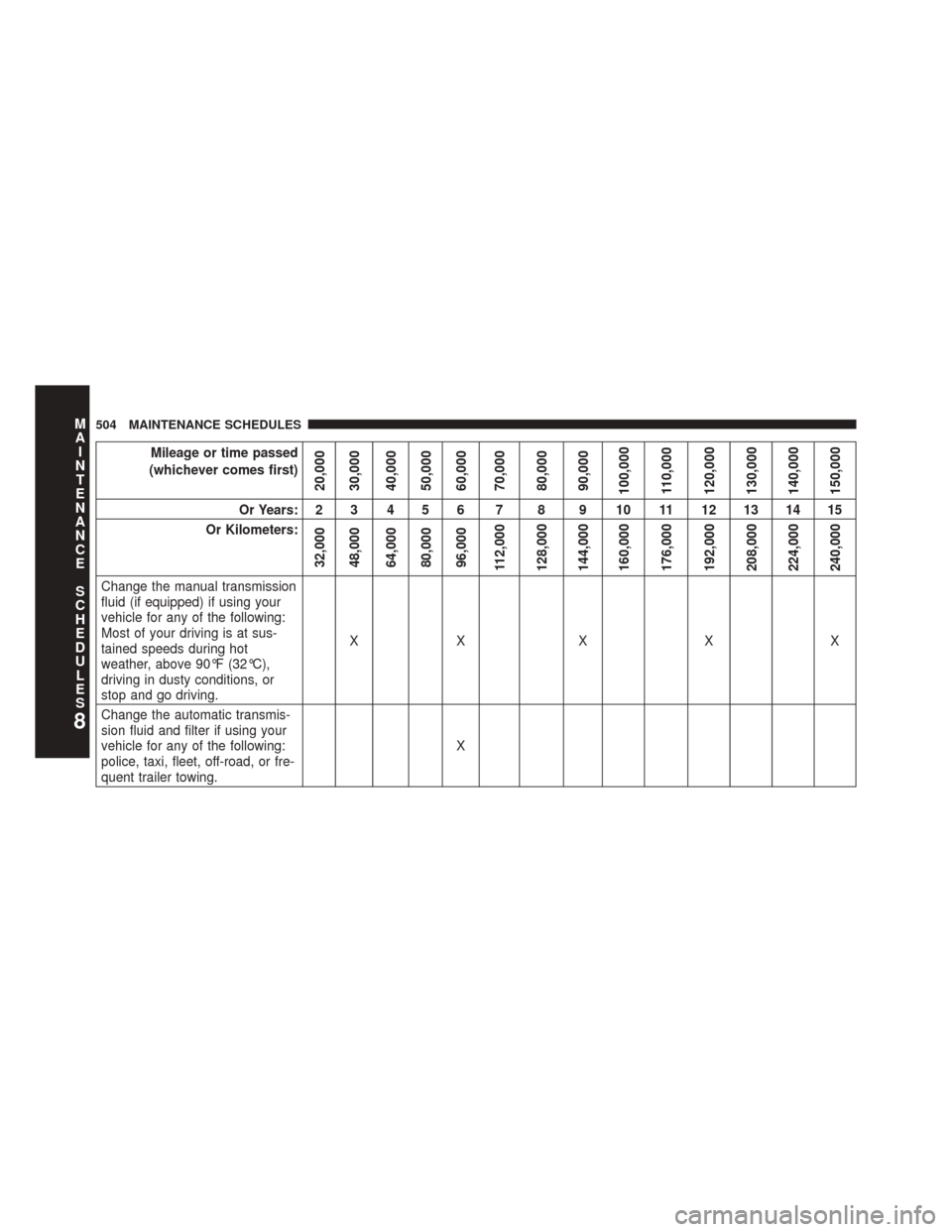
Mileage or time passed
(whichever comes first)
20,000
30,000
40,000
50,000
60,000
70,000
80,000
90,000
100,000
110,000
120,000
130,000
140,000
150,000
Or Years: 2 3 4 5 6 7 8 9 10 11 12 13 14 15
Or Kilometers:
32,000
48,000
64,000
80,000
96,000
112,000
128,000
144,000
160,000
176,000
192,000
208,000
224,000
240,000
Change the manual transmission
fluid (if equipped) if using your
vehicle for any of the following:
Most of your driving is at sus-
tained speeds during hot
weather, above 90°F (32°C),
driving in dusty conditions, or
stop and go driving. XX X X X
Change the automatic transmis-
sion fluid and filter if using your
vehicle for any of the following:
police, taxi, fleet, off-road, or fre-
quent trailer towing. X
8
M
A I
N T
E
N
A
N
C E
S
C
H E
D
U L
E
S504 MAINTENANCE SCHEDULES
Page 507 of 543
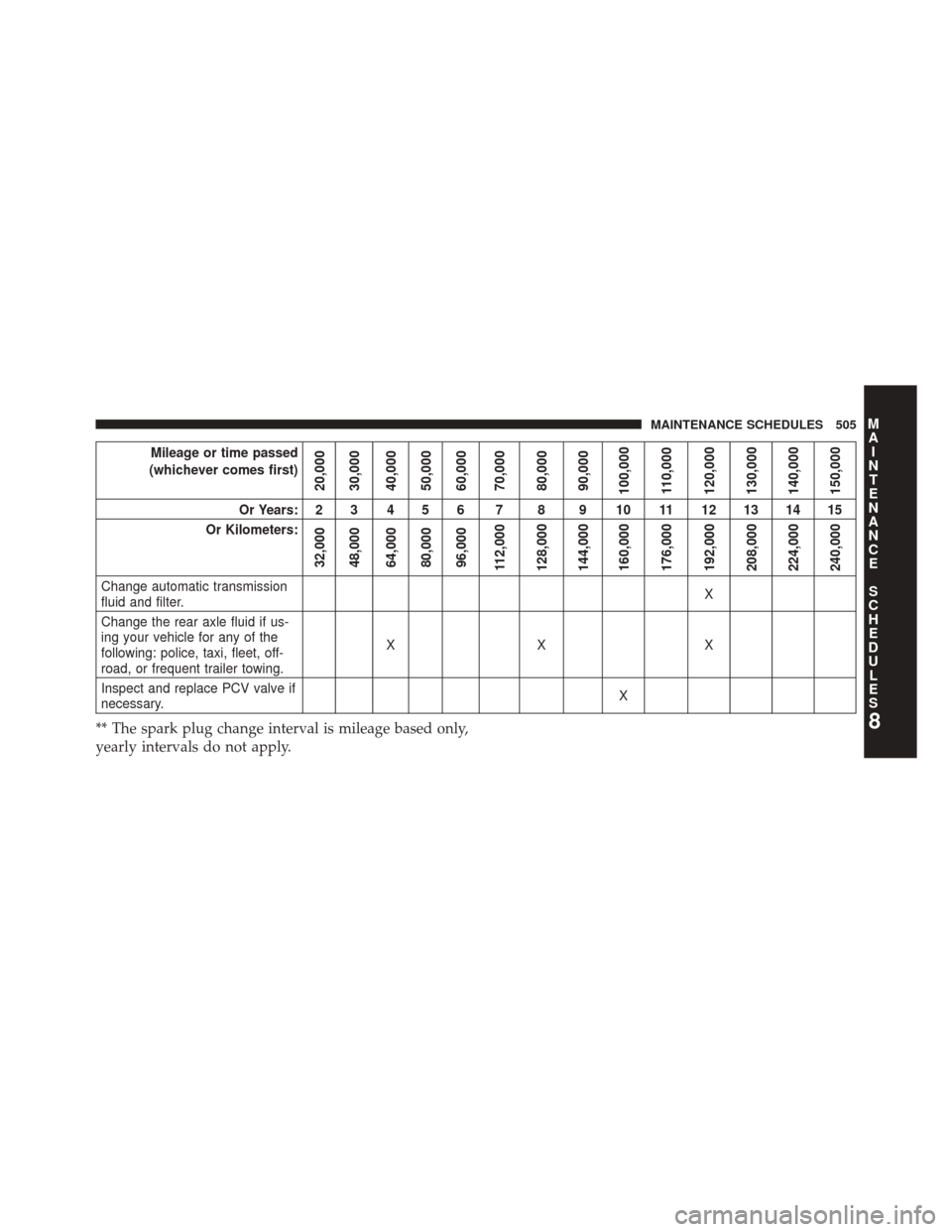
Mileage or time passed
(whichever comes first)
20,000
30,000
40,000
50,000
60,000
70,000
80,000
90,000
100,000
110,000
120,000
130,000
140,000
150,000
Or Years: 2 3 4 5 6 7 8 9 10 11 12 13 14 15
Or Kilometers:
32,000
48,000
64,000
80,000
96,000
112,000
128,000
144,000
160,000
176,000
192,000
208,000
224,000
240,000
Change automatic transmission
fluid and filter. X
Change the rear axle fluid if us-
ing your vehicle for any of the
following: police, taxi, fleet, off-
road, or frequent trailer towing. XX X
Inspect and replace PCV valve if
necessary. X
** The spark plug change interval is mileage based only,
yearly intervals do not apply.8
M
A I
N T
E
N
A
N
C E
S
C
H E
D
U L
E
SMAINTENANCE SCHEDULES 505
Page 522 of 543
About Your Brakes....................... .326
ABS (Anti-Lock Brake System) ................330
Adding Engine Coolant (Antifreeze) ............465
Adding Fuel ............................ .383
Adding Washer Fluid ..................... .459
Additives, Fuel .......................... .382
Airbag ..................................59
Airbag Deployment ........................69
Airbag Light .............................66
Airbag Maintenance ........................71
Airbag, Side ..............................62
Airbag, Window (Side Curtain) ................63
Air Cleaner, Engine (Engine Air Cleaner Filter) . . . .453
Air Conditioner Maintenance .................455
Air Conditioning Filter .....................287
Air Conditioning, Operating Tips ..............288
Air Conditioning Refrigerant .................455
Air Conditioning System ....................280
Air Pressure, Tires ........................ .356Alarm Light
............................ .220
Alarm, Panic .............................27
Alarm (Security Alarm) ......................19
Alarm System (Security Alarm) ................19
Alterations/Modifications, Vehicle ...............7
Antenna, Satellite Radio .....................265
Antifreeze (Engine Coolant) ..................464
Disposal ............................. .467
Anti-Lock Brake System (ABS) ................330
Anti-Lock Warning Light ....................222
Anti-Theft Security Alarm (Theft Alarm) ..........19
Appearance Care ........................ .475
Arming Theft System (Security Alarm) ...........19
Assistance Towing ........................ .127
Auto Down Power Windows ..................42
Automatic Dimming Mirror ..................108
Automatic Door Locks ......................35
Automatic Headlights ..................... .163
Automatic Temperature Control (ATC) ..........280
520 INDEX
Page 525 of 543
Coolant Pressure Cap (Radiator Cap)...........466
Cooling System .......................... .463
Adding Coolant (Antifreeze) ...............465
Coolant Capacity ...................... .495
Coolant Level ......................... .463
Disposal of Used Coolant .................467
Drain, Flush, and Refill ...................464
Inspection ........................... .467
Points to Remember .....................468
Pressure Cap ......................... .466
Radiator Cap ......................... .466
Selection of Coolant (Antifreeze) .............464
Corrosion Protection ...................... .475
Cruise Light ............................ .212
Cupholders ............................ .201
Customer Assistance ...................... .509
Data Recorder, Event .......................72
Daytime Brightness, Interior Lights .............169Daytime Running Lights
....................164
Dealer Service ........................... .447
Deck Lid, Emergency Release .................45
Deck Lid, Power Release .....................43
Defroster, Rear Window .....................205
Defroster, Windshield .......................99
Delay (Intermittent) Wipers ..................170
Diagnostic System, Onboard .................444
Dimmer Switch, Headlight ...................167
Dipsticks Oil (Engine) .......................... .448
Disabled Vehicle Towing ....................435
Disposal Antifreeze (Engine Coolant) ................467
Door Locks ..............................33
Door Locks, Automatic ......................35
Driving Through Flowing, Rising, or Shallow Standing
Water ............................... .322
10
INDEX 523
Page 526 of 543
Driving to Achieve Maximum Fuel Economy......229
Electrical Power Outlets .....................198
Electric Remote Mirrors .....................110
Electronic Brake Control System ...............332
Electronic Power Distribution Center (Fuses) ......483
Electronic Speed Control (Cruise Control) ........173
Electronic Stability Control (ESC) ..............337
Electronic Throttle Control Warning Light ........213
Electronic Vehicle Information Center (EVIC) ......224
Emergency Deck Lid Release ..................45
Emergency, In Case of Freeing Vehicle When Stuck ................432
Hazard Warning Flasher ..................406
Jacking .............................. .418
Jump Starting ......................... .427
Overheating .......................... .406
Towing ............................. .435
Emergency Trunk Release ....................45 Emission Control System Maintenance
..........445
Engine ................................ .443
Air Cleaner .......................... .453
Block Heater ......................... .303
Break-In Recommendations .................96
Checking Oil Level ..................... .448
Compartment ......................... .442
Compartment Identification ................442
Coolant (Antifreeze) .....................463
Cooling ............................. .463
Exhaust Gas Caution .....................97
Fails to Start .......................... .301
Flooded, Starting ...................... .301
Fuel Requirements ..................... .378
Jump Starting ......................... .427
Oil................................. .448
Oil Filler Cap ......................... .451
Oil Selection .......................... .450
Oil Synthetic ......................... .452
524 INDEX