manual transmission DODGE CHALLENGER 2013 3.G Owner's Manual
[x] Cancel search | Manufacturer: DODGE, Model Year: 2013, Model line: CHALLENGER, Model: DODGE CHALLENGER 2013 3.GPages: 140, PDF Size: 5.35 MB
Page 93 of 140
Using The Power Button
• Push and release the Power Button (4) once to turn On the TIREFIT kit. Push and release
the Power Button (4) again to turn Off the TIREFIT kit.
Using The Deflation Button
• Press the Deflation Button (2) to reduce the air pressure in the tire if it becomes
over-inflated.
TIREFIT Usage Precautions
• Replace the TIREFIT Sealant Bottle (1) and Sealant Hose (6) prior to the expiration date
(printed on the bottle label) to assure optimum operation of the system. Refer to “Sealing
a Tire with TIREFIT” section (F) “Sealant Bottle and Hose Replacement”.
• The Sealant Bottle (1) and Sealant Hose (6) are a one tire application use. After each use,
always replace these components immediately at an authorized dealer.
• When the TIREFIT sealant is in a liquid form, clean water, and a damp cloth will remove
the material from the vehicle or tire and wheel components. Once the sealant dries, it can
easily be peeled off and properly discarded.
• For optimum performance, make sure the valve stem on the wheel is free of debris before
connecting the TIREFIT kit.
• You can use the TIREFIT air pump to inflate bicycle tires. The kit also comes with two
needles, located in the Accessory Storage Compartment (on the bottom of the air pump)
for inflating sport balls, rafts, or similar inflatable items. However, use only the Air Pump
Hose (7) and make sure the Mode Select Knob (5) is in the Air Mode when inflating such
items to avoid injecting sealant into them. The TIREFIT Sealant is only intended to seal
punctures less than 1/4 in (6 mm) diameter in the tread of your vehicle.
• Do not lift or carry the TIREFIT kit by the hoses.
Sealing A Tire With TIREFIT
(A) Whenever You Stop To Use TIREFIT:
1. Pull over to a safe location and turn on the vehicle’s Hazard Warning flashers.
2. Verify that the valve stem (on the wheel with the deflated tire) is in a position that is near
to the ground. This will allow the TIREFIT Hoses (6) and (7) to reach the valve stem and
keep the TIREFIT kit flat on the ground. This will provide the best positioning of the kit
when injecting the sealant into the deflated tire and running the air pump. Move the
vehicle as necessary to place the valve stem in this position before proceeding.
3. Place the transmission in PARK (auto transmission) or in Gear (manual transmission)
and cycle the ignition to the OFF position.
4. Set the parking brake.
WHAT TO DO IN EMERGENCIES
91
Page 94 of 140
(B) Setting Up To Use TIREFIT:
1. Turn the Mode Select Knob (5) to the Sealant Mode position.
2. Uncoil the Sealant Hose (6) and then remove the cap from the fitting at the end of the
hose.
3. Place the TIREFIT kit flat on the ground next to the deflated tire.
4. Remove the cap from the valve stem and then screw the fitting at the end of the Sealant
Hose (6) onto the valve stem.
5. Uncoil the Power Plug (8) and insert the plug into the vehicle’s 12 Volt power outlet.
6. Do not remove foreign objects (e.g., screws or nails) from the tire.
(C) Injecting TIREFIT Sealant Into The Deflated Tire:
• Always start the engine before turning ON the TIREFIT kit.
NOTE:
Manual transmission vehicles must have the parking brake engaged and the shift lever in
NEUTRAL.
• After pressing the Power Button (4), the sealant (white fluid) will flow from the Sealant
Bottle (1) through the Sealant Hose (6) and into the tire.
NOTE:
Sealant may leak out through the puncture in the tire.
•If the sealant (white fluid) does not flow within 0 – 10 seconds through the Sealant
Hose (6):
1. Press the Power Button (4) to turn Off the TIREFIT kit. Disconnect the Sealant Hose (6)
from the valve stem. Make sure the valve stem is free of debris. Reconnect the Sealant
Hose (6) to the valve stem. Check that the Mode Select Knob (5) is in the Sealant Mode
position and not Air Mode. Press the Power Button (4) to turn On the TIREFIT kit.
2. Connect the Power Plug (8) to a different 12 Volt power outlet in your vehicle or another
vehicle, if available. Make sure the engine is running before turning ON the TIREFIT kit.
3. The Sealant Bottle (1) may be empty due to previous use. Call for assistance.
NOTE:
If the Mode Select Knob (5) is on Air Mode and the pump is operating, air will dispense from
the Air Pump Hose (7) only, not the Sealant Hose (6).
•If the sealant (white fluid) does flow through the Sealant Hose (6):
1. Continue to operate the pump until sealant is no longer flowing through the hose
(typically takes 30 - 70 seconds). As the sealant flows through the Sealant Hose (6), the
Pressure Gauge (3) can read as high as 70 psi (5 kPa). The Pressure Gauge (3) will
decrease quickly from approximately 70 psi (5 kPa) to the actual tire pressure when the
Sealant Bottle (1) is empty.
WHAT TO DO IN EMERGENCIES
92
Page 101 of 140
TOWING A DISABLED VEHICLE
Model Flat Towing (all four
wheels on the ground)Flatbed Towing (all four
wheels suspended OFF the
ground)Front Wheels Raised, Rear
Wheels on the GroundRear Wheels Raised, Front
Wheels on the Ground
RWDWithoutaKeyNOT Permitted Recommended Method NOT Permitted NOT Permitted
RWDWithaKey–
Automatic TransmissionShift lever must be in
NEUTRAL. The distance
to be traveled must not
exceed 15 mi (24 km), and
the towing speed must not
exceed 30 mph (48 km/h).Recommended Method NOT Permitted NOT Permitted
RWDWithaKey–
Manual TransmissionShift lever must be in
NEUTRAL. There is no
limitation on the distance
to be traveled. The towing
speed must not exceed
65 mph (104 km/h)Recommended Method NOT Permitted NOT Permitted
WHAT TO DO IN EMERGENCIES
99
Page 102 of 140
FREEING A STUCK VEHICLE
• If your vehicle becomes stuck in mud, sand or snow, it can often be moved using a
rocking motion. Turn your steering wheel right and left to clear the area around the front
wheels. Then shift back and forth between DRIVE and REVERSE (with automatic trans-
mission) or 2nd gear and REVERSE (with manual transmission) while gently pressing the
accelerator. Use the least amount of accelerator pedal pressure that will maintain the
rocking motion, without spinning the wheels or racing the engine.
NOTE:
Press the "ESC Off" switch, to place the Electronic Stability Control (ESC) system in "Partial
Off" mode before rocking the vehicle. Once the vehicle has been freed, press the "ESC Off"
switch again to restore "ESC On" mode.
CAUTION!
• Racing the engine or spinning the wheels may lead to transmission overheating and
failure. Allow the engine to idle with the shift lever in NEUTRAL for at least one minute
after every five rocking-motion cycles. This will minimize overheating and reduce the
risk of transmission failure during prolonged efforts to free a stuck vehicle.
• When “rocking” a stuck vehicle by moving between DRIVE/2nd and REVERSE, do not
spin the wheels faster than 15 mph (24 km/h), or drivetrain damage may result.
• Revving the engine or spinning the wheels too fast may lead to transmission over-
heating and failure. It can also damage the tires. Do not spin the wheels above
30 mph (48 km/h) while in gear (no transmission shifting occurring).
WHAT TO DO IN EMERGENCIES
100
Page 108 of 140
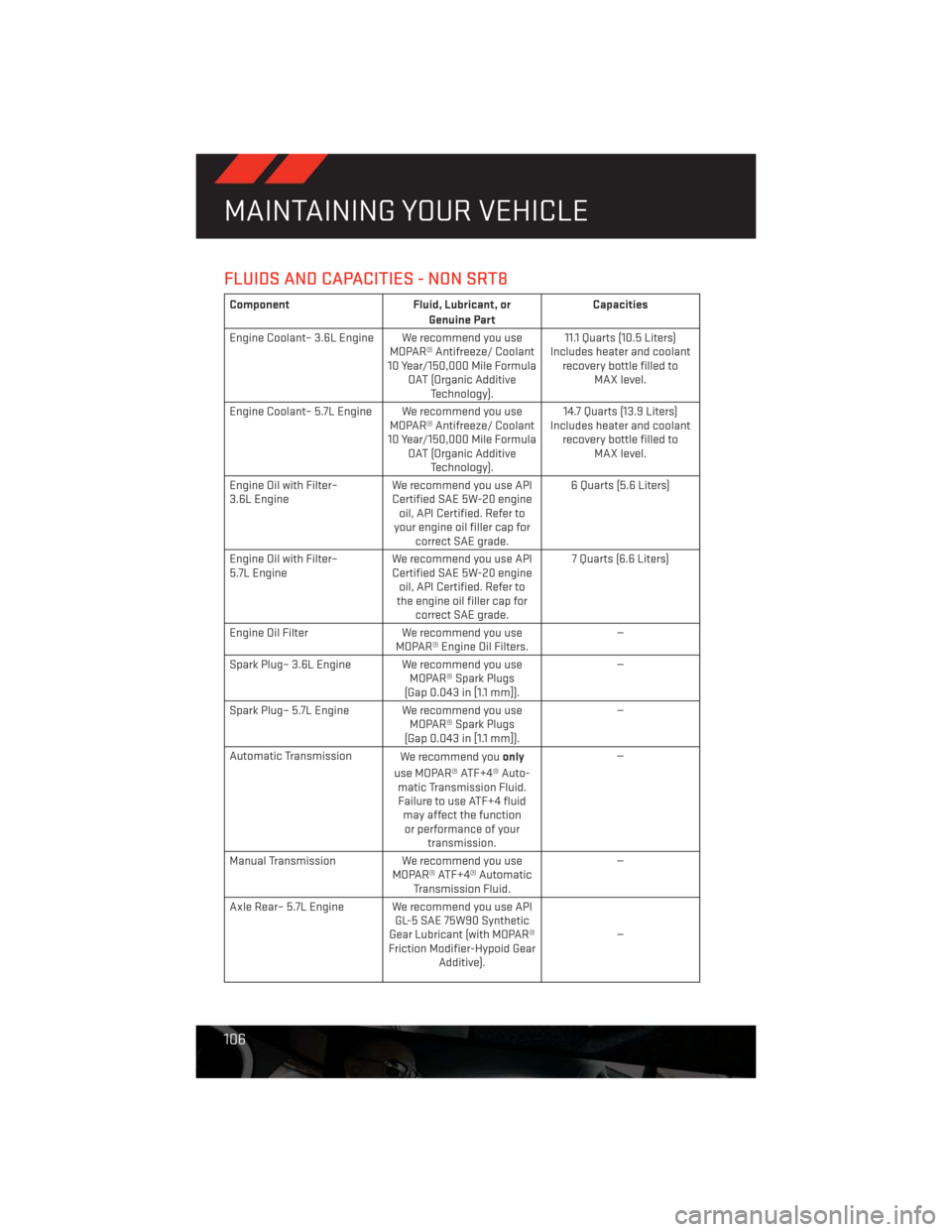
FLUIDS AND CAPACITIES - NON SRT8
Component Fluid, Lubricant, or
Genuine PartCapacities
Engine Coolant– 3.6L Engine We recommend you use
MOPAR® Antifreeze/ Coolant
10 Year/150,000 Mile Formula
OAT (Organic Additive
Technology).11.1 Quarts (10.5 Liters)
Includes heater and coolant
recovery bottle filled to
MAX level.
Engine Coolant– 5.7L Engine We recommend you use
MOPAR® Antifreeze/ Coolant
10 Year/150,000 Mile Formula
OAT (Organic Additive
Technology).14.7 Quarts (13.9 Liters)
Includes heater and coolant
recovery bottle filled to
MAX level.
Engine Oil with Filter–
3.6L EngineWe recommend you use API
Certified SAE 5W-20 engine
oil, API Certified. Refer to
your engine oil filler cap for
correct SAE grade.6 Quarts (5.6 Liters)
Engine Oil with Filter–
5.7L EngineWe recommend you use API
Certified SAE 5W-20 engine
oil, API Certified. Refer to
the engine oil filler cap for
correct SAE grade.7 Quarts (6.6 Liters)
Engine Oil Filter We recommend you use
MOPAR® Engine Oil Filters.—
Spark Plug– 3.6L Engine We recommend you use
MOPAR® Spark Plugs
(Gap 0.043 in [1.1 mm]).—
Spark Plug– 5.7L Engine We recommend you use
MOPAR® Spark Plugs
(Gap 0.043 in [1.1 mm]).—
Automatic Transmission
We recommend youonly
use MOPAR® ATF+4® Auto-
matic Transmission Fluid.
Failure to use ATF+4 fluid
may affect the function
or performance of your
transmission.—
Manual Transmission We recommend you use
MOPAR® ATF+4® Automatic
Transmission Fluid.—
Axle Rear– 5.7L Engine We recommend you use API
GL-5 SAE 75W90 Synthetic
Gear Lubricant (with MOPAR®
Friction Modifier-Hypoid Gear
Additive).—
MAINTAINING YOUR VEHICLE
106
Page 111 of 140
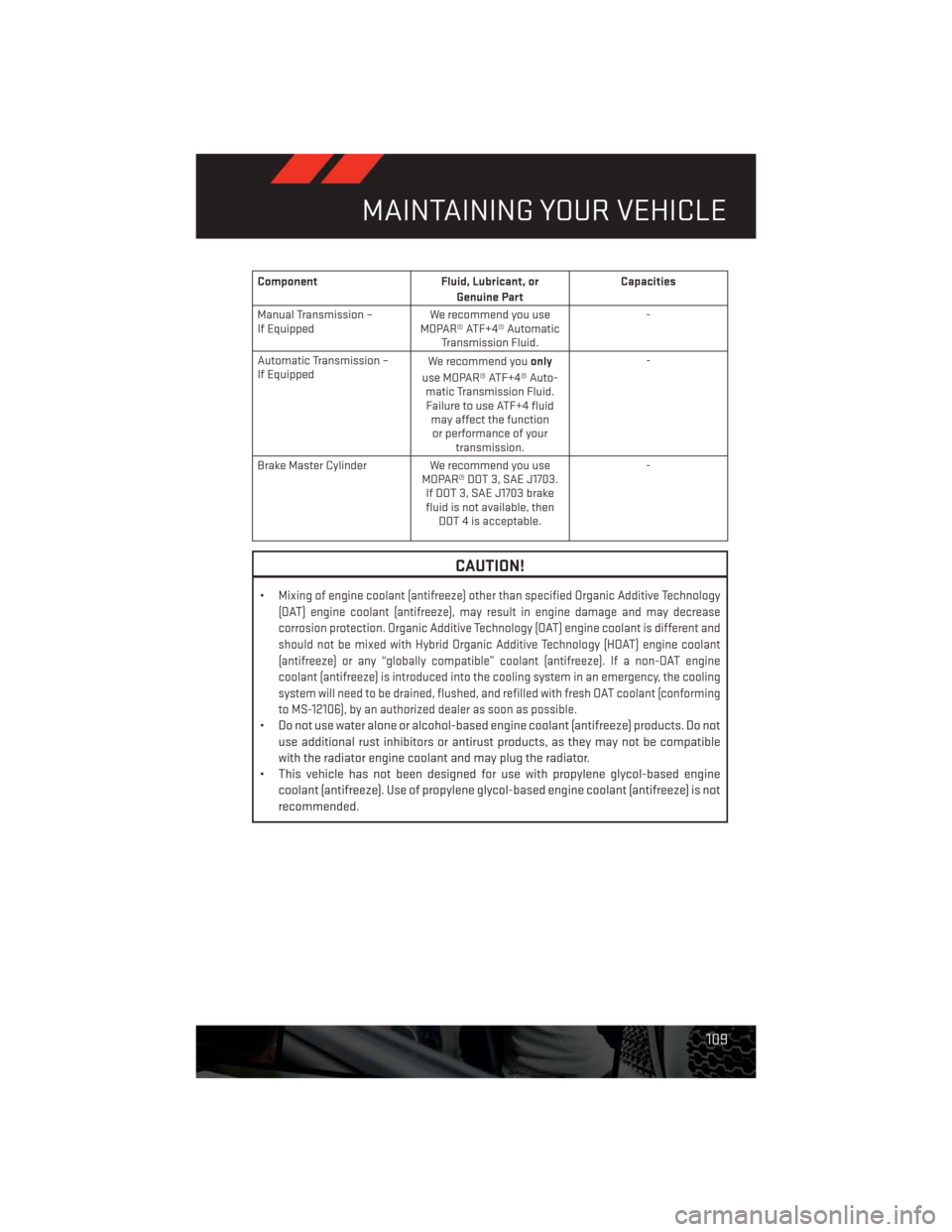
Component Fluid, Lubricant, or
Genuine PartCapacities
Manual Transmission –
If EquippedWe recommend you use
MOPAR® ATF+4® Automatic
Transmission Fluid.-
Automatic Transmission –
If EquippedWe recommend youonly
use MOPAR® ATF+4® Auto-
matic Transmission Fluid.
Failure to use ATF+4 fluid
may affect the function
or performance of your
transmission.-
Brake Master Cylinder We recommend you use
MOPAR® DOT 3, SAE J1703.
If DOT 3, SAE J1703 brake
fluid is not available, then
DOT 4 is acceptable.-
CAUTION!
•Mixing of engine coolant (antifreeze) other than specified Organic Additive Technology
(OAT) engine coolant (antifreeze), may result in engine damage and may decrease
corrosion protection. Organic Additive Technology (OAT) engine coolant is different and
should not be mixed with Hybrid Organic Additive Technology (HOAT) engine coolant
(antifreeze) or any “globally compatible” coolant (antifreeze). If a non-OAT engine
coolant (antifreeze) is introduced into the cooling system in an emergency, the cooling
system will need to be drained, flushed, and refilled with fresh OAT coolant (conforming
to MS-12106), by an authorized dealer as soon as possible.
• Do not use water alone or alcohol-based engine coolant (antifreeze) products. Do not
use additional rust inhibitors or antirust products, as they may not be compatible
with the radiator engine coolant and may plug the radiator.
• This vehicle has not been designed for use with propylene glycol-based engine
coolant (antifreeze). Use of propylene glycol-based engine coolant (antifreeze) is not
recommended.
MAINTAINING YOUR VEHICLE
109
Page 114 of 140
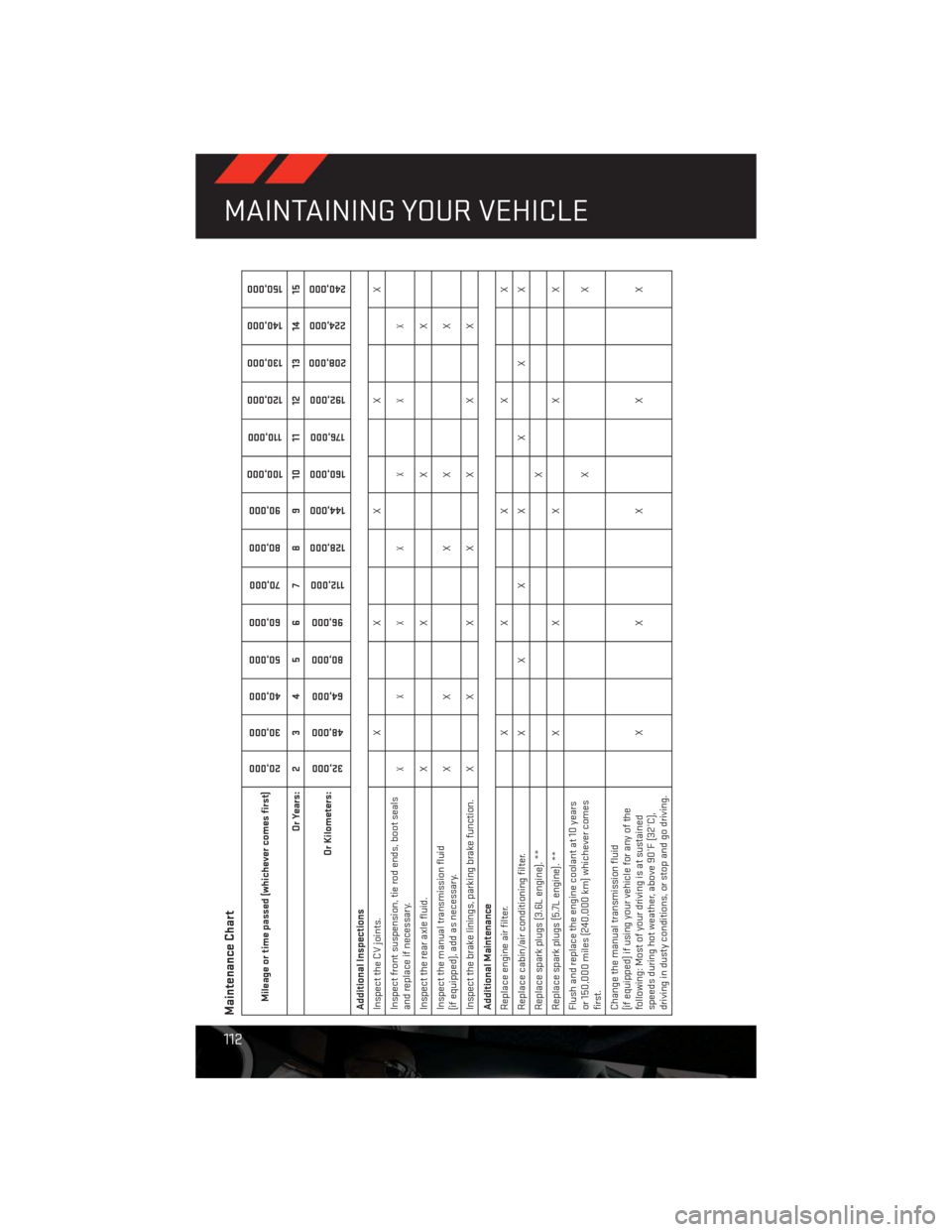
Maintenance ChartMileage or time passed (whichever comes first)
20,000
30,000
40,000
50,000
60,000
70,000
80,000
90,000
100,000
110,000
120,000
130,000
140,000
150,000
Or Years: 2 3 4 5 6 7 8 9 10 11 12 13 14 15
Or Kilometers:
32,000
48,000
64,000
80,000
96,000
112,000
128,000
144,000
160,000
176,000
192,000
208,000
224,000
240,000
Additional Inspections
Inspect the CV joints. X X X X X
Inspect front suspension, tie rod ends, boot seals
and replace if necessary.
XX X X X X X
Inspect the rear axle fluid. X X X X
Inspect the manual transmission fluid
(if equipped), add as necessary.XX X X X
Inspect the brake linings, parking brake function. X X X X X X X
Additional Maintenance
Replace engine air filter. X X X X X
Replace cabin/air conditioning filter. X X X X X X X
Replace spark plugs (3.6L engine). **X
Replace spark plugs (5.7L engine). ** X X X X X
Flush and replace the engine coolant at 10 years
or 150,000 miles (240,000 km) whichever comes
first.XX
Change the manual transmission fluid
(if equipped) if using your vehicle for any of the
following: Most of your driving is at sustained
speeds during hot weather, above 90°F (32°C),
driving in dusty conditions, or stop and go driving.XX X X X
MAINTAINING YOUR VEHICLE
112
Page 117 of 140
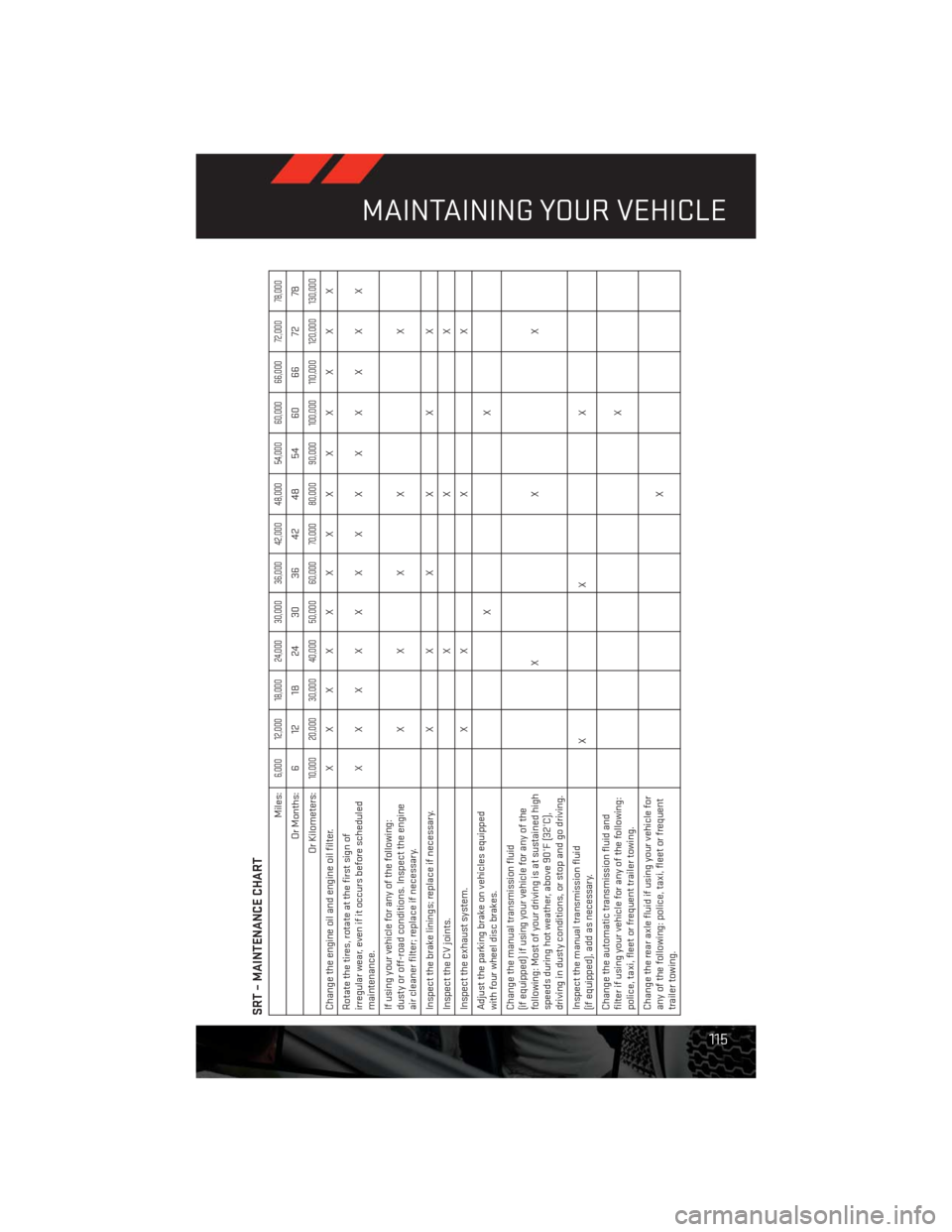
SRT – MAINTENANCE CHART
Miles:
6,000 12,000 18,000 24,000 30,000 36,000 42,000 48,000 54,000 60,000 66,000 72,000 78,000
Or Months: 6 12 18 24 30 36 42 48 54 60 66 72 78
Or Kilometers:
10,000 20,000 30,000 40,000 50,000 60,000 70,000 80,000 90,000 100,000 110,000 120,000 130,000
Change the engine oil and engine oil filter.XXXXXXX XXXXXX
Rotate the tires, rotate at the first sign of
irregular wear, even if it occurs before scheduled
maintenance.XXXXXXX XXXXXX
If using your vehicle for any of the following:
dusty or off-road conditions. Inspect the engine
air cleaner filter; replace if necessary.XXX X X
Inspect the brake linings; replace if necessary. X X X X X X
Inspect the CV joints. X X X
Inspect the exhaust system. X X X X
Adjust the parking brake on vehicles equipped
with four wheel disc brakes.XX
Change the manual transmission fluid
(if equipped) if using your vehicle for any of the
following: Most of your driving is at sustained high
speeds during hot weather, above 90°F (32°C),
driving in dusty conditions, or stop and go driving.XXX
Inspect the manual transmission fluid
(if equipped), add as necessary.XX X
Change the automatic transmission fluid and
filter if using your vehicle for any of the following:
police, taxi, fleet or frequent trailer towing.X
Change the rear axle fluid if using your vehicle for
any of the following: police, taxi, fleet or frequent
trailer towing.X
MAINTAINING YOUR VEHICLE
115