towing DODGE CHALLENGER 2015 3.G Owner's Manual
[x] Cancel search | Manufacturer: DODGE, Model Year: 2015, Model line: CHALLENGER, Model: DODGE CHALLENGER 2015 3.GPages: 603, PDF Size: 14.97 MB
Page 448 of 603
Towing Tips
Before setting out on a trip, practice turning, stopping,
and backing up the trailer in an area located away from
heavy traffic.
Automatic Transmission — If Equipped
The DRIVE range can be selected when towing. The
transmission controls include a drive strategy to avoid
frequent shifting when towing. However, if frequent
shifting does occur while in DRIVE, you can use the
AutoStick® shift control to manually select a lower gear.
NOTE:Using a lower gear while operating the vehicle
under heavy loading conditions will improve perfor-
mance and extend transmission life by reducing exces-
sive shifting and heat build up. This action will also
provide better engine braking.
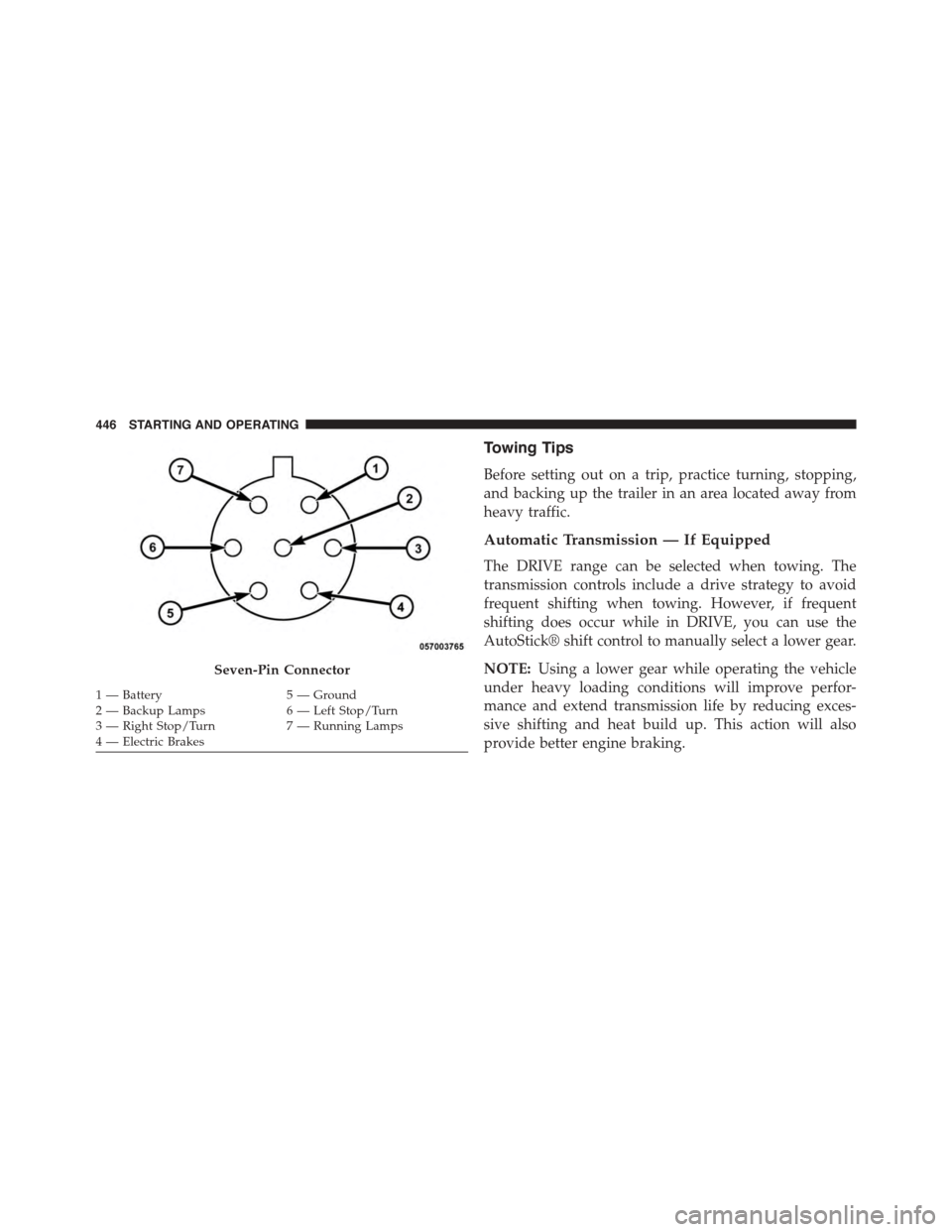
Seven-Pin Connector
1—Battery5—Ground2—BackupLamps6—LeftStop/Turn3—RightStop/Turn7—RunningLamps4 — Electric Brakes
446 STARTING AND OPERATING
Page 450 of 603
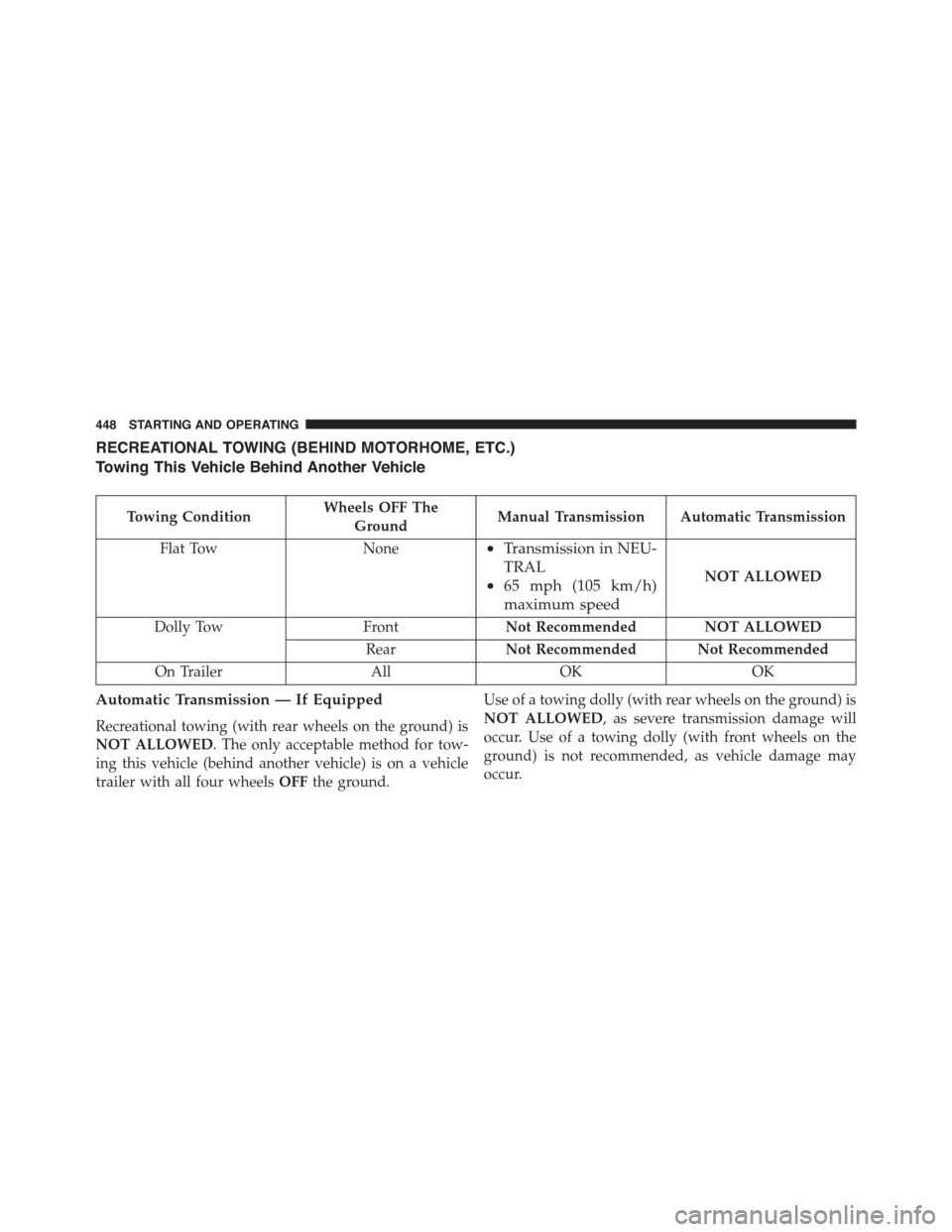
RECREATIONAL TOWING (BEHIND MOTORHOME, ETC.)
Towing This Vehicle Behind Another Vehicle
Towing ConditionWheels OFF The
GroundManual Transmission Automatic Transmission
Flat Tow None•Transmission in NEU-
TRAL
•65 mph (105 km/h)
maximum speed
NOT ALLOWED
Dolly TowFrontNot Recommended NOT ALLOWED
RearNot Recommended Not Recommended
On TrailerAllOKOK
Automatic Transmission — If Equipped
Recreational towing (with rear wheels on the ground) is
NOT ALLOWED. The only acceptable method for tow-
ing this vehicle (behind another vehicle) is on a vehicle
trailer with all four wheelsOFFthe ground.
Use of a towing dolly (with rear wheels on the ground) is
NOT ALLOWED, as severe transmission damage will
occur. Use of a towing dolly (with front wheels on the
ground) is not recommended, as vehicle damage may
occur.
448 STARTING AND OPERATING
Page 451 of 603
CAUTION!
Towing this vehicle in violation of the above require-
ments can cause severe transmission damage. Dam-
age from improper towing is not covered under the
New Vehicle Limited Warranty.
Manual Transmission — If Equipped
Vehicles with a manual transmission may be flat towed
(with all four wheels on the ground) under the following
conditions:
•The transmission must be in NEUTRAL.
•The towing speed must not exceed 65 mph
(105 km/h).
•There is no limitation on towing distance.
Manual transmission vehicles may also be towed using a
vehicle trailer (with all four wheels off the ground).
Use of a towing dolly is not recommended, as vehicle
damage may occur.
CAUTION!
Towing this vehicle in violation of the above require-
ments can cause severe engine and/or transmission
damage. Damage from improper towing is not cov-
ered under the New Vehicle Limited Warranty.
5
STARTING AND OPERATING 449
Page 454 of 603
!MANUAL PARK RELEASE — 8 SPEED
TRANSMISSION.......................481
!TOWING A DISABLED VEHICLE...........484
▫Automatic Transmission.................485
▫Manual Transmission...................486
452 WHAT TO DO IN EMERGENCIES
Page 486 of 603
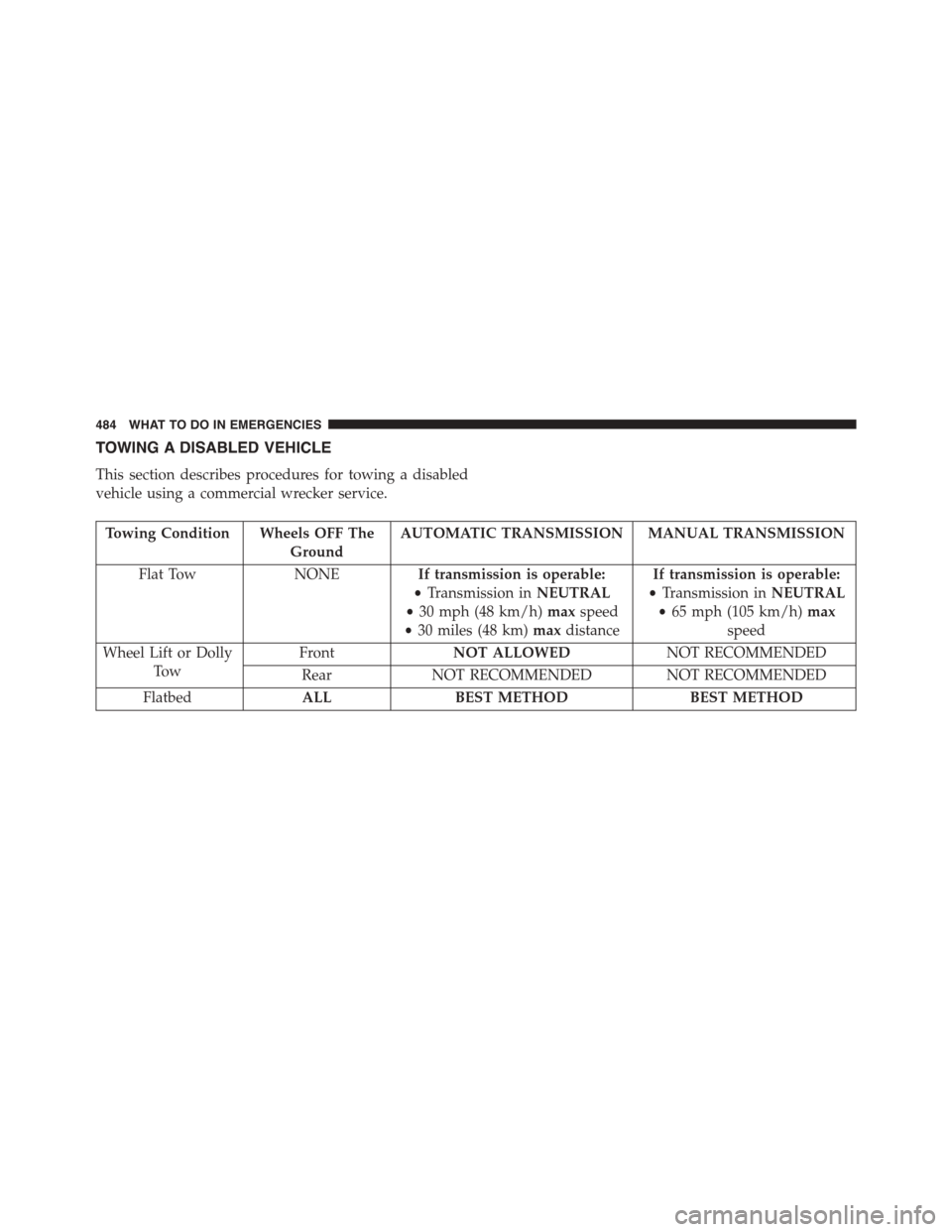
TOWING A DISABLED VEHICLE
This section describes procedures for towing a disabled
vehicle using a commercial wrecker service.
Towing Condition Wheels OFF The
Ground
AUTOMATIC TRANSMISSION MANUAL TRANSMISSION
Flat Tow NONEIf transmission is operable:
•Transmission inNEUTRAL
•30 mph (48 km/h)maxspeed
•30 miles (48 km)maxdistance
If transmission is operable:
•Transmission inNEUTRAL
•65 mph (105 km/h)max
speed
Wheel Lift or Dolly
To w
FrontNOT ALLOWEDNOT RECOMMENDED
RearNOT RECOMMENDEDNOT RECOMMENDED
FlatbedALLBEST METHODBEST METHOD
484 WHAT TO DO IN EMERGENCIES
Page 487 of 603
Proper towing or lifting equipment is required to prevent
damage to your vehicle. Use only tow bars and other
equipment designed for this purpose, following equip-
ment manufacturer ’s instructions. Use of safety chains is
mandatory. Attach a tow bar or other towing device to
main structural members of the vehicle, not to bumpers
or associated brackets. State and local laws regarding
vehicles under tow must be observed.
If you must use the accessories (wipers, defrosters, etc.)
while being towed, the ignition must be in the ON/RUN
position, not the ACC position.
CAUTION!
•Do not use sling type equipment when towing.
Vehicle damage may occur.
(Continued)
CAUTION!(Continued)
•When securing the vehicle to a flatbed truck, do not
attach to front or rear suspension components. Dam-
age to your vehicle may occur from improper towing.
•The manufacturer does not recommend towing this
vehicle using a tow dolly. Vehicle damage may occur.
Automatic Transmission
The manufacturer recommends towing your vehicle with
all four wheels OFF the ground using a flatbed.
If flatbed equipment is not available, and the transmission is
operable, the vehicle may be flat towed (with all four wheels
on the ground) under the following conditions:
•The transmission must be in NEUTRAL.
•The towing distance must not exceed 30 miles (48 km).
•The towing speed must not exceed 30 mph (48 km/h).
6
WHAT TO DO IN EMERGENCIES 485
Page 488 of 603
If the transmission is not operable, or the vehicle must
be towed faster than 30 mph (48 km/h) or farther than 30
miles (48 km), then the only acceptable method of
towing is with a flatbed truck.
CAUTION!
Towing this vehicle in violation of the above require-
ments can cause severe transmission damage. Dam-
age from improper towing is not covered under the
New Vehicle Limited Warranty.
If the key fob is unavailable, or the vehicle’s battery is
discharged, refer to “Manual Park Release” in this section
for instructions on shifting the automatic transmission
out of PARK for towing.
Manual Transmission
The manufacturer recommends towing your vehicle with
all four wheels OFF the ground using a flatbed.
If flatbed equipment is not available, and the transmis-
sion is operable, the vehicle may be flat towed (with all
four wheels on the ground) under the following condi-
tions:
•The transmission must be in NEUTRAL.
•The towing speed must not exceed 65 mph
(105 km/h).
•There is no limitation on towing distance.
If the transmission is not operable, then the only accept-
able method of towing is with a flatbed truck.
CAUTION!
Towing this vehicle in violation of the above require-
ments can cause severe engine and/or transmission
damage. Damage from improper towing is not cov-
ered under the New Vehicle Limited Warranty.
486 WHAT TO DO IN EMERGENCIES
Page 494 of 603
ONBOARD DIAGNOSTIC SYSTEM — OBD II
Your vehicle is equipped with a sophisticated onboard
diagnostic system called OBD II. This system monitors
the performance of the emissions, engine, and automatic
transmission control systems. When these systems are
operating properly, your vehicle will provide excellent
performance and fuel economy, as well as engine emis-
sions well within current government regulations.
If any of these systems require service, the OBD II system
will turn on the “Malfunction Indicator Light” (MIL). It
will also store diagnostic codes and other information to
assist your service technician in making repairs. Al-
though your vehicle will usually be drivable and not
need towing, see your authorized dealer for service as
soon as possible.
CAUTION!
•Prolonged driving with the MIL on could cause
further damage to the emission control system. It
could also affect fuel economy and driveability.
The vehicle must be serviced before any emissions
tests can be performed.
•If the MIL is flashing while the engine is running,
severe catalytic converter damage and power loss
will soon occur. Immediate service is required.
Loose Fuel Filler Cap
If the vehicle diagnostic system determines that the fuel
filler cap is loose, improperly installed, or damaged, a
”gASCAP” message will display in the odometer or a
“Check Gascap” message will display in the Driver
Information Display (DID). If this occurs, tighten the fuel
filler cap properly and press the Trip Odometer button to
492 MAINTAINING YOUR VEHICLE
Page 513 of 603
To minimize the possibility of catalytic converter dam-
age:
•Do not shut off the engine or interrupt the ignition,
when the transmission is in gear and the vehicle is in
motion.
•Do not try to start the engine by pushing or towing the
vehicle.
•Do not idle the engine with any spark plug wires
disconnected or removed, such as when diagnostic
testing, or for prolonged periods during very rough
idle or malfunctioning operating conditions.
NOTE:Your vehicles exhaust system may be equipped
with an Electronic Exhaust Valve (EEV) system, if the
exhaust system is replaced with aftermarket products a
Malfunction Indicator Lamp (MIL) may be illuminated.
Cooling System
WARNING!
•When working near the radiator cooling fan,
disconnect the fan motor lead or place the ignition
in the LOCK position (OFF position for Keyless
Enter-N-Go™). The fan is temperature controlled
and can start at any time the ignition switch is in
the ON position (RUN position for Keyless Enter-
N-Go™).
•You or others can be badly burned by hot engine
coolant (antifreeze) or steam from your radiator. If
you see or hear steam coming from under the hood,
do not open the hood until the radiator has had
time to cool. Never try to open a cooling system
pressure cap when the radiator is hot.
7
MAINTAINING YOUR VEHICLE 511
Page 561 of 603
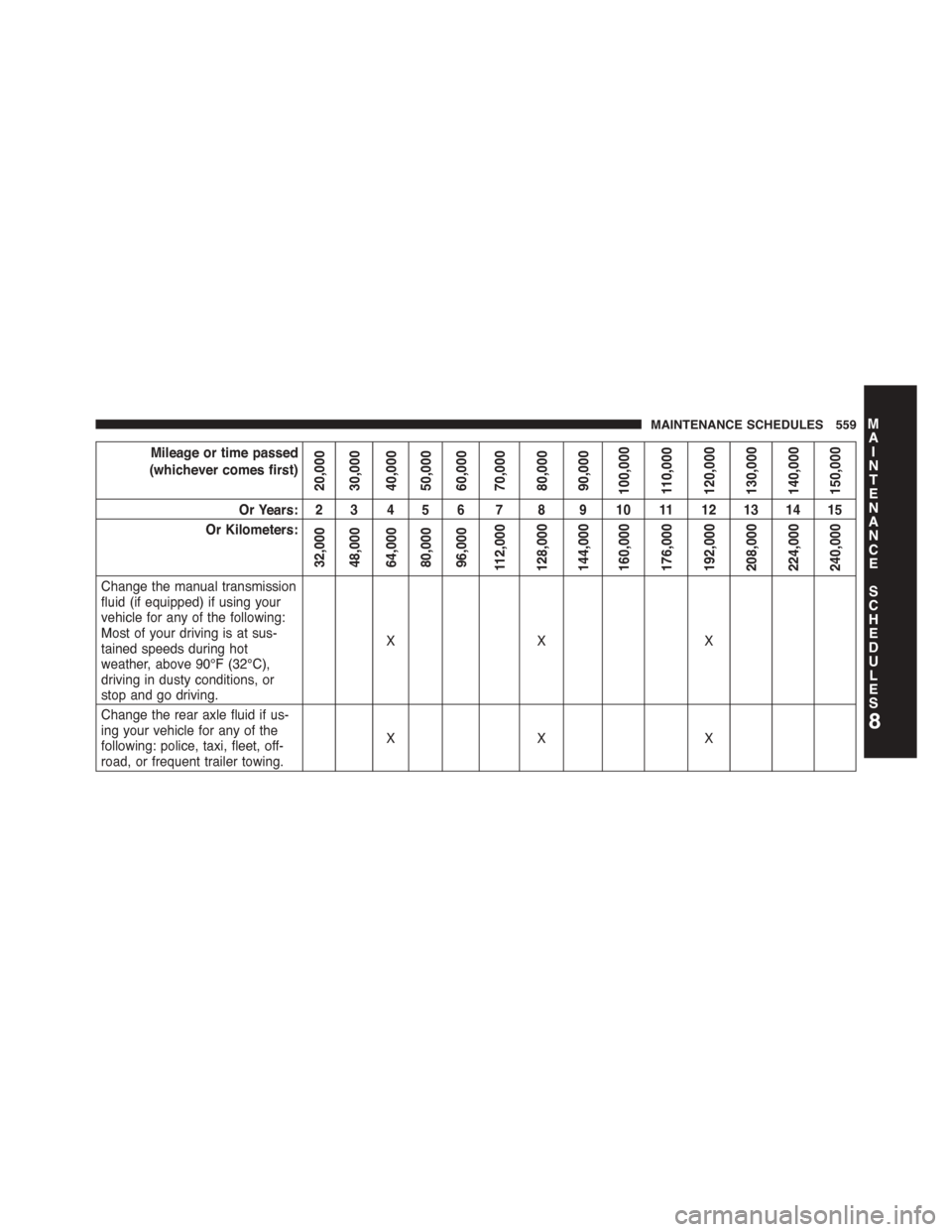
Mileage or time passed
(whichever comes first)
20,00030,00040,00050,00060,00070,00080,00090,000100,000110,000120,000130,000140,000150,000
Or Years: 2 3 4 5 6 7 8 9 10 11 12 13 14 15
Or Kilometers:
32,00048,00064,00080,00096,000112,000128,000144,000160,000176,000192,000208,000224,000240,000
Change the manual transmissionfluid (if equipped) if using yourvehicle for any of the following:Most of your driving is at sus-tained speeds during hotweather, above 90°F (32°C),driving in dusty conditions, orstop and go driving.
XX X
Change the rear axle fluid if us-ing your vehicle for any of thefollowing: police, taxi, fleet, off-road, or frequent trailer towing.
XX X8
MAINTENANCE
SCHEDULES
MAINTENANCE SCHEDULES 559