weight DODGE CHALLENGER 2015 3.G Owners Manual
[x] Cancel search | Manufacturer: DODGE, Model Year: 2015, Model line: CHALLENGER, Model: DODGE CHALLENGER 2015 3.GPages: 603, PDF Size: 14.97 MB
Page 73 of 603
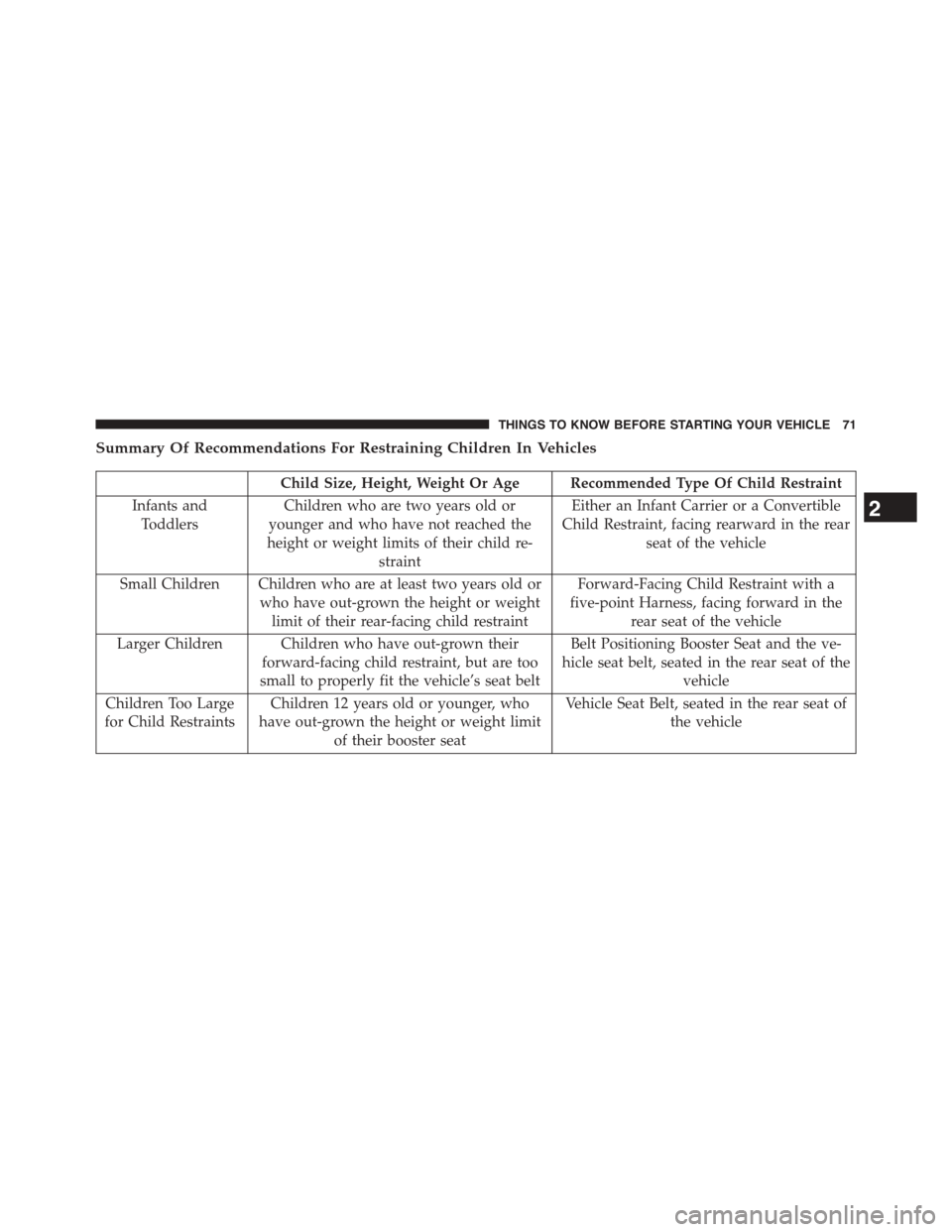
Summary Of Recommendations For Restraining Children In Vehicles
Child Size, Height, Weight Or Age Recommended Type Of Child Restraint
Infants and
Toddlers
Children who are two years old or
younger and who have not reached the
height or weight limits of their child re-
straint
Either an Infant Carrier or a Convertible
Child Restraint, facing rearward in the rear
seat of the vehicle
Small Children Children who are at least two years old or
who have out-grown the height or weight
limit of their rear-facing child restraint
Forward-Facing Child Restraint with a
five-point Harness, facing forward in the
rear seat of the vehicle
Larger Children Children who have out-grown their
forward-facing child restraint, but are too
small to properly fit the vehicle’s seat belt
Belt Positioning Booster Seat and the ve-
hicle seat belt, seated in the rear seat of the
vehicle
Children Too Large
for Child Restraints
Children 12 years old or younger, who
have out-grown the height or weight limit
of their booster seat
Vehicle Seat Belt, seated in the rear seat of
the vehicle
2
THINGS TO KNOW BEFORE STARTING YOUR VEHICLE 71
Page 74 of 603
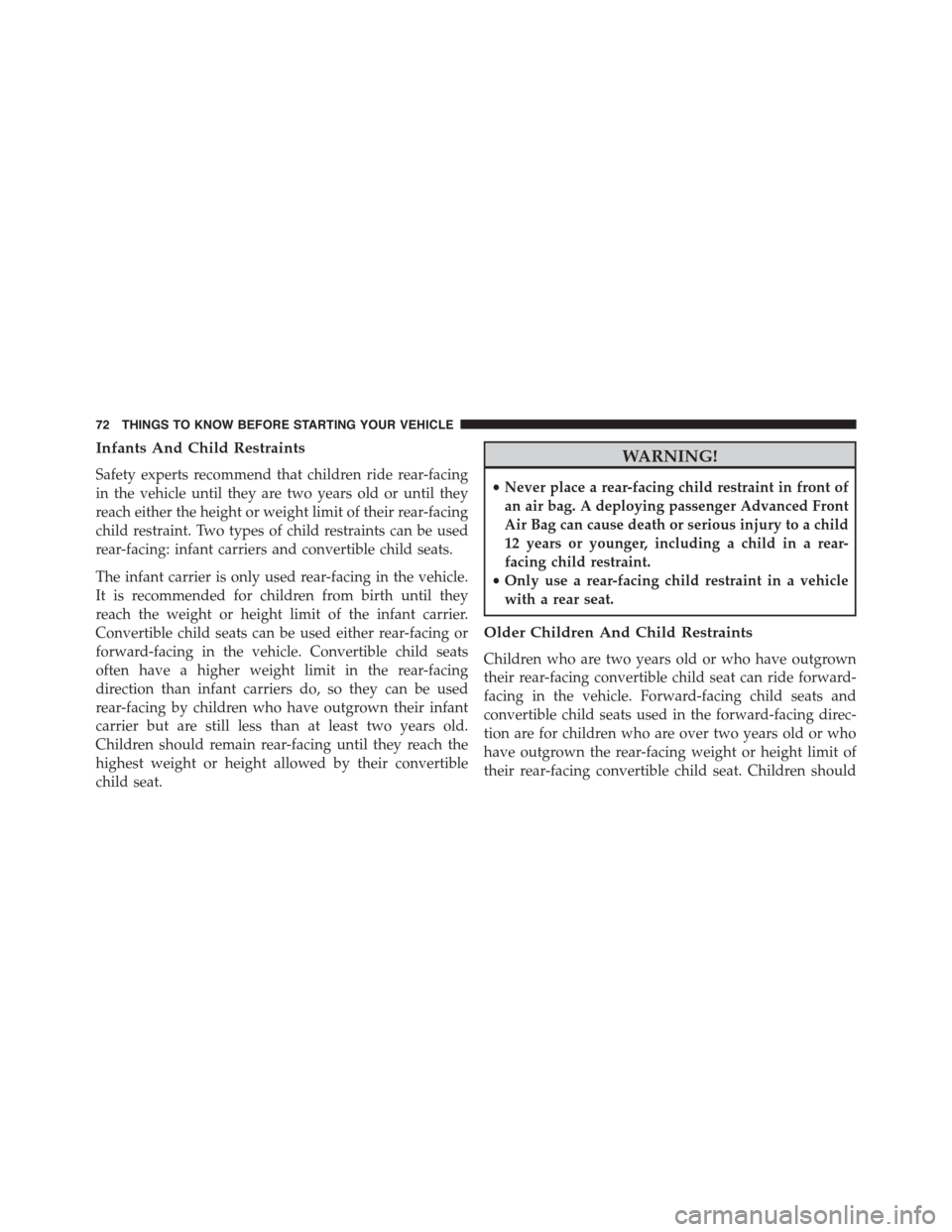
Infants And Child Restraints
Safety experts recommend that children ride rear-facing
in the vehicle until they are two years old or until they
reach either the height or weight limit of their rear-facing
child restraint. Two types of child restraints can be used
rear-facing: infant carriers and convertible child seats.
The infant carrier is only used rear-facing in the vehicle.
It is recommended for children from birth until they
reach the weight or height limit of the infant carrier.
Convertible child seats can be used either rear-facing or
forward-facing in the vehicle. Convertible child seats
often have a higher weight limit in the rear-facing
direction than infant carriers do, so they can be used
rear-facing by children who have outgrown their infant
carrier but are still less than at least two years old.
Children should remain rear-facing until they reach the
highest weight or height allowed by their convertible
child seat.
WARNING!
•Never place a rear-facing child restraint in front of
an air bag. A deploying passenger Advanced Front
Air Bag can cause death or serious injury to a child
12 years or younger, including a child in a rear-
facing child restraint.
•Only use a rear-facing child restraint in a vehicle
with a rear seat.
Older Children And Child Restraints
Children who are two years old or who have outgrown
their rear-facing convertible child seat can ride forward-
facing in the vehicle. Forward-facing child seats and
convertible child seats used in the forward-facing direc-
tion are for children who are over two years old or who
have outgrown the rear-facing weight or height limit of
their rear-facing convertible child seat. Children should
72 THINGS TO KNOW BEFORE STARTING YOUR VEHICLE
Page 75 of 603
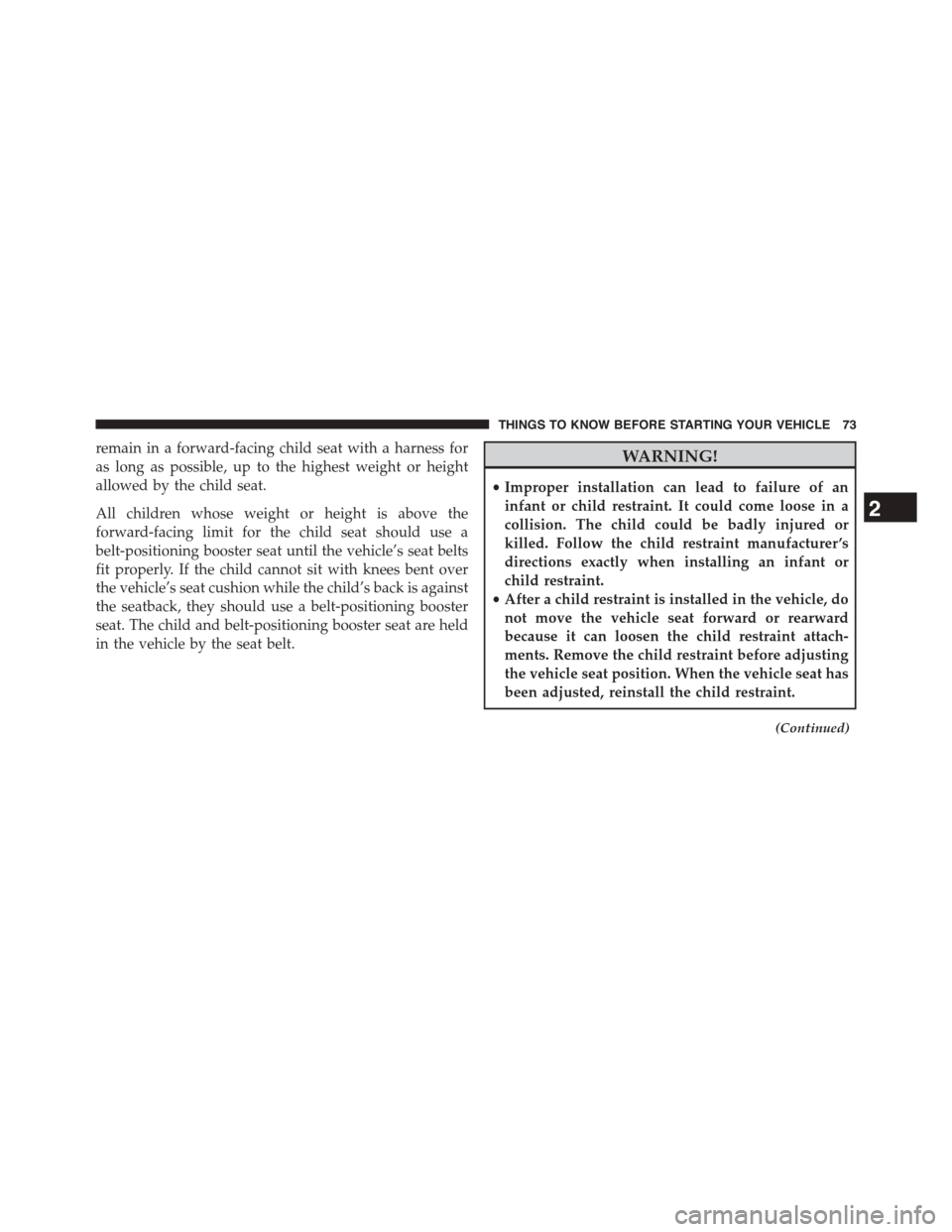
remain in a forward-facing child seat with a harness for
as long as possible, up to the highest weight or height
allowed by the child seat.
All children whose weight or height is above the
forward-facing limit for the child seat should use a
belt-positioning booster seat until the vehicle’s seat belts
fit properly. If the child cannot sit with knees bent over
the vehicle’s seat cushion while the child’s back is against
the seatback, they should use a belt-positioning booster
seat. The child and belt-positioning booster seat are held
in the vehicle by the seat belt.
WARNING!
•Improper installation can lead to failure of an
infant or child restraint. It could come loose in a
collision. The child could be badly injured or
killed. Follow the child restraint manufacturer ’s
directions exactly when installing an infant or
child restraint.
•After a child restraint is installed in the vehicle, do
not move the vehicle seat forward or rearward
because it can loosen the child restraint attach-
ments. Remove the child restraint before adjusting
the vehicle seat position. When the vehicle seat has
been adjusted, reinstall the child restraint.
(Continued)
2
THINGS TO KNOW BEFORE STARTING YOUR VEHICLE 73
Page 78 of 603
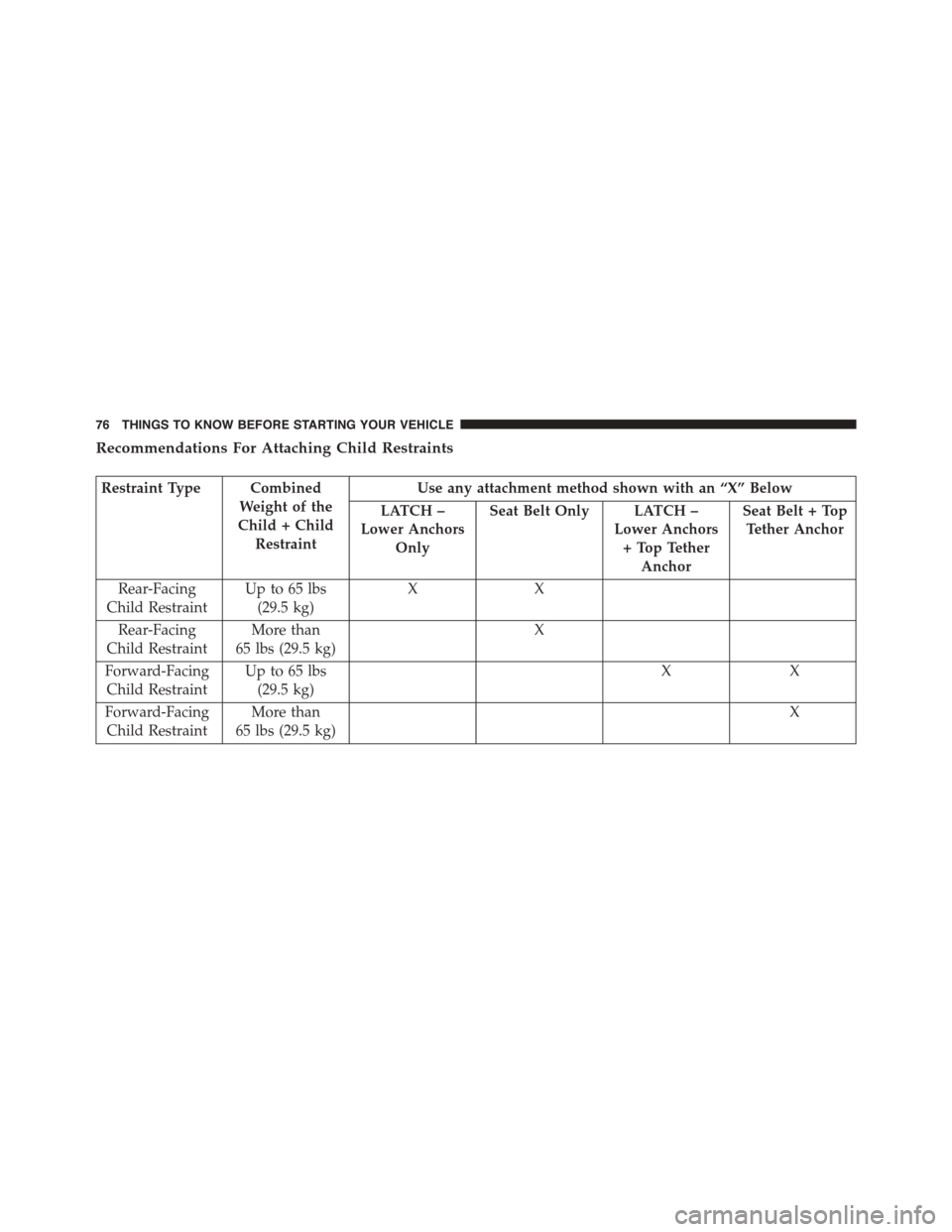
Recommendations For Attaching Child Restraints
Restraint Type Combined
Weight of the
Child + Child
Restraint
Use any attachment method shown with an “X” Below
LATCH –
Lower Anchors
Only
Seat Belt Only LATCH –
Lower Anchors
+ Top Tether
Anchor
Seat Belt + Top
Tether Anchor
Rear-Facing
Child Restraint
Up to 65 lbs
(29.5 kg)
XX
Rear-Facing
Child Restraint
More than
65 lbs (29.5 kg)
X
Forward-Facing
Child Restraint
Up to 65 lbs
(29.5 kg)
XX
Forward-Facing
Child Restraint
More than
65 lbs (29.5 kg)
X
76 THINGS TO KNOW BEFORE STARTING YOUR VEHICLE
Page 81 of 603
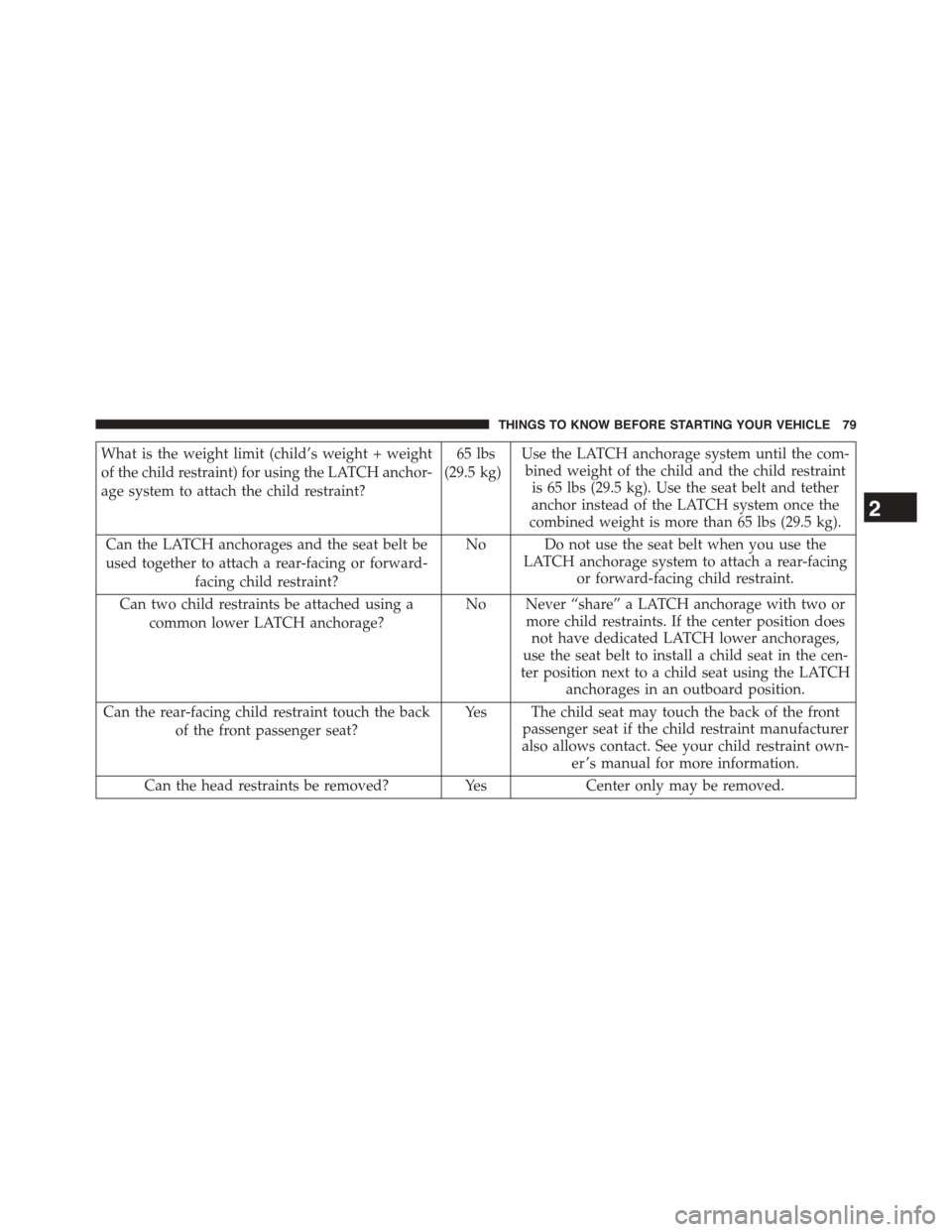
What is the weight limit (child’s weight + weight
of the child restraint) for using the LATCH anchor-
age system to attach the child restraint?
65 lbs
(29.5 kg)
Use the LATCH anchorage system until the com-
bined weight of the child and the child restraint
is 65 lbs (29.5 kg). Use the seat belt and tether
anchor instead of the LATCH system once the
combined weight is more than 65 lbs (29.5 kg).
Can the LATCH anchorages and the seat belt be
used together to attach a rear-facing or forward-
facing child restraint?
No Do not use the seat belt when you use the
LATCH anchorage system to attach a rear-facing
or forward-facing child restraint.
Can two child restraints be attached using a
common lower LATCH anchorage?
No Never “share” a LATCH anchorage with two or
more child restraints. If the center position does
not have dedicated LATCH lower anchorages,
use the seat belt to install a child seat in the cen-
ter position next to a child seat using the LATCH
anchorages in an outboard position.
Can the rear-facing child restraint touch the back
of the front passenger seat?
Yes The child seat may touch the back of the front
passenger seat if the child restraint manufacturer
also allows contact. See your child restraint own-
er ’s manual for more information.
Can the head restraints be removed?YesCenter only may be removed.
2
THINGS TO KNOW BEFORE STARTING YOUR VEHICLE 79
Page 88 of 603
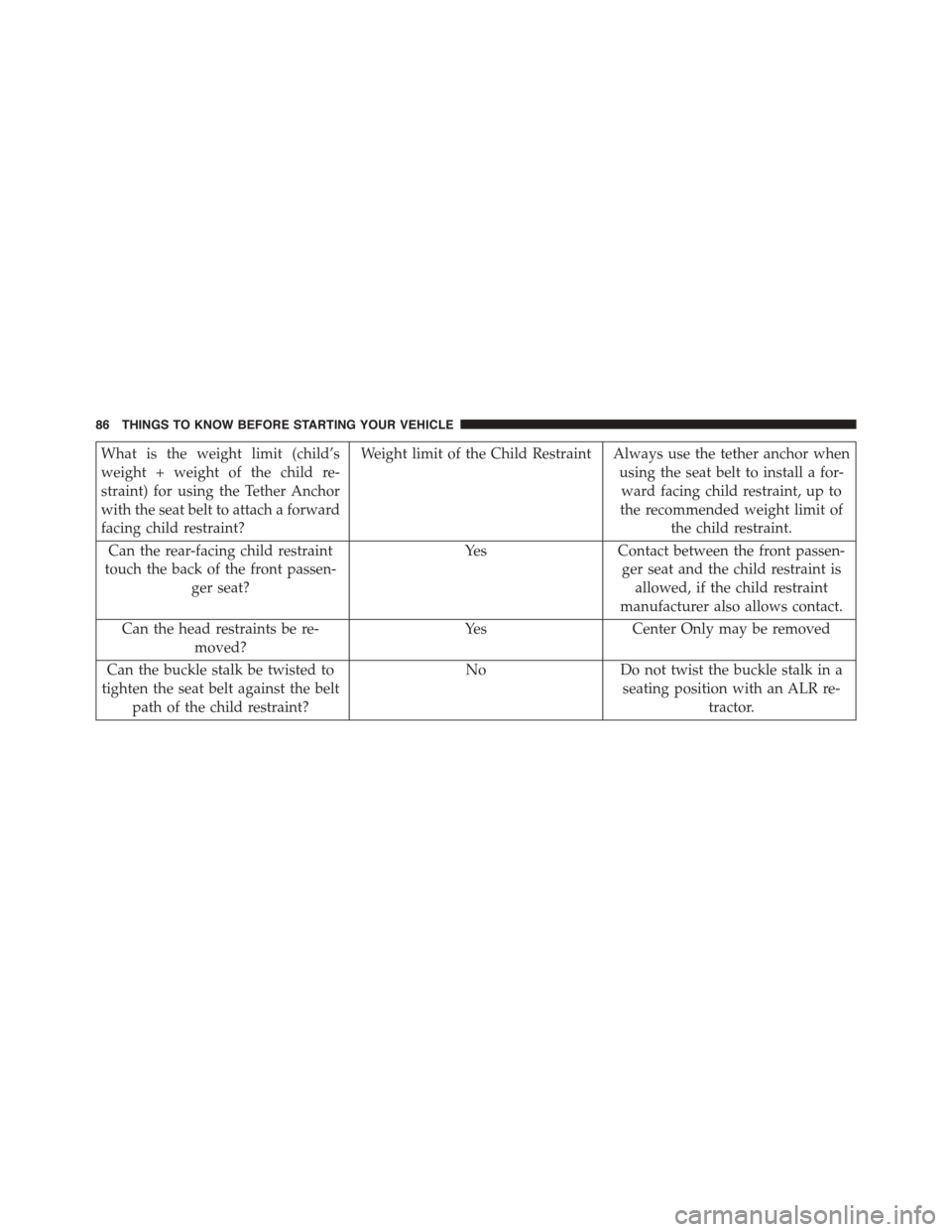
What is the weight limit (child’s
weight + weight of the child re-
straint) for using the Tether Anchor
with the seat belt to attach a forward
facing child restraint?
Weight limit of the Child Restraint Always use the tether anchor when
using the seat belt to install a for-
ward facing child restraint, up to
the recommended weight limit of
the child restraint.
Can the rear-facing child restraint
touch the back of the front passen-
ger seat?
YesContact between the front passen-
ger seat and the child restraint is
allowed, if the child restraint
manufacturer also allows contact.
Can the head restraints be re-
moved?
YesCenter Only may be removed
Can the buckle stalk be twisted to
tighten the seat belt against the belt
path of the child restraint?
NoDo not twist the buckle stalk in a
seating position with an ALR re-
tractor.
86 THINGS TO KNOW BEFORE STARTING YOUR VEHICLE
Page 348 of 603
▫6.4L Engine..........................426
▫Reformulated Gasoline.................427
▫Gasoline/Oxygenate Blends..............427
▫E-85 Usage In Non-Flex Fuel Vehicles.......428
▫MMT In Gasoline.....................428
▫Materials Added To Fuel................429
▫Fuel System Cautions...................429
▫Carbon Monoxide Warnings.............430
!ADDING FUEL........................431
▫Fuel Filler Cap (Gas Cap)...............431
▫Loose Fuel Filler Cap Message............433
!VEHICLE LOADING....................433
▫Vehicle Certification Label...............433
▫Gross Vehicle Weight Rating (GVWR).......434
▫Gross Axle Weight Rating (GAWR).........434
▫Overloading.........................434
▫Loading............................435
!TRAILER TOWING.....................435
▫Common Towing Definitions.............436
▫Trailer Hitch Classification...............439
▫Trailer Towing Weights (Maximum Trailer Weight
Ratings)............................440
▫Trailer And Tongue Weight..............440
▫Towing Requirements..................441
▫Towing Tips.........................446
!RECREATIONAL TOWING (BEHIND
MOTORHOME, ETC.)...................448
▫Towing This Vehicle Behind Another Vehicle . .448
346 STARTING AND OPERATING
Page 401 of 603
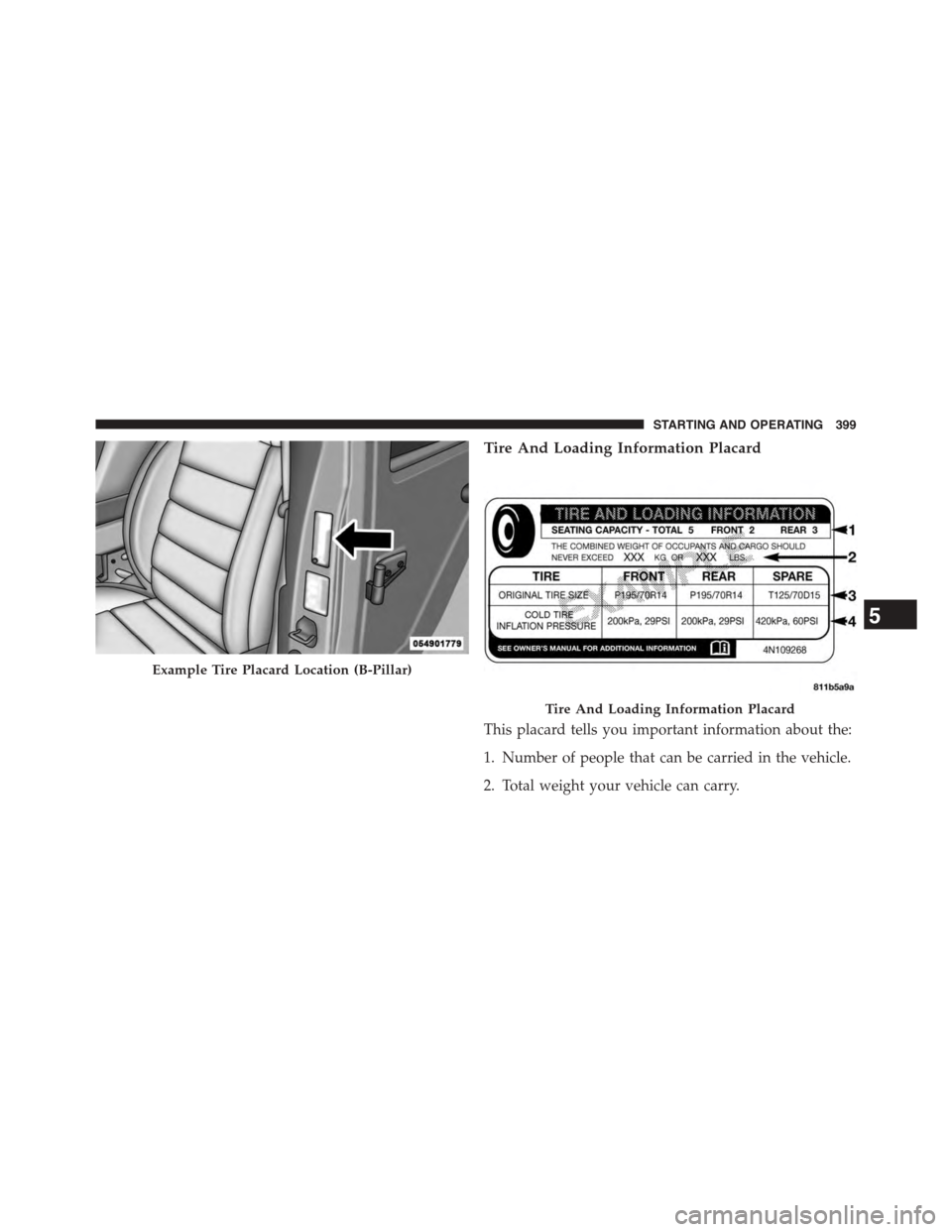
Tire And Loading Information Placard
This placard tells you important information about the:
1. Number of people that can be carried in the vehicle.
2. Total weight your vehicle can carry.
Example Tire Placard Location (B-Pillar)
Tire And Loading Information Placard
5
STARTING AND OPERATING 399
Page 402 of 603
3. Tire size designed for your vehicle.
4. Cold tire inflation pressures for the front, rear, and
spare tires.
Loading
The vehicle maximum load on the tire must not exceed
the load carrying capacity of the tire on your vehicle. You
will not exceed the tire’s load carrying capacity if you
adhere to the loading conditions, tire size, and cold tire
inflation pressures specified on the Tire and Loading
Information placard and in the “Vehicle Loading” section
of this manual.
NOTE:Under a maximum loaded vehicle condition,
gross axle weight ratings (GAWRs) for the front and rear
axles must not be exceeded. For further information on
GAWRs, vehicle loading, and trailer towing, refer to
“Vehicle Loading” in this section.
To determine the maximum loading conditions of your
vehicle, locate the statement “The combined weight of
occupants and cargo should never exceed XXX lbs or
XXX kg” on the Tire and Loading Information placard.
The combined weight of occupants, cargo/luggage and
trailer tongue weight (if applicable) should never exceed
the weight referenced here.
Steps For Determining Correct Load Limit
1. Locate the statement “The combined weight of occu-
pants and cargo should never exceed XXX lbs or
XXX kg” on your vehicle’s placard.
2. Determine the combined weight of the driver and
passengers that will be riding in your vehicle.
3. Subtract the combined weight of the driver and pas-
sengers from XXX lbs or XXX kg.
400 STARTING AND OPERATING
Page 403 of 603
4. The resulting figure equals the available amount of
cargo and luggage load capacity. For example, if
“XXX” amount equals 1,400 lbs (635 kg) and there will
be five 150 lb (68 kg) passengers in your vehicle, the
amount of available cargo and luggage load capacity
is 650 lbs (295 kg) (since 5 x 150 lbs (68 kg) = 750 lbs
(340 kg), and 1400 lbs (635 kg) – 750 lbs (340 kg) =
650 lbs [295 kg]).
5. Determine the combined weight of luggage and cargo
being loaded on the vehicle. That weight may not
safely exceed the available cargo and luggage load
capacity calculated in step 4.
NOTE:
•If your vehicle will be towing a trailer, load from your
trailer will be transferred to your vehicle. The follow-
ing table shows examples on how to calculate total
load, cargo/luggage, and towing capacities of your
vehicle with varying seating configurations and num-
ber and size of occupants. This table is for illustration
purposes only and may not be accurate for the seating
and load carry capacity of your vehicle.
•For the following example, the combined weight of
occupants and cargo should never exceed 865 lbs
(392 kg).
5
STARTING AND OPERATING 401