brake light DODGE CHALLENGER 2017 3.G Owner's Manual
[x] Cancel search | Manufacturer: DODGE, Model Year: 2017, Model line: CHALLENGER, Model: DODGE CHALLENGER 2017 3.GPages: 506, PDF Size: 4.44 MB
Page 331 of 506
WARNING!(Continued)
•Failure to follow these warnings may cause the
vehicle to roll down the incline and could collide
with another vehicle, object or person, and cause
serious or fatal injury. Always remember to use the
parking brake while parking on a hill and that the
driver is responsible for braking the vehicle.
Disabling And Enabling HSA
This feature can be turned on or turned off. To change the
current setting, proceed as follows:
• For vehicles equipped with the instrument cluster dis-
play, refer to “Instrument Cluster Display” in “Under-
standing Your Instrument Panel” for further informa-
tion.
• If disabling HSA using Uconnect Settings, refer to
“Uconnect Settings” in “Understanding Your Instrument
Panel” for further information.
For vehicles not equipped with the instrument cluster
display, perform the following steps:
1. Center the steering wheel (front wheels pointing straight forward). 2. Shift the transmission into PARK.
3. Apply the parking brake.
4. Start the engine.
5. Rotate the steering wheel slightly more than one-half
turn to the left.
6. Push the “ESC Off” button located in the lower switch bank below the climate control four times within twenty
seconds. The “ESC Off Indicator Light” should turn on
and turn off two times.
7. Rotate the steering wheel back to center and then an additional slightly more than one-half turn to the right.
8. Turn the ignition switch to the OFF position and then back to the ON position. If the sequence was completed
properly, the “ESC Off Indicator Light” will blink sev-
eral times to confirm HSA is disabled.
9. Repeat these steps if you want to return this feature to its previous setting.
Traction Control System (TCS)
This system monitors the amount of wheel spin of each of
the driven wheels. If wheel spin is detected, the TCS may
apply brake pressure to the spinning wheel(s) and/or
5
STARTING AND OPERATING 329
Page 332 of 506
reduce engine power to provide enhanced acceleration and
stability. A feature of the TCS, Brake Limited Differential
(BLD), functions similar to a limited slip differential and
controls the wheel spin across a driven axle. If one wheel
on a driven axle is spinning faster than the other, the
system will apply the brake of the spinning wheel. This
will allow more engine torque to be applied to the wheel
that is not spinning. BLD may remain enabled even if TCS
and ESC are in a reduced mode.
Electronic Stability Control (ESC)
This system enhances directional control and stability of
the vehicle under various driving conditions. ESC corrects
for oversteering or understeering of the vehicle by apply-
ing the brake of the appropriate wheel(s) to assist in
counteracting the oversteer or understeer condition. En-
gine power may also be reduced to help the vehicle
maintain the desired path.
ESC uses sensors in the vehicle to determine the vehicle
path intended by the driver and compares it to the actual
path of the vehicle. When the actual path does not match
the intended path, ESC applies the brake of the appropriate
wheel to assist in counteracting the oversteer or understeer
condition.•
Oversteer - when the vehicle is turning more than
appropriate for the steering wheel position.
• Understeer - when the vehicle is turning less than
appropriate for the steering wheel position.
The “ESC Activation/Malfunction Indicator Light” located
in the instrument cluster will start to flash as soon as the
ESC system becomes active. The “ESC Activation/
Malfunction Indicator Light” also flashes when the TCS is
active. If the “ESC Activation/Malfunction Indicator
Light” begins to flash during acceleration, ease up on the
accelerator and apply as little throttle as possible. Be sure to
adapt your speed and driving to the prevailing road
conditions.
WARNING!
• Electronic Stability Control (ESC) cannot prevent the
natural laws of physics from acting on the vehicle,
nor can it increase the traction afforded by prevailing
road conditions. ESC cannot prevent accidents, in-
cluding those resulting from excessive speed in
turns, driving on very slippery surfaces, or hydro-
planing. ESC also cannot prevent accidents resulting
from loss of vehicle control due to inappropriate
(Continued)
330 STARTING AND OPERATING
Page 380 of 506
CAUTION!
If the trailer weighs more than 1,000 lbs (453 kg)
loaded, it should have its own brakes and they should
be of adequate capacity. Failure to do this could lead to
accelerated brake lining wear, higher brake pedal
effort, and longer stopping distances.
Towing Requirements — Trailer Lights And Wiring
(If Equipped)
Whenever you pull a trailer, regardless of the trailer size,
stoplights and turn signals on the trailer are required for
motoring safety.
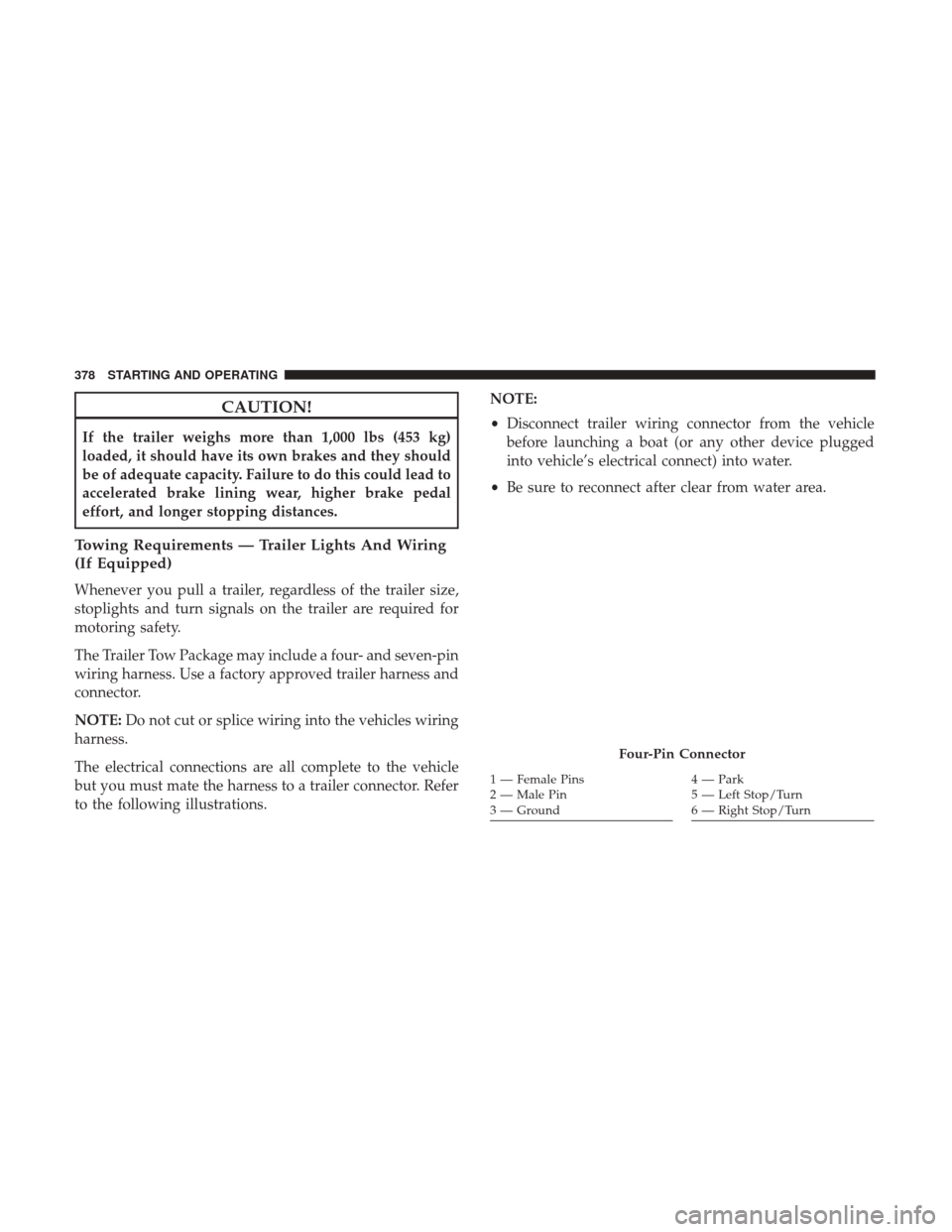
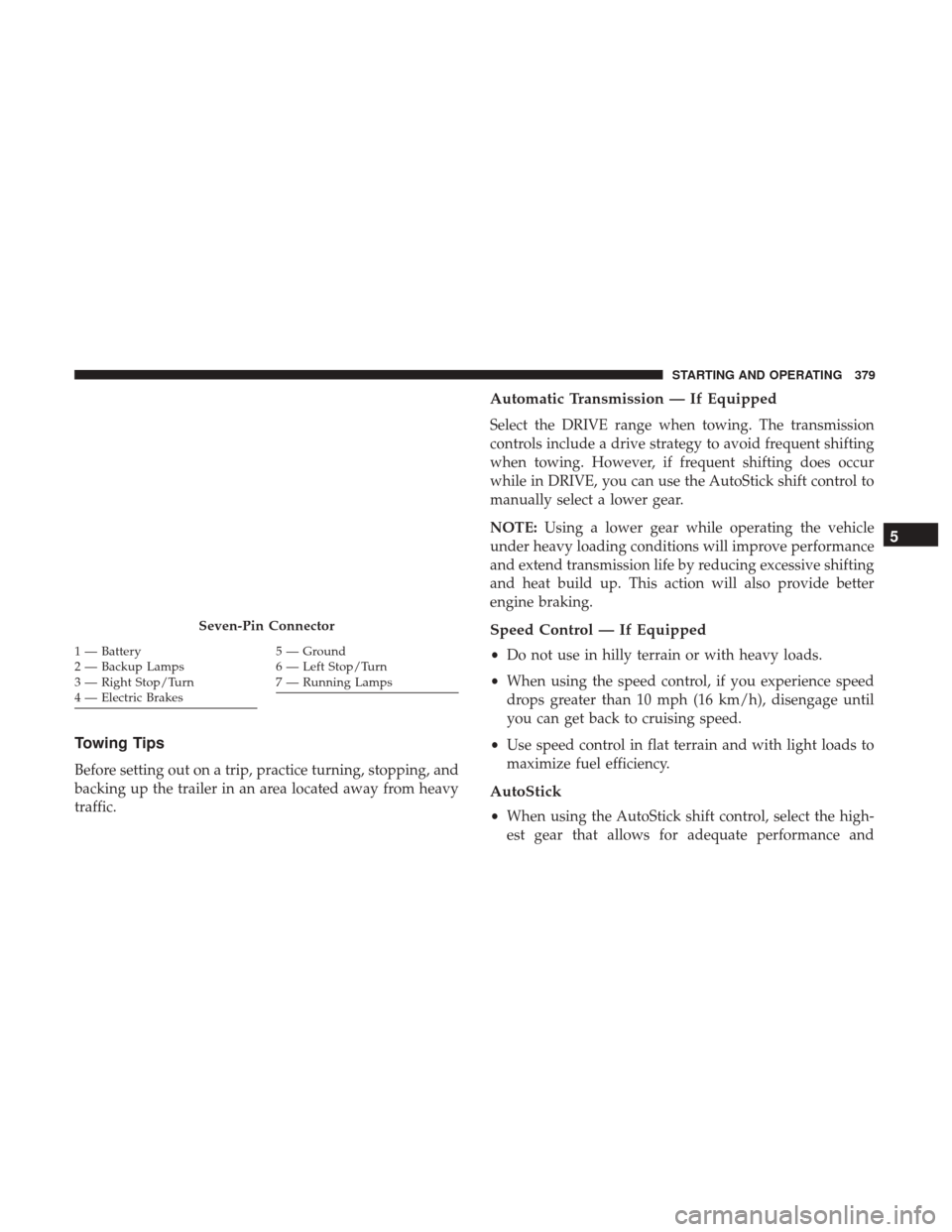
The Trailer Tow Package may include a four- and seven-pin
wiring harness. Use a factory approved trailer harness and
connector.
NOTE:Do not cut or splice wiring into the vehicles wiring
harness.
The electrical connections are all complete to the vehicle
but you must mate the harness to a trailer connector. Refer
to the following illustrations. NOTE:
•
Disconnect trailer wiring connector from the vehicle
before launching a boat (or any other device plugged
into vehicle’s electrical connect) into water.
• Be sure to reconnect after clear from water area.
Four-Pin Connector
1 — Female Pins
2 — Male Pin
3 — Ground4 — Park
5 — Left Stop/Turn
6 — Right Stop/Turn
378 STARTING AND OPERATING
Page 381 of 506
Towing Tips
Before setting out on a trip, practice turning, stopping, and
backing up the trailer in an area located away from heavy
traffic.
Automatic Transmission — If Equipped
Select the DRIVE range when towing. The transmission
controls include a drive strategy to avoid frequent shifting
when towing. However, if frequent shifting does occur
while in DRIVE, you can use the AutoStick shift control to
manually select a lower gear.
NOTE:Using a lower gear while operating the vehicle
under heavy loading conditions will improve performance
and extend transmission life by reducing excessive shifting
and heat build up. This action will also provide better
engine braking.
Speed Control — If Equipped
• Do not use in hilly terrain or with heavy loads.
• When using the speed control, if you experience speed
drops greater than 10 mph (16 km/h), disengage until
you can get back to cruising speed.
• Use speed control in flat terrain and with light loads to
maximize fuel efficiency.
AutoStick
• When using the AutoStick shift control, select the high-
est gear that allows for adequate performance and
Seven-Pin Connector
1 — Battery
2 — Backup Lamps
3 — Right Stop/Turn
4 — Electric Brakes5 — Ground
6 — Left Stop/Turn
7 — Running Lamps
5
STARTING AND OPERATING 379
Page 437 of 506
WARNING!
Riding the brakes can lead to brake failure and possi-
bly a collision. Driving with your foot resting or riding
on the brake pedal can result in abnormally high brake
temperatures, excessive lining wear, and possible
brake damage. You would not have your full braking
capacity in an emergency.
Master Cylinder — Brake Fluid Level Check
Check the fluid level in the master cylinder immediately if
the brake system warning light indicates system failure.
Check the fluid level in the master cylinder when perform-
ing underhood services.
Clean the top of the master cylinder area before removing
the cap. Add fluid to bring the level up to the “MAX” mark
on the side of the master cylinder reservoir.
Overfilling of fluid is not recommended because it may
cause leaking in the system.
Add enough fluid to bring the level up to the requirements
described on the brake fluid reservoir. With disc brakes,fluid level can be expected to fall as the brake pads wear.
However, low fluid level may be caused by a leak and a
checkup may be needed.
Use only manufacturer’s recommended brake fluid. Refer
to “Fluids, Lubricants, And Genuine Parts” in “Maintain-
ing Your Vehicle” for further information.
WARNING!
•
Use only manufacturer’s recommended brake fluid.
Refer to “Fluids, Lubricants, And Genuine Parts” in
“Maintaining Your Vehicle” for further information.
Using the wrong type of brake fluid can severely
damage your brake system and/or impair its perfor-
mance. The proper type of brake fluid for your
vehicle is also identified on the original factory
installed hydraulic master cylinder reservoir.
• To avoid contamination from foreign matter or mois-
ture, use only new brake fluid or fluid that has been
in a tightly closed container. Keep the master cylin-
der reservoir cap secured at all times. Brake fluid in
a open container absorbs moisture from the air
resulting in a lower boiling point. This may cause it
(Continued)
7
MAINTAINING YOUR VEHICLE 435
Page 472 of 506
Once A Month Or Before A Long Trip:
•Check engine oil level.
• Check windshield washer fluid level.
• Check tire pressure and look for unusual wear or
damage. Rotate tires at the first sign of irregular wear,
even if it occurs before your next scheduled service.
• Check the fluid levels of the coolant reservoir, brake
master cylinder, and power steering and fill as needed.
• Check function of all interior and exterior lights.Maintenance Chart — 3.6L And 5.7L
Required Maintenance Intervals
Refer to the maintenance chart for the required mainte-
nance intervals.
At Every Oil Change Interval As Indicated By Oil
Change Indicator System:
•Change oil and filter
• Rotate the tires.
Rotate at the first sign of irregular
wear, even if it occurs before your next scheduled
service
• Inspect battery and clean and tighten terminals as
required
• Inspect brake pads, shoes, rotors, drums, hoses and
park brake
• Inspect engine cooling system protection and hoses
• Inspect exhaust system
• Inspect engine air cleaner if using in dusty or
off-road conditions
470 MAINTENANCE SCHEDULES
Page 476 of 506
Your authorized dealer will reset the oil change indicator
message after completing the scheduled oil change. If a
scheduled oil change is performed by someone other than
your authorized dealer, the message can be reset. Refer to
the steps described under “Instrument Cluster Display” in
“Understanding Your Instrument Panel” for further infor-
mation.
At Each Stop For Fuel
•Check the engine oil level. Refer to “Maintenance
Procedures/Engine Oil” in “Maintaining Your Vehicle”
for further information.
• Check the windshield washer solvent and add if re-
quired.
Once A Month
• Check tire pressure and look for unusual wear or
damage.
• Inspect the battery, and clean and tighten the terminals
as required.
• Check the fluid levels of the coolant reservoir, brake
master cylinder, and power steering, and add as needed.
• Check all lights and other electrical items for correct
operation. At Each Oil Change
•
Change the engine oil filter.
• Inspect the brake hoses and lines.
CAUTION!
Failure to perform the required maintenance items
may result in damage to the vehicle.
474 MAINTENANCE SCHEDULES
Page 488 of 506
About Your Brakes..................... .322, 324
Adaptive Cruise Control (ACC) (Cruise Control) . . . .120
Adding Engine Coolant (Antifreeze) .............431
Adding Fuel ............................. .368
Adding Washer Fluid ....................... .428
Additives, Fuel ........................... .366
Adjust Down .................................95
Forward ............................ .94, 97
Rearward ........................... .94, 97
Up....................................95
AirBag ..................................44 Advance Front Air Bag .....................44
Air Bag Operation .........................46
Air Bag Warning Light .....................43
Enhanced Accident Response ..............52, 408
Event Data Recorder (EDR) .................408
FrontAirBag ............................44
If A Deployment Occurs ....................51
Knee Impact Bolsters .......................47
Maintaining Your Air Bag System ..............53
Redundant Air Bag Warning Light .............44
Side Air Bags ............................47
Transporting Pets .........................68
Air Bag Light ....................... .43, 72, 175Air Bag Maintenance
.........................53
Air Cleaner, Engine (Engine Air Cleaner Filter) ......422
Air Conditioner Maintenance ..................424
Air Conditioning .......................... .269
Air Conditioning Controls ....................269
Air Conditioning Filter ...................278, 426
Air Conditioning, Operating Tips ............277, 279
Air Conditioning Refrigerant ...............424, 425
Air Conditioning System ...............269, 276, 424
Air Pressure, Tires ......................... .346
Alarm Arm The System ..........................14
Disarm The System ........................15
Alarm, Panic ...............................18
Alarm (Security Alarm) ................14, 178, 183
Alarm System (Security Alarm) .................14
All Wheel Drive (AWD) ...................318, 438
Alterations/Modifications, Vehicle ................6
Antifreeze (Engine Coolant) .............431,
460, 461
Disposal .............................. .433
Anti-Lock Brake System (ABS) .................325
Anti-Lock Warning Light .....................189
Appearance Care .......................... .439
Arming System (Security Alarm) ................14
Assist, Hill Start .......................... .327
486 INDEX
Page 489 of 506
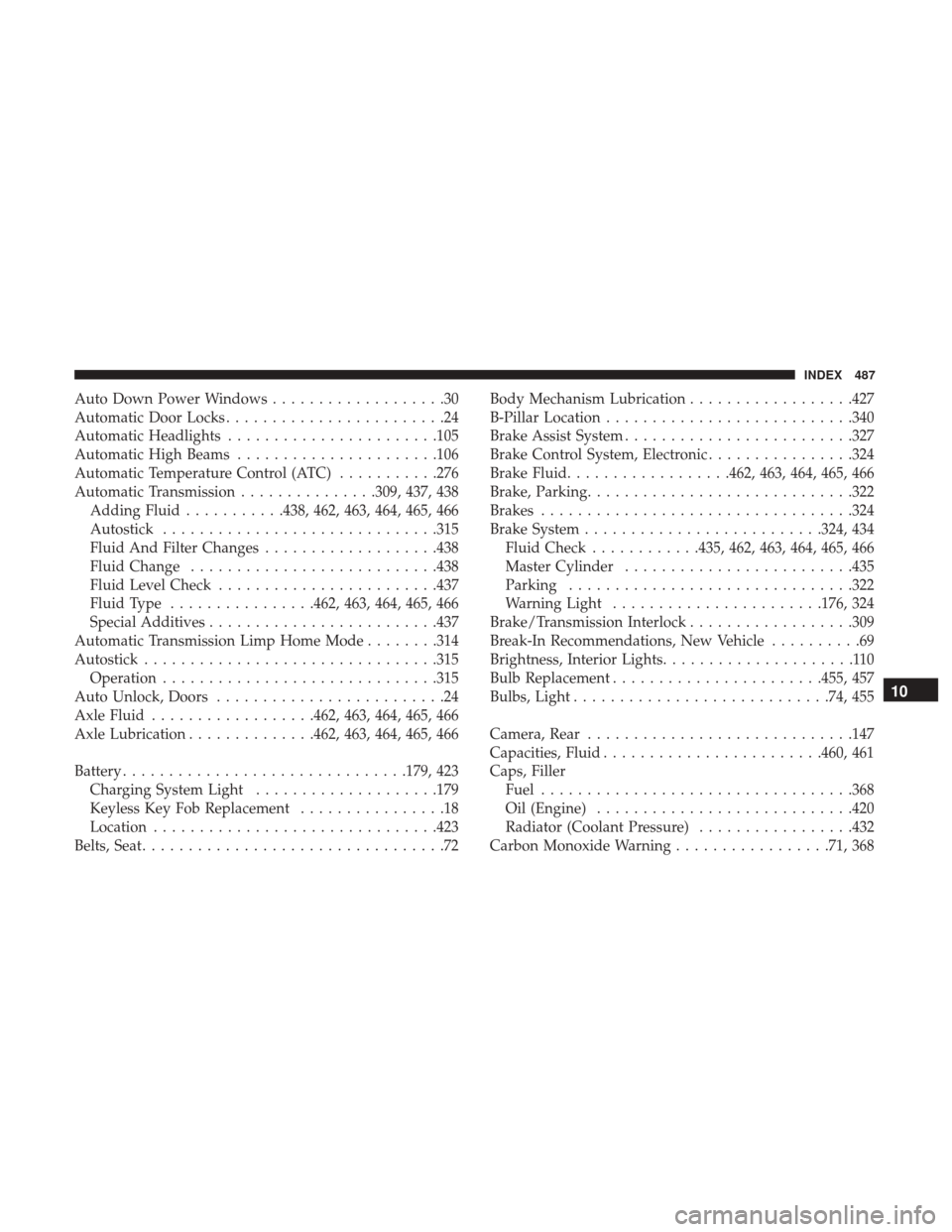
Auto Down Power Windows...................30
Automatic Door Locks ........................24
Automatic Headlights ...................... .105
Automatic High Beams ..................... .106
Automatic Temperature Control (ATC) ...........276
Automatic Transmission ...............309, 437, 438
Adding Fluid ...........438, 462, 463, 464, 465, 466
Autostick ............................. .315
Fluid And Filter Changes ...................438
Fluid Change .......................... .438
Fluid Level Check ....................... .437
Fluid Type ................462, 463, 464, 465, 466
Special Additives ........................ .437
Automatic Transmission Limp Home Mode ........314
Autostick ............................... .315
Operation ............................. .315
Auto Unlock, Doors .........................24
Axle Fluid ..................462, 463, 464, 465, 466
Axle Lubrication ..............462, 463, 464, 465, 466
Battery .............................. .179, 423
Charging System Light ....................179
Keyless Key Fob Replacement ................18
Location .............................. .423
Belts, Seat .................................72 Body Mechanism Lubrication
..................427
B-Pillar Location .......................... .340
Brake Assist System ........................ .327
Brake Control System, Electronic ................324
Brake Fluid ..................462, 463, 464, 465, 466
Brake, Parking ............................ .322
Brakes ................................. .324
Brake System ......................... .324, 434
Fluid Check ............435, 462, 463, 464, 465, 466
Master Cylinder ........................ .435
Parking .............................. .322
Warning Light ...................... .176,
324
Brake/Transmission Interlock ..................309
Break-In Recommendations, New Vehicle ..........69
Brightness, Interior Lights .....................110
Bulb Replacement ...................... .455, 457
Bulbs, Light ........................... .74, 455
Camera, Rear ............................ .147
Capacities, Fluid ....................... .460, 461
Caps, Filler Fuel ................................. .368
Oil (Engine) ........................... .420
Radiator (Coolant Pressure) .................432
Carbon Monoxide Warning .................71, 368
10
INDEX 487
Page 491 of 506
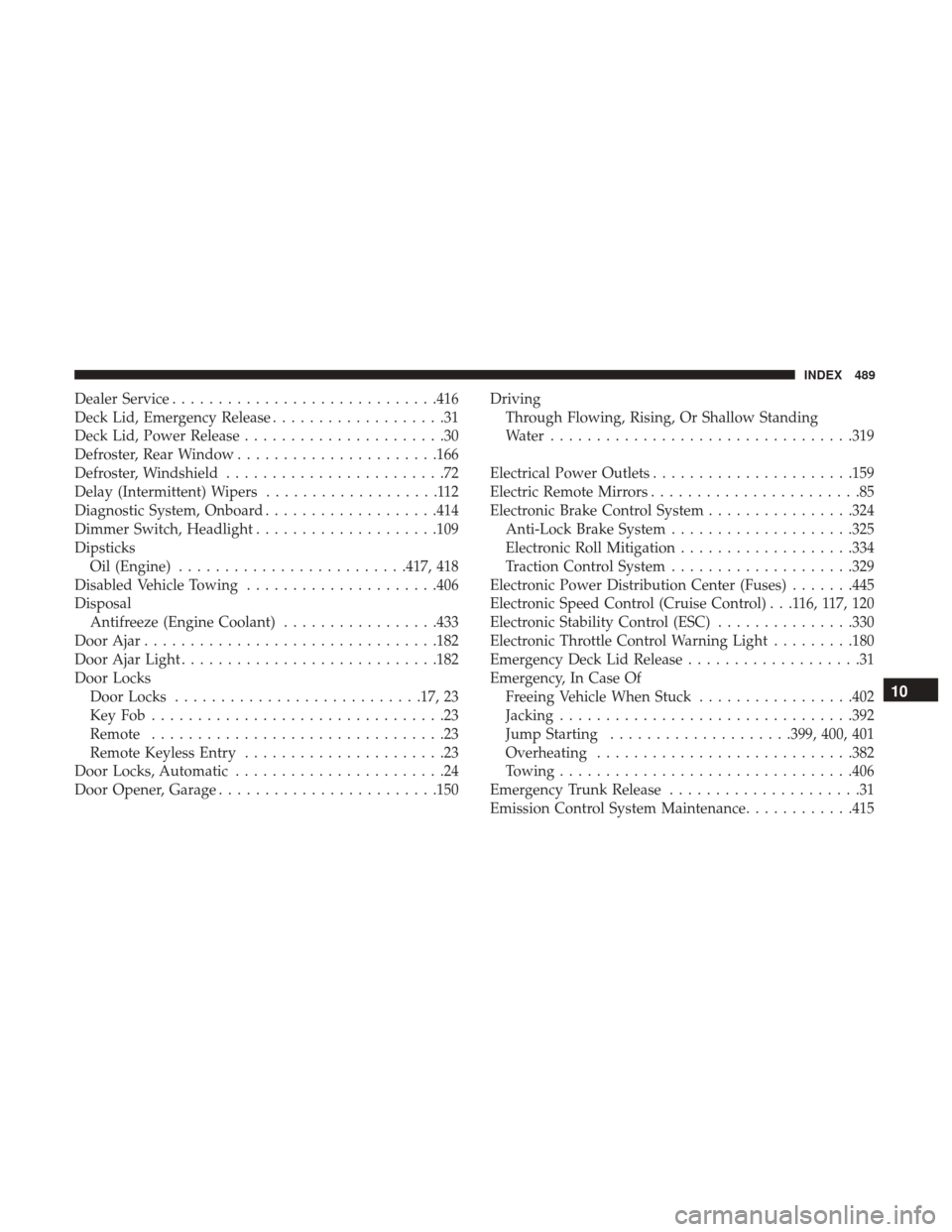
Dealer Service............................ .416
Deck Lid, Emergency Release ...................31
Deck Lid, Power Release ......................30
Defroster, Rear Window ..................... .166
Defroster, Windshield ........................72
Delay (Intermittent) Wipers ...................112
Diagnostic System, Onboard ...................414
Dimmer Switch, Headlight ....................109
Dipsticks Oil (Engine) ........................ .417, 418
Disabled Vehicle Towing .....................406
Disposal Antifreeze (Engine Coolant) .................433
Door Ajar ............................... .182
Door Ajar Light ........................... .182
Door Locks Door Locks .......................... .17, 23
KeyFob................................23
Remote ................................23
Remote Keyless Entry ......................23
Door Locks, Automatic .......................24
Door Opener, Garage ....................... .150Driving
Through Flowing, Rising, Or Shallow Standing
Water ................................ .319
Electrical Power Outlets ..................... .159
Electric Remote Mirrors .......................85
Electronic Brake Control System ................324
Anti-Lock Brake System ....................325
Electronic Roll Mitigation ...................334
Traction Control System ....................329
Electronic Power Distribution Center (Fuses) .......445
Electronic Speed Control (Cruise Control) . . .116, 117, 120
Electronic Stability Control (ESC) ...............330
Electronic Throttle Control Warning Light .........180
Emergency Deck Lid Release ...................31
Emergency, In Case Of Freeing Vehicle When Stuck .................402
Jacking ............................... .392
Jump Starting ....................399, 400, 401
Overheating ........................... .382
Towing ............................... .406
Emergency Trunk Release .....................31
Emission Control System Maintenance ............415
10
INDEX 489