oil DODGE CHALLENGER 2017 3.G Owner's Guide
[x] Cancel search | Manufacturer: DODGE, Model Year: 2017, Model line: CHALLENGER, Model: DODGE CHALLENGER 2017 3.GPages: 506, PDF Size: 4.44 MB
Page 424 of 506
3. Using a water and mild detergent clean the followinglocations.
— The water drain slot located at the front forward edge of
the shaker assembly.
— The seals attached to the scoop and air box.
— Lower water drains located in the lower shaker assem-
bly and air box as well as the hood interface areas for the
seals. Apply Mopar Leather, Rubber & Vinyl Protectant
after cleaning to seals.
4. Re-install shaker assembly.
Synthetic Engine Oils
You may use synthetic engine oils provided the recom-
mended oil quality requirements are met, and the recom-
mended maintenance intervals for oil and filter changes are
followed.
Synthetic engine oils which do not have both the engine oil
certification mark and the correct SAE viscosity grade
number should not be used.
Disposing Of Used Engine Oil And Oil Filters
Care should be taken in disposing of used engine oil and
oil filters from your vehicle. Used oil and oil filters,
indiscriminately discarded, can present a problem to the
environment. Contact your authorized dealer, service sta-
tion or governmental agency for advice on how and where
used oil and oil filters can be safely discarded in your area.
Engine Oil Filter
The engine oil filter should be replaced with a new filter at
every engine oil change.
Engine Oil Filter Selection
This manufacturer’s engines have a full-flow type oil filter.
Use a filter of this type for replacement. The quality of
replacement filters varies considerably. Only high quality
filters should be used to assure most efficient service.
Mopar engine oil filters are high quality oil filters and are
recommended.
Engine Air Cleaner Filter
Refer to the “Maintenance Schedule” for the proper main-
tenance intervals.
422 MAINTAINING YOUR VEHICLE
Page 427 of 506
WARNING!
•Use only refrigerants and compressor lubricants ap-
proved by the manufacturer for your air conditioning
system. Some unapproved refrigerants are flam-
mable and can explode, injuring you. Other unap-
proved refrigerants or lubricants can cause the sys-
tem to fail, requiring costly repairs. Refer to
Warranty Information Book, located on the DVD, for
further warranty information.
• The air conditioning system contains refrigerant un-
der high pressure. To avoid risk of personal injury or
damage to the system, adding refrigerant or any
repair requiring lines to be disconnected should be
done by an experienced technician.
CAUTION!
Do not use chemical flushes in your air conditioning
system as the chemicals can damage your air condition-
ing components. Such damage is not covered by the
New Vehicle Limited Warranty.
Refrigerant Recovery And Recycling R134a — If
Equipped
R-134a Air Conditioning Refrigerant is a hydrofluoro-
carbon (HFC) that is endorsed by the Environmental
Protection Agency and is an ozone-saving product. How-
ever, the manufacturer recommends that air conditioning
service be performed by authorized dealer or other service
facilities using recovery and recycling equipment.
NOTE: Use only manufacturer approved A/C system PAG
compressor oil and refrigerants.
Refrigerant Recovery And Recycling R1234yf — If
Equipped
R-1234yf Air Conditioning Refrigerant is a hydrofluoole-
fine HFO that is endorsed by the Environmental Protection
Agency and is an ozone-saving product with a low GWP
(Global Warming Potential). However, the manufacturer
recommends that air conditioning service be performed by
authorized dealer or other service facilities using recovery
and recycling equipment.
NOTE: Use only manufacturer approved A/C system
PAG compressor oil and refrigerants.
7
MAINTAINING YOUR VEHICLE 425
Page 429 of 506
5. Close the filter access cover.
Refer to the “Maintenance Schedule” for the proper main-
tenance intervals.
Body Lubrication
Locks and all body pivot points, including such items as
seat tracks, door hinge pivot points and rollers, liftgate,
tailgate, decklid, sliding doors and hood hinges, should be
lubricated periodically with a lithium based grease, such as
Mopar Spray White Lube to assure quiet, easy operation
and to protect against rust and wear. Prior to the applica-
tion of any lubricant, the parts concerned should be wipedclean to remove dust and grit; after lubricating excess oil
and grease should be removed. Particular attention should
also be given to hood latching components to ensure
proper function. When performing other underhood ser-
vices, the hood latch, release mechanism and safety catch
should be cleaned and lubricated.
The external lock cylinders should be lubricated twice a
year, preferably in the Fall and Spring. Apply a small
amount of a high quality lubricant, such as Mopar Lock
Cylinder Lubricant directly into the lock cylinder.
Windshield Wiper Blades
Clean the rubber edges of the wiper blades and the
windshield periodically with a sponge or soft cloth and a
mild nonabrasive cleaner. This will remove accumulations
of salt or road film.
Operation of the wipers on dry glass for long periods may
cause deterioration of the wiper blades. Always use washer
fluid when using the wipers to remove salt or dirt from a
dry windshield.
Avoid using the wiper blades to remove frost or ice from
the windshield. Keep the blade rubber out of contact with
petroleum products such as engine oil, gasoline, etc.A/C Air Filter
7
MAINTAINING YOUR VEHICLE 427
Page 430 of 506
NOTE:Life expectancy of wiper blades varies depending
on geographical area and frequency of use. Poor perfor-
mance of blades may be present with chattering, marks,
water lines or wet spots. If any of these conditions are
present, clean the wiper blades or replace as necessary.
Adding Washer Fluid
The windshield washer fluid reservoir is located in the
front of the engine compartment. Be sure to check the fluid
level at regular intervals. Fill the reservoir with windshield
washer solvent (not radiator antifreeze) and operate the
system for a few seconds to flush out the residual water.
When refilling the washer fluid reservoir, apply some
washer fluid to a cloth or towel and wipe the wiper blades
clean. This will help blade performance.
To prevent freeze-up of your windshield washer system in
cold weather, select a solution or mixture that meets or
exceeds the temperature range of your climate. This rating
information can be found on most washer fluid containers.
The fluid reservoir will hold nearly 1 gallon (4 liters) of
washer fluid when the message “Low Washer Fluid”
appears in the instrument cluster.
WARNING!
Commercially available windshield washer solvents
are flammable. They could ignite and burn you. Care
must be exercised when filling or working around the
washer solution.
Exhaust System
The best protection against carbon monoxide entry into the
vehicle body is a properly maintained engine exhaust
system.
If you notice a change in the sound of the exhaust system;
or if the exhaust fumes can be detected inside the vehicle;
or when the underside or rear of the vehicle is damaged;
have an authorized technician inspect the complete ex-
haust system and adjacent body areas for broken, dam-
aged, deteriorated, or mispositioned parts. Open seams or
loose connections could permit exhaust fumes to seep into
the passenger compartment. In addition, have the exhaust
system inspected each time the vehicle is raised for lubri-
cation or oil change. Replace as required.
428 MAINTAINING YOUR VEHICLE
Page 437 of 506
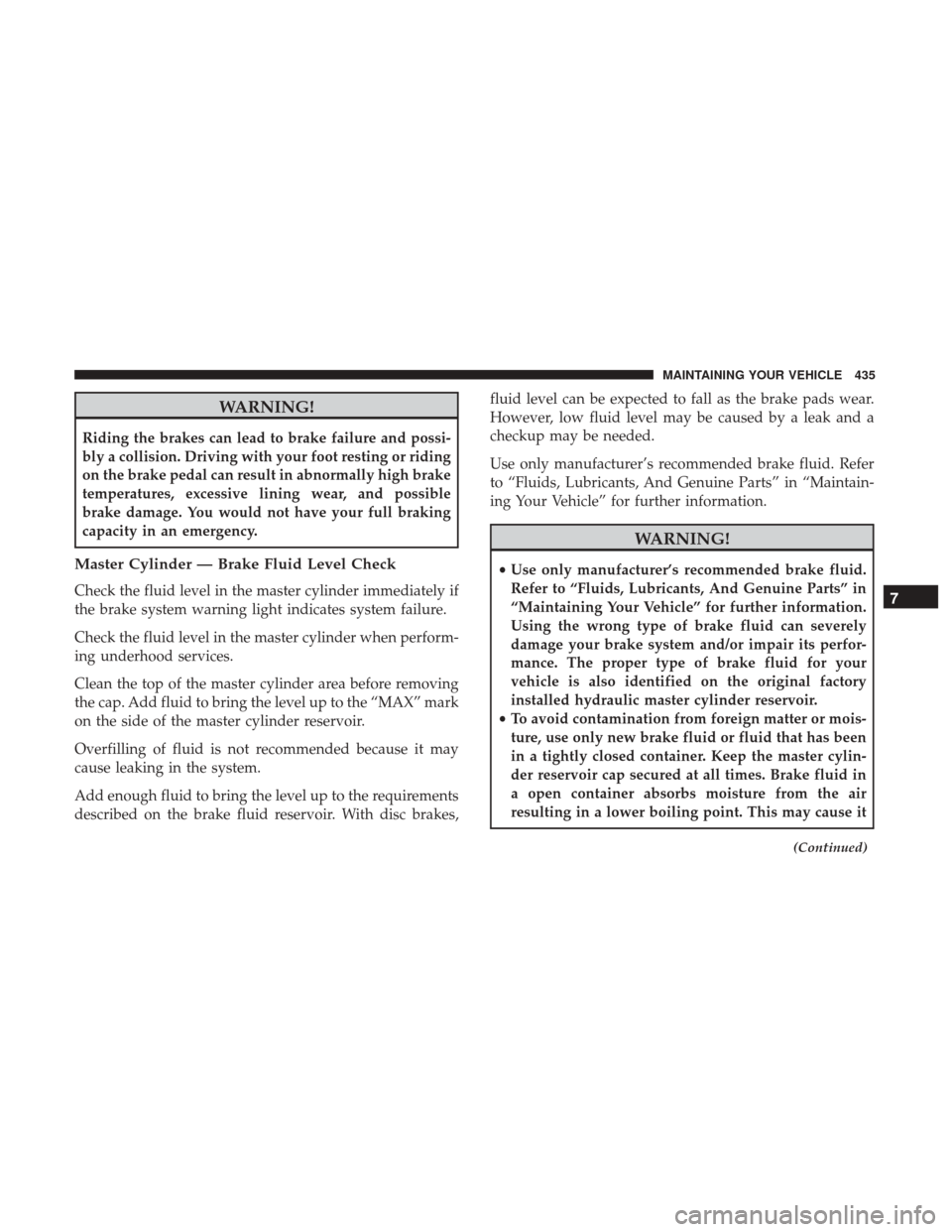
WARNING!
Riding the brakes can lead to brake failure and possi-
bly a collision. Driving with your foot resting or riding
on the brake pedal can result in abnormally high brake
temperatures, excessive lining wear, and possible
brake damage. You would not have your full braking
capacity in an emergency.
Master Cylinder — Brake Fluid Level Check
Check the fluid level in the master cylinder immediately if
the brake system warning light indicates system failure.
Check the fluid level in the master cylinder when perform-
ing underhood services.
Clean the top of the master cylinder area before removing
the cap. Add fluid to bring the level up to the “MAX” mark
on the side of the master cylinder reservoir.
Overfilling of fluid is not recommended because it may
cause leaking in the system.
Add enough fluid to bring the level up to the requirements
described on the brake fluid reservoir. With disc brakes,fluid level can be expected to fall as the brake pads wear.
However, low fluid level may be caused by a leak and a
checkup may be needed.
Use only manufacturer’s recommended brake fluid. Refer
to “Fluids, Lubricants, And Genuine Parts” in “Maintain-
ing Your Vehicle” for further information.
WARNING!
•
Use only manufacturer’s recommended brake fluid.
Refer to “Fluids, Lubricants, And Genuine Parts” in
“Maintaining Your Vehicle” for further information.
Using the wrong type of brake fluid can severely
damage your brake system and/or impair its perfor-
mance. The proper type of brake fluid for your
vehicle is also identified on the original factory
installed hydraulic master cylinder reservoir.
• To avoid contamination from foreign matter or mois-
ture, use only new brake fluid or fluid that has been
in a tightly closed container. Keep the master cylin-
der reservoir cap secured at all times. Brake fluid in
a open container absorbs moisture from the air
resulting in a lower boiling point. This may cause it
(Continued)
7
MAINTAINING YOUR VEHICLE 435
Page 438 of 506
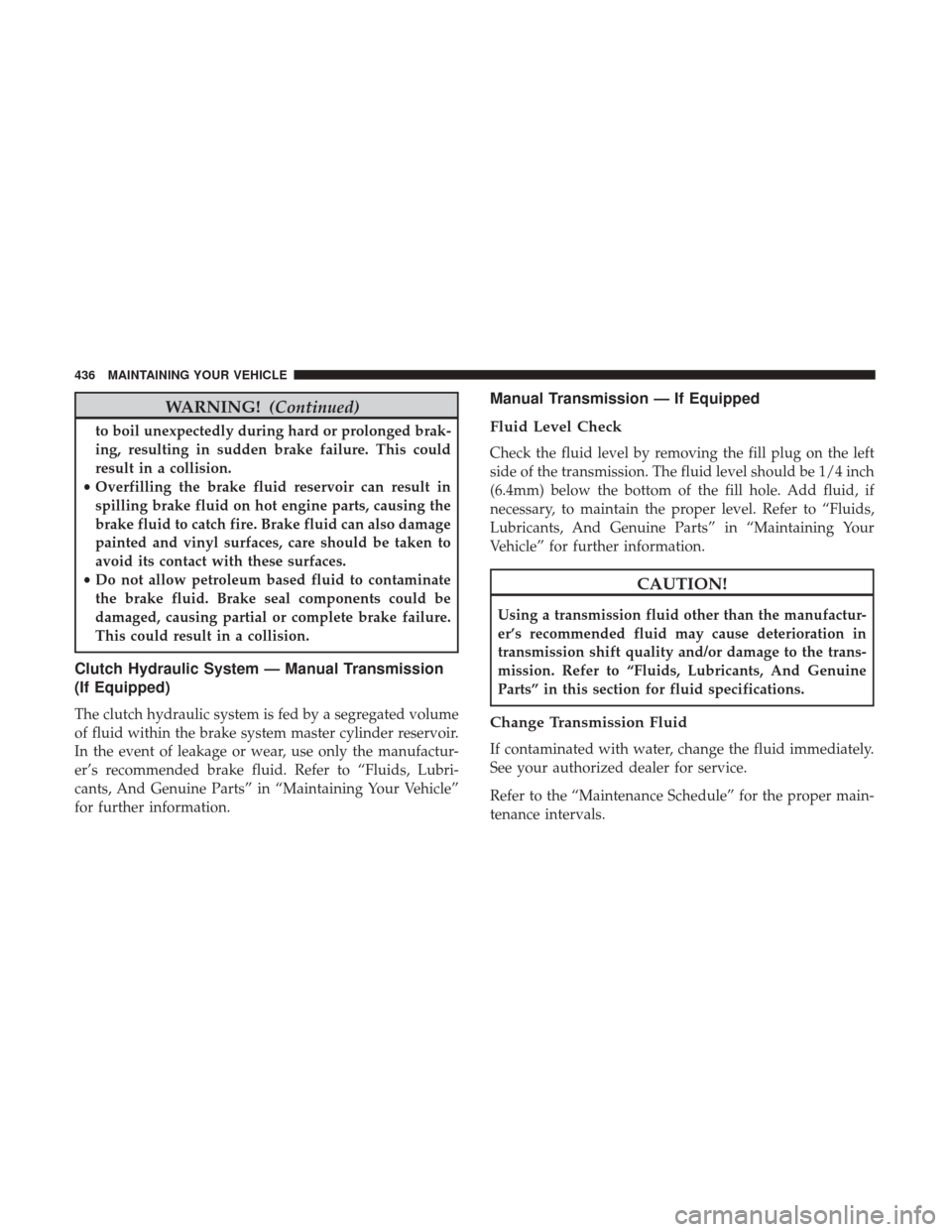
WARNING!(Continued)
to boil unexpectedly during hard or prolonged brak-
ing, resulting in sudden brake failure. This could
result in a collision.
• Overfilling the brake fluid reservoir can result in
spilling brake fluid on hot engine parts, causing the
brake fluid to catch fire. Brake fluid can also damage
painted and vinyl surfaces, care should be taken to
avoid its contact with these surfaces.
• Do not allow petroleum based fluid to contaminate
the brake fluid. Brake seal components could be
damaged, causing partial or complete brake failure.
This could result in a collision.
Clutch Hydraulic System — Manual Transmission
(If Equipped)
The clutch hydraulic system is fed by a segregated volume
of fluid within the brake system master cylinder reservoir.
In the event of leakage or wear, use only the manufactur-
er’s recommended brake fluid. Refer to “Fluids, Lubri-
cants, And Genuine Parts” in “Maintaining Your Vehicle”
for further information.
Manual Transmission — If Equipped
Fluid Level Check
Check the fluid level by removing the fill plug on the left
side of the transmission. The fluid level should be 1/4 inch
(6.4mm) below the bottom of the fill hole. Add fluid, if
necessary, to maintain the proper level. Refer to “Fluids,
Lubricants, And Genuine Parts” in “Maintaining Your
Vehicle” for further information.
CAUTION!
Using a transmission fluid other than the manufactur-
er’s recommended fluid may cause deterioration in
transmission shift quality and/or damage to the trans-
mission. Refer to “Fluids, Lubricants, And Genuine
Parts” in this section for fluid specifications.
Change Transmission Fluid
If contaminated with water, change the fluid immediately.
See your authorized dealer for service.
Refer to the “Maintenance Schedule” for the proper main-
tenance intervals.
436 MAINTAINING YOUR VEHICLE
Page 444 of 506
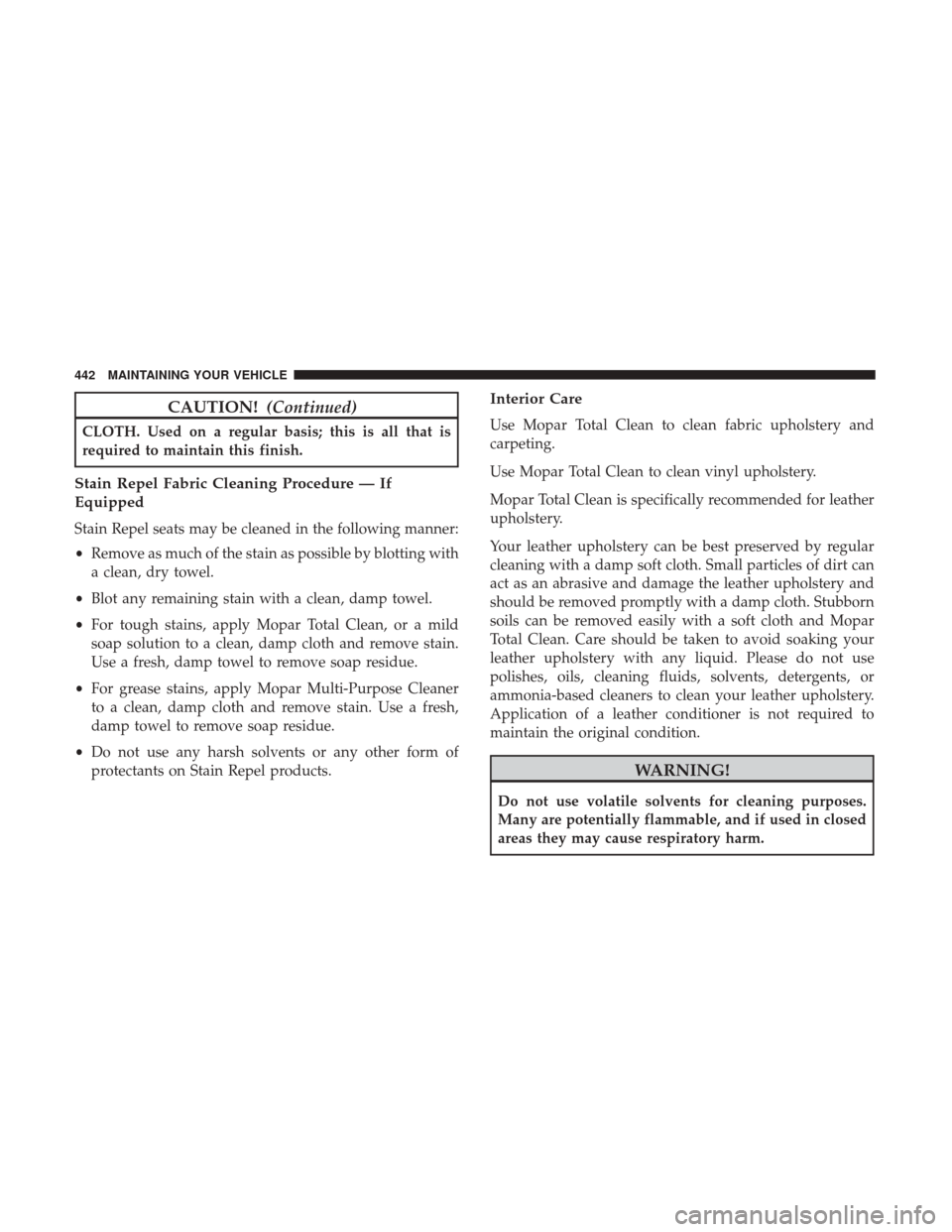
CAUTION!(Continued)
CLOTH. Used on a regular basis; this is all that is
required to maintain this finish.
Stain Repel Fabric Cleaning Procedure — If
Equipped
Stain Repel seats may be cleaned in the following manner:
•Remove as much of the stain as possible by blotting with
a clean, dry towel.
• Blot any remaining stain with a clean, damp towel.
• For tough stains, apply Mopar Total Clean, or a mild
soap solution to a clean, damp cloth and remove stain.
Use a fresh, damp towel to remove soap residue.
• For grease stains, apply Mopar Multi-Purpose Cleaner
to a clean, damp cloth and remove stain. Use a fresh,
damp towel to remove soap residue.
• Do not use any harsh solvents or any other form of
protectants on Stain Repel products.
Interior Care
Use Mopar Total Clean to clean fabric upholstery and
carpeting.
Use Mopar Total Clean to clean vinyl upholstery.
Mopar Total Clean is specifically recommended for leather
upholstery.
Your leather upholstery can be best preserved by regular
cleaning with a damp soft cloth. Small particles of dirt can
act as an abrasive and damage the leather upholstery and
should be removed promptly with a damp cloth. Stubborn
soils can be removed easily with a soft cloth and Mopar
Total Clean. Care should be taken to avoid soaking your
leather upholstery with any liquid. Please do not use
polishes, oils, cleaning fluids, solvents, detergents, or
ammonia-based cleaners to clean your leather upholstery.
Application of a leather conditioner is not required to
maintain the original condition.
WARNING!
Do not use volatile solvents for cleaning purposes.
Many are potentially flammable, and if used in closed
areas they may cause respiratory harm.
442 MAINTAINING YOUR VEHICLE
Page 462 of 506
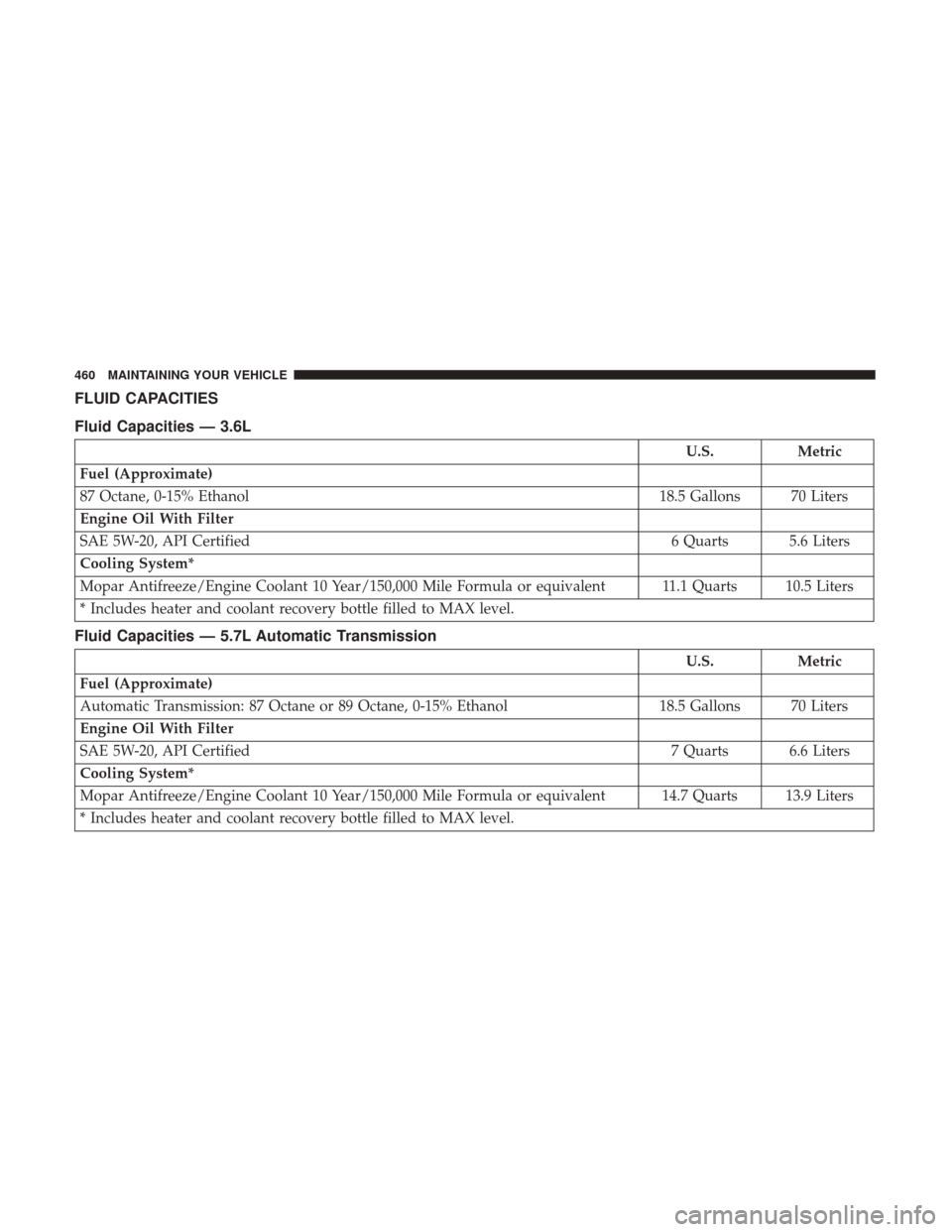
FLUID CAPACITIES
Fluid Capacities — 3.6L
U.S.Metric
Fuel (Approximate)
87 Octane, 0-15% Ethanol 18.5 Gallons 70 Liters
Engine Oil With Filter
SAE 5W-20, API Certified 6 Quarts 5.6 Liters
Cooling System*
Mopar Antifreeze/Engine Coolant 10 Year/150,000 Mile Formula or equivalent 11.1 Quarts 10.5 Liters
* Includes heater and coolant recovery bottle filled to MAX level.
Fluid Capacities — 5.7L Automatic Transmission
U.S. Metric
Fuel (Approximate)
Automatic Transmission: 87 Octane or 89 Octane, 0-15% Ethanol 18.5 Gallons 70 Liters
Engine Oil With Filter
SAE 5W-20, API Certified 7 Quarts 6.6 Liters
Cooling System*
Mopar Antifreeze/Engine Coolant 10 Year/150,000 Mile Formula or equivalent 14.7 Quarts 13.9 Liters
* Includes heater and coolant recovery bottle filled to MAX level.
460 MAINTAINING YOUR VEHICLE
Page 463 of 506
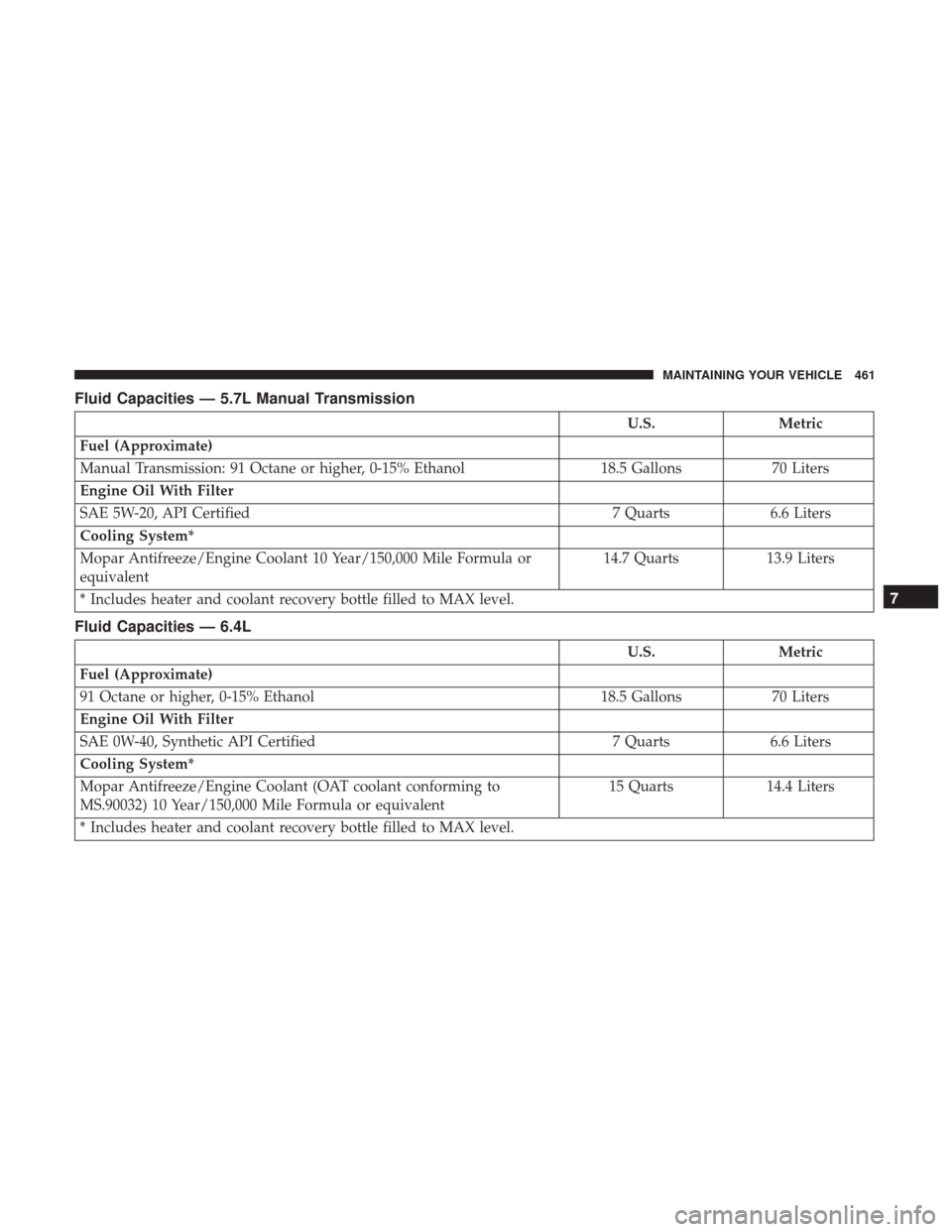
Fluid Capacities — 5.7L Manual Transmission
U.S.Metric
Fuel (Approximate)
Manual Transmission: 91 Octane or higher, 0-15% Ethanol 18.5 Gallons70 Liters
Engine Oil With Filter
SAE 5W-20, API Certified 7 Quarts6.6 Liters
Cooling System*
Mopar Antifreeze/Engine Coolant 10 Year/150,000 Mile Formula or
equivalent 14.7 Quarts
13.9 Liters
* Includes heater and coolant recovery bottle filled to MAX level.
Fluid Capacities — 6.4L
U.S. Metric
Fuel (Approximate)
91 Octane or higher, 0-15% Ethanol 18.5 Gallons70 Liters
Engine Oil With Filter
SAE 0W-40, Synthetic API Certified 7 Quarts6.6 Liters
Cooling System*
Mopar Antifreeze/Engine Coolant (OAT coolant conforming to
MS.90032) 10 Year/150,000 Mile Formula or equivalent 15 Quarts
14.4 Liters
* Includes heater and coolant recovery bottle filled to MAX level.
7
MAINTAINING YOUR VEHICLE 461
Page 464 of 506
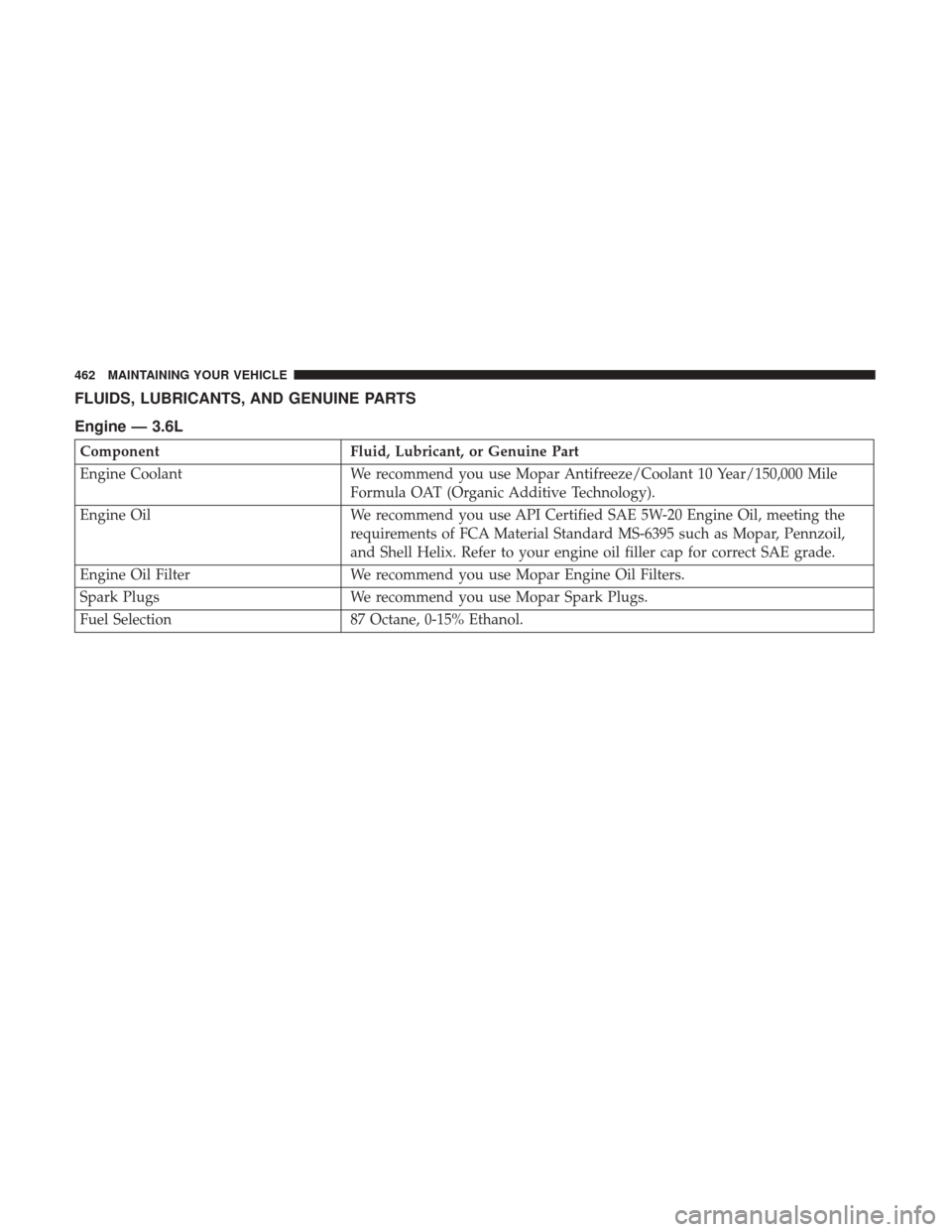
FLUIDS, LUBRICANTS, AND GENUINE PARTS
Engine — 3.6L
ComponentFluid, Lubricant, or Genuine Part
Engine Coolant We recommend you use Mopar Antifreeze/Coolant 10 Year/150,000 Mile
Formula OAT (Organic Additive Technology).
Engine Oil We recommend you use API Certified SAE 5W-20 Engine Oil, meeting the
requirements of FCA Material Standard MS-6395 such as Mopar, Pennzoil,
and Shell Helix. Refer to your engine oil filler cap for correct SAE grade.
Engine Oil Filter We recommend you use Mopar Engine Oil Filters.
Spark Plugs We recommend you use Mopar Spark Plugs.
Fuel Selection 87 Octane, 0-15% Ethanol.
462 MAINTAINING YOUR VEHICLE