battery DODGE CHALLENGER 2017 3.G Workshop Manual
[x] Cancel search | Manufacturer: DODGE, Model Year: 2017, Model line: CHALLENGER, Model: DODGE CHALLENGER 2017 3.GPages: 506, PDF Size: 4.44 MB
Page 496 of 506
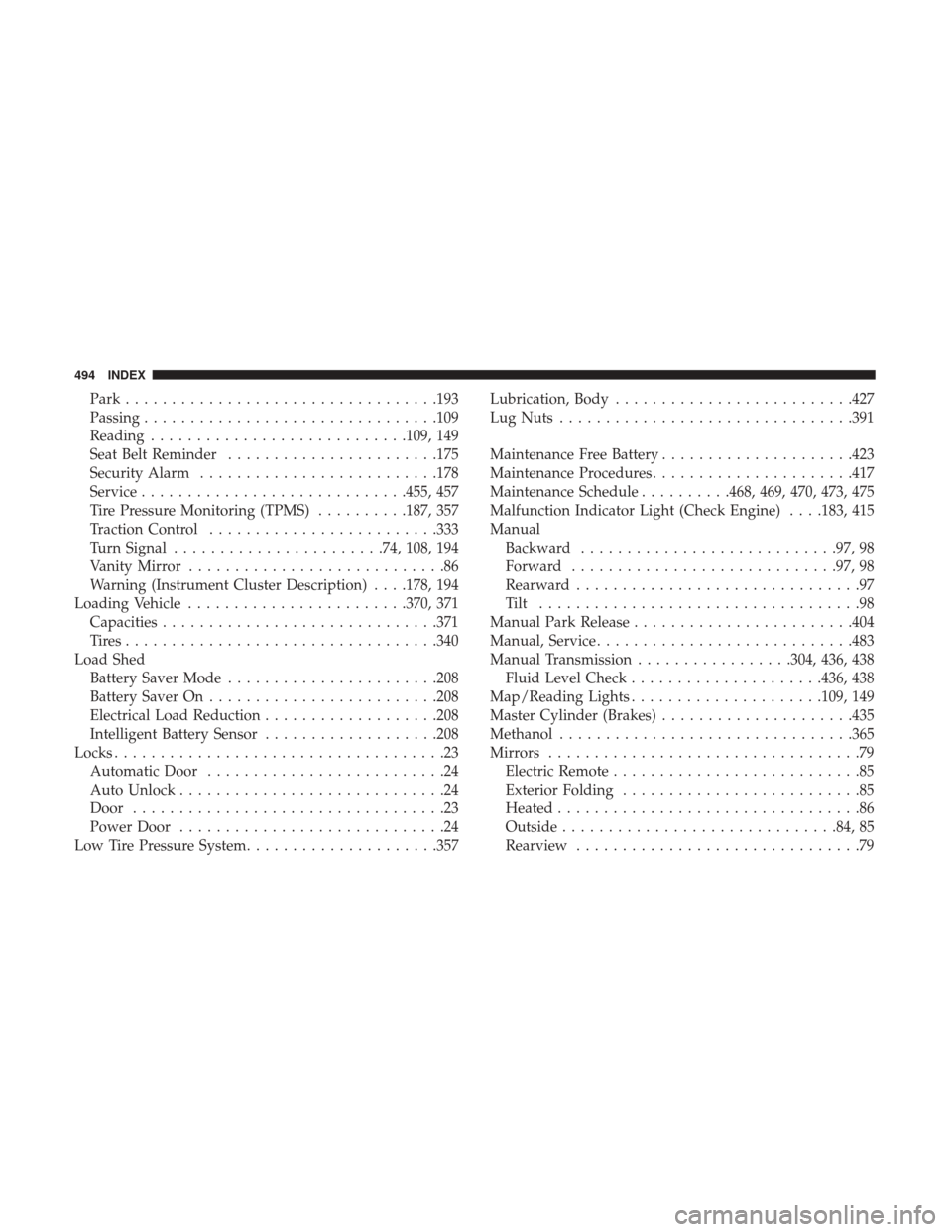
Park................................. .193
Passing ............................... .109
Reading ........................... .109, 149
Seat Belt Reminder ...................... .175
Security Alarm ......................... .178
Service ............................ .455, 457
Tire Pressure Monitoring (TPMS) ..........187, 357
Traction Control ........................ .333
Turn Signal ...................... .74, 108, 194
Vanity Mirror ............................86
Warning (Instrument Cluster Description) . . . .178, 194
Loading Vehicle ....................... .370, 371
Capacities ............................. .371
Tires................................. .340
Load Shed Battery Saver Mode ...................... .208
Battery Saver On ........................ .208
Electrical Load Reduction ...................208
Intelligent Battery Sensor ...................208
Locks ....................................23
Automatic Door ..........................24
Auto Unlock .............................24
Door ..................................23
Power Door .............................24
Low Tire Pressure System .....................357 Lubrication, Body
......................... .427
Lug Nuts ............................... .391
Maintenance Free Battery .....................423
Maintenance Procedures ..................... .417
Maintenance Schedule ..........468, 469, 470, 473, 475
Malfunction Indicator Light (Check Engine) . . . .183, 415
Manual Backward ........................... .97, 98
Forward ............................ .97, 98
Rearward ...............................97
Tilt ...................................98
Manual Park Release ....................... .404
Manual, Service ........................... .483
Manual Transmission .................304, 436, 438
Fluid Level Check .....................436,
438
Map/Reading Lights .....................109, 149
Master Cylinder (Brakes) .....................435
Methanol ............................... .365
Mirrors ..................................79
Electric Remote ...........................85
Exterior Folding ..........................85
Heated .................................86
Outside ............................. .84, 85
Rearview ...............................79
494 INDEX
Page 505 of 506

INSTALLATION OF RADIO TRANSMITTING
EQUIPMENT
Special design considerations are incorporated into this
vehicle’s electronic system to provide immunity to radio
frequency signals. Mobile two-way radios and telephone
equipment must be installed properly by trained person-
nel. The following must be observed during installation.
The positive power connection should be made directly
to the battery and fused as close to the battery as possible.
The negative power connection should be made to body
sheet metal adjacent to the negative battery connection.
This connection should not be fused.
Antennas for two-way radios should be mounted on the
roof or the rear area of the vehicle. Care should be used
in mounting antennas with magnet bases. Magnets may
affect the accuracy or operation of the compass on
vehicles so equipped.The antenna cable should be as short as practical and
routed away from the vehicle wiring when possible. Use
only fully shielded coaxial cable.
Carefully match the antenna and cable to the radio to
ensure a low Standing Wave Ratio (SWR).
Mobile radio equipment with output power greater than
normal may require special precautions.
All installations should be checked for possible interfer-
ence between the communications equipment and the
vehicle’s electronic systems.