oil filter DODGE CHALLENGER 2020 Owners Manual
[x] Cancel search | Manufacturer: DODGE, Model Year: 2020, Model line: CHALLENGER, Model: DODGE CHALLENGER 2020Pages: 396, PDF Size: 16.64 MB
Page 8 of 396
6
DEALER SERVICE .............................................. 252 Engine Oil ...................................................252
Engine Oil Filter .........................................255
Engine Air Cleaner Filter ...........................255
Air Conditioner Maintenance ....................257
Accessory Drive Belt Inspection................258Body Lubrication ........................................259
Windshield Wiper Blades ..........................259
Exhaust System .........................................261
Cooling System ........................................262
Brake System ............................................266
Clutch Hydraulic System — Manual
Transmission (If Equipped) .......................267 Manual Transmission — If Equipped ........267Automatic Transmission — If Equipped ....267
All Wheel Drive (AWD) — If Equipped .......268
Rear Axle ....................................................268
RAISING THE VEHICLE ...................................... 269
TIRES ................................................................... 269
Tire Safety Information .............................. 269
Tires — General Information .....................276Tire Types ...................................................280
Spare Tires — If Equipped .........................281
Wheel And Wheel Trim Care .....................283Tire Chains And Traction Devices —
Non-SRT......................................................284 Tire Chains And Traction Devices —
SRT .............................................................285 Tire Rotation Recommendations —
Non-SRT ..................................................... 285 Tire Rotation Recommendations —
SRT ............................................................ 285 Tire Rotation—Different Tire Size On
Front And Rear Axle ................................... 286
DEPARTMENT OF TRANSPORTATION
UNIFORM TIRE QUALITY GRADES ................... 286
Treadwear .................................................. 286
Traction Grades ......................................... 286
Temperature Grades ................................. 287
VEHICLE STORAGE ...........................................287
BODYWORK ........................................................ 287
Protection From Atmospheric Agents ...... 287
Body And Underbody Maintenance .......... 288Preserving The Bodywork .......................... 288
INTERIORS ......................................................... 289
Seats And Fabric Parts .............................. 289
Plastic And Coated Parts ........................... 290
Leather Parts ............................................. 290
Glass Surfaces .......................................... 290
TECHNICAL SPECIFICATIONS
IDENTIFICATION DATA .......................................291Vehicle Identification Number .................. 291
BRAKE SYSTEM ................................................. 291 WHEEL AND TIRE TORQUE
SPECIFICATIONS .............................................. 291
Torque Specifications................................ 292
FUEL REQUIREMENTS ....................................... 293
3.6L Engine ................................................ 293
5.7L Engine (With Automatic
Transmission) ............................................ 293 5.7L Engine (With Manual
Transmission) ............................................ 293 6.2L Supercharged Engine ....................... 2946.4L Engine ................................................ 294
Reformulated Gasoline ............................. 294
Materials Added To Fuel ........................... 295
Gasoline/Oxygenate Blends ..................... 295
Do Not Use E-85 In Non-Flex Fuel
Vehicles ...................................................... 295 CNG And LP Fuel System
Modifications ............................................. 295 MMT In Gasoline........................................ 296
Fuel System Cautions................................ 296
Carbon Monoxide Warnings...................... 296
FLUID CAPACITIES — NON-SRT ........................ 297
FLUID CAPACITIES — SRT ................................. 298
FLUIDS AND LUBRICANTS — NON-SRT .......... 299
Engine ....................................................... 299
Chassis ................................................... 301
FLUIDS AND LUBRICANTS — SRT .................... 302
Engine ........................................................ 302
Chassis ....................................................... 304
20_LA_OM_EN_USC_t.book Page 6
Page 208 of 396
206IN CASE OF EMERGENCY
REPLACING EXTERIOR BULBS
Low Beam Headlamp, High Beam
Headlamp — Models With Halogen
Headlamps — If Equipped
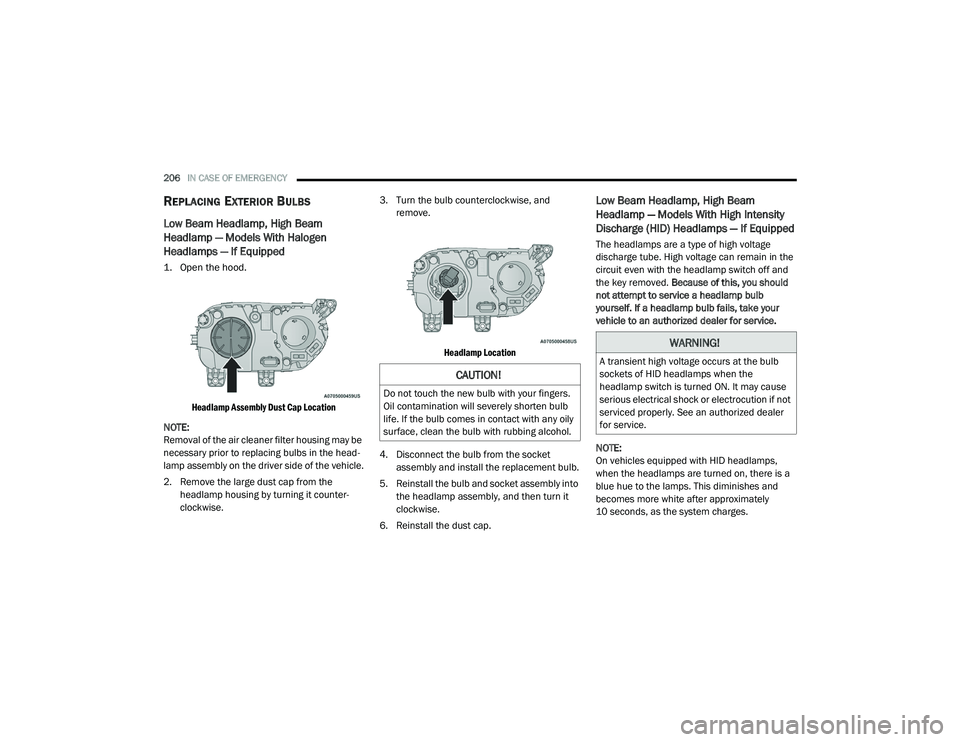
1. Open the hood.
Headlamp Assembly Dust Cap Location
NOTE:
Removal of the air cleaner filter housing may be
necessary prior to replacing bulbs in the head -
lamp assembly on the driver side of the vehicle.
2. Remove the large dust cap from the headlamp housing by turning it counter -
clockwise. 3. Turn the bulb counterclockwise, and
remove.
Headlamp Location
4. Disconnect the bulb from the socket assembly and install the replacement bulb.
5. Reinstall the bulb and socket assembly into the headlamp assembly, and then turn it
clockwise.
6. Reinstall the dust cap.
Low Beam Headlamp, High Beam
Headlamp — Models With High Intensity
Discharge (HID) Headlamps — If Equipped
The headlamps are a type of high voltage
discharge tube. High voltage can remain in the
circuit even with the headlamp switch off and
the key removed. Because of this, you should
not attempt to service a headlamp bulb
yourself. If a headlamp bulb fails, take your
vehicle to an authorized dealer for service.
NOTE:
On vehicles equipped with HID headlamps,
when the headlamps are turned on, there is a
blue hue to the lamps. This diminishes and
becomes more white after approximately
10 seconds, as the system charges.
CAUTION!
Do not touch the new bulb with your fingers.
Oil contamination will severely shorten bulb
life. If the bulb comes in contact with any oily
surface, clean the bulb with rubbing alcohol.
WARNING!
A transient high voltage occurs at the bulb
sockets of HID headlamps when the
headlamp switch is turned ON. It may cause
serious electrical shock or electrocution if not
serviced properly. See an authorized dealer
for service.
20_LA_OM_EN_USC_t.book Page 206
Page 237 of 396
SERVICING AND MAINTENANCE235
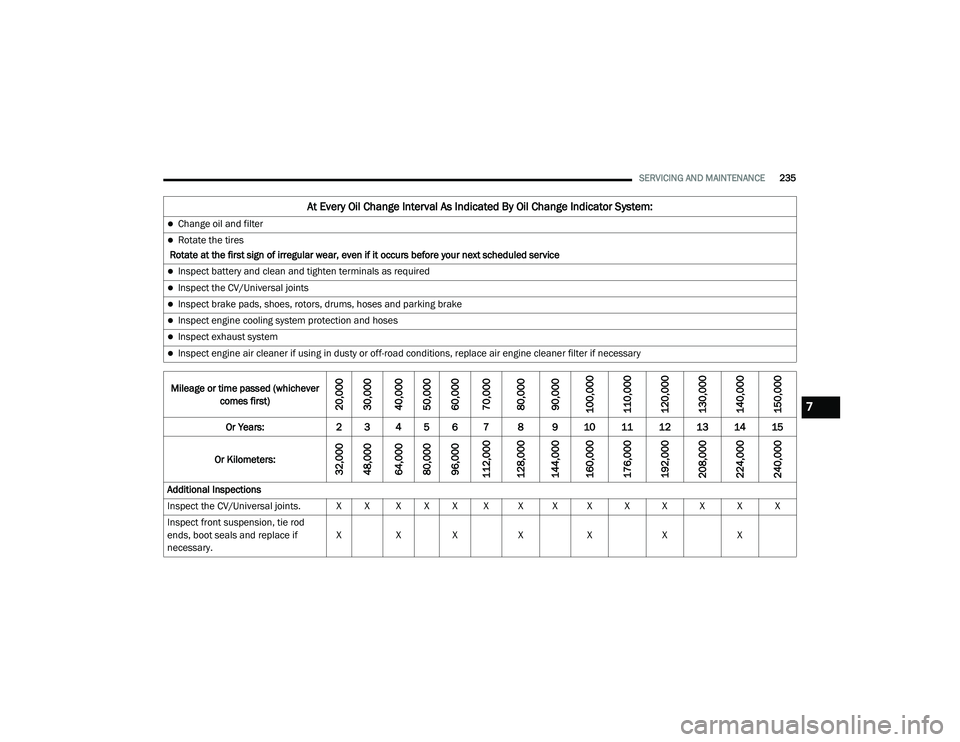
At Every Oil Change Interval As Indicated By Oil Change Indicator System:
Change oil and filter
Rotate the tires
Rotate at the first sign of irregular wear, even if it occurs before your next scheduled service
Inspect battery and clean and tighten terminals as required
Inspect the CV/Universal joints
Inspect brake pads, shoes, rotors, drums, hoses and parking brake
Inspect engine cooling system protection and hoses
Inspect exhaust system
Inspect engine air cleaner if using in dusty or off-road conditions, replace air engine cleaner filter if necessary
Mileage or time passed (whichever comes first)
20,000
30,000
40,000
50,000
60,000
70,000
80,000
90,000
100,000
110,000
120,000
130,000
140,000
150,000
Or Years: 2 3 4 5 6 7 8 9 10 11 12 13 14 15
Or Kilometers:
32,000
48,000
64,000
80,000
96,000
112,000
128,000
144,000
160,000
176,000
192,000
208,000
224,000
240,000
Additional Inspections
Inspect the CV/Universal joints. X X X X X X X X X X X X X X
Inspect front suspension, tie rod
ends, boot seals and replace if
necessary. X
XX X X XX
7
20_LA_OM_EN_USC_t.book Page 235
Page 241 of 396
SERVICING AND MAINTENANCE239
Heavy Duty Use Of The Vehicle
Change engine oil at 4,000 miles (6,500 km) or
350 hours of engine run time if the vehicle is
operated in a dusty and off road environment or
is operated predominately at idle or only very
low engine RPM. This type of vehicle use is
considered Severe Duty.
6.2L SUPERCHARGED AND 6.4L
E
NGINES
The scheduled maintenance services listed in
this manual must be done at the times or
mileages specified to protect your vehicle
warranty and ensure the best vehicle
performance and reliability. More frequent
maintenance may be needed for vehicles in
severe operating conditions, such as dusty
areas and very short trip driving. Inspection and
service should also be done anytime a
malfunction is suspected.
The oil change indicator system will remind you
that it is time to take your vehicle in for
scheduled maintenance.
An “Oil Change Required” message will be
displayed in the instrument cluster and a single
chime will sound, indicating that an oil change
is necessary. Based on engine operation conditions, the oil
change indicator message will illuminate. This
means that service is required for your vehicle.
Have your vehicle serviced as soon as possible,
within the next 500 miles (805 km).
NOTE:
The oil change indicator message will not
monitor the time since the last oil change.
Change your vehicle's oil if it has been six
months since your last oil change, even if the
oil change indicator message is NOT illumi-
nated.
Change your engine oil more often if you drive
your vehicle off-road/track usage for an
extended period of time.
Under no circumstances should oil change
intervals exceed 6,000 miles (10,000 km) or
6 months, whichever comes first.
An authorized dealer will reset the oil change
indicator message after completing the
scheduled oil change. If a scheduled oil change
is performed by someone other than an
authorized dealer, the message can be reset by
referring to the steps described under
“Instrument Cluster Display” in “Getting To
Know Your Instrument Panel” for further
information. At Each Stop For Fuel
Check the engine oil level. Refer to “Engine
Compartment” in this chapter for further
information.
Check the windshield washer solvent and
add if required.
Once A Month
Check tire pressure and look for unusual
wear or damage.
Inspect the battery, and clean and tighten the
terminals as required.
Check the fluid levels of the coolant reservoir,
brake master cylinder and add as needed.
Check all lights and other electrical items for
correct operation.
At Each Oil Change
Change the engine oil filter.
Inspect the brake hoses and lines.
Inspect the CV/Universal joints.
CAUTION!
Failure to perform the required maintenance
items may result in damage to the vehicle.
7
20_LA_OM_EN_USC_t.book Page 239
Page 242 of 396
240SERVICING AND MAINTENANCE
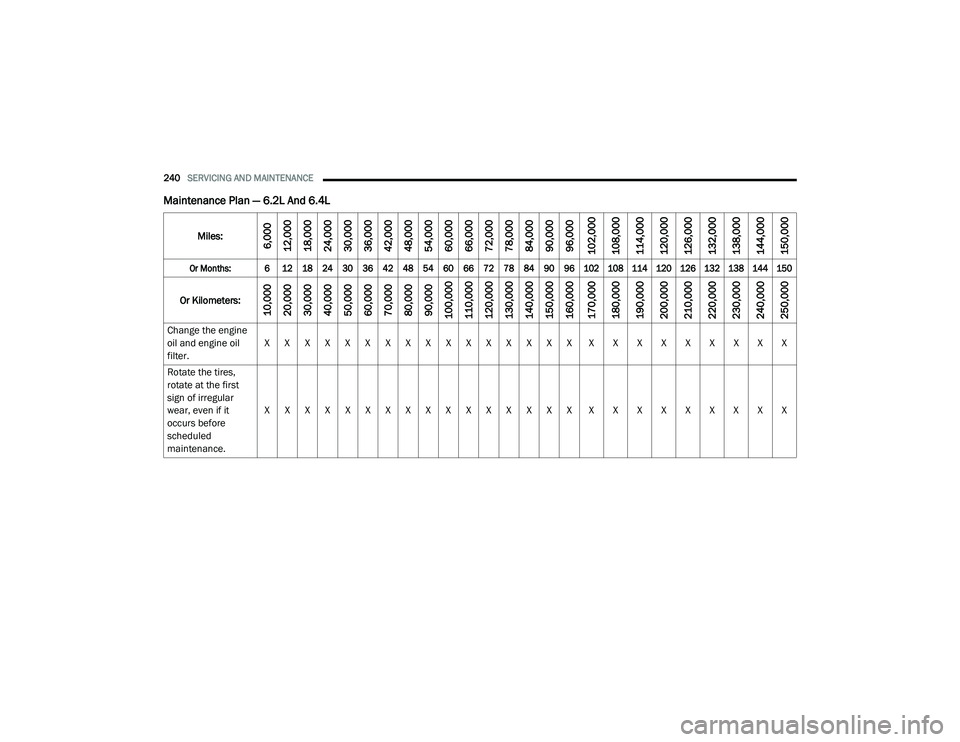
Maintenance Plan — 6.2L And 6.4L
Miles:6,000
12,000
18,000
24,000
30,000
36,000
42,000
48,000
54,000
60,000
66,000
72,000
78,000
84,000
90,000
96,000
102,000
108,000
114,000
120,000
126,000
132,000
138,000
144,000
150,000
Or Months: 6 12 18 24 30 36 42 48 54 60 66 72 78 84 90 96 102 108 114 120 126 132 138 144 150
Or Kilometers:
10,000
20,000
30,000
40,000
50,000
60,000
70,000
80,000
90,000
100,000
110,000
120,000
130,000
140,000
150,000
160,000
170,000
180,000
190,000
200,000
210,000
220,000
230,000
240,000
250,000
Change the engine
oil and engine oil
filter. X X X X X X X X X X X X X X X X X X X X X X X X X
Rotate the tires,
rotate at the first
sign of irregular
wear, even if it
occurs before
scheduled
maintenance. X X X X X X X X
X X X X X X X X X X X X X X X X X
20_LA_OM_EN_USC_t.book Page 240
Page 248 of 396
246SERVICING AND MAINTENANCE
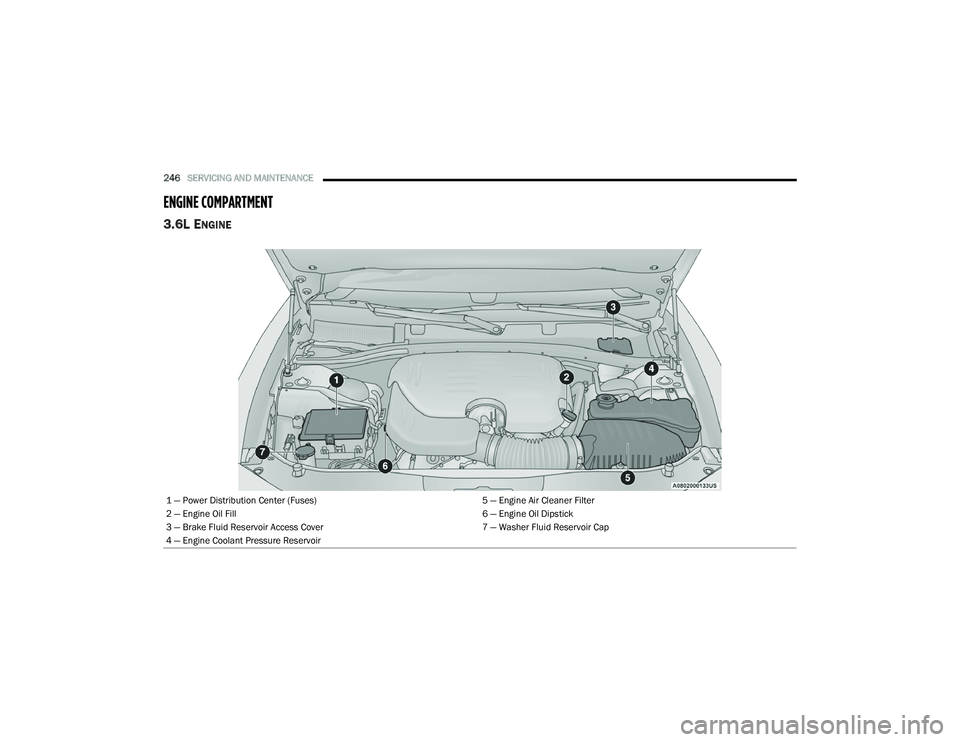
ENGINE COMPARTMENT
3.6L ENGINE
1 — Power Distribution Center (Fuses) 5 — Engine Air Cleaner Filter
2 — Engine Oil Fill 6 — Engine Oil Dipstick
3 — Brake Fluid Reservoir Access Cover 7 — Washer Fluid Reservoir Cap
4 — Engine Coolant Pressure Reservoir
20_LA_OM_EN_USC_t.book Page 246
Page 249 of 396
SERVICING AND MAINTENANCE247
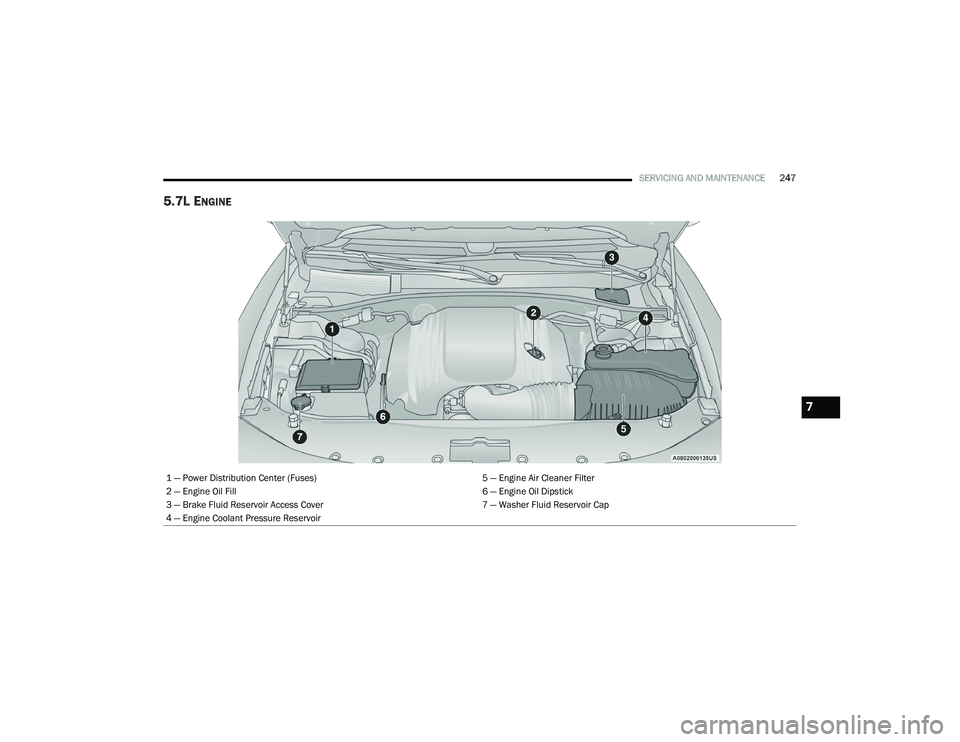
5.7L ENGINE
1 — Power Distribution Center (Fuses) 5 — Engine Air Cleaner Filter
2 — Engine Oil Fill 6 — Engine Oil Dipstick
3 — Brake Fluid Reservoir Access Cover 7 — Washer Fluid Reservoir Cap
4 — Engine Coolant Pressure Reservoir
7
20_LA_OM_EN_USC_t.book Page 247
Page 250 of 396
248SERVICING AND MAINTENANCE
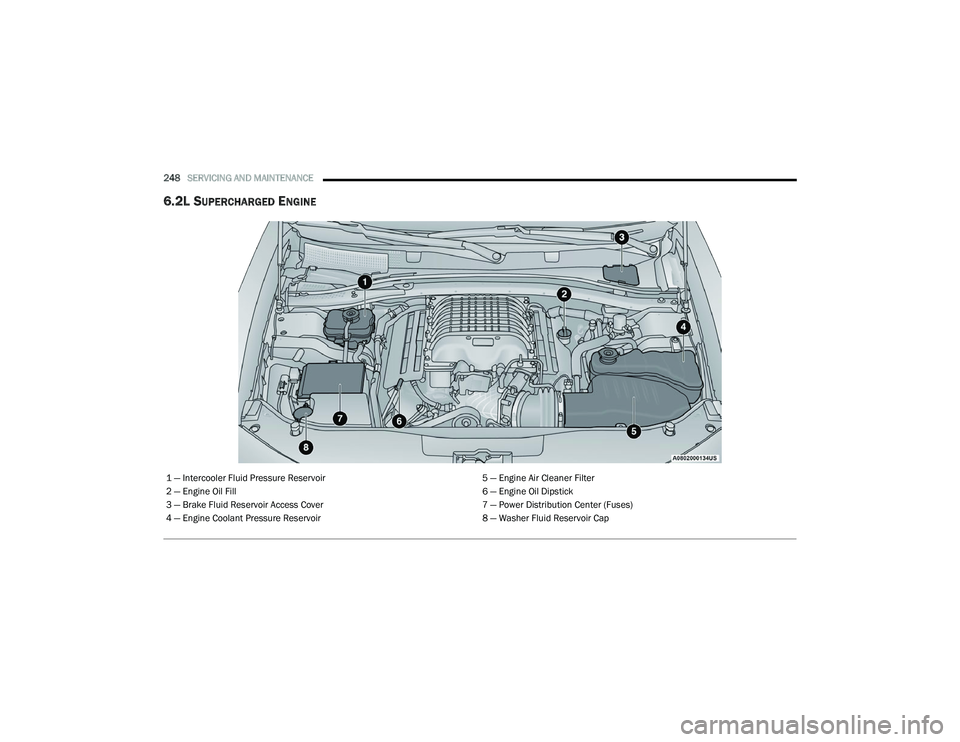
6.2L SUPERCHARGED ENGINE
1 — Intercooler Fluid Pressure Reservoir 5 — Engine Air Cleaner Filter
2 — Engine Oil Fill 6 — Engine Oil Dipstick
3 — Brake Fluid Reservoir Access Cover 7 — Power Distribution Center (Fuses)
4 — Engine Coolant Pressure Reservoir 8 — Washer Fluid Reservoir Cap
20_LA_OM_EN_USC_t.book Page 248
Page 251 of 396
SERVICING AND MAINTENANCE249
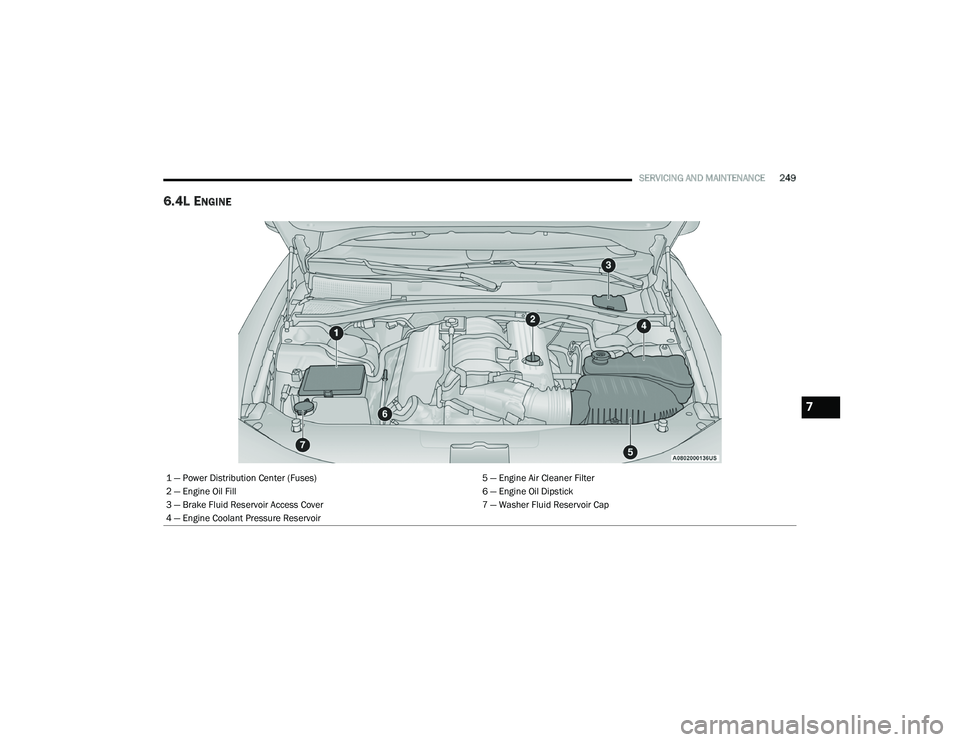
6.4L ENGINE
1 — Power Distribution Center (Fuses) 5 — Engine Air Cleaner Filter
2 — Engine Oil Fill 6 — Engine Oil Dipstick
3 — Brake Fluid Reservoir Access Cover 7 — Washer Fluid Reservoir Cap
4 — Engine Coolant Pressure Reservoir
7
20_LA_OM_EN_USC_t.book Page 249
Page 256 of 396
254SERVICING AND MAINTENANCE
Engine Oil Viscosity (SAE Grade) — 5.7L
Engine
Mopar SAE 5W-20 engine oil approved to FCA
Material Standard MS-6395 such as Pennzoil,
Shell Helix Ultra or equivalent is recommended
for all operating temperatures. This engine oil
improves low temperature starting and vehicle
fuel economy.
The engine oil filler cap also shows the
recommended engine oil viscosity for your
engine. For information on engine oil filler cap
location, refer to the “Engine Compartment”
illustration in this section.
NOTE:
Vehicles equipped with a 5.7L engine must use
SAE 5W-20 oil. Failure to do so may result in
improper operation of the Fuel Saver Tech -
nology. Refer to “Fuel Saver Technology – If
Equipped” in “Starting And Operating” for
further information.
Lubricants which do not have both the engine
oil certification mark and the correct SAE
viscosity grade number should not be used.
Engine Oil Viscosity — 6.2L And 6.4L
Engine
Use Pennzoil Ultra Platinum 0W-40 engine or
equivalent Mopar oil meeting the FCA Material
Standard MS-12633 for use in all operating
temperatures.
The engine oil filler cap also shows the
recommended engine oil viscosity for your
engine. For information on engine oil filler cap
location, refer to “Engine Compartment” in this
section for further information.
Synthetic Engine Oils
You may use synthetic engine oils provided the
recommended oil quality requirements are met,
and the recommended maintenance intervals
for oil and filter changes are followed.
Synthetic engine oils which do not have both the
engine oil certification mark and the correct SAE
viscosity grade number should not be used.
Shaker Hood — If Equipped
Shaker Hood Oil Filler
For vehicles equipped with a “Shaker Hood”,
the upper scoop will need to be removed so that
oil can be properly added to the engine. To do this, you will need follow the procedure
below:
1. Remove the four nuts with the Shaker tool
located in glove compartment.
2. Lift off the upper scoop.
NOTE:
Be sure to clean off all debris around or inside
for the Shaker assembly.
3. Locate the oil fill cover in base assembly to expose the oil fill cap.
4. Remove oil fill cap to add oil.
5. Re-install Shaker assembly.
Shaker Hood Air Filter Cleaning
1. Remove the air filter from the intake and set the filter clamp a side.
2. Measure the length of the filter media.
3. Fill a bucket with warm clean water to the depth matching the filter media
measurement and add a mild household
detergent or air filter cleaning solution.
4. Without allowing the solution to flow back into the inside of the air filter, submerge the
filter media in to the water and let it soak for
ten minutes.
20_LA_OM_EN_USC_t.book Page 254