warning DODGE CHALLENGER 2021 Vehicle Warranty
[x] Cancel search | Manufacturer: DODGE, Model Year: 2021, Model line: CHALLENGER, Model: DODGE CHALLENGER 2021Pages: 262, PDF Size: 10.42 MB
Page 166 of 262

MICHELIN®
165
all provisions of the limited warranty are void. For a list of approved
systems, see an authorized PAX® System retailer, or call toll free:
1-877-PAX TIRE or 1-877-729-8473
For all types of tires, consult your vehicle tire placard or owner’s
ma
nual for recommended operating pressures. If the tires are
purchased as replacement tires, operating instructions for the low
pressure warning system will be provided by the manufacturer of that
system. Recommended operating pressures will be provided by a
participating Michelin® tire retailer for self supporting ZP tires.
Recommended operating pressure for PAX® System Tires will be
provided by a PAX System retailer. These inflation pressures must be
maintained as a minimum. However, do not exceed the maximum
pressure rating indicated on the tire sidewall.
CHECK THE COLD INFLATION PRESSURES IN ALL YOUR
T I
RES, INCLUDING THE SPARE, AT LEAST ONCE EACH
MONTH
Failure to maintain correct inflation may result in improper vehicle
ha
ndling and may cause rapid and irregular tire wear, sudden tire
destruction, loss of vehicle control and serious personal injury.
Therefore, inflation pressures should be checked at least once each
month and always prior to long distance trips. This applies to all tires,
including sealant types, and Self-Supporting Zero Pressure (ZP) tires
which are as susceptible to losing air pressure as any other type of tire
if not properly maintained.
UNDERINFLATION
It is impossible to determine whether tires are properly inflated by
si
mply looking at them. It is almost impossible to “feel or hear” when
a tire is being run underinflated or nearly flat. Tires must be checked
monthly with a tire pressure gauge.
Pressures should be checked when tires are cold, in other words,
be
fore they have been driven on. Driving, even for a short distance,
causes tires to heat up and air pressure to increase.
Checking pressure when tires are hot:
If pressures are checked after tires have been driven for more than
th
ree minutes or more than one mile, (2 km) the tires become hot and
th
e pressures will increase by approximately 4 psi. Therefore when the
tire pressure is adjusted under these conditions, it should be increased
to a gauge reading of 4 psi greater than the recommended cold
inflation pressure.
Page 167 of 262

MICHELIN®
166
For Example Only:
• Gauge reading of hot tire:.............................................. 32 psi (220 kPa)
•
If recommended cold inflation pressure is: ................ 30 psi (205 kPa)
•
Desired gauge reading of hot tire 30 + 4 psi =... 34 psi (205 + 30 = 235 kPa)
•
Therefore: add 2 psi.................................................................... (15 kPa)
C
heck cold pressure as soon as possible, preferably within 24 hours.
“B
leeding” air from hot tires could result in underinflation. Use an
accurate tire gauge to check pressures. Never allow children to
inflate or deflate tires.
FOR MICHELIN® PAX® SYSTEM TIRES/SELF-SUPPORTING
ZE
RO PRESSURE (ZP) TIRES CHECK INFLATION PRESSURES
AS SOON AS POSSIBLE FOLLOWING A LOW PRESSURE
WARNING
The PAX® System requires a functioning, correctly calibrated
on
-board vehicle tire pressure monitoring system (TPMS) to
monitor the air pressure and alert the driver when a low pressure
event occurs. Be certain to ensure that your vehicle’s TPMS is
functioning and is correctly calibrated. Refer to your vehicle
Owner’s Manual or your vehicle dealer.
Low pressure warning systems are designed to alert the driver to a
lo
w air pressure situation in at least one tire on the vehicle. While your
ZP tires are designed to provide continued mobility in the event of an
air loss, the sooner you respond to a warning and take corrective
action, the greater the likelihood that the tire can be returned to
service.
Always visually inspect your MICHELIN® PAX® System tire and
se
lf-supporting tires and use a pressure gauge to check the air
pressure in all four tires following any low pressure warning.
(Unless advised to do otherwise by the manufacturer of your low
pressure warning system.)
If the tire pressure is at or below 18 PSI, proceed to the nearest
Au
thorized PAX® System Retailer for PAX® tires or a participating
Michelin® tire retailer for ZP tires or a representative of your
vehicle manufacturer if advised to do so in your vehicle Owner’s
Manual and have the tire demounted and thoroughly inspected for
possible internal damage.
If you are unable to see any damage to the tire, and the tire pressure
is
more than 18 PSI, reinflate your tire to the proper air pressure. See
Page 173 of 262

MICHELIN®
172
DO NOT OVERLOAD - DRIVING ON ANY OVERLOADED TIRE IS
DANGEROUS
The maximum load rating of your tires is molded on the tire sidewall.
Do
not exceed this rating. Follow the loading instructions of FCA US
LLC for your vehicle and this will ensure that your tires are not
overloaded. Tires which are loaded beyond their maximum allowable
loads for the particular application will build up excessive heat that
may result in sudden tire destruction.
Do not exceed the gross axle weight rating for any axle on your
ve
hicle.
TRAILER TOWING
If you anticipate towing a trailer, you should visit any Michelin® tire
re
tailer for advice concerning the correct size tire and pressures. Tire
size and pressures will depend upon the type and size of trailer and
hitch utilized, but in no case must the maximum cold inflation
pressure or tire load rating be exceeded. Check the tire decal and the
owner’s manual supplied by FCA US LLC for your vehicle for further
recommendations on trailer towing.
MICHELIN® PAX® System Tires/Self-Supporting Zero Pressure
(Z
P) Tires and Trailer Towing
Operation of Pax® or ZP tires at low or zero air pressure with a trailer
in
tow, is dangerous and is not recommended. If the low pressure
warning indicator is activated when a trailer is in tow, stop, disconnect
the trailer, and do not continue to tow the trailer until the tire has been
repaired and re-inflated to the proper air pressure. If the tire cannot be
repaired, it must be replaced with a new full size, PAX®/ZP tire, and
inflated to the proper air pressure, before the trailer can be safely
towed again.
WHEEL ALIGNMENT AND BALANCING ARE IMPORTANT
FO
R SAFETY AND MAXIMUM MILEAGE FROM YOUR TIRES.
CHECK HOW YOUR TIRES ARE WEARING AT LEAST ONCE
EA
CH MONTH
If your tires are wearing unevenly, such as the inside shoulder of the
ti
re wearing faster than the rest of the tread, or if you detect excessive
vibration, your vehicle may be out of alignment or balance. These
conditions not only shorten the life of your tires but adversely affect
the handling characteristics of your vehicle, which could be
dangerous. If you detect irregular wear or vibration, have your
Page 206 of 262

PIRELLI TIRES
205
tread edges. Over inflation results in an uncomfortable ride, a reduced
area of tire contact with the road surface (i.e., smaller tire footprint),
higher susceptibility to impact damage and rapid wear on the tread
center.
Inflation pressure must be checked at least once a month and should
b e
checked only when the tire is cold or before it has been driven.
Driving even a short distance (1 kilometer or 2 to 3 minutes) causes
ti
res to heat up and the air pressure to increase approximately 4 psi. In
case it is necessary to adjust the air pressure in tires that have been
driven, the air pressure should be increased to a gauge reading of 4 psi
higher than the recommended cold inflation pressure.
For Example Only:
Check the cold inflation pressure on the tires, at least by the next day.
N e
ver reduce or “bleed” pressure from hot tires since your tires will
then be underinflated when they cool down. Always use a reliable
pressure gauge.
4. Ultra High Performance (UHP) Summer Tires
Rubber compounds formulated for ultra high performance summer
ti
res can lose flexibility and may develop random surface cracks at
cold temperatures. Therefore extra care should be used in handling
tires in this condition. These compounds are optimized for maximum
dry and wet performance in warm conditions. Special tread
compounds in these tires will have decreased performance, such as
lateral and braking traction, at temperatures below 7° C or when
driving on snow or ice. Therefore, it is recommended to install winter
tires in these conditions.
WARNING!
Driving on tires with improper inflation pressure is dangerous.
Th
ese situations can cause a tire failure, including tread/belt
separation, even at a later date, which could lead to an accident
and serious personal injury or death.
Gauge Reading of Hot Tire: 27 PSI
Recommended Cold Inflation Pressure: 26 PSI
Desired Gauge Reading of Hot Tire:26 PSI + 4 PSI = 30 PSI
Therefore: Add 3 PSI
Page 209 of 262

PIRELLI TIRES
208
TO MAINTAIN PROPER VEHICLE DYNAMICS AND LOAD
CARRYING CAPACITY, REPLACEMENT TIRES MUST ALWAYS
HAVE A LOAD INDEX AND SPEED SYMBOL EQUAL TO OR
GREATER THAN THOSE FITTED AS ORIGINAL EQUIPMENT.
When making plus size fitments, you should consult with the dealer
re
garding any suspension or braking system modifications which
may be recommended for the vehicle.
9. Tire Inspection
As a minimum, tires (including the spare tire) should be examined
an
d air pressure checked monthly and always prior to long trips. They
should also be examined if you strike any unusual object on the road.
Tires showing bulges, cracks, cuts, penetrations or uneven wear must
be dismounted and examined by an authorized Pirelli tire dealer and
replaced if necessary. Pirelli tires have treadwear indicators in the
tread grooves, which show up when the tread has worn to 2/32”
remaining. At this point, your tires must be replaced because they are
illegal and dangerous.
The mere passage of time (age) does not cause tires to deteriorate, but
ra
ther exposure to outside forces. Such outside forces can include, but
are not limited to: road hazards, punctures, improper repairs,
misalignment, under inflated operation, over inflated operation,
excessive heat caused by over deflected operation, excessive exposure
to ozone, improper storage conditions, etc. Tire companies can only
have an impact on a few of these exposures. Tire companies add
antiozinants and anti-oxidants (anti-degradation compounds) to
minimize degradation. Pirelli believes that since there is no way to
accurately predict what outside forces a tire will be exposed to there is
no scientifically supportable age limit that can be set for tires.
To avoid cosmetic damage, use a mild soap solution to clean sidewalls
a n
d rinse off with low-pressure tap water. Never apply cleaners or
dressings to enhance sidewall appearance to avoid removal of
antioxidants, which are intended to prevent ozone degradation. The
removal of anti-oxidants may degrade the rubber and can lead to
sidewall cracking. Use of high-pressure sprayers may cause sidewall
damage.
WARNING!
Driving on a damaged tire is dangerous, as the tire can suddenly
fa
il, which can lead to an accident and serious personal injury or
death.
Page 210 of 262

PIRELLI TIRES
209
10. Tire Rotation
Pirelli recommends that you follow the tire rotation procedure as
de
fined in your vehicle owner’s manual. If there is no procedure, PTI
recommends tire rotation every 8,000 to 11,000 kilometers to optimize
your tire wear.
11. Tire Repair
Punctures, nail holes or cuts located in the tread area of Pirelli radial
ti
res may be repaired if the diameter does not exceed six mm. The
repair material used must seal the inner liner and fill the injury to be
considered a permanent repair. Tire and Rubber Association of
Canada and industry approved repair methods include a combination
of plug and patch; chemical or hot vulcanizing patches, and head type
plugs, all applied from inside the tire. A self-vulcanizing plug repair
may be used only in conjunction with a patch repair, but not by itself.
Plugs may cause further damage to the tire, they are not always
airtight and the plug may fail. If a tire puncture exceeds six mm or is
located in the shoulder or sidewall deflection areas, the tire must be
replaced. Never resort to tubes (in tubeless tires) or sleeves or large
thick patches, which can upset the balance and may result in a sudden
failure at highway speeds and high operating temperatures.
PIRELLI TIRE DOES NOT ENDORSE:
• T he use of tire sealants in Pirelli tires to repair, even temporarily, a
p
uncture
• The repairing of V, W, Y or Z Speed Rated tires
•
The repairing of Run Flat tires
WARNING!
Driving on an improperly repaired tire is dangerous, as the tire
ca
n suddenly fail, which can lead to an accident and serious
personal injury or death.
Page 218 of 262
TOYO TIRES® – LIMITED WARRANTY
217
TIRE SAFETY AND MAINTENANCE INFORMATION
IMPORTANT SAFETY INFORMATION
This manual is not intended to provide proper training or service
pr
ocedures for tire mounting, dismounting, balancing, rotation, or
repair. Please leave these tasks to qualified tire service professionals.
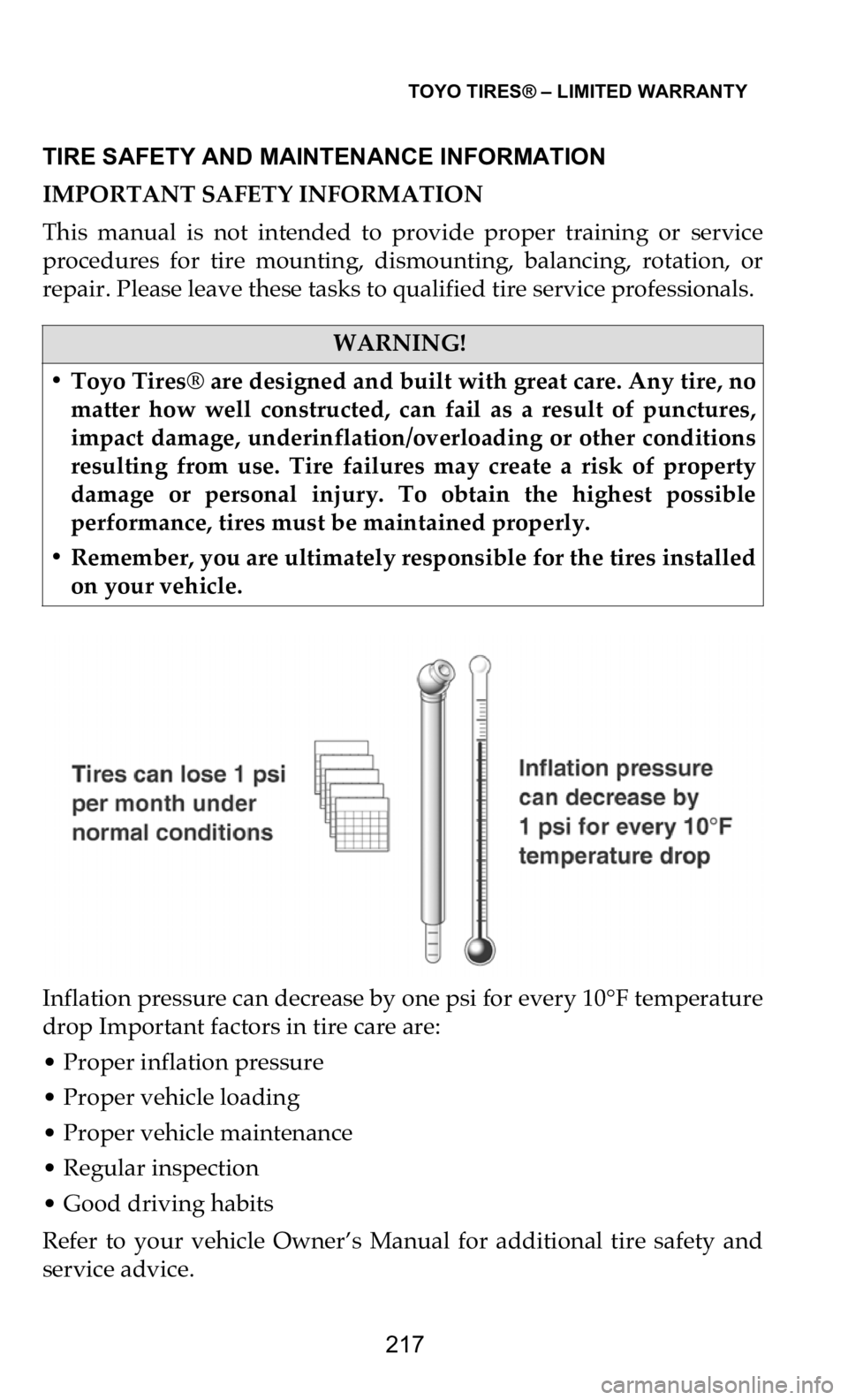
Inflation pressure can decrease by one psi for every 10°F temperature
d r
op Important factors in tire care are:
• Proper inflation pressure
•
Proper vehicle loading
•
Proper vehicle maintenance
•
Regular inspection
•
Good driving habits
R
efer to your vehicle Owner’s Manual for additional tire safety and
se
rvice advice.
WARNING!
• Toyo Tires® are designed and built with great care. Any tire, no
m
atter how well constructed, can fail as a result of punctures,
impact damage, underinflation/overloading or other conditions
resulting from use. Tire failures may create a risk of property
damage or personal injury. To obtain the highest possible
performance, tires must be maintained properly.
• Remember, you are ultimately responsible for the tires installed
o
n your vehicle.
Page 222 of 262
TOYO TIRES® – LIMITED WARRANTY
221
CAUTION!
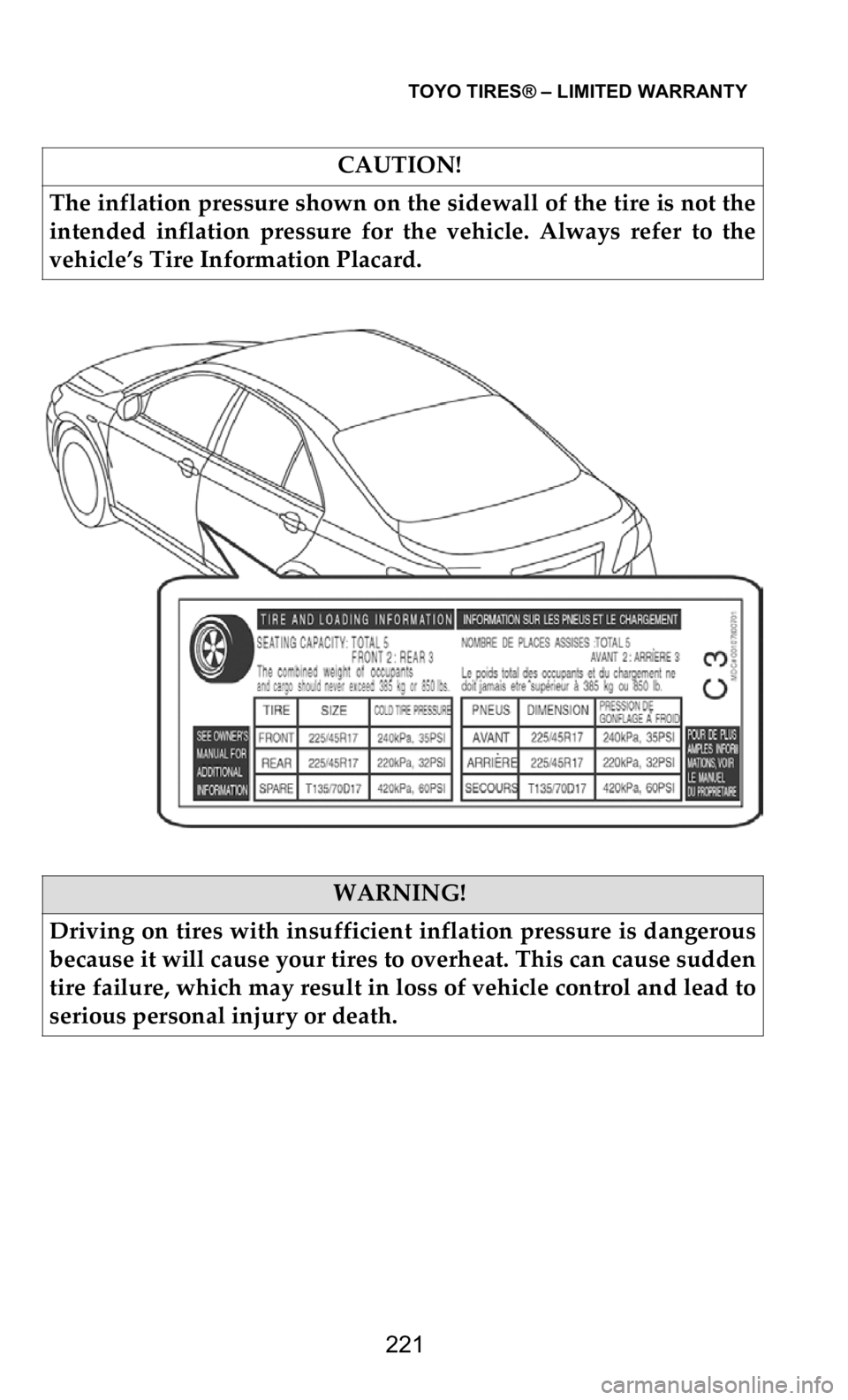
The inflation pressure shown on the sidewall of the tire is not the
in
tended inflation pressure for the vehicle. Always refer to the
vehicle’s Tire Information Placard.
WARNING!
Driving on tires with insufficient inflation pressure is dangerous
be
cause it will cause your tires to overheat. This can cause sudden
tire failure, which may result in loss of vehicle control and lead to
serious personal injury or death.
Page 224 of 262
TOYO TIRES® – LIMITED WARRANTY
223
RECOMMENDATIONS FOR SAFE TIRE INFLATION
• If you must inflate your tires when they are hot, add four pounds
p
er square inch (4 psi) (28 kPa) above the recommended inflation
pressure specification. Recheck the inflation pressure when the tires
are cold and adjust to the recommended inflation pressure shown
on the vehicle’s Tire Information Placard.
• Never release air or nitrogen from a hot tire in order to reach the
r
ecommended cold tire pressure. Normal driving causes tires to run
hotter and inflation pressure to increase. If you release pressure
when your tires are hot, you may dangerously underinflate your
tires. If your tires lose more than one pound per square inch (1 psi)
per month, the tire, the valve, or the wheel may be damaged.
Consult an authorized Toyo Tires dealer for an inspection.
• Over-inflation can cause the tire to be more susceptible to impact
d
amage.
• Over-inflation or underinflation may adversely affect vehicle
h
andling.
• Remember to check your spare tire. Consult your vehicle Owner’s
M
anual for the correct inflation pressure and use of a “temporary
use” spare tire. The inflation pressure specified for a spare tire is
typically different from that specified for your regular tires.
• Use valve caps to keep valve cores clean and clear of debris and to
h
elp guard against air leakage.
WARNING!
Never inflate a tire unless it is secured to the vehicle or a tire
mo
unting machine. Inflating an unsecured tire is dangerous. If
the tire bursts, it could be propelled into the air with explosive
force and cause serious personal injury or death.
Page 225 of 262
TOYO TIRES® – LIMITED WARRANTY
224
VEHICLES EQUIPPED WITH TIRE PRESSURE MONITORING
SYSTEMS (TPMS)Even if your vehicle is equipped with a tire pressure
monitoring system, you should check your tire pressure
at
least once per month when the tires are cold for
example, after being parked overnight. Tire pressure
warning systems are not a substitute for regular tire
pressure maintenance.
IDENTIFYING DAMAGED TIRES
• I f your tire strikes a road hazard at any speed, internal tire damage
c
ould result, which may lead to sudden tire failure and loss of
vehicle control. Tire failure may even occur miles after the initial
impact. Impact damage from such hazards may not be visible on the
outside of the tire. Have your Toyo Tires® dealer dismount the tire
and inspect it for damage. A tire may not have visible signs of
damage on the tire surface or the interior.
• If the impact was sufficient to bend the wheel flange, internal tire
d
amage may have occurred, compromising the safety and integrity
of the tire. Such impact damage may result in a sudden tire failure
many weeks or months later. Tire replacement is highly recom -
mended as a safety precaution.
• Indications of impact damage include, but are not limited to, a
b
ubble or a blister on the outside of the tire.
• Have your dealer inspect your tires if you see anything unusual or
i
f cuts, cracks, splitting, or bruises in the tread and sidewall areas are
visible. Bumps or bulges may indicate a serious and dangerous
separation within the tire body. Have your tire inspected by a qual -
ified tire service person. It may be necessary to have the tire
re
moved from the wheel for a complete inspection.
WARNING!
If your vehicle is equipped with TPMS, read the vehicle Owner’s
Ma
nual regarding its operation. Some TPMS systems do not alert
you until the tires are significantly underinflated, which could
result in permanent tire damage and possible sudden tire failure.
In the event that your TPMS malfunction indicator lamp is
displayed, you should immediately pull over to a safe parking
area and check your tires.