park assist DODGE CHALLENGER 2022 User Guide
[x] Cancel search | Manufacturer: DODGE, Model Year: 2022, Model line: CHALLENGER, Model: DODGE CHALLENGER 2022Pages: 336, PDF Size: 16.47 MB
Page 130 of 336
128MULTIMEDIA
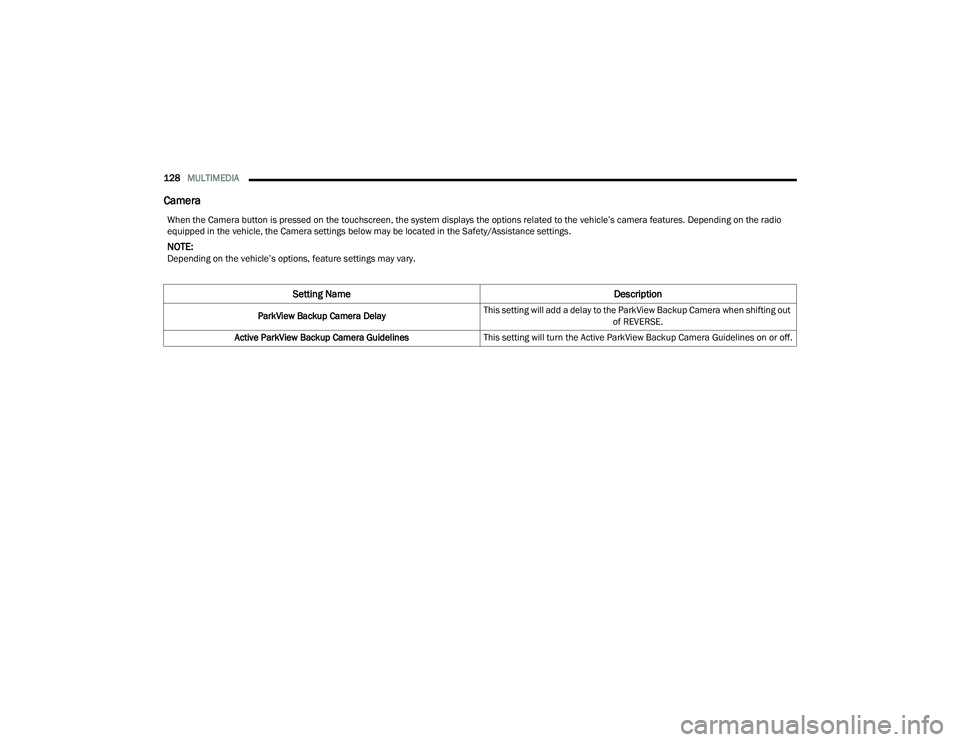
Camera
When the Camera button is pressed on the touchscreen, the system displays the options related to the vehicle’s camera features. Depending on the radio
equipped in the vehicle, the Camera settings below may be located in the Safety/Assistance settings.
NOTE:Depending on the vehicle’s options, feature settings may vary.
Setting Name Description
ParkView Backup Camera DelayThis setting will add a delay to the ParkView Backup Camera when shifting out
of REVERSE.
Active ParkView Backup Camera Guidelines This setting will turn the Active ParkView Backup Camera Guidelines on or off.
22_LA_OM_EN_USC_t.book Page 128
Page 131 of 336
MULTIMEDIA129
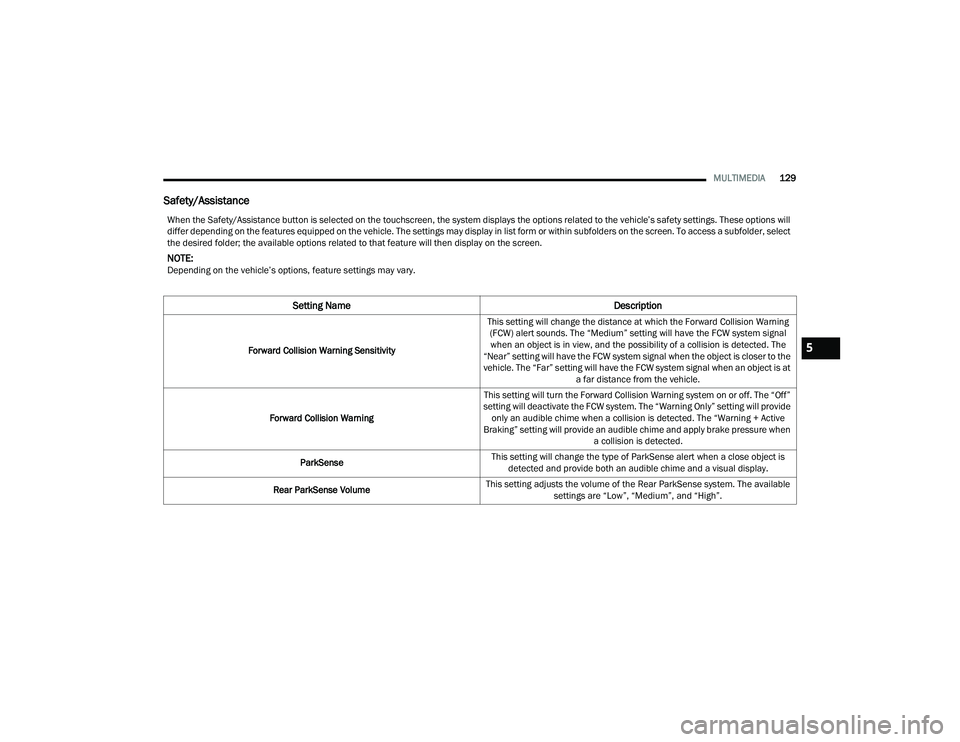
Safety/Assistance
When the Safety/Assistance button is selected on the touchscreen, the system displays the options related to the vehicle’s safety settings. These options will
differ depending on the features equipped on the vehicle. The settings may display in list form or within subfolders on the screen. To access a subfolder, select
the desired folder; the available options related to that feature will then display on the screen.
NOTE:Depending on the vehicle’s options, feature settings may vary.
Setting Name Description
Forward Collision Warning SensitivityThis setting will change the distance at which the Forward Collision Warning
(FCW) alert sounds. The “Medium” setting will have the FCW system signal when an object is in view, and the possibility of a collision is detected. The
“Near” setting will have the FCW system signal when the object is closer to the
vehicle. The “Far” setting will have the FCW system signal when an object is at a far distance from the vehicle.
Forward Collision Warning This setting will turn the Forward Collision Warning system on or off. The “Off”
setting will deactivate the FCW system. The “Warning Only” setting will provide only an audible chime when a collision is detected. The “Warning + Active
Braking” setting will provide an audible chime and apply brake pressure when a collision is detected.
ParkSense This setting will change the type of ParkSense alert when a close object is
detected and provide both an audible chime and a visual display.
Rear ParkSense Volume This setting adjusts the volume of the Rear ParkSense system. The available
settings are “Low”, “Medium”, and “High”.5
22_LA_OM_EN_USC_t.book Page 129
Page 132 of 336
130MULTIMEDIA
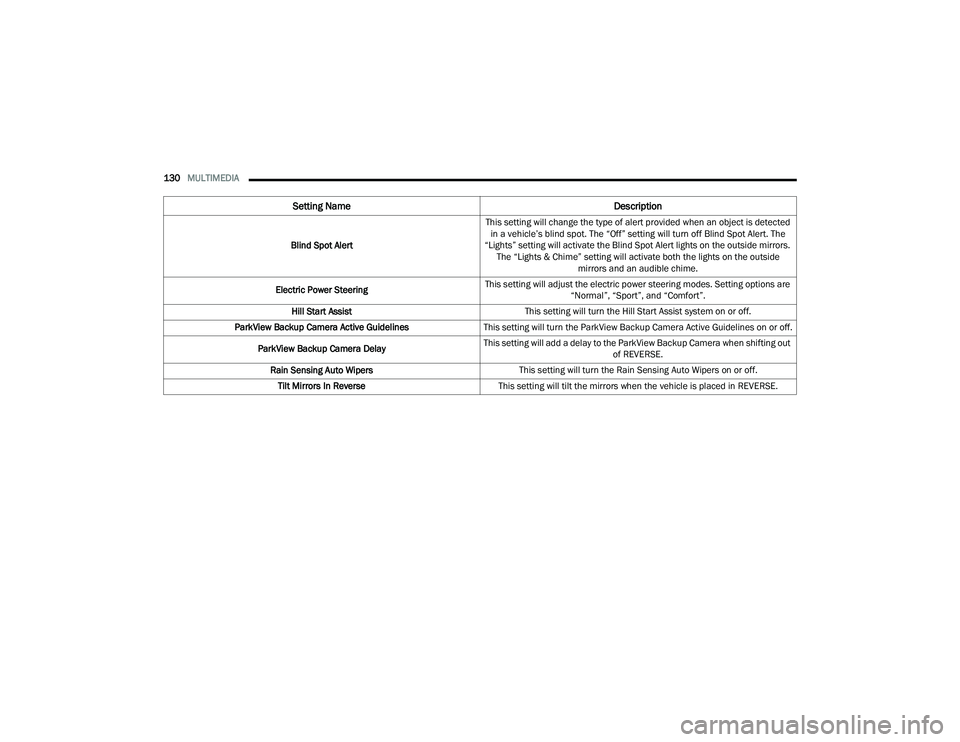
Blind Spot Alert This setting will change the type of alert provided when an object is detected
in a vehicle’s blind spot. The “Off” setting will turn off Blind Spot Alert. The
“Lights” setting will activate the Blind Spot Alert lights on the outside mirrors. The “Lights & Chime” setting will activate both the lights on the outside mirrors and an audible chime.
Electric Power Steering This setting will adjust the electric power steering modes. Setting options are
“Normal”, “Sport”, and “Comfort”.
Hill Start Assist This setting will turn the Hill Start Assist system on or off.
ParkView Backup Camera Active Guidelines This setting will turn the ParkView Backup Camera Active Guidelines on or off.
ParkView Backup Camera Delay This setting will add a delay to the ParkView Backup Camera when shifting out
of REVERSE.
Rain Sensing Auto Wipers This setting will turn the Rain Sensing Auto Wipers on or off.
Tilt Mirrors In Reverse This setting will tilt the mirrors when the vehicle is placed in REVERSE.
Setting Name Description
22_LA_OM_EN_USC_t.book Page 130
Page 191 of 336
SAFETY189
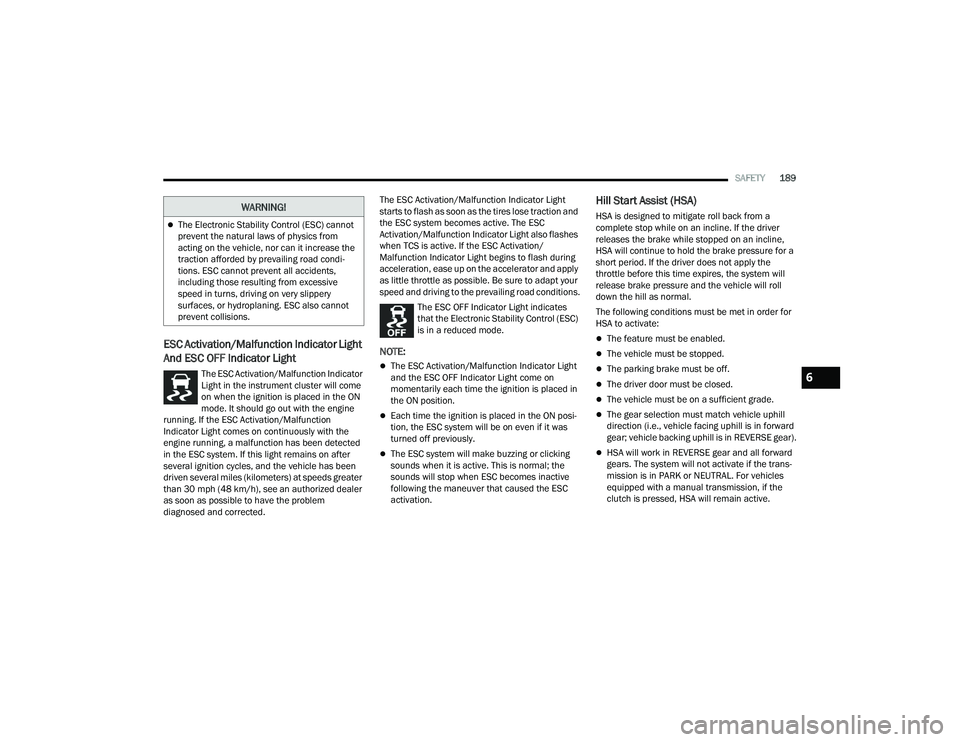
ESC Activation/Malfunction Indicator Light
And ESC OFF Indicator Light
The ESC Activation/Malfunction Indicator
Light in the instrument cluster will come
on when the ignition is placed in the ON
mode. It should go out with the engine
running. If the ESC Activation/Malfunction
Indicator Light comes on continuously with the
engine running, a malfunction has been detected
in the ESC system. If this light remains on after
several ignition cycles, and the vehicle has been
driven several miles (kilometers) at speeds greater
than 30 mph (48 km/h), see an authorized dealer
as soon as possible to have the problem
diagnosed and corrected. The ESC Activation/Malfunction Indicator Light
starts to flash as soon as the tires lose traction and
the ESC system becomes active. The ESC
Activation/Malfunction Indicator Light also flashes
when TCS is active. If the ESC Activation/
Malfunction Indicator Light begins to flash during
acceleration, ease up on the accelerator and apply
as little throttle as possible. Be sure to adapt your
speed and driving to the prevailing road conditions.
The ESC OFF Indicator Light indicates
that the Electronic Stability Control (ESC)
is in a reduced mode.
NOTE:
The ESC Activation/Malfunction Indicator Light
and the ESC OFF Indicator Light come on
momentarily each time the ignition is placed in
the ON position.
Each time the ignition is placed in the ON posi -
tion, the ESC system will be on even if it was
turned off previously.
The ESC system will make buzzing or clicking
sounds when it is active. This is normal; the
sounds will stop when ESC becomes inactive
following the maneuver that caused the ESC
activation.
Hill Start Assist (HSA)
HSA is designed to mitigate roll back from a
complete stop while on an incline. If the driver
releases the brake while stopped on an incline,
HSA will continue to hold the brake pressure for a
short period. If the driver does not apply the
throttle before this time expires, the system will
release brake pressure and the vehicle will roll
down the hill as normal.
The following conditions must be met in order for
HSA to activate:
The feature must be enabled.
The vehicle must be stopped.
The parking brake must be off.
The driver door must be closed.
The vehicle must be on a sufficient grade.
The gear selection must match vehicle uphill
direction (i.e., vehicle facing uphill is in forward
gear; vehicle backing uphill is in REVERSE gear).
HSA will work in REVERSE gear and all forward
gears. The system will not activate if the trans -
mission is in PARK or NEUTRAL. For vehicles
equipped with a manual transmission, if the
clutch is pressed, HSA will remain active.
The Electronic Stability Control (ESC) cannot
prevent the natural laws of physics from
acting on the vehicle, nor can it increase the
traction afforded by prevailing road condi -
tions. ESC cannot prevent all accidents,
including those resulting from excessive
speed in turns, driving on very slippery
surfaces, or hydroplaning. ESC also cannot
prevent collisions.
WARNING!
6
22_LA_OM_EN_USC_t.book Page 189
Page 192 of 336

190SAFETY
Disabling And Enabling HSA
This feature can be turned on or turned off. To
change the current setting, proceed as follows:
If disabling HSA using Uconnect Settings, see
Úpage 123.
Towing With HSA
HSA will also provide assistance to mitigate roll
back while towing a trailer.
Rain Brake Support (RBS)
RBS may improve braking performance in wet
conditions. It will periodically apply a small amount
of brake pressure to remove any water buildup on
the front brake rotors. It functions when the
windshield wipers are in LO or HI speed. When RBS
is active, there is no notification to the driver and
no driver interaction is required.
Ready Alert Braking (RAB)
RAB may reduce the time required to reach full
braking during emergency braking situations. It
anticipates when an emergency braking situation
may occur by monitoring how fast the throttle is
released by the driver. The Electronic Brake
Controller (EBC) will prepare the brake system for
a panic stop.
Traction Control System (TCS)
The TCS monitors the amount of wheel spin of
each of the driven wheels. If wheel spin is
detected, the TCS may apply brake pressure to the
spinning wheel(s) and/or reduce engine power to
provide enhanced acceleration and stability. A
feature of the TCS, Brake Limited Differential (BLD)
functions similarly to a limited slip differential and
controls the wheel spin across a driven axle. If one
wheel on a driven axle is spinning faster than the
other, the system will apply the brake of the
spinning wheel. This will allow more engine power
to be applied to the wheel that is not spinning. BLD
may remain enabled even if TCS and ESC are in
reduced modes.
WARNING!
There may be situations where the Hill Start
Assist (HSA) will not activate and slight rolling
may occur, such as on minor hills or with a
loaded vehicle, or while pulling a trailer. HSA is
not a substitute for active driving involvement. It
is always the driver’s responsibility to be
attentive to distance to other vehicles, people,
and objects, and most importantly brake
operation to ensure safe operation of the vehicle
under all road conditions. Your complete
attention is always required while driving to
maintain safe control of your vehicle. Failure to
follow these warnings can result in a collision or
serious personal injury.
WARNING!
If you use a trailer brake controller with your
trailer, the trailer brakes may be activated and
deactivated with the brake switch. If so, there
may not be enough brake pressure to hold
both the vehicle and the trailer on a hill when
the brake pedal is released. In order to avoid
rolling down an incline while resuming accel -
eration, manually activate the trailer brake or
apply more vehicle brake pressure prior to
releasing the brake pedal.
HSA is not a parking brake. Always apply the
parking brake fully when exiting your vehicle.
Also, be certain to place the transmission in
PARK.
Failure to follow these warnings can result in a
collision or serious personal injury.
22_LA_OM_EN_USC_t.book Page 190
Page 246 of 336
244IN CASE OF EMERGENCY
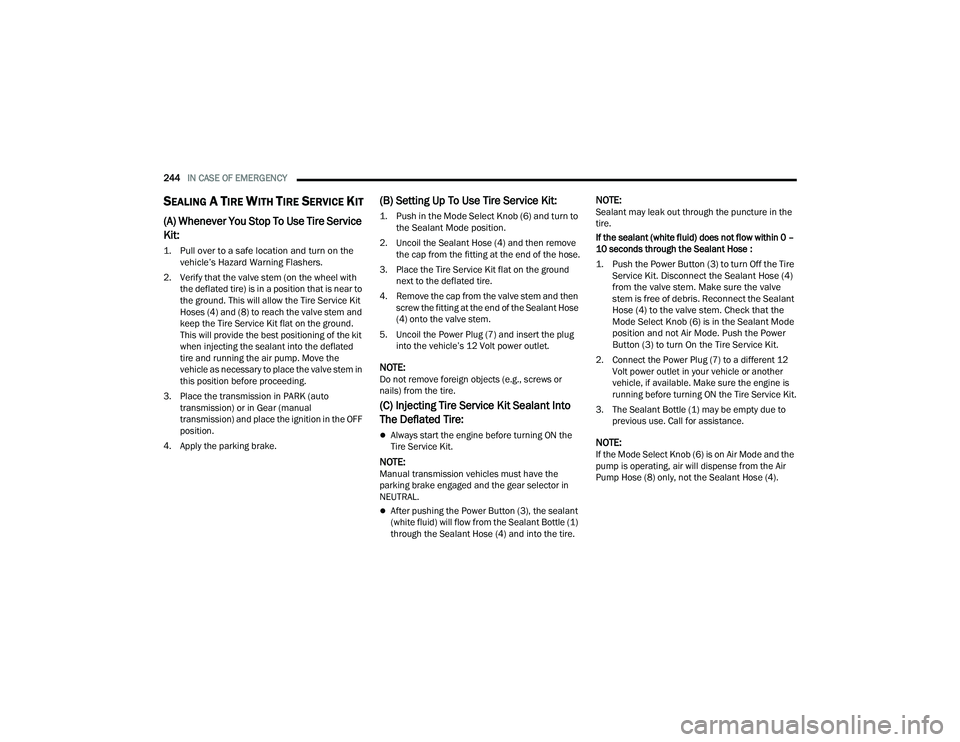
SEALING A TIRE WITH TIRE SERVICE KIT
(A) Whenever You Stop To Use Tire Service
Kit:
1. Pull over to a safe location and turn on the
vehicle’s Hazard Warning Flashers.
2. Verify that the valve stem (on the wheel with the deflated tire) is in a position that is near to
the ground. This will allow the Tire Service Kit
Hoses (4) and (8) to reach the valve stem and
keep the Tire Service Kit flat on the ground.
This will provide the best positioning of the kit
when injecting the sealant into the deflated
tire and running the air pump. Move the
vehicle as necessary to place the valve stem in
this position before proceeding.
3. Place the transmission in PARK (auto transmission) or in Gear (manual
transmission) and place the ignition in the OFF
position.
4. Apply the parking brake.
(B) Setting Up To Use Tire Service Kit:
1. Push in the Mode Select Knob (6) and turn to the Sealant Mode position.
2. Uncoil the Sealant Hose (4) and then remove the cap from the fitting at the end of the hose.
3. Place the Tire Service Kit flat on the ground next to the deflated tire.
4. Remove the cap from the valve stem and then screw the fitting at the end of the Sealant Hose
(4) onto the valve stem.
5. Uncoil the Power Plug (7) and insert the plug into the vehicle’s 12 Volt power outlet.
NOTE:Do not remove foreign objects (e.g., screws or
nails) from the tire.
(C) Injecting Tire Service Kit Sealant Into
The Deflated Tire:
Always start the engine before turning ON the
Tire Service Kit.
NOTE:Manual transmission vehicles must have the
parking brake engaged and the gear selector in
NEUTRAL.
After pushing the Power Button (3), the sealant
(white fluid) will flow from the Sealant Bottle (1)
through the Sealant Hose (4) and into the tire.
NOTE:Sealant may leak out through the puncture in the
tire.
If the sealant (white fluid) does not flow within 0 –
10 seconds through the Sealant Hose :
1. Push the Power Button (3) to turn Off the Tire Service Kit. Disconnect the Sealant Hose (4)
from the valve stem. Make sure the valve
stem is free of debris. Reconnect the Sealant
Hose (4) to the valve stem. Check that the
Mode Select Knob (6) is in the Sealant Mode
position and not Air Mode. Push the Power
Button (3) to turn On the Tire Service Kit.
2. Connect the Power Plug (7) to a different 12 Volt power outlet in your vehicle or another
vehicle, if available. Make sure the engine is
running before turning ON the Tire Service Kit.
3. The Sealant Bottle (1) may be empty due to previous use. Call for assistance.
NOTE:If the Mode Select Knob (6) is on Air Mode and the
pump is operating, air will dispense from the Air
Pump Hose (8) only, not the Sealant Hose (4).
22_LA_OM_EN_USC_t.book Page 244
Page 286 of 336
284SERVICING AND MAINTENANCE
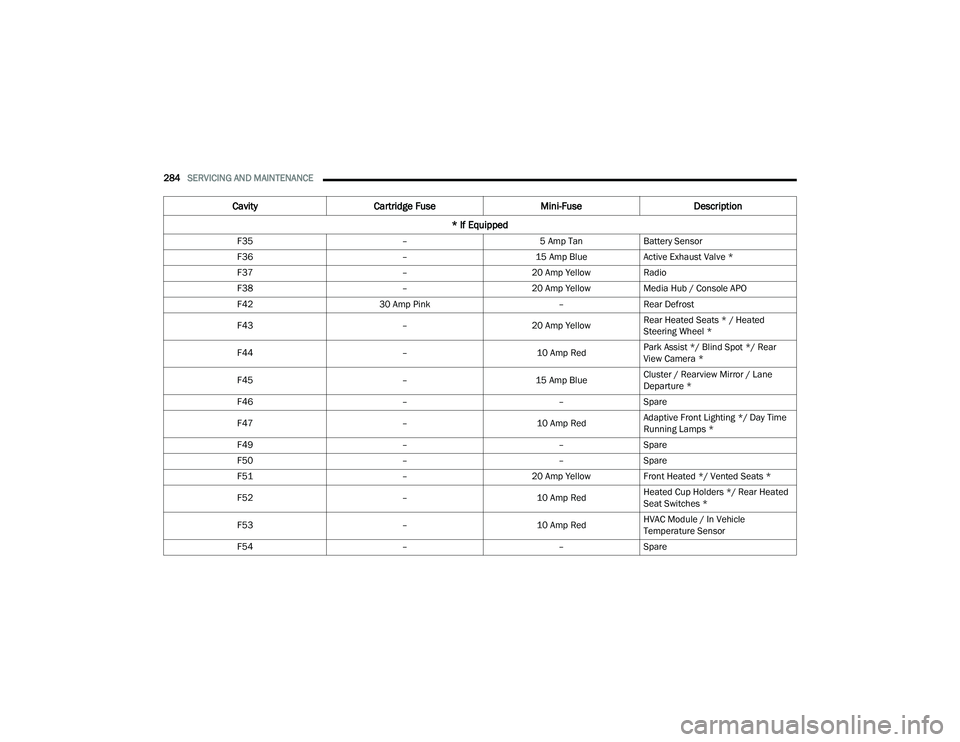
F35 –5 Amp TanBattery Sensor
F36 –15 Amp BlueActive Exhaust Valve *
F37 –20 Amp YellowRadio
F38 –20 Amp YellowMedia Hub / Console APO
F42 30 Amp Pink –Rear Defrost
F43 –20 Amp YellowRear Heated Seats * / Heated
Steering Wheel *
F44 –10 Amp RedPark Assist */ Blind Spot */ Rear
View Camera *
F45 –15 Amp BlueCluster / Rearview Mirror / Lane
Departure *
F46 ––Spare
F47 –10 Amp RedAdaptive Front Lighting */ Day Time
Running Lamps *
F49 ––Spare
F50 ––Spare
F51 –20 Amp YellowFront Heated */ Vented Seats *
F52 –10 Amp RedHeated Cup Holders */ Rear Heated
Seat Switches *
F53 –10 Amp RedHVAC Module / In Vehicle
Temperature Sensor
F54 ––Spare
Cavity Cartridge Fuse Mini-FuseDescription
* If Equipped
22_LA_OM_EN_USC_t.book Page 284
Page 316 of 336
314TECHNICAL SPECIFICATIONS
(Continued)
CNG AND LP FUEL SYSTEM
M
ODIFICATIONS
Modifications that allow the engine to run on
Compressed Natural Gas (CNG) or Liquid Propane
(LP) may result in damage to the engine,
emissions, and fuel system components. Problems
that result from running CNG or LP are not the
responsibility of the manufacturer and may void or
not be covered under the New Vehicle Limited
Warranty.
METHYLCYCLOPENTADIENYL
M
ANGANESE TRICARBONYL (MMT) IN
G
ASOLINE
MMT is a manganese-containing metallic additive
that is blended into some gasoline to increase
octane. Gasoline blended with MMT provides no
performance advantage beyond gasoline of the
same octane number without MMT. Gasoline
blended with MMT reduces spark plug life and
reduces emissions system performance in some
vehicles. The manufacturer recommends that gasoline
without MMT be used in your vehicle. The MMT
content of gasoline may not be indicated on the
gasoline pump; therefore, you should ask your
gasoline retailer whether the gasoline contains
MMT. MMT is prohibited in Federal and California
reformulated gasoline.
FUEL SYSTEM CAUTIONS
NOTE:Intentional tampering with the emissions control
system can result in civil penalties being assessed
against you.
CAUTION!
Follow these guidelines to maintain your
vehicle’s performance:
The use of leaded gasoline is prohibited by
Federal law. Using leaded gasoline can impair
engine performance and damage the emis
-
sions control system.
An out-of-tune engine or certain fuel or ignition
malfunctions can cause the catalytic
converter to overheat. If you notice a pungent
burning odor or some light smoke, your engine
may be out of tune or malfunctioning and may
require immediate service. Contact an autho -
rized dealer for service assistance.
The use of fuel additives, which are now being
sold as octane enhancers, is not recom -
mended. Most of these products contain high
concentrations of methanol. Fuel system
damage or vehicle performance problems
resulting from the use of such fuels or addi -
tives is not the responsibility of the manufac-
turer and may void or not be covered under
the New Vehicle Limited Warranty.
CAUTION!
22_LA_OM_EN_USC_t.book Page 314
Page 326 of 336
324 AutoPark
.......................................................... 84Autostick Operation.................................................... 95Axle Fluid....................................................... 318Axle Lubrication............................................. 318
B
Back-Up......................................................... 111Battery.................................................... 74, 262Charging System Light................................. 74Keyless Key Fob Replacement.................... 14Location.................................................... 262Belts, Seat..................................................... 230Blind Spot Monitoring.................................... 191BluetoothConnecting To A Particular MobilePhone Or Audio Device After Pairing
..... 161Body Mechanism Lubrication........................ 268B-Pillar Location............................................. 294Brake Assist System...................................... 186Brake Control System.................................... 186Brake Fluid.......................................... 274, 318Brake System...................................... 274, 311Fluid Check..................................... 274, 318Master Cylinder......................................... 274Parking........................................................ 86Warning Light..................................... 73, 311Brake/Transmission Interlock......................... 91Break-In Recommendations, New Vehicle....... 86Brightness, Interior Lights................................ 49
Bulb Replacement........................................ 286Bulbs, Light.......................................... 232, 286
C
Camera, Rear................................................ 111Capacities, Fluid........................................... 315Caps, FillerFuel.......................................................... 112Oil (Engine)............................................... 259Radiator (Coolant Pressure)..................... 273Car Washes................................................... 308Carbon Monoxide Warning............................ 232CargoVehicle Loading........................................ 113CD................................................................. 154Cellular Phone.............................................. 184Certification Label......................................... 113Chains, Tire................................................... 304Chart, Tire Sizing........................................... 291Check Engine Light
(Malfunction Indicator Light)............................ 81Checking Your Vehicle For Safety................. 230Checks, Safety.............................................. 230Child Restraint.............................................. 216Child RestraintsBooster Seats........................................... 219Child Seat Installation.............................. 228How To Stow An unused ALR Seat Belt.... 225Infant And Child Restraints....................... 217
Lower Anchors And Tethers ForChildren................................................ 221Older Children And Child Restraints.......... 218Seating Positions...................................... 220Clean Air Gasoline......................................... 313CleaningWheels...................................................... 303Climate Control................................................51Cold Weather Operation...................................86Compact Spare Tire...................................... 302Contract, Service........................................... 320Controls........................................................ 145Cooling Pressure Cap (Radiator Cap)............ 273Cooling System............................................. 271Adding Coolant (Antifreeze)...................... 272Coolant Level................................... 271, 273Cooling Capacity....................................... 315Disposal Of Used Coolant......................... 273Drain, Flush, And Refill............................. 271Inspection................................................. 273Points To Remember................................ 273Pressure Cap............................................ 273Radiator Cap............................................. 273Selection Of Coolant(Antifreeze)......................... 272, 315, 316Corrosion Protection..................................... 308Cruise Control..................................................97Cruise Control (Speed Control).........................97Cruise Light......................................................80Customer Assistance.................................... 319
22_LA_OM_EN_USC_t.book Page 324
Page 329 of 336
327
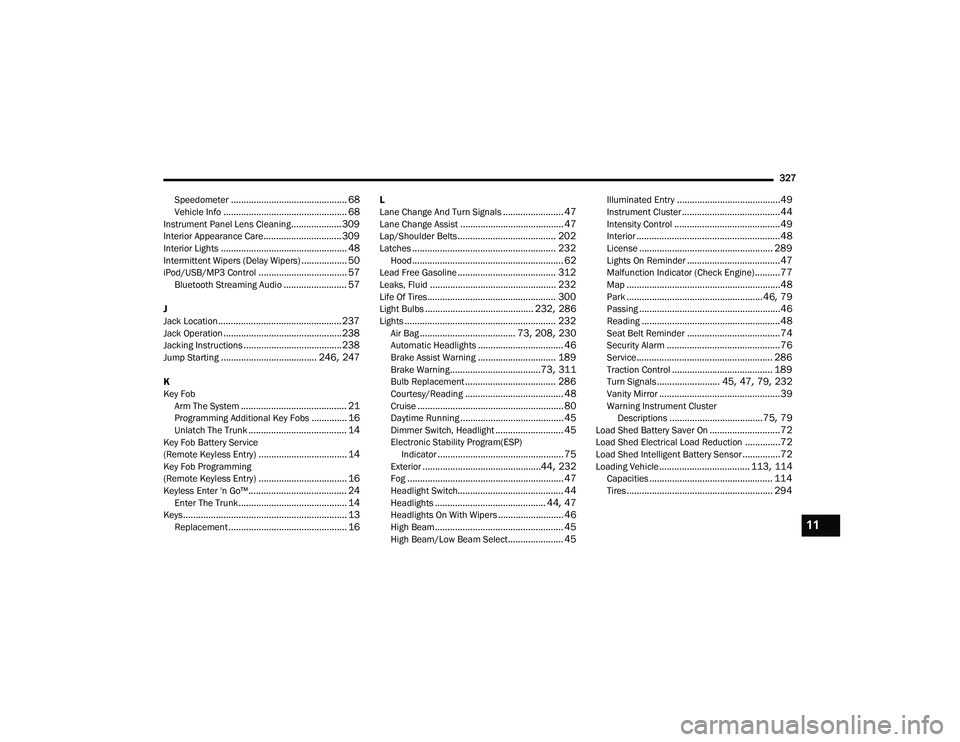
Speedometer
.............................................. 68Vehicle Info................................................. 68Instrument Panel Lens Cleaning.................... 309Interior Appearance Care............................... 309Interior Lights.................................................. 48Intermittent Wipers (Delay Wipers).................. 50iPod/USB/MP3 Control................................... 57Bluetooth Streaming Audio......................... 57
J
Jack Location................................................. 237Jack Operation............................................... 238Jacking Instructions....................................... 238Jump Starting...................................... 246, 247
K
Key Fob Arm The System
.......................................... 21Programming Additional Key Fobs.............. 16Unlatch The Trunk....................................... 14Key Fob Battery Service
(Remote Keyless Entry)................................... 14Key Fob Programming
(Remote Keyless Entry)................................... 16Keyless Enter 'n Go™....................................... 24Enter The Trunk........................................... 14Keys................................................................. 13Replacement............................................... 16
L
Lane Change And Turn Signals........................ 47Lane Change Assist......................................... 47Lap/Shoulder Belts....................................... 202Latches......................................................... 232Hood............................................................ 62Lead Free Gasoline....................................... 312Leaks, Fluid.................................................. 232Life Of Tires................................................... 300Light Bulbs........................................... 232, 286Lights............................................................ 232Air Bag...................................... 73, 208, 230Automatic Headlights.................................. 46Brake Assist Warning............................... 189Brake Warning....................................73, 311Bulb Replacement.................................... 286Courtesy/Reading....................................... 48Cruise.......................................................... 80Daytime Running......................................... 45Dimmer Switch, Headlight........................... 45Electronic Stability Program(ESP)Indicator.................................................. 75Exterior...............................................44, 232Fog.............................................................. 47Headlight Switch.......................................... 44Headlights............................................ 44, 47Headlights On With Wipers.......................... 46High Beam................................................... 45High Beam/Low Beam Select...................... 45
Illuminated Entry.........................................49Instrument Cluster.......................................44Intensity Control..........................................49Interior.........................................................48License..................................................... 289Lights On Reminder.....................................47Malfunction Indicator (Check Engine)..........77Map.............................................................48Park......................................................46, 79Passing........................................................46Reading.......................................................48Seat Belt Reminder.....................................74Security Alarm.............................................76Service...................................................... 286Traction Control........................................ 189Turn Signals......................... 45, 47, 79, 232Vanity Mirror................................................39Warning Instrument ClusterDescriptions.....................................75, 79Load Shed Battery Saver On............................72Load Shed Electrical Load Reduction..............72Load Shed Intelligent Battery Sensor...............72Loading Vehicle.................................... 113, 114Capacities................................................. 114Tires.......................................................... 294
11
22_LA_OM_EN_USC_t.book Page 327