Sport DODGE CHALLENGER 2022 Owner's Manual
[x] Cancel search | Manufacturer: DODGE, Model Year: 2022, Model line: CHALLENGER, Model: DODGE CHALLENGER 2022Pages: 336, PDF Size: 16.47 MB
Page 218 of 336
216SAFETY
NOTE:EDR data are recorded by your vehicle only if a
non-trivial crash situation occurs; no data are
recorded by the EDR under normal driving condi -
tions and no personal data (e.g., name, gender,
age, and crash location) are recorded. However,
other parties, such as law enforcement, could
combine the EDR data with the type of personally
identifying data routinely acquired during a crash
investigation.
To read data recorded by an EDR, special
equipment is required, and access to the vehicle or
the EDR is needed. In addition to the vehicle
manufacturer, other parties, such as law
enforcement, that have the special equipment,
can read the information if they have access to the
vehicle or the EDR.
CHILD RESTRAINTS
Everyone in your vehicle needs to be buckled up at
all times, including babies and children. Every
state in the United States, and every Canadian
province, requires that small children ride in
proper restraint systems. This is the law, and you
can be prosecuted for ignoring it. Children 12 years or younger should ride properly
buckled up in a rear seat, if available.
According to crash statistics, children are safer
when properly restrained in the rear seats rather
than in the front.
If your vehicle is not equipped with a rear seat,
FCA US LLC recommends that you do not allow
children 12 years old and under to ride in your
vehicle. If the rear seats are not present in your
vehicle, NEVER install a child restraint in these
positions.
There are different sizes and types of restraints for
children from newborn size to the child almost
large enough for an adult safety belt. Always check
the child seat Owner’s Manual to make sure you
have the correct seat for your child. Carefully read
and follow all the instructions and warnings in the
child restraint Owner’s Manual and on all the
labels attached to the child restraint.
Before buying any restraint system, make sure that
it has a label certifying that it meets all applicable
Safety Standards. You should also make sure that
you can install it in the vehicle where you will use it.
NOTE:
For additional information, refer to http://
www.nhtsa.gov/parents-and-caregivers or
call: 1–888–327–4236
Canadian residents should refer to Transport
Canada’s website for additional information:
http://www.tc.gc.ca/en/services/road/
child-car-seat-safety.html
WARNING!
In a collision, an unrestrained child can become
a projectile inside the vehicle. The force required
to hold even an infant on your lap could become
so great that you could not hold the child, no
matter how strong you are. The child and others
could be badly injured or killed. Any child riding
in your vehicle should be in a proper restraint for
the child’s size.
22_LA_OM_EN_USC_t.book Page 216
Page 220 of 336
218SAFETY
Older Children And Child Restraints
NOTE:If your vehicle is not equipped with a rear seat, FCA
US LLC recommends that you do not allow children
12 years old and under to ride in your vehicle. If the
rear seats are not present in your vehicle, NEVER
install a child restraint in these positions. If you
must install a forward facing child restraint in the
front passenger seat, then you must use the seat
belt system to secure the restraint. A top tether
strap extension may be needed to reach the tether
anchor on the rear shelf directly behind the
passenger seat. Children who are two years old or who have
outgrown their rear-facing convertible child seat
can ride forward-facing in the vehicle.
Forward-facing child seats and convertible child
seats used in the forward-facing direction are for
children who are over two years old or who have
outgrown the rear-facing weight or height limit of
their rear-facing convertible child seat. Children
should remain in a forward-facing child seat with a
harness for as long as possible, up to the highest
weight or height allowed by the child seat.
All children whose weight or height is above the
forward-facing limit for the child seat should use a
belt-positioning booster seat until the vehicle’s
seat belts fit properly. If the child cannot sit with
knees bent over the vehicle’s seat cushion while
the child’s back is against the seatback, they
should use a belt-positioning booster seat. The
child and belt-positioning booster seat are held in
the vehicle by the seat belt.
WARNING!
Never place a rear-facing child restraint in
front of an air bag. A deploying passenger
front air bag can cause death or serious injury
to a child 12 years or younger, including a
child in a rear-facing child restraint.
Never install a rear-facing child restraint in the
front seat of a vehicle. Only use a rear-facing
child restraint in the rear seat. If the vehicle
does not have a rear seat, do not transport a
rear-facing child restraint in that vehicle.
WARNING!
Improper installation can lead to failure of an
infant or child restraint. It could come loose in
a collision. The child could be badly injured or
killed. Follow the child restraint manufac
-
turer’s directions exactly when installing an
infant or child restraint.
After a child restraint is installed in the
vehicle, do not move the vehicle seat forward
or rearward because it can loosen the child
restraint attachments. Remove the child
restraint before adjusting the vehicle seat
position. When the vehicle seat has been
adjusted, reinstall the child restraint.
When your child restraint is not in use, secure
it in the vehicle with the seat belt or LATCH
anchorages, or remove it from the vehicle. Do
not leave it loose in the vehicle. In a sudden
stop or accident, it could strike the occupants
or seatbacks and cause serious personal
injury.
22_LA_OM_EN_USC_t.book Page 218
Page 223 of 336
SAFETY221
Lower Anchors And Tethers For CHildren
(LATCH) Restraint System
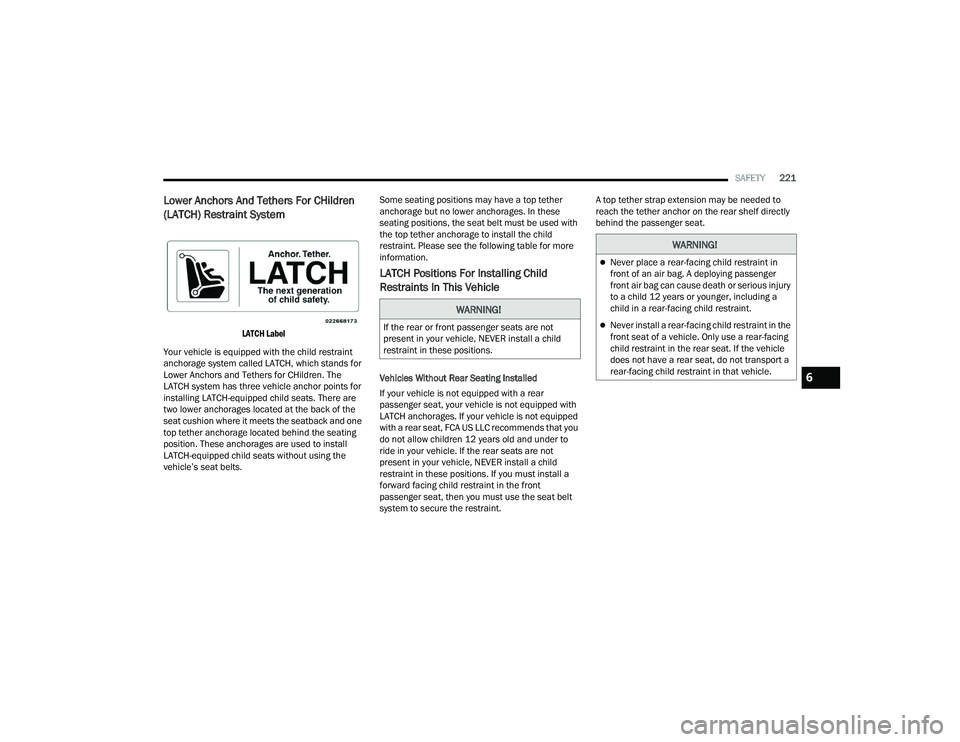
LATCH Label
Your vehicle is equipped with the child restraint
anchorage system called LATCH, which stands for
Lower Anchors and Tethers for CHildren. The
LATCH system has three vehicle anchor points for
installing LATCH-equipped child seats. There are
two lower anchorages located at the back of the
seat cushion where it meets the seatback and one
top tether anchorage located behind the seating
position. These anchorages are used to install
LATCH-equipped child seats without using the
vehicle’s seat belts. Some seating positions may have a top tether
anchorage but no lower anchorages. In these
seating positions, the seat belt must be used with
the top tether anchorage to install the child
restraint. Please see the following table for more
information.
LATCH Positions For Installing Child
Restraints In This Vehicle
Vehicles Without Rear Seating Installed
If your vehicle is not equipped with a rear
passenger seat, your vehicle is not equipped with
LATCH anchorages. If your vehicle is not equipped
with a rear seat, FCA US LLC recommends that you
do not allow children 12 years old and under to
ride in your vehicle. If the rear seats are not
present in your vehicle, NEVER install a child
restraint in these positions. If you must install a
forward facing child restraint in the front
passenger seat, then you must use the seat belt
system to secure the restraint.A top tether strap extension may be needed to
reach the tether anchor on the rear shelf directly
behind the passenger seat.
WARNING!
If the rear or front passenger seats are not
present in your vehicle, NEVER install a child
restraint in these positions.
WARNING!
Never place a rear-facing child restraint in
front of an air bag. A deploying passenger
front air bag can cause death or serious injury
to a child 12 years or younger, including a
child in a rear-facing child restraint.
Never install a rear-facing child restraint in the
front seat of a vehicle. Only use a rear-facing
child restraint in the rear seat. If the vehicle
does not have a rear seat, do not transport a
rear-facing child restraint in that vehicle.
6
22_LA_OM_EN_USC_t.book Page 221
Page 228 of 336
226SAFETY
Installing Child Restraints Using The
Vehicle Seat Belt
NOTE:If your vehicle is not equipped with a rear seat, FCA
US LLC recommends that you do not allow children
12 years old and under to ride in your vehicle. If the
rear seats are not present in your vehicle, NEVER
install a child restraint in these positions.
Child restraint systems are designed to be secured
in vehicle seats by lap belts or the lap belt portion
of a lap/shoulder belt. The seat belts in the passenger seating positions
are equipped with a Switchable Automatic Locking
Retractor (ALR) that is designed to keep the lap
portion of the seat belt tight around the child
restraint so that it is not necessary to use a locking
clip. The ALR retractor can be “switched” into a
locked mode by pulling all of the webbing out of the
retractor and then letting the webbing retract back
into the retractor. If it is locked, the ALR will make a clicking noise
while the webbing is pulled back into the retractor.
Refer to the “Automatic Locking Mode” description
on Ú
page 206 for additional information on ALR.
Please see the table below and the following
sections for more information.
Lap/Shoulder Belt Systems For Installing
Child Restraints In This Vehicle
NOTE:If your vehicle is not equipped with a rear seat, FCA
US LLC recommends that you do not allow children
12 years old and under to ride in your vehicle. If the
rear seats are not present in your vehicle, NEVER
install a child restraint in these positions.
WARNING!
Never place a rear-facing child restraint in
front of an air bag. A deploying passenger
front air bag can cause death or serious injury
to a child 12 years or younger, including a
child in a rear-facing child restraint.
Never install a rear-facing child restraint in the
front seat of a vehicle. Only use a rear-facing
child restraint in the rear seat. If the vehicle
does not have a rear seat, do not transport a
rear-facing child restraint in that vehicle.
WARNING!
Improper installation or failure to properly
secure a child restraint can lead to failure of
the restraint. The child could be badly injured
or killed.
Follow the child restraint manufacturer’s
directions exactly when installing an infant or
child restraint.
22_LA_OM_EN_USC_t.book Page 226
Page 232 of 336
230SAFETY
SAFETY TIPS
TRANSPORTING PASSENGERS
NEVER TRANSPORT PASSENGERS IN THE CARGO
AREA.
TRANSPORTING PETS
Air Bags deploying in the front seat could harm
your pet. An unrestrained pet will be thrown about
and possibly injured, or injure a passenger during
panic braking or in a collision. Pets should be restrained in the rear seat (if
equipped) in pet harnesses or pet carriers that are
secured by seat belts.
SAFETY CHECKS YOU SHOULD MAKE
I
NSIDE THE VEHICLE
Seat Belts
Inspect the seat belt system periodically, checking
for cuts, frays, and loose parts. Damaged parts
must be replaced immediately. Do not
disassemble or modify the system.
If your vehicle is involved in a collision, or if you
have questions regarding the seat belt or retractor
conditions, take your vehicle to an authorized FCA
dealer or authorized FCA Certified Collision Care
Program facility for inspection.
Air Bag Warning Light
The Air Bag Warning Light will turn on for
four to eight seconds as a bulb check
when the ignition switch is first placed in
the ON/RUN mode. If the light is either
not on during starting, stays on, or turns on while
driving, have the system inspected at an
authorized dealer as soon as possible. After the
bulb check, this light will illuminate with a single
chime when a fault with the Air Bag System has
been detected. It will stay on until the fault is removed. If the light comes on intermittently or
remains on while driving, have an authorized
dealer service the vehicle immediately
Ú
page 200.
Defroster
Check operation by selecting the defrost mode and
place the blower control on high speed. You should
be able to feel the air directed against the
windshield. See an authorized dealer for service if
your defroster is inoperable.
Floor Mat Safety Information
Always use floor mats designed to fit your vehicle.
Only use a floor mat that does not interfere with the
operation of the accelerator, brake or clutch
pedals. Only use a floor mat that is securely
attached using the floor mat fasteners so it cannot
slip out of position and interfere with the
accelerator, brake or clutch pedals or impair safe
operation of your vehicle in other ways.
WARNING!
Do not leave children or animals inside parked
vehicles in hot weather. Interior heat buildup
may cause serious injury or death.
It is extremely dangerous to ride in a cargo
area, inside or outside of a vehicle. In a colli -
sion, people riding in these areas are more
likely to be seriously injured or killed.
Do not allow people to ride in any area of your
vehicle that is not equipped with seats and
seat belts.
Be sure everyone in your vehicle is in a seat
and using a seat belt properly.
22_LA_OM_EN_USC_t.book Page 230
Page 245 of 336
IN CASE OF EMERGENCY243
(Continued)
When the Tire Service Kit sealant is in a liquid
form, clean water and a damp cloth will remove
the material from the vehicle or tire and wheel
components. Once the sealant dries, it can
easily be peeled off and properly discarded.
For optimum performance, make sure the valve
stem on the wheel is free of debris before
connecting the Tire Service Kit.
You can use the Tire Service Kit air pump to
inflate bicycle tires. The kit also comes with two
needles, located in the Accessory Storage
Compartment (on the bottom of the air pump)
for inflating sport balls, rafts, or similar inflat -
able items. However, use only the Air Pump
Hose (8) and make sure the Mode Select Knob
(6) is in the Air Mode when inflating such items
to avoid injecting sealant into them. The Tire
Service Kit Sealant is only intended to seal
punctures less than 1/4 inch (6 mm) diameter
in the tread of your tire.
Do not lift or carry the Tire Service Kit by the
hoses.
WARNING!
Do not attempt to seal a tire on the side of the
vehicle closest to traffic. Pull far enough off
the road to avoid the danger of being hit when
using the Tire Service Kit.
Do not use Tire Service Kit or drive the vehicle
under the following circumstances:
If the puncture in the tire tread is approxi -
mately 1/4 inch (6 mm) or larger.
If the tire has any sidewall damage.
If the tire has any damage from driving
with extremely low tire pressure.
If the tire has any damage from driving on
a flat tire.
If the wheel has any damage.
If you are unsure of the condition of the
tire or the wheel.
Keep Tire Service Kit away from open flames
or heat source.
A loose Tire Service Kit thrown forward in a
collision or hard stop could endanger the
occupants of the vehicle. Always stow the Tire
Service Kit in the place provided. Failure to
follow these warnings can result in injuries
that are serious or fatal to you, your passen -
gers, and others around you.
Take care not to allow the contents of Tire
Service Kit to come in contact with hair, eyes,
or clothing. Tire Service Kit sealant is harmful
if inhaled, swallowed, or absorbed through the
skin. It causes skin, eye, and respiratory irrita -
tion. Flush immediately with plenty of water if
there is any contact with eyes or skin. Change
clothing as soon as possible, if there is any
contact with clothing.
Tire Service Kit Sealant solution contains
latex. In case of an allergic reaction or rash,
consult a physician immediately. Keep Tire
Service Kit out of reach of children. If swal -
lowed, rinse mouth immediately with plenty of
water and drink plenty of water. Do not induce
vomiting! Consult a physician immediately.
WARNING!
7
22_LA_OM_EN_USC_t.book Page 243
Page 294 of 336
292SERVICING AND MAINTENANCE
Tire Identification Number (TIN)
The TIN may be found on one or both sides of the tire; however, the date code may only be on one side. Tires with white sidewalls will have the full TIN, including
the date code, located on the white sidewall side of the tire. Look for the TIN on the outboard side of black sidewall tires as mounted on the vehicle. If the TIN is
not found on the outboard side, then you will find it on the inboard side of the tire.Load Identification:
Absence of the following load identification symbols on the sidewall of the tire indicates a Standard Load (SL) tire:
XL = Extra load (or reinforced) tire, or
LL
= Light load tire or
C, D, E, F, G = Load range associated with the maximum load a tire can carry at a specified pressure
Maximum Load – Maximum load indicates the maximum load this tire is designed to carry
Maximum Pressure – Maximum pressure indicates the maximum permissible cold tire inflation pressure for this tire
EXAMPLE:
EXAMPLE:
DOT MA L9 ABCD 0301
DOT = Department of Transportation
This symbol certifies that the tire is in compliance with the US Department of Transportation tire safety standards and is approved for highway use
MA = Code representing the tire manufacturing location (two digits)
L9 = Code representing the tire size (two digits)
ABCD = Code used by the tire manufacturer (one to four digits)
22_LA_OM_EN_USC_t.book Page 292
Page 308 of 336
306SERVICING AND MAINTENANCE
(Continued)
TIRE ROTATION RECOMMENDATIONS
Tires on the front and rear axles of vehicles
operate at different loads and perform different
steering, driving, and braking functions. For these
reasons, they wear at unequal rates.
These effects can be reduced by timely rotation of
tires. The benefits of rotation are especially
worthwhile with aggressive tread designs such as
those on all season type tires. Rotation will
increase tread life, help to maintain mud, snow
and wet traction levels, and contribute to a
smooth, quiet ride.
For the proper maintenance intervals Úpage 254.
The reasons for any rapid or unusual wear should
be corrected prior to rotation being performed.
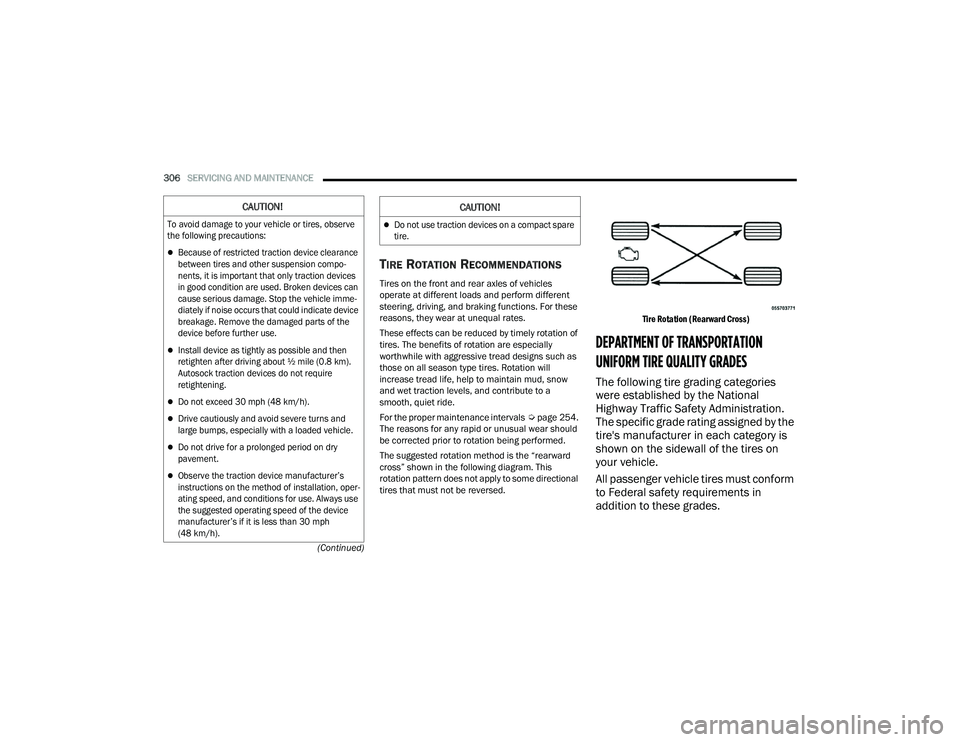
The suggested rotation method is the “rearward
cross” shown in the following diagram. This
rotation pattern does not apply to some directional
tires that must not be reversed.
Tire Rotation (Rearward Cross)
DEPARTMENT OF TRANSPORTATION
UNIFORM TIRE QUALITY GRADES
The following tire grading categories
were established by the National
Highway Traffic Safety Administration.
The specific grade rating assigned by the
tire's manufacturer in each category is
shown on the sidewall of the tires on
your vehicle.
All passenger vehicle tires must conform
to Federal safety requirements in
addition to these grades.
CAUTION!
To avoid damage to your vehicle or tires, observe
the following precautions:
Because of restricted traction device clearance
between tires and other suspension compo
-
nents, it is important that only traction devices
in good condition are used. Broken devices can
cause serious damage. Stop the vehicle imme -
diately if noise occurs that could indicate device
breakage. Remove the damaged parts of the
device before further use.
Install device as tightly as possible and then
retighten after driving about ½ mile (0.8 km).
Autosock traction devices do not require
retightening.
Do not exceed 30 mph (48 km/h).
Drive cautiously and avoid severe turns and
large bumps, especially with a loaded vehicle.
Do not drive for a prolonged period on dry
pavement.
Observe the traction device manufacturer’s
instructions on the method of installation, oper -
ating speed, and conditions for use. Always use
the suggested operating speed of the device
manufacturer’s if it is less than 30 mph
(48 km/h).
Do not use traction devices on a compact spare
tire.
CAUTION!
22_LA_OM_EN_USC_t.book Page 306
Page 323 of 336
CUSTOMER ASSISTANCE321
WARRANTY INFORMATION
See the Warranty Information for the terms and
provisions of FCA US LLC warranties applicable to
this vehicle and market. Refer to
www.mopar.com/om for further information.
See the Warranty Information for the terms and
provisions of FCA Canada Inc. warranties
applicable to this vehicle and market.
Use this QR code to access your
digital experience.
MOPAR® PARTS
Mopar® original equipment parts & accessories
and factory filled fluids are available from an
authorized dealer. They are recommended for your
vehicle to keep it operating at its best and maintain
its original condition.
REPORTING SAFETY DEFECTS
IN THE 50 UNITED STATES AND
W
ASHINGTON, D.C.
If you believe that your vehicle has a
defect that could cause a crash or cause
injury or death, you should immediately
inform the National Highway Traffic
Safety Administration (NHTSA) in
addition to notifying FCA US LLC.
If NHTSA receives similar complaints, it
may open an investigation, and if it finds
that a safety defect exists in a group of
vehicles, it may order a recall and
remedy campaign. However, NHTSA
cannot become involved in individual
problems between you, an authorized
dealer or FCA US LLC. To contact NHTSA, you may call the
Vehicle Safety Hotline toll free at
1-888-327-4236 (TTY:
1-800-424-9153); or go to http://
www.safercar.gov; or write to:
Administrator, NHTSA, 1200 New Jersey
Avenue, SE., West Building, Washington,
D.C. 20590. You can also obtain other
information about motor vehicle safety
from http://www.safercar.gov.
IN CANADA
If you believe that your vehicle has a
safety defect, you should contact the
Customer Service Department
immediately. Canadian customers who
wish to report a safety defect to the
Canadian government should contact
Transport Canada, Motor Vehicle Defect
Investigations and Recalls at
1-800-333-0510 or go to
wwwapps.tc.gc.ca/Saf-Sec-Sur/7/
PCDB-BDPP.
10
22_LA_OM_EN_USC_t.book Page 321
Page 325 of 336
323
INDEX
A
About Your Brakes.................................. 86, 311ACC (Adaptive Cruise Control........................... 97Adaptive Cruise Control (ACC).......................... 97Adding Engine Coolant (Antifreeze)............... 272Adding Washing Fluid.................................... 261Additives, Fuel............................................... 313AdjustForward................................................ 32, 34Rearward.............................................. 32, 34Advance Phone Connectivity......................... 165Air Bag........................................................... 208Advance Front Air Bag............................... 208Air Bag Operation...................................... 210Air Bag Warning Light................................ 208Enhanced Accident Response......... 214, 253Event Data Recorder (EDR)....................... 253Front Air Bag............................................. 208If Deployment Occurs................................ 213Knee Impact Bolsters................................ 210Maintaining Your Air Bag System.............. 215Maintenance............................................. 215Redundant Air Bag Warning Light.............208Side Air Bags............................................. 210Transporting Pets...................................... 230
Air Bag Light.................................. 73, 208, 230Air Cleaner, Engine
(Engine Air Cleaner Filter)............................. 265Air Conditioner Maintenance........................ 266Air Conditioner Refrigerant........................... 266Air Conditioner System................................. 266Air Conditioning................................................ 51Air Conditioning Filter..............................55, 266Air Conditioning System................................... 51Air Conditioning, Operating Tips....................... 55Air Filter........................................................ 265Air PressureTires......................................................... 298AlarmArm The System.......................................... 21Rearm The System...................................... 21Security Alarm...................................... 21, 76Alarm SystemSecurity Alarm............................................. 21All Wheel Drive (AWD)................................... 276Alterations/ModificationsVehicle........................................................... 9Android Auto........................................ 167, 168Android Auto™
b
....................................... 167
Antifreeze (Engine Coolant).................. 272, 315Disposal.................................................... 273Anti-Lock Brake System (ABS)....................... 185Anti-Lock Warning Light...................................76Apple CarPlay....................................... 167, 170Apple CarPlay®
b
...................................... 169Arming SystemSecurity Alarm.............................................21Assist, Hill Start............................................. 189Audio Settings............................................... 152Audio Systems (Radio).................................. 122Auto Down Power Windows..............................60Automatic Door Locks......................................27Automatic Headlights.......................................46Automatic High Beams.....................................45Automatic Temperature Control (ATC)..............54Automatic Transmission...................................91Adding Fluid..................................... 276, 318Fluid And Filter Change............................. 276Fluid Change............................................. 276Fluid Level Check...................................... 275Fluid Type........................................ 276, 318Special Additives...................................... 275Automatic Transmission Limp
Home Mode..............................................27, 9411
22_LA_OM_EN_USC_t.book Page 323