wheel DODGE CHARGER 2008 6.G Workshop Manual
[x] Cancel search | Manufacturer: DODGE, Model Year: 2008, Model line: CHARGER, Model: DODGE CHARGER 2008 6.GPages: 466, PDF Size: 6.37 MB
Page 334 of 466
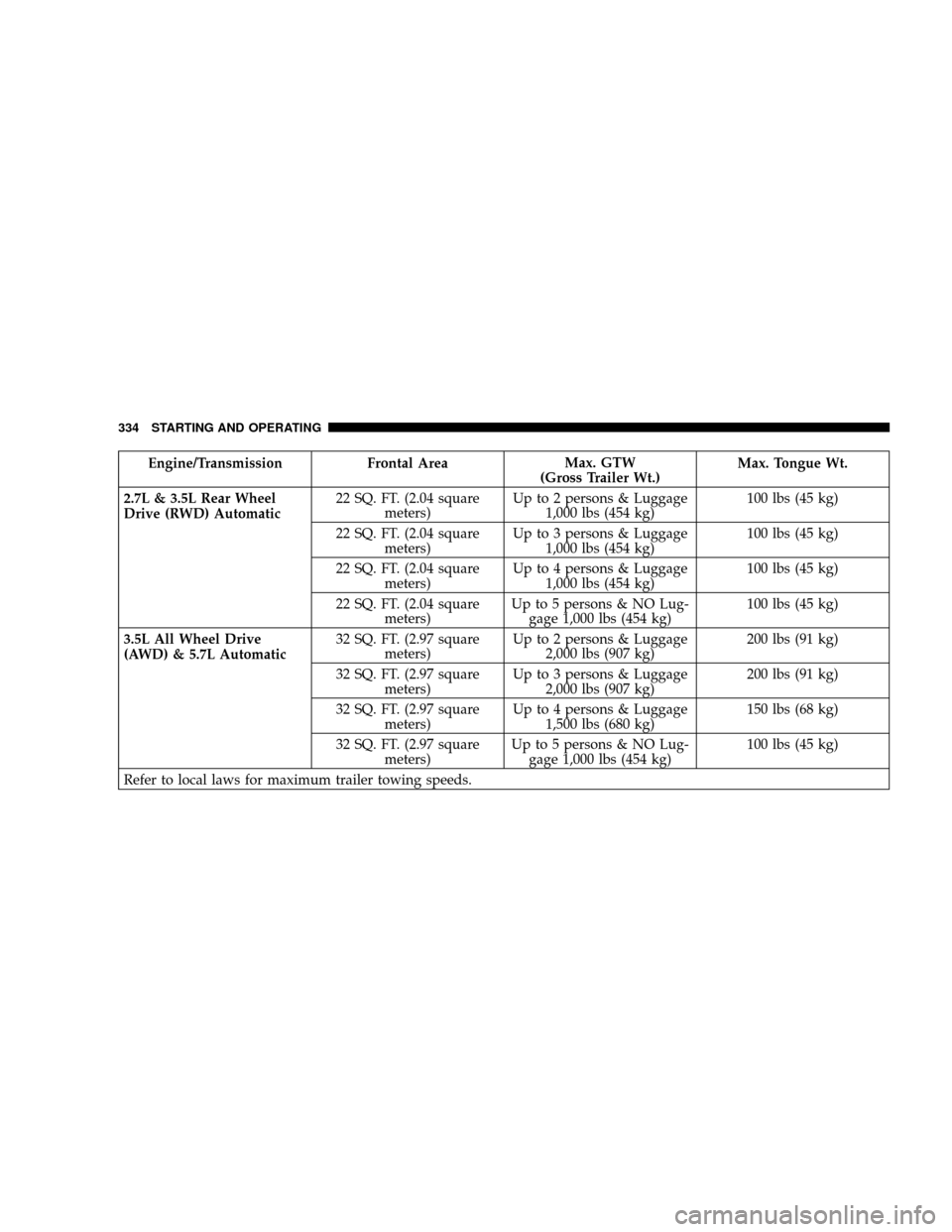
Engine/Transmission Frontal AreaMax. GTW
(Gross Trailer Wt.)Max. Tongue Wt.
2.7L & 3.5L Rear Wheel
Drive (RWD) Automatic22 SQ. FT. (2.04 square
meters)Up to 2 persons & Luggage
1,000 lbs (454 kg)100 lbs (45 kg)
22 SQ. FT. (2.04 square
meters)Up to 3 persons & Luggage
1,000 lbs (454 kg)100 lbs (45 kg)
22 SQ. FT. (2.04 square
meters)Up to 4 persons & Luggage
1,000 lbs (454 kg)100 lbs (45 kg)
22 SQ. FT. (2.04 square
meters)Up to 5 persons & NO Lug-
gage 1,000 lbs (454 kg)100 lbs (45 kg)
3.5L All Wheel Drive
(AWD) & 5.7L Automatic32 SQ. FT. (2.97 square
meters)Up to 2 persons & Luggage
2,000 lbs (907 kg)200 lbs (91 kg)
32 SQ. FT. (2.97 square
meters)Up to 3 persons & Luggage
2,000 lbs (907 kg)200 lbs (91 kg)
32 SQ. FT. (2.97 square
meters)Up to 4 persons & Luggage
1,500 lbs (680 kg)150 lbs (68 kg)
32 SQ. FT. (2.97 square
meters)Up to 5 persons & NO Lug-
gage 1,000 lbs (454 kg)100 lbs (45 kg)
Refer to local laws for maximum trailer towing speeds.
334 STARTING AND OPERATING
Page 335 of 466

NOTE:The trailer tongue weight must be considered as
part of the combined weight of occupants and cargo, and
it should never exceed the weight referenced on the ªTire
and Loading Informationº placard. Refer to ªTire±Safety
Informationº in this section.
Trailer and Tongue Weight
Always load a trailer with 60% to 65% of the weight in
the front of the trailer. This places 10% to 15% of the
Gross Trailer Weight (GTW) on the tow hitch of your
vehicle. Loads balanced over the wheels or heavier in the
rear can cause the trailer to swayseverelyside to side
which will cause loss of control of the vehicle and trailer.
Failure to load trailers heavier in front is the cause of
many trailer accidents.
Never exceed the maximum tongue weight stamped on
your bumper or trailer hitch.Consider the following items when computing the
weight on the rear axle of the vehicle:
²The tongue weight of the trailer.
²The weight of any other type of cargo or equipment
put in or on your vehicle.
²The weight of the driver and all passengers.
STARTING AND OPERATING 335
5
Page 337 of 466

²When hauling cargo, or towing a trailer, do not
overload your vehicle or trailer. Overloading can cause
a loss of control, poor performance, or damage to
brakes, axle, engine, transmission, steering, suspen-
sion, chassis structure, or tires.
²Safety chains must always be used between your
vehicle and trailer. Always connect the chains to the
frame or hook retainers of the vehicle hitch. Cross the
chains under the trailer tongue and allow enough
slack for turning corners.
²Vehicles with trailers should not be parked on a grade.
When parking, apply the parking brake on the tow
vehicle. Put the tow vehicle automatic transmission in
P for Park. Always, block or9chock9the trailer wheels.
²GCWR must not be exceeded.
²Total weight must be distributed between the tow
vehicle and the trailer such that the following four
ratings are not exceeded:1. GVWR
2. GTW
3. GAWR
4. Tongue weight rating for the trailer hitch utilized
(This requirement may limit the ability to always
achieve the 10% to 15% range of tongue weight as a
percentage of total trailer weight).
Towing Requirements Ð Tires
þ
Do not attempt to tow a trailer while using a compact
spare tire.
þProper tire inflation pressures are essential to the safe
and satisfactory operation of your vehicle. Refer to
ªTires±General Informationº in this section for infor-
mation on tire pressures and for proper tire inflation
procedures.
STARTING AND OPERATING 337
5
Page 342 of 466

þExtended driving at high RPM should be avoided to
prevent excess heat generation. A reduction in vehicle
speed may be required to avoid extended driving at
high RPM. Return to a higher gear range or vehicle
speed when road conditions and RPM level allows.
Towing Tips Ð Cooling System
To reduce potential for engine and transmission over-
heating, take the following actions:
þCity Driving
When stopped for short periods, put transmission in ªNº
(Neutral) and increase engine idle speed.
þHighway Driving
Reduce speed.
þAir Conditioning
Turn off temporarily.
þRefer to ªCooling Systemº under ªMaintenance Pro-
ceduresº in Section 7 of this manual for more informa-
tion.
RECREATIONAL TOWING (BEHIND
MOTORHOME, ETC.)
TOWING THIS VEHICLE BEHIND ANOTHER
VEHICLE (Flat towing with all four wheels on the
ground)
Recreational towing for this vehicle is not recommended.
NOTE:If the vehicle requires towing, make sure all four
wheels are off the ground.
342 STARTING AND OPERATING
Page 343 of 466

WHAT TO DO IN EMERGENCIES
CONTENTS
mHazard Warning Flasher..................344
mIf Your Engine Overheats.................345
mJacking And Tire Changing................346
NPreparations For Jacking................347
NJack Location/Spare Tire Stowage..........348
NJacking And Changing a Tire.............350
NCompact Spare Tire....................354
NWheel Cover Or Center Cap Installation
(If Required).........................354mJump-Starting Procedures.................356
mFreeing A Stuck Vehicle..................359
mTowing A Disabled Vehicle................360
NWithout The Ignition Key...............360
NTowing This Vehicle Behind Another Vehicle
(Flat Towing With All Four Wheels On The
Ground)............................361
NTowing This Vehicle Behind Another Vehicle
With A Tow Dolly.....................362
6
Page 346 of 466

WARNING!
A hot engine cooling system is dangerous. You or
others could be badly burned by steam or boiling
coolant. You may want to call a service center if your
vehicle overheats. If you decide to look under the
hood yourself, see Section 7, Maintenance, of this
manual. Follow the warnings under the Cooling
System Pressure Cap paragraph.
JACKING AND TIRE CHANGING
WARNING!
²Do not attempt to change a tire on the side of the
vehicle close to moving traffic. Pull far enough off
the road to avoid the danger of being hit when
operating the jack or changing the wheel.
²Getting under a jacked-up vehicle is dangerous.
The vehicle could slip off the jack and fall on you.
You could be crushed. Never get any part of your
body under a vehicle that is on a jack. Never start
or run the engine while the vehicle is on a jack. If
you need to get under a raised vehicle, take it to a
service center where it can be raised on a lift.
²The jack is designed to use as a tool for changing
tires only. The jack should not be used to lift the
vehicle for service purposes. The vehicle should
be jacked on a firm level surface only. Avoid ice or
slippery areas.
346 WHAT TO DO IN EMERGENCIES
Page 347 of 466

Preparations For Jacking
1. Park the vehicle on a firm level surface as far from the
edge of the roadway as possible. Avoid icy or slippery
areas.
2.Set the parking brakeand place the gear selector in
PARK.
3. Turn OFF the ignition.
4. Turn on the Hazard Warning Flasher.
5. Passengers should not remain in the vehicle when the
vehicle is being jacked.
6. Block both the front and rear of the wheel diagonally
opposite the jacking position. For example, if changing
the right front tire, block the left rear wheel.
Hazard Flasher Switch
WHAT TO DO IN EMERGENCIES 347
6
Page 350 of 466

WARNING!
A loose tire or jack thrown forward in a collision or
hard stop could endanger the occupants of the ve-
hicle. Always stow the jack parts and the spare tire in
the places provided.
Jacking and Changing a Tire
1. Block the wheel diagonally
opposite the flat tire. Passengers
should not remain in the vehicle
when the vehicle is being jacked.
2. Remove the spare tire, jack, and lug wrench.3. If equipped with steel wheels, do not remove the
wheel cover at this time. If equipped with aluminum
wheels where the center cap covers the lug nuts, use the
lug wrench to pry the center cap off carefully before
raising the vehicle.
Center Cap Removal
350 WHAT TO DO IN EMERGENCIES
Page 351 of 466

WARNING!
To avoid possible personal injury, handle the wheel
covers with care to avoid contact with the metal edges
and retention teeth.
4. Before raising the vehicle, use the lug wrench to
loosen, but not remove, the lug nuts on the wheel with
the flat tire. Turn the lug nuts counter-clockwise one turn
while the wheel is still on the ground.
5. Place the jack underneath the lift area that is closest to
the flat tire. Turn the jack screw clockwise to firmly
engage the jack saddle with the lift area of the sill flange.
WHAT TO DO IN EMERGENCIES 351
6
Page 353 of 466

6. Raise the vehicle just enough to remove the flat tire
and install the spare tire.
WARNING!
Raising the vehicle higher than necessary can make
the vehicle less stable. It could slip off the jack and
hurt someone near it. Raise the vehicle only enough
to remove the tire.
7. Remove the lug nuts, wheel cover (if equipped), and
tire. Remove the cover by hand. Do not pry it off.
8. Mount the spare tire.
NOTE:For vehicles so equipped, do not attempt to
install a center cap or wheel cover on the compact spare.
However, when reinstalling the road tire, follow the
procedure under ªWheel Cover or Center Cap Installa-
tionº in place of the remaining steps in this procedure.9. Install the lug nuts with the cone shaped end of the
nut toward the wheel. Lightly tighten the lug nuts. To
avoid the risk of forcing the vehicle off the jack, do not
tighten the lug nuts fully until the vehicle is lowered to
the ground.
10. Lower the vehicle to the ground by turning the jack
handle counter-clockwise.
11. Finish tightening the lug nuts. Push down on the
wrench while tightening for increased leverage. Alternate
lug nuts until each nut has been tightened twice. The
correct tightness of each lug nut is 100 ft/lb. (135 N. m).
If in doubt about the correct tightness, have them
checked with a torque wrench by your dealer or at a
service station.
12. Stow the jack, tools, and flat tire. Make sure the base
of the jack faces the rear of the vehicle before tightening
down the fastener.
WHAT TO DO IN EMERGENCIES 353
6