wheel DODGE CHARGER 2008 6.G Repair Manual
[x] Cancel search | Manufacturer: DODGE, Model Year: 2008, Model line: CHARGER, Model: DODGE CHARGER 2008 6.GPages: 466, PDF Size: 6.37 MB
Page 354 of 466

WARNING!
A loose tire or jack thrown forward in a collision or
hard stop could endanger the occupants of the ve-
hicle. Always stow the jack parts and the spare tire in
the places provided.
Compact Spare Tire
The compact spare tire is for temporary emergency use
with radial tires. It is engineered to be used on your style
vehicle only. Since this tire has limited tread life, the
original tire should be repaired (or replaced) and rein-
stalled at the first opportunity.
²Keep tire inflated to 60 PSI (414 KPa) Cold Inflation
Pressure.
²This tire is designed as an emergency spare only. Do
not exceed 50 MPH (80 km/h) speed.
WARNING!
The limited use spare tires are for emergency use
only. Installation of this limited use spare tire affects
vehicle handling. With this tire, do not drive more
than 60 mph (100 km/h). Keep inflated to the cold tire
inflation pressure listed on either your tire placard or
limited use spare tire and wheel assembly. Replace
(or repair) the original tire at the first opportunity
and reinstall it on your vehicle. Failure to do so could
result in loss of vehicle control.
Wheel Cover or Center Cap Installation (If
Required)
NOTE:Do not attempt to install a center cap or wheel
cover on the compact spare.
354 WHAT TO DO IN EMERGENCIES
Page 355 of 466

1. Mount the road tire on the axle. For vehicles equipped
with wheel covers, perform Steps 2 and 3. For vehicles
equipped with center caps, proceed to Step 4.
2. Install two lug nuts on the mounting studs, which are
on each side of the stud that is in alignment with the
valve stem. Install the lug nuts with the cone shaped end
of the nut toward the wheel. Lightly tighten the lug nuts.To avoid the risk of forcing the vehicle off the jack, do not
tighten the lug nuts fully until the vehicle is lowered to
the ground.
3. Align the valve notch in the wheel cover with the
valve stem on the wheel. Install the cover by hand,
snapping the cover over the two lug nuts. Do not use a
hammer or excessive force to install the cover.
4. Install the remaining lug nuts with the cone shaped
end of the nut toward the wheel. Lightly tighten the lug
nuts. To avoid the risk of forcing the vehicle off the jack,
do not tighten the lug nuts fully until the vehicle is
lowered to the ground.
5. Lower the vehicle to the ground by turning the jack
handle counter-clockwise.
6. Finish tightening the lug nuts. Push down on the
wrench while tightening for increased leverage. Alternate
lug nuts until each nut has been tightened twice. The
WHAT TO DO IN EMERGENCIES 355
6
Page 359 of 466
NOTE:For vehicles equipped with ESP, refer to9Syn-
chronizing ESP9under9Electronic Stability Program9in
Section 5 of this manual if the ESP/BAS light (in the
instrument cluster) remains on continuously after start-
ing the engine of the vehicle with the discharged battery.
8. When removing the jumper cables, reverse the above
sequence exactly. Be careful of the moving belts and fan.
WARNING!
Any procedure other than above could result in:
1. Personal injury caused by electrolyte squirting out
the battery vent;
2. Personal injury or property damage due to battery
explosion;
3. Damage to charging system of booster vehicle or
of immobilized vehicle.
FREEING A STUCK VEHICLE
If your vehicle becomes stuck in mud, sand, or snow, it
can often be moved by a rocking motion. Turn your
steering wheel right and left to clear the area around the
front wheels. Then shift back and forth between Reverse
and Drive. Usually the least accelerator pedal pressure to
maintain the rocking motion without spinning the
wheels is most effective.
NOTE:Turn off the Electronic Stability Program (ESP)
Ð if equipped, or Traction Control System (TCS) Ð if
equipped before rocking the vehicle. For details, refer to
ªElectronic Stability Programº or ªTraction Control Sys-
temº in this manual.
WHAT TO DO IN EMERGENCIES 359
6
Page 360 of 466
CAUTION!
²When ªrockingº a stuck vehicle by moving be-
tween ªFirstº and R (Reverse), do not spin the
wheels faster than 15 mph (24 km/h), or drivetrain
damage may result.
²Racing the engine or spinning the wheels too fast
may lead to transmission overheating and failure.
It can also damage the tires. Do not spin the
wheels above 35 mph (55 km/h).
WARNING!
Fast spinning tires can be dangerous. Forces gener-
ated by excessive wheel speeds may cause tire dam-
age or failure. A tire could explode and injure some-
one. Do not spin your vehicle's wheels faster than 35
mph (55 km/h) when you are stuck, and don't let
anyone near a spinning wheel, no matter what the
speed.
TOWING A DISABLED VEHICLE
WITHOUT THE IGNITION KEY
Special care must be taken when the vehicle is towed
with the ignition in the LOCK position. The only ap-
proved method of towing without the ignition key is
with a flat bed truck. Proper towing equipment is neces-
sary to prevent damage to the vehicle.
360 WHAT TO DO IN EMERGENCIES
Page 361 of 466

TOWING THIS VEHICLE BEHIND ANOTHER
VEHICLE (Flat towing with all four wheels on the
ground)
Flat towing of vehicles equipped with an automatic
transmission, is only permitted within the following
limitations:
With The Ignition Key
Your vehicle may be towed under the following condi-
tions: The gear selector must be in ªNº (Neutral), the
distance to be traveled must not exceed 30 miles (48 km),
and the towing speed must not exceed 30 mph (48
km/h). Exceeding these towing limits may cause a trans-
mission geartrain failure. If the transmission is not op-
erative, or if the vehicle is to be towed more than 30 miles
(48 km), the vehicle must be transported using a flat bed
truck.
CAUTION!
²Do not attempt to tow this vehicle from the front
with sling type towing equipment. Damage to the
front fascia will result.
²If the transmission is not operative, or if the
vehicle is to be towed more than 30 miles (48 km),
then the only approved method of towing is with
a flat bed truck. Damage to the transmission may
result.
²Do not tow the vehicle from the rear. Damage to
the rear sheet metal, and fascia will occur.
²Do not push or tow this vehicle with another
vehicle as damage to the bumper fascia and trans-
mission may result.
WHAT TO DO IN EMERGENCIES 361
6
Page 364 of 466

NMaintenance-Free Battery................381
NAir Conditioner Maintenance.............383
NA/C Air Filter Ð If Equipped............384
NPower Steering Ð Fluid Check............384
NFront & Rear Suspension Ball Joints........385
NSteering Linkage......................385
NBody Lubrication.....................385
NWindshield Wiper Blades................386
NWindshield Washers...................386
NExhaust System......................387
NCooling System.......................388
NHoses And Vacuum/Vapor Harnesses.......393
NFuel System.........................393NBrake System........................394
NAutomatic Transmission................396
NAll Wheel Drive (AWD) Ð If Equipped.....398
NFront And Rear Wheel Bearings...........398
NAppearance Care And Protection From
Corrosion...........................398
NCleaning The Center Console Cup Holders . . . 403
mFuses (Power Distribution Centers)..........404
NFuses (Front Power Distribution Center).....404
NFuses (Rear Power Distribution Center)......406
mVehicle Storage........................411
mReplacement Light Bulbs.................412
mBulb Replacement......................413
364 MAINTAINING YOUR VEHICLE
Page 398 of 466

All Wheel Drive (AWD) Ð If Equipped
The all wheel drive system consists of a Transfer Case
and Front Differential. The exterior surface of these
components should be inspected for evidence of fluid
leaks. Confirmed leaks should be repaired as soon as
possible.
The transfer case fluid inspection plug is located in the
middle of the rear housing. To inspect the transfer case
fluid level, remove the inspection plug. The fluid level
should be even with the bottom of the hole. The transfer
case fill plug is located on the rear housing near the
output shaft.
The front differential fill plug is located on the outer
cover near the halfshaft attachment. To inspect the differ-
ential fluid level, remove the fill plug. The fluid level
should be even with or slightly below the bottom of the
hole.
Fluid Changes
Refer to the ªMaintenance Scheduleº in Section 8 of this
manual for the recommended transfer case fluid change
intervals.
Front And Rear Wheel Bearings
Front and rear wheel bearings are permanently sealed.
No regular maintenance is required for these compo-
nents.
Appearance Care and Protection from Corrosion
Protection of Body and Paint from Corrosion
Vehicle body care requirements vary according to geo-
graphic locations and usage. Chemicals that make roads
passable in snow and ice, and chemicals that are sprayed
on trees and road surfaces during other seasons, are
highly corrosive to the metal in your vehicle. Outside
parking, which exposes your vehicle to airborne contami-
nants, road surfaces on which the vehicle is operated,
398 MAINTAINING YOUR VEHICLE
Page 400 of 466

CAUTION!
Do not use abrasive or strong cleaning materials such
as steel wool or scouring powder, which will scratch
metal and painted surfaces.
Special Care
²
If you drive on salted or dusty roads or if you drive
near the ocean, hose off the undercarriage at least once
a month.
²It is important that the drain holes in the lower edges
of the doors, rocker panels, and trunk be kept clear
and open.
²If you detect any stone chips or scratches in the paint,
touch them up immediately. The cost of such repairs is
considered the responsibility of the owner.
²If your vehicle is damaged due to an accident or
similar cause, which destroys the paint and protective
coating, have your vehicle repaired as soon as pos-
sible. The cost of such repairs is considered the respon-
sibility of the owner.
²If you carry special cargo such as chemicals, fertilizers,
de-icer salt, etc., be sure that such materials are well
packaged and sealed.
²If a lot of driving is done on gravel roads, consider
mud or stone shields behind each wheel.
²Use Moparttouch up paint or equivalent on scratches
as soon as possible. Your dealer has touch up paint to
match the color of your vehicle.
400 MAINTAINING YOUR VEHICLE
Page 401 of 466

Wheel and Wheel Trim Care
All wheels and wheel trim, especially aluminum and
chrome plated wheels should be cleaned regularly with a
mild soap and water to prevent corrosion. To remove
heavy soil and/or excessive brake dust, use Mopart
Wheel Cleaner (05066247AB) or equivalent or select a
nonabrasive, non-acidic cleaner. Do not use scouring
pads, steel wool, a bristle brush, or metal polishes. Only
Mopartor equivalent is recommended. Do not use oven
cleaner. Avoid automatic car washes that use acidic
solutions or harsh brushes that may damage the wheels'
protective finish.
Interior Care
Use MopartFabric Cleaner or equivalent to clean fabric
upholstery and MopartCarpet Cleaner for carpeting.Interior Trim should be cleaned starting with a damp
cloth, or MopartSatin Select. Do not use harsh cleaners
or Armorall. Use MopartTotal Clean to clean vinyl
upholstery.
MopartTotal Clean is specifically recommended for
leather upholstery.
Your leather upholstery can be best preserved by regular
cleaning with a damp soft cloth. Small particles of dirt
can act as an abrasive and damage the leather upholstery
and should be removed promptly with a damp cloth.
Stubborn soils can be removed easily with a soft cloth
and MopartTotal Clean or equivalent. Care should be
taken to avoid soaking your leather upholstery with any
liquid. Please do not use polishes, oils, cleaning fluids,
solvents, detergents, or ammonia-based cleaners to clean
your leather upholstery. Application of a leather condi-
tioner is not required to maintain the original condition.
MAINTAINING YOUR VEHICLE 401
7
Page 419 of 466
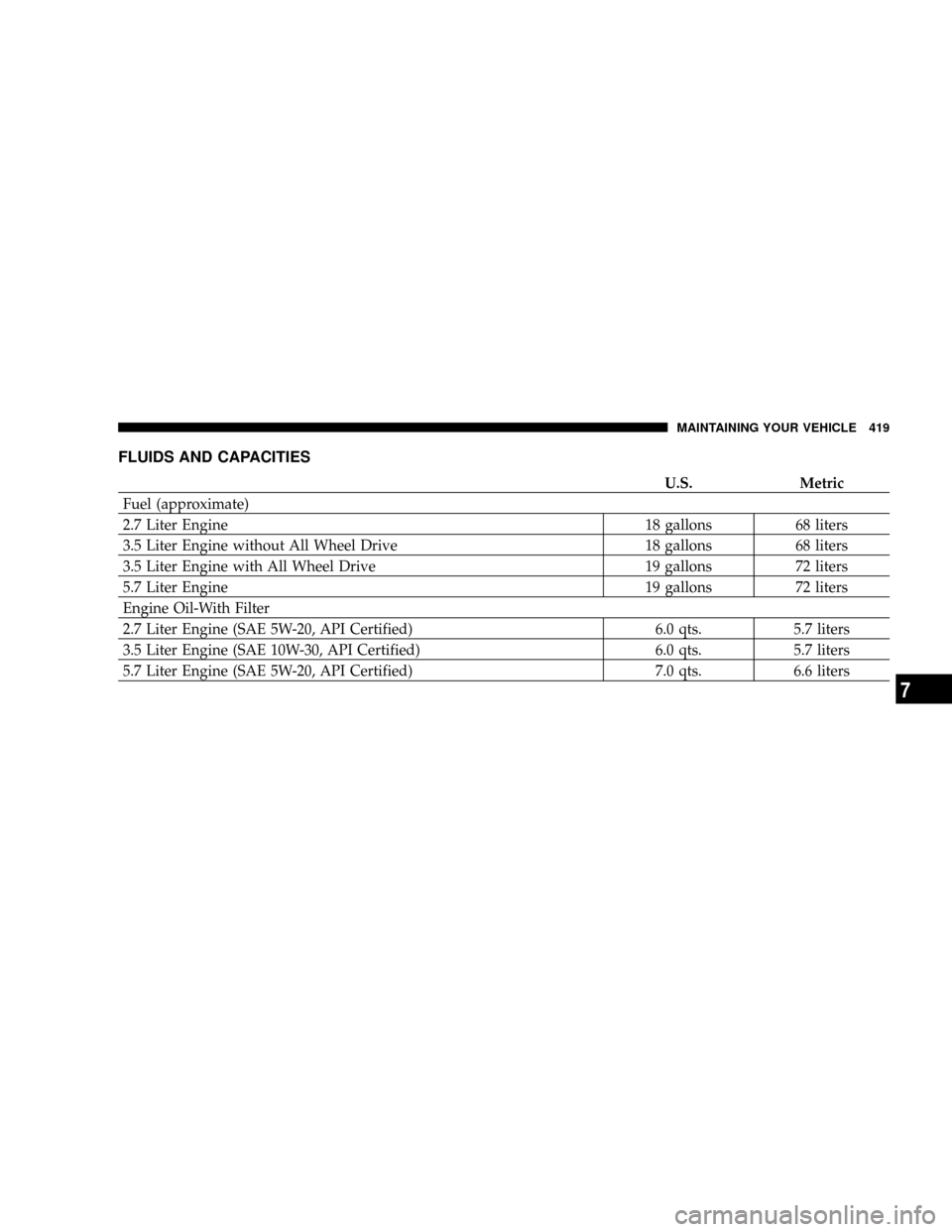
FLUIDS AND CAPACITIES
U.S. Metric
Fuel (approximate)
2.7 Liter Engine 18 gallons 68 liters
3.5 Liter Engine without All Wheel Drive 18 gallons 68 liters
3.5 Liter Engine with All Wheel Drive 19 gallons 72 liters
5.7 Liter Engine 19 gallons 72 liters
Engine Oil-With Filter
2.7 Liter Engine (SAE 5W-20, API Certified) 6.0 qts. 5.7 liters
3.5 Liter Engine (SAE 10W-30, API Certified) 6.0 qts. 5.7 liters
5.7 Liter Engine (SAE 5W-20, API Certified) 7.0 qts. 6.6 liters
MAINTAINING YOUR VEHICLE 419
7