fuel DODGE CHARGER 2013 7.G Owner's Manual
[x] Cancel search | Manufacturer: DODGE, Model Year: 2013, Model line: CHARGER, Model: DODGE CHARGER 2013 7.GPages: 132, PDF Size: 4.77 MB
Page 78 of 132
ROADSIDE ASSISTANCE
•Dial toll-free 1-800-521-2779 for U.S. Residents or 1-800-363-4869 for Canadian Residents.
•Provide your name, vehicle identification number, license plate number, and your location,
including the telephone number from which you are calling.
• Briefly describe the nature of the problem and answer a few simple questions.
•
You will be given the name of the service provider and an estimated time of arrival. If you feel
you are in an “unsafe situation”, please let us know. With your consent, we will contact local
police or safety authorities.
INSTRUMENT CLUSTER WARNING LIGHTS
- Electronic Stability Control (ESC) Activation/Malfunction Indicator Light
• The “ESC Activation/Malfunction Indicator Light” in the instrument cluster will come on when the ignition switch is turned to the ON/RUN position. It should go out with the
engine running. If the “ESC Activation/Malfunction Indicator Light” comes on continu-
ously with the engine running, a malfunction has been detected in the ESC system.
• If this light remains on after several ignition cycles, and the vehicle has been driven several miles (kilometers) at speeds greater than 30 mph (48 km/h), we recommend you
drive to the nearest service center and have the vehicle serviced immediately.
- Tire Pressure Monitoring System (TPMS) Light
• Each tire, including the spare (if provided), should be checked monthly, when cold and inflated to the inflation pressure recommended by the vehicle manufacturer on the
vehicle placard or tire inflation pressure label. (If your vehicle has tires of a different size
than the size indicated on the vehicle placard or tire inflation pressure label, you should
determine the proper tire inflation pressure for those tires.)
• As an added safety feature, your vehicle has been equipped with a Tire Pressure Moni- toring System (TPMS) that illuminates a low tire pressure telltale when one or more of
your tires is significantly under-inflated. Accordingly, when the low tire pressure telltale
illuminates, you should stop and check your tires as soon as possible, and inflate them to
the proper pressure. Driving on a significantly under-inflated tire causes the tire to
overheat and can lead to tire failure. Under-inflation also reduces fuel efficiency and tire
tread life, and may affect the vehicle’s handling and stopping ability.
• IF THE LIGHT STARTS FLASHING INDICATING A LOW TIRE PRESSURE, ADJUST THE AIR
PRESSURE IN THE LOW TIRE TO THE AIR PRESSURE SHOWN ON THE VEHICLE PLAC-
ARD OR TIRE INFLATION PRESSURE LABEL LOCATED ON THE DRIVER'S DOOR.
NOTE:
AFTER INFLATION, THE VEHICLE MAY NEED TO BE DRIVEN FOR 20 MINUTES BEFORE THE
FLASHING LIGHT WILL TURN OFF.
• Please note that the TPMS is not a substitute for proper tire maintenance, and it is the driver’s responsibility to maintain correct tire pressure, even if under-inflation has not
reached the level to trigger illumination of the TPMS low tire pressure telltale.
WHAT TO DO IN EMERGENCIES
76
Page 80 of 132
BRAKE- Brake Warning Light
• The Brake Warning light illuminates when there is either a system malfunction or the parking brake is applied. If the light is on and the parking brake is not applied, it indicates
a possible brake hydraulic malfunction, brake booster problem or an Anti-Lock Brake
System problem.
• Please have your vehicle serviced immediately.
WARNING!
Driving a vehicle with the red brake light on is dangerous. Part of the brake system may
have failed. It will take longer to stop the vehicle. You could have a collision. Have the
vehicle checked immediately.
- Malfunction Indicator Light (MIL)
• Certain conditions, such as a poor fuel quality, etc., may illuminate the MIL after engine start. The vehicle should be serviced if the light stays on through several typical driving
cycles. In most situations, the vehicle will drive normally and not require towing.
• If the MIL flashes when the engine is running, serious conditions may exist that could lead to immediate loss of power or severe catalytic converter damage. We recommend
you do not operate the vehicle. Have the vehicle serviced immediately.
- Electronic Stability Control (ESC) OFF Indicator Light
• This light indicates the Electronic Stability Control (ESC) is off.
- Charging System Light
•
This light shows the status of the electrical charging system. If the charging system light
remains on, it means that the vehicle is experiencing a problem with the charging system.
• We recommend you do not continue driving if the charging system light is on. Have the vehicle serviced immediately.
- Oil Pressure Warning Light
• This light indicates low engine oil pressure. If the light turns on while driving, stop the vehicle and shut off the engine as soon as possible. A chime will sound when this light
turns on.
• We recommend you do not operate the vehicle or engine damage will occur. Have the vehicle serviced immediately.
- Anti-Lock Brake (ABS) Light
• This light monitors the Anti-Lock Brake System (ABS).
• If the light is not on during starting, stays on, or turns on while driving, we recommend you drive to the nearest service center and have the vehicle serviced immediately.
WHAT TO DO IN EMERGENCIES
78
Page 102 of 132
FUEL DOOR RELEASE
• The fuel door release button is located inthe driver's door map pocket.
• Push the button once and release to open the fuel door.
Fuel Door Emergency Release
• To manually open the fuel door, remove the cover and pull the release cable lo-
cated in the trunk.
MAINTAINING YOUR VEHICLE
100
Page 103 of 132
Emergency Refueling
• A funnel is provided (located in the trunkin the spare tire area) to open the flapper
door to allow for emergency refueling with
a gas can.
CAUTION!
To avoid fuel spillage and overfilling, do not “top off” the fuel tank after filling.
WARNING!
• Never have any smoking materials lit in or near the vehicle when the fuel door is open
or the tank is being filled.
• Never add fuel when the engine is running. This is in violation of most state and
federal fire regulations and/or local bylaws, and will cause the MIL to turn on.
•
A fire may result if gasoline is pumped into a portable container that is inside of a
vehicle. You could be burned. Always place gas containers on the ground while filling.
MAINTAINING YOUR VEHICLE
101
Page 108 of 132
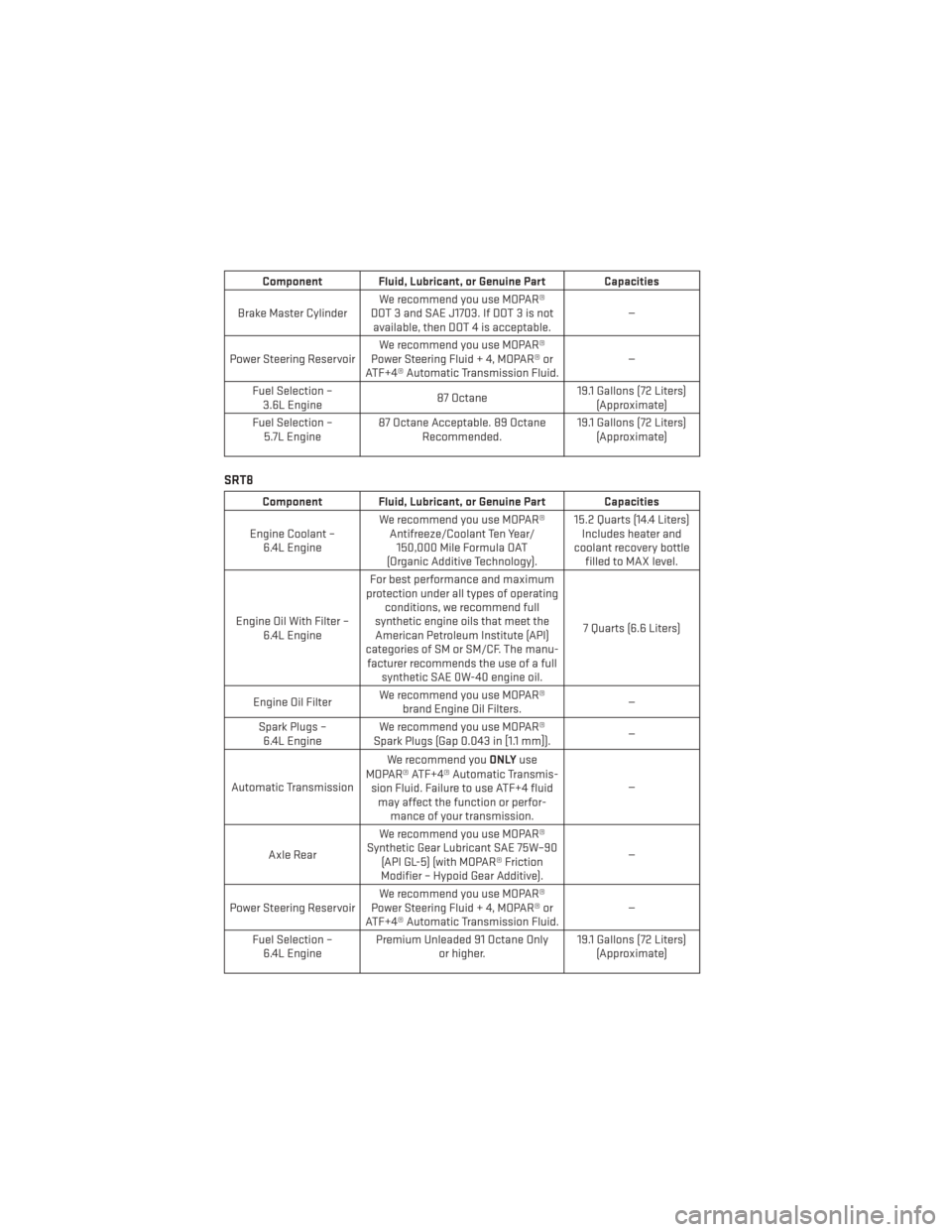
Component Fluid, Lubricant, or Genuine Part Capacities
Brake Master Cylinder We recommend you use MOPAR®
DOT 3 and SAE J1703. If DOT 3 is not available, then DOT 4 is acceptable. —
Power Steering Reservoir We recommend you use MOPAR®
Power Steering Fluid + 4, MOPAR® or
ATF+4® Automatic Transmission Fluid. —
Fuel Selection – 3.6L Engine 87 Octane19.1 Gallons (72 Liters)
(Approximate)
Fuel Selection – 5.7L Engine 87 Octane Acceptable. 89 Octane
Recommended. 19.1 Gallons (72 Liters)
(Approximate)
SRT8
Component Fluid, Lubricant, or Genuine Part Capacities
Engine Coolant – 6.4L Engine We recommend you use MOPAR®
Antifreeze/Coolant Ten Year/150,000 Mile Formula OAT
(Organic Additive Technology). 15.2 Quarts (14.4 Liters)
Includes heater and
coolant recovery bottle filled to MAX level.
Engine Oil With Filter – 6.4L Engine For best performance and maximum
protection under all types of operating conditions, we recommend full
synthetic engine oils that meet the American Petroleum Institute (API)
categories of SM or SM/CF. The manu- facturer recommends the use of a full synthetic SAE 0W-40 engine oil. 7 Quarts (6.6 Liters)
Engine Oil Filter We recommend you use MOPAR®
brand Engine Oil Filters. —
Spark Plugs – 6.4L Engine We recommend you use MOPAR®
Spark Plugs (Gap 0.043 in [1.1 mm]). —
Automatic Transmission We recommend you
ONLYuse
MOPAR® ATF+4® Automatic Transmis- sion Fluid. Failure to use ATF+4 fluid may affect the function or perfor- mance of your transmission. —
Axle Rear We recommend you use MOPAR®
Synthetic Gear Lubricant SAE 75W–90 (API GL-5) (with MOPAR® Friction
Modifier – Hypoid Gear Additive). —
Power Steering Reservoir We recommend you use MOPAR®
Power Steering Fluid + 4, MOPAR® or
ATF+4® Automatic Transmission Fluid. —
Fuel Selection – 6.4L Engine Premium Unleaded 91 Octane Only
or higher. 19.1 Gallons (72 Liters)
(Approximate)
MAINTAINING YOUR VEHICLE
106
Page 109 of 132
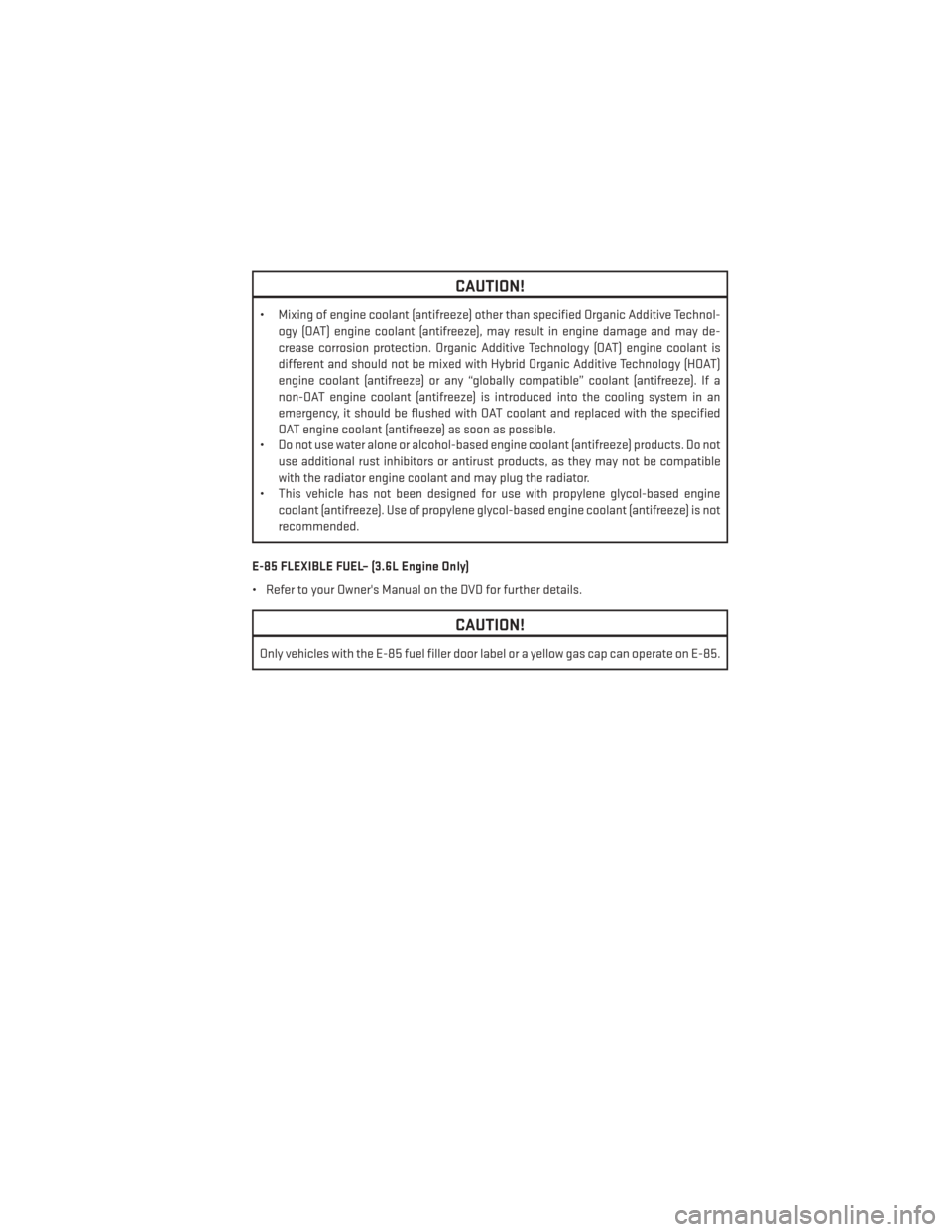
CAUTION!
• Mixing of engine coolant (antifreeze) other than specified Organic Additive Technol-ogy (OAT) engine coolant (antifreeze), may result in engine damage and may de-
crease corrosion protection. Organic Additive Technology (OAT) engine coolant is
different and should not be mixed with Hybrid Organic Additive Technology (HOAT)
engine coolant (antifreeze) or any “globally compatible” coolant (antifreeze). If a
non-OAT engine coolant (antifreeze) is introduced into the cooling system in an
emergency, it should be flushed with OAT coolant and replaced with the specified
OAT engine coolant (antifreeze) as soon as possible.
• Do not use water alone or alcohol-based engine coolant (antifreeze) products. Do not
use additional rust inhibitors or antirust products, as they may not be compatible
with the radiator engine coolant and may plug the radiator.
• This vehicle has not been designed for use with propylene glycol-based engine
coolant (antifreeze). Use of propylene glycol-based engine coolant (antifreeze) is not
recommended.
E-85 FLEXIBLE FUEL– (3.6L Engine Only)
• Refer to your Owner's Manual on the DVD for further details.
CAUTION!
Only vehicles with the E-85 fuel filler door label or a yellow gas cap can operate on E-85.
MAINTAINING YOUR VEHICLE
107
Page 110 of 132
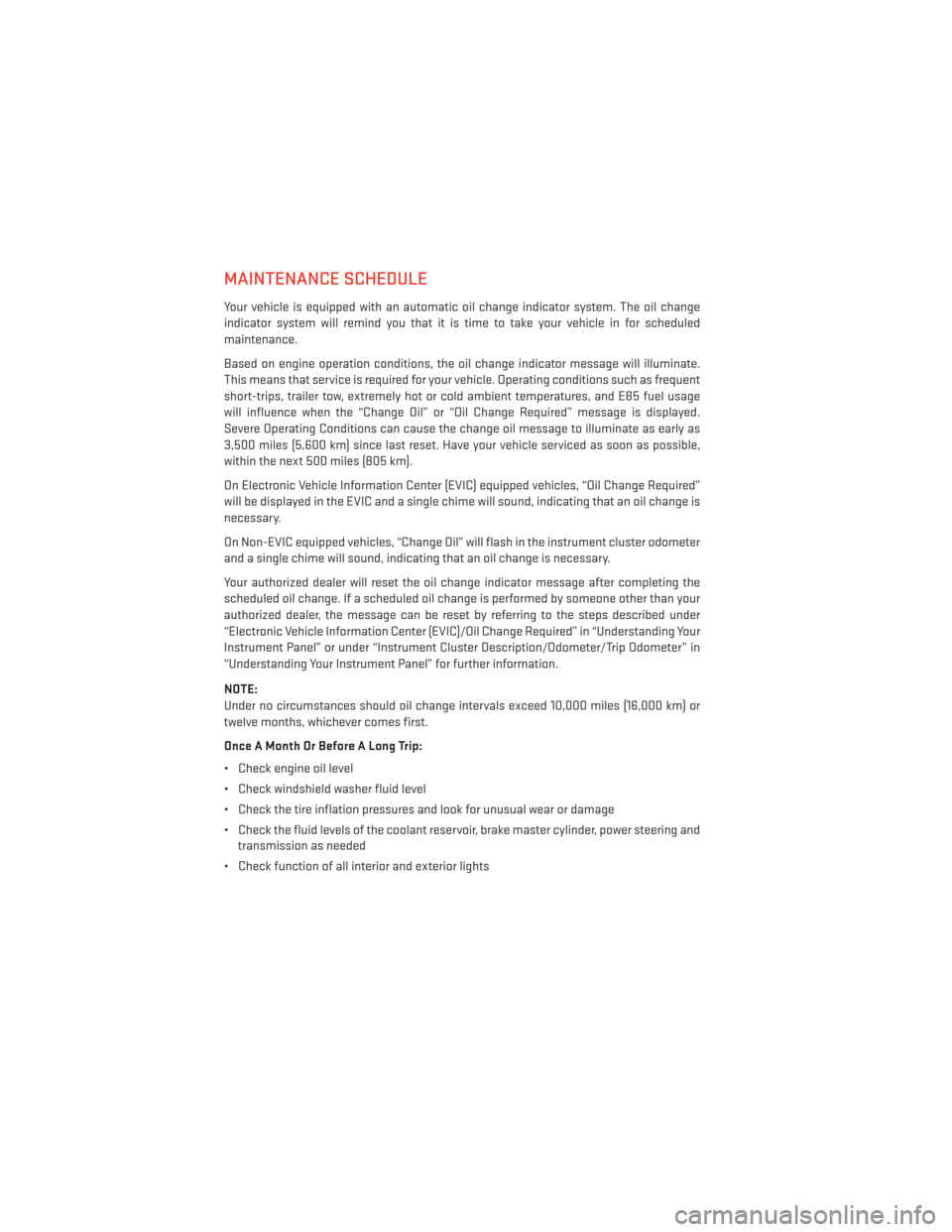
MAINTENANCE SCHEDULE
Your vehicle is equipped with an automatic oil change indicator system. The oil change
indicator system will remind you that it is time to take your vehicle in for scheduled
maintenance.
Based on engine operation conditions, the oil change indicator message will illuminate.
This means that service is required for your vehicle. Operating conditions such as frequent
short-trips, trailer tow, extremely hot or cold ambient temperatures, and E85 fuel usage
will influence when the “Change Oil” or “Oil Change Required” message is displayed.
Severe Operating Conditions can cause the change oil message to illuminate as early as
3,500 miles (5,600 km) since last reset. Have your vehicle serviced as soon as possible,
within the next 500 miles (805 km).
On Electronic Vehicle Information Center (EVIC) equipped vehicles, “Oil Change Required”
will be displayed in the EVIC and a single chime will sound, indicating that an oil change is
necessary.
On Non-EVIC equipped vehicles, “Change Oil” will flash in the instrument cluster odometer
and a single chime will sound, indicating that an oil change is necessary.
Your authorized dealer will reset the oil change indicator message after completing the
scheduled oil change. If a scheduled oil change is performed by someone other than your
authorized dealer, the message can be reset by referring to the steps described under
“Electronic Vehicle Information Center (EVIC)/Oil Change Required” in “Understanding Your
Instrument Panel” or under “Instrument Cluster Description/Odometer/Trip Odometer” in
“Understanding Your Instrument Panel” for further information.
NOTE:
Under no circumstances should oil change intervals exceed 10,000 miles (16,000 km) or
twelve months, whichever comes first.
Once A Month Or Before A Long Trip:
• Check engine oil level
• Check windshield washer fluid level
• Check the tire inflation pressures and look for unusual wear or damage
• Check the fluid levels of the coolant reservoir, brake master cylinder, power steering andtransmission as needed
• Check function of all interior and exterior lights
MAINTAINING YOUR VEHICLE
108
Page 118 of 132
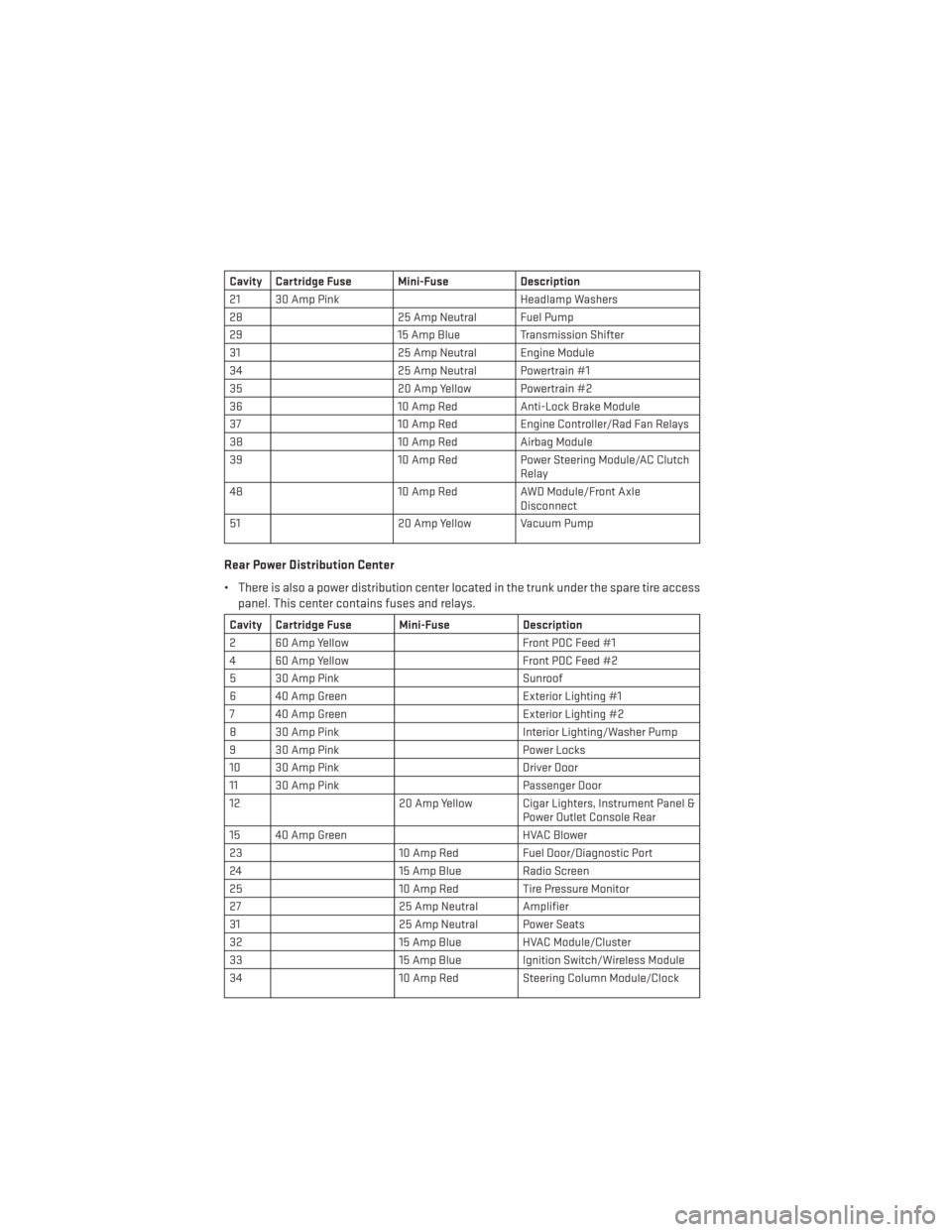
Cavity Cartridge Fuse Mini-FuseDescription
21 30 Amp Pink Headlamp Washers
28 25 Amp Neutral Fuel Pump
29 15 Amp Blue Transmission Shifter
31 25 Amp Neutral Engine Module
34 25 Amp Neutral Powertrain #1
35 20 Amp Yellow Powertrain #2
36 10 Amp RedAnti-Lock Brake Module
37 10 Amp RedEngine Controller/Rad Fan Relays
38 10 Amp RedAirbag Module
39 10 Amp RedPower Steering Module/AC Clutch
Relay
48 10 Amp RedAWD Module/Front Axle
Disconnect
51 20 Amp Yellow Vacuum Pump
Rear Power Distribution Center
• There is also a power distribution center located in the trunk under the spare tire access
panel. This center contains fuses and relays.
Cavity Cartridge Fuse Mini-Fuse Description
2 60 Amp Yellow Front PDC Feed #1
4 60 Amp Yellow Front PDC Feed #2
5 30 Amp Pink Sunroof
6 40 Amp Green Exterior Lighting #1
7 40 Amp Green Exterior Lighting #2
8 30 Amp Pink Interior Lighting/Washer Pump
9 30 Amp Pink Power Locks
10 30 Amp Pink Driver Door
11 30 Amp Pink Passenger Door
12 20 Amp Yellow Cigar Lighters, Instrument Panel &
Power Outlet Console Rear
15 40 Amp Green HVAC Blower
23 10 Amp RedFuel Door/Diagnostic Port
24 15 Amp Blue Radio Screen
25 10 Amp RedTire Pressure Monitor
27 25 Amp Neutral Amplifier
31 25 Amp Neutral Power Seats
32 15 Amp Blue HVAC Module/Cluster
33 15 Amp Blue Ignition Switch/Wireless Module
34 10 Amp RedSteering Column Module/Clock
MAINTAINING YOUR VEHICLE
116
Page 126 of 132
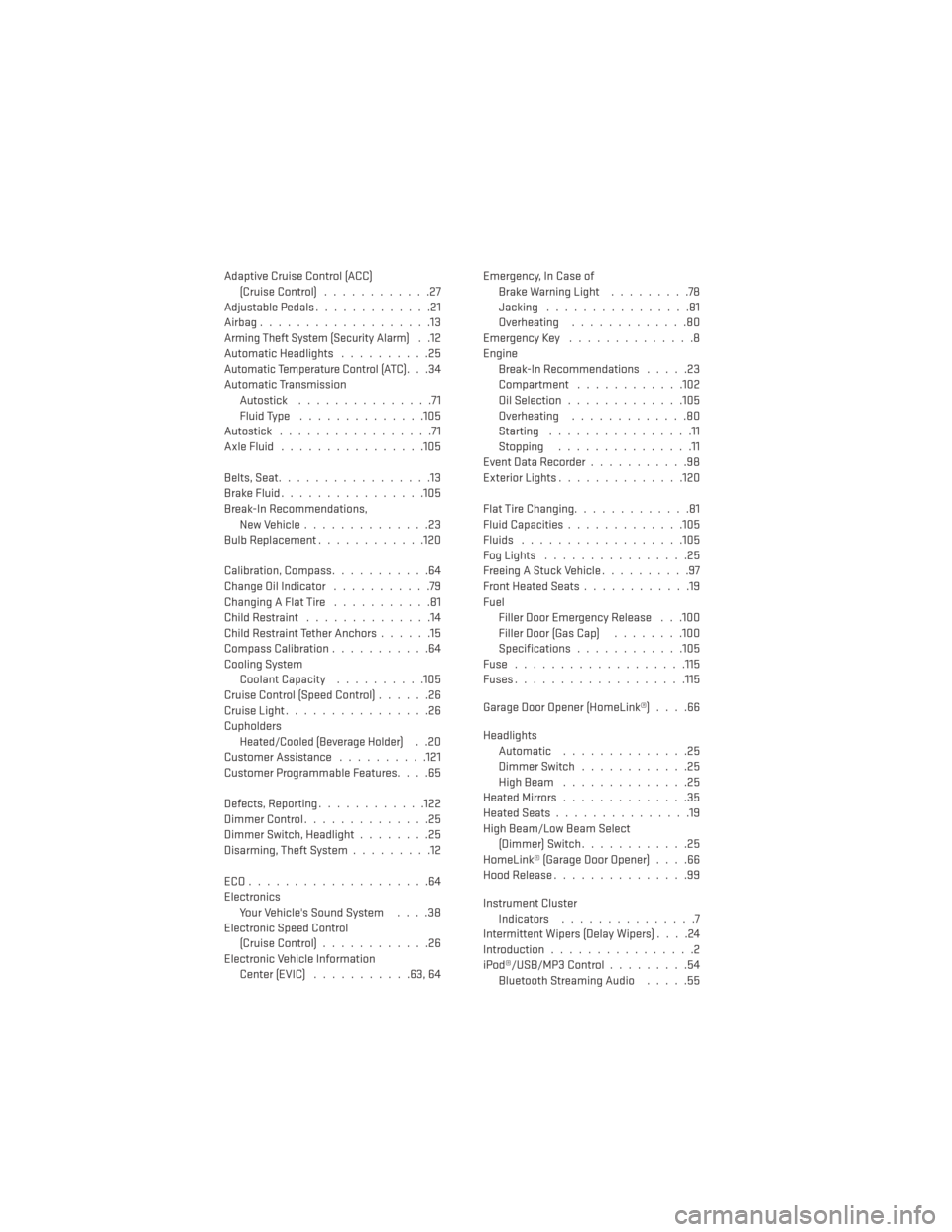
Adaptive Cruise Control (ACC)(Cruise Control) ............27
AdjustablePedals.............21
Airbag ...................13
Arming Theft System (Security Alarm). .12
Automatic Headlights ..........25
Automatic Temperature Control (ATC)...34
Automatic Transmission Autostick ...............71
Fluid Type ..............105
Autostick .................71
AxleFluid ................105
Belts, Seat .................13
BrakeFluid................105
Break-In Recommendations, New Vehicle ..............23
Bulb Replacement ............120
Calibration, Compass ...........64
Change Oil Indicator ...........79
ChangingAFlatTire ...........81
Child Restraint ..............14
Child Restraint Tether Anchors ......15
Compass Calibration ...........64
Cooling System Coolant Capacity ..........105
Cruise Control (Speed Control) ......26
Cruise Light ................26
Cupholders
Heated/Cooled (Beverage Holder)..20
Customer Assistance ..........121
Customer Programmable Features. . . .65
Defects, Reporting ............122
DimmerControl..............25
Dimmer Switch, Headlight ........25
Disarming, Theft System .........12
ECO....................64
Electronics Your Vehicle's Sound System ....38
Electronic Speed Control (Cruise Control) ............26
Electronic Vehicle Information Center(EVIC) ...........63,64 Emergency, In Case of
Brake Warning Light .........78
Jacking ................81
Overheating .............80
Emergency Key ..............8
Engine Break-In Recommendations .....23
Compartment ........... .102
Oil Selection .............105
Overheating .............80
Starting ................11
Stopping ...............11
Event Data Recorder ...........98
Exterior Lights ..............120
Flat Tire Changing .............81
Fluid Capacities .............105
Fluids ..................105
FogLights ................25
Freeing A Stuck Vehicle ..........97
Front Heated Seats ............19
Fuel Filler Door Emergency Release . . .100
Filler Door (Gas Cap) ........100
Specifications ............105
Fuse .................. .115
Fuses ...................115
Garage Door Opener (HomeLink®) ....66
Headlights Automatic ..............25
Dimmer Switch ............25
HighBeam ..............25
Heated Mirrors ..............35
Heated Seats ...............19
High Beam/Low Beam Select (Dimmer) Switch ............25
HomeLink® (Garage Door Opener) ....66
Hood Release ...............99
Instrument Cluster Indicators ...............7
Intermittent Wipers (Delay Wipers) ....24
Introduction ................2
iPod®/USB/MP3 Control .........54
Bluetooth Streaming Audio .....55
INDEX
124