coolant temperature DODGE CHARGER 2021 User Guide
[x] Cancel search | Manufacturer: DODGE, Model Year: 2021, Model line: CHARGER, Model: DODGE CHARGER 2021Pages: 320, PDF Size: 20.61 MB
Page 263 of 320
SERVICING AND MAINTENANCE261
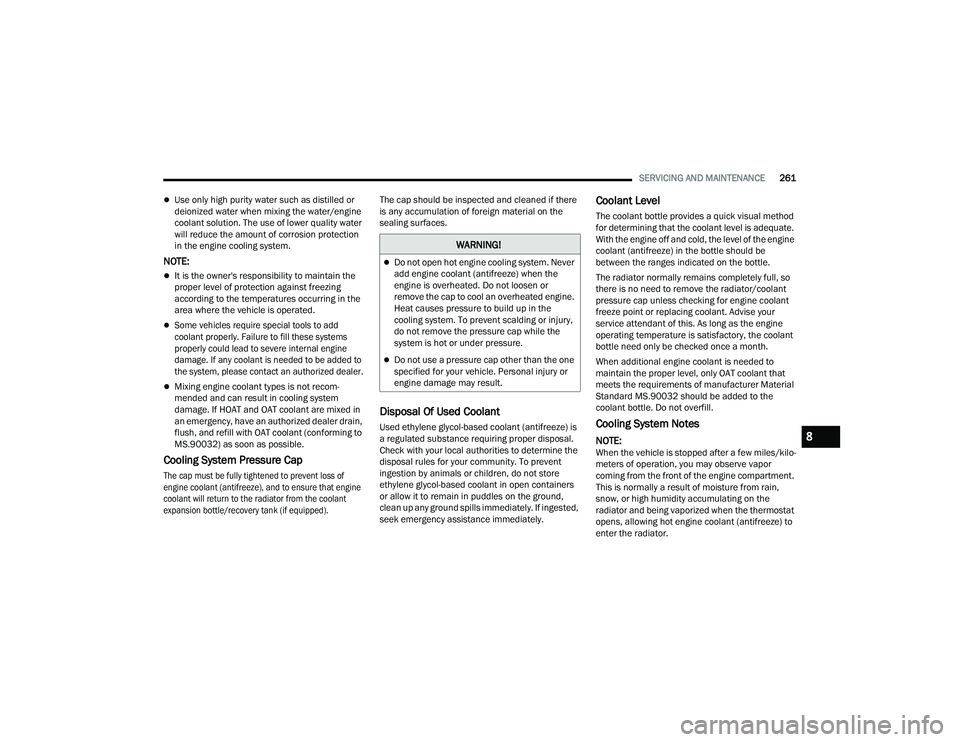
Use only high purity water such as distilled or
deionized water when mixing the water/engine
coolant solution. The use of lower quality water
will reduce the amount of corrosion protection
in the engine cooling system.
NOTE:
It is the owner's responsibility to maintain the
proper level of protection against freezing
according to the temperatures occurring in the
area where the vehicle is operated.
Some vehicles require special tools to add
coolant properly. Failure to fill these systems
properly could lead to severe internal engine
damage. If any coolant is needed to be added to
the system, please contact an authorized dealer.
Mixing engine coolant types is not recom -
mended and can result in cooling system
damage. If HOAT and OAT coolant are mixed in
an emergency, have an authorized dealer drain,
flush, and refill with OAT coolant (conforming to
MS.90032) as soon as possible.
Cooling System Pressure Cap
The cap must be fully tightened to prevent loss of
engine coolant (antifreeze), and to ensure that engine
coolant will return to the radiator from the coolant
expansion bottle/recovery tank (if equipped).
The cap should be inspected and cleaned if there
is any accumulation of foreign material on the
sealing surfaces.
Disposal Of Used Coolant
Used ethylene glycol-based coolant (antifreeze) is
a regulated substance requiring proper disposal.
Check with your local authorities to determine the
disposal rules for your community. To prevent
ingestion by animals or children, do not store
ethylene glycol-based coolant in open containers
or allow it to remain in puddles on the ground,
clean up any ground spills immediately. If ingested,
seek emergency assistance immediately.
Coolant Level
The coolant bottle provides a quick visual method
for determining that the coolant level is adequate.
With the engine off and cold, the level of the engine
coolant (antifreeze) in the bottle should be
between the ranges indicated on the bottle.
The radiator normally remains completely full, so
there is no need to remove the radiator/coolant
pressure cap unless checking for engine coolant
freeze point or replacing coolant. Advise your
service attendant of this. As long as the engine
operating temperature is satisfactory, the coolant
bottle need only be checked once a month.
When additional engine coolant is needed to
maintain the proper level, only OAT coolant that
meets the requirements of manufacturer Material
Standard MS.90032 should be added to the
coolant bottle. Do not overfill.
Cooling System Notes
NOTE:When the vehicle is stopped after a few miles/kilo
-
meters of operation, you may observe vapor
coming from the front of the engine compartment.
This is normally a result of moisture from rain,
snow, or high humidity accumulating on the
radiator and being vaporized when the thermostat
opens, allowing hot engine coolant (antifreeze) to
enter the radiator.
WARNING!
Do not open hot engine cooling system. Never
add engine coolant (antifreeze) when the
engine is overheated. Do not loosen or
remove the cap to cool an overheated engine.
Heat causes pressure to build up in the
cooling system. To prevent scalding or injury,
do not remove the pressure cap while the
system is hot or under pressure.
Do not use a pressure cap other than the one
specified for your vehicle. Personal injury or
engine damage may result.
8
21_LD_OM_EN_USC_t.book Page 261
Page 264 of 320
262SERVICING AND MAINTENANCE
(Continued)
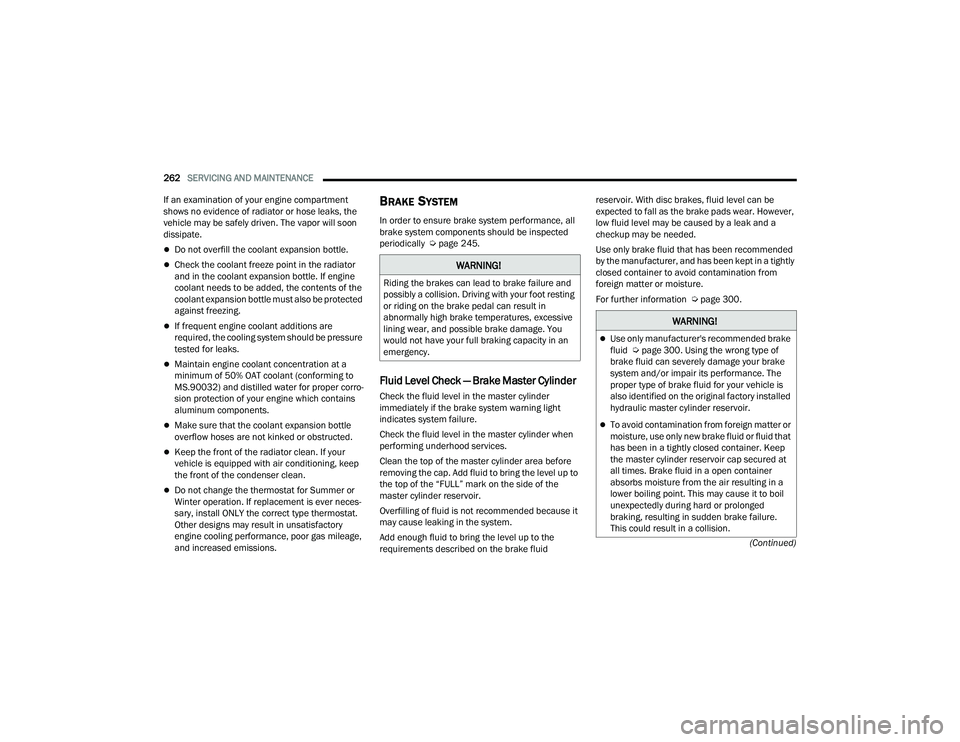
If an examination of your engine compartment
shows no evidence of radiator or hose leaks, the
vehicle may be safely driven. The vapor will soon
dissipate.
Do not overfill the coolant expansion bottle.
Check the coolant freeze point in the radiator
and in the coolant expansion bottle. If engine
coolant needs to be added, the contents of the
coolant expansion bottle must also be protected
against freezing.
If frequent engine coolant additions are
required, the cooling system should be pressure
tested for leaks.
Maintain engine coolant concentration at a
minimum of 50% OAT coolant (conforming to
MS.90032) and distilled water for proper corro
-
sion protection of your engine which contains
aluminum components.
Make sure that the coolant expansion bottle
overflow hoses are not kinked or obstructed.
Keep the front of the radiator clean. If your
vehicle is equipped with air conditioning, keep
the front of the condenser clean.
Do not change the thermostat for Summer or
Winter operation. If replacement is ever neces -
sary, install ONLY the correct type thermostat.
Other designs may result in unsatisfactory
engine cooling performance, poor gas mileage,
and increased emissions.
BRAKE SYSTEM
In order to ensure brake system performance, all
brake system components should be inspected
periodically Ú page 245.
Fluid Level Check — Brake Master Cylinder
Check the fluid level in the master cylinder
immediately if the brake system warning light
indicates system failure.
Check the fluid level in the master cylinder when
performing underhood services.
Clean the top of the master cylinder area before
removing the cap. Add fluid to bring the level up to
the top of the “FULL” mark on the side of the
master cylinder reservoir.
Overfilling of fluid is not recommended because it
may cause leaking in the system.
Add enough fluid to bring the level up to the
requirements described on the brake fluid reservoir. With disc brakes, fluid level can be
expected to fall as the brake pads wear. However,
low fluid level may be caused by a leak and a
checkup may be needed.
Use only brake fluid that has been recommended
by the manufacturer, and has been kept in a tightly
closed container to avoid contamination from
foreign matter or moisture.
For further information Ú
page 300.
WARNING!
Riding the brakes can lead to brake failure and
possibly a collision. Driving with your foot resting
or riding on the brake pedal can result in
abnormally high brake temperatures, excessive
lining wear, and possible brake damage. You
would not have your full braking capacity in an
emergency.
WARNING!
Use only manufacturer's recommended brake
fluid Úpage 300. Using the wrong type of
brake fluid can severely damage your brake
system and/or impair its performance. The
proper type of brake fluid for your vehicle is
also identified on the original factory installed
hydraulic master cylinder reservoir.
To avoid contamination from foreign matter or
moisture, use only new brake fluid or fluid that
has been in a tightly closed container. Keep
the master cylinder reservoir cap secured at
all times. Brake fluid in a open container
absorbs moisture from the air resulting in a
lower boiling point. This may cause it to boil
unexpectedly during hard or prolonged
braking, resulting in sudden brake failure.
This could result in a collision.
21_LD_OM_EN_USC_t.book Page 262
Page 308 of 320
306
INDEX
A
About Your Brakes......................................... 296Adaptive Cruise Control (ACC)
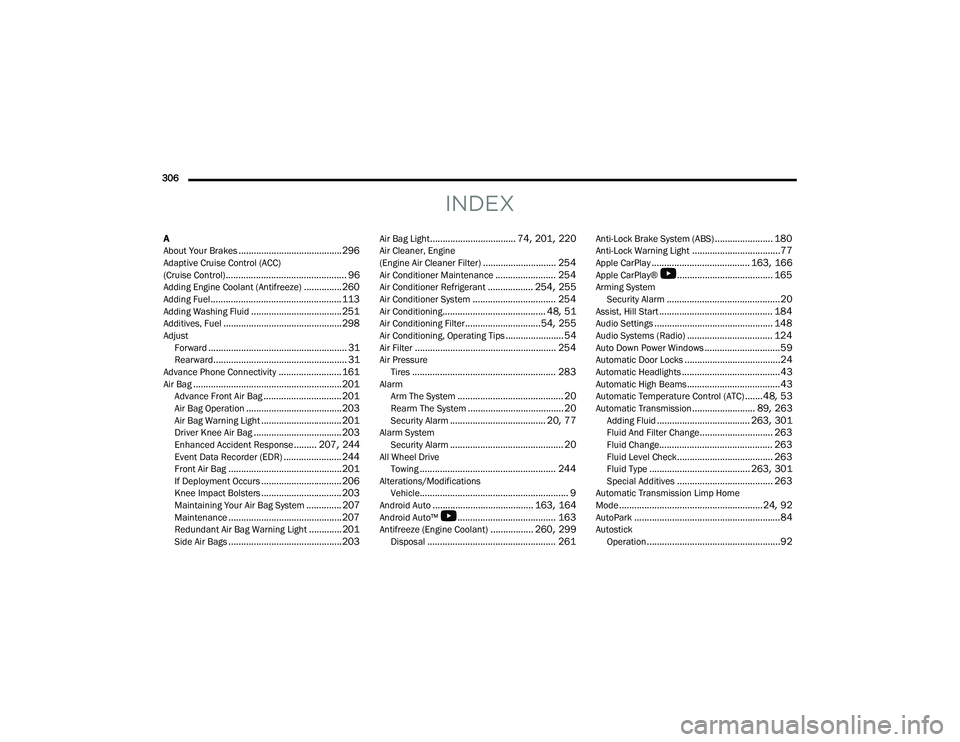
(Cruise Control)................................................ 96Adding Engine Coolant (Antifreeze)............... 260Adding Fuel.................................................... 113Adding Washing Fluid.................................... 251Additives, Fuel............................................... 298AdjustForward....................................................... 31Rearward..................................................... 31Advance Phone Connectivity......................... 161Air Bag........................................................... 201Advance Front Air Bag............................... 201Air Bag Operation...................................... 203Air Bag Warning Light................................ 201Driver Knee Air Bag................................... 203Enhanced Accident Response......... 207, 244Event Data Recorder (EDR)....................... 244Front Air Bag............................................. 201If Deployment Occurs................................ 206Knee Impact Bolsters................................ 203Maintaining Your Air Bag System.............. 207Maintenance............................................. 207Redundant Air Bag Warning Light.............201Side Air Bags............................................. 203
Air Bag Light.................................. 74, 201, 220Air Cleaner, Engine
(Engine Air Cleaner Filter)............................. 254Air Conditioner Maintenance........................ 254Air Conditioner Refrigerant.................. 254, 255Air Conditioner System................................. 254Air Conditioning......................................... 48, 51Air Conditioning Filter..............................54, 255Air Conditioning, Operating Tips....................... 54Air Filter........................................................ 254Air PressureTires......................................................... 283AlarmArm The System.......................................... 20Rearm The System...................................... 20Security Alarm...................................... 20, 77Alarm SystemSecurity Alarm............................................. 20All Wheel DriveTowing...................................................... 244Alterations/ModificationsVehicle........................................................... 9Android Auto........................................ 163, 164Android Auto™
b
....................................... 163Antifreeze (Engine Coolant)................. 260, 299Disposal................................................... 261
Anti-Lock Brake System (ABS)....................... 180Anti-Lock Warning Light...................................77Apple CarPlay....................................... 163, 166Apple CarPlay®
b
...................................... 165Arming SystemSecurity Alarm.............................................20Assist, Hill Start............................................. 184Audio Settings............................................... 148Audio Systems (Radio).................................. 124Auto Down Power Windows..............................59Automatic Door Locks......................................24Automatic Headlights.......................................43Automatic High Beams.....................................43Automatic Temperature Control (ATC).......48, 53Automatic Transmission......................... 89, 263Adding Fluid..................................... 263, 301Fluid And Filter Change............................. 263Fluid Change............................................. 263Fluid Level Check...................................... 263Fluid Type........................................ 263, 301Special Additives...................................... 263Automatic Transmission Limp Home
Mode.........................................................24, 92AutoPark..........................................................84AutostickOperation.....................................................92
21_LD_OM_EN_USC_t.book Page 306