traction control DODGE CHARGER 2021 User Guide
[x] Cancel search | Manufacturer: DODGE, Model Year: 2021, Model line: CHARGER, Model: DODGE CHARGER 2021Pages: 320, PDF Size: 20.61 MB
Page 185 of 320
SAFETY183
"Partial Off"
This mode may be useful if the vehicle becomes
stuck. This mode may modify TCS and ESC
thresholds for activation, which allows for more
wheel spin than normally allowed.
To enter the “Partial Off” mode, momentarily push
the ESC OFF button and the ESC OFF Indicator
Light will illuminate. To turn the ESC on again,
momentarily push the ESC OFF button and the ESC
OFF Indicator Light will turn off.
NOTE:
For vehicles with multiple partial ESC modes,
the push and release of the button will toggle
the ESC modes. Multiple attempts may be
required to return to "ESC On" mode.
Trailer Sway Control (TSC) is disabled when the
ESC system is in the “Partial Off” mode.
If Equipped — "ESC Sport" and "ESC Track" are
ESC “Partial Off” mode(s). “Full Off” – If Equipped
This mode is intended for off-highway or off-road use
only and should not be used on any public roadways.
In this mode, TCS and ESC features are turned off.
To enter the “Full Off” mode, push and hold the ESC
OFF button for five seconds while the vehicle is stopped
with the engine running. After five seconds, a chime will
sound, the ESC OFF Indicator Light will illuminate, and
the ESC OFF message will display in the instrument
cluster. To turn ESC on again, momentarily push the
ESC OFF button.
ESC Activation/Malfunction Indicator Light
And ESC OFF Indicator Light
The ESC Activation/Malfunction Indicator
Light in the instrument cluster will come
on when the ignition is placed in the
ON/RUN mode. It should go out with the
engine running. If the ESC Activation/Malfunction
Indicator Light comes on continuously with the
engine running, a malfunction has been detected
in the ESC system. If this light remains on after
several ignition cycles, and the vehicle has been
driven several miles (kilometers) at speeds greater
than 30 mph (48 km/h), see an authorized dealer
as soon as possible to have the problem
diagnosed and corrected.
The ESC Activation/Malfunction Indicator Light
(located in the instrument cluster) starts to flash as
soon as the tires lose traction and the ESC system
becomes active. The ESC Activation/Malfunction
Indicator Light also flashes when TCS is active.
If the ESC Activation/Malfunction Indicator Light
begins to flash during acceleration, ease up on the
accelerator and apply as little throttle as possible.
Be sure to adapt your speed and driving to the
prevailing road conditions.
The ESC OFF Indicator Light indicates
the customer has elected to have the
Electronic Stability Control (ESC) in a
reduced mode.
WARNING!
When in “Partial Off” mode, the TCS functionality of
ESC, except for the limited slip feature described in
the TCS section, has been disabled and the ESC OFF
Indicator Light will be illuminated. When in “Partial
Off” mode, the engine power reduction feature of
Traction Control System (TCS) is disabled, and the
enhanced vehicle stability offered by the ESC system
is reduced.
WARNING!
In the ESC “Full Off” mode, the engine torque
reduction and stability features are disabled.
Therefore, enhanced vehicle stability offered
by the ESC system is unavailable. In an emer -
gency evasive maneuver, the ESC system will
not engage to assist in maintaining stability.
ESC “Full Off” mode is intended for
off-highway or off-road use only.
The Electronic Stability Control (ESC) cannot
prevent the natural laws of physics from
acting on the vehicle, nor can it increase the
traction afforded by prevailing road condi -
tions. ESC cannot prevent all accidents,
including those resulting from excessive
speed in turns, driving on very slippery
surfaces, or hydroplaning. ESC also cannot
prevent collisions.
6
21_LD_OM_EN_USC_t.book Page 183
Page 187 of 320
SAFETY185
Rain Brake Support (RBS)
RBS may improve braking performance in wet
conditions. It will periodically apply a small amount
of brake pressure to remove any water buildup
on the front brake rotors. It functions when the
windshield wipers are in LO or HI speed. When RBS
is active, there is no notification to the driver and
no driver interaction is required.
Ready Alert Braking (RAB)
RAB may reduce the time required to reach full braking
during emergency braking situations. It anticipates
when an emergency braking situation may occur by
monitoring how fast the throttle is released by the
driver. The Electronic Brake Controller (EBC) will
prepare the brake system for a panic stop.
Traction Control System (TCS)
The TCS monitors the amount of wheel spin of each of
the driven wheels. If wheel spin is detected, the TCS
may apply brake pressure to the spinning wheel(s)
and/or reduce engine power to provide enhanced
acceleration and stability. A feature of the TCS, Brake
Limited Differential (BLD) functions similarly to a
limited slip differential and controls the wheel spin
across a driven axle. If one wheel on a driven axle is
spinning faster than the other, the system will apply the
brake of the spinning wheel. This will allow more engine
power to be applied to the wheel that is not spinning.
BLD may remain enabled even if TCS and ESC are in
reduced modes.
AUXILIARY DRIVING SYSTEMS
BLIND SPOT MONITORING (BS M) —
I
F EQUIPPED
The BSM system uses two radar sensors, located
inside the rear fascia/bumper, to detect highway
licensable vehicles (automobiles, trucks,
motorcycles, etc.) that enter the blind spot zones
from the rear/front/side of the vehicle.
Rear Detection Zones
When the vehicle is started, the BSM Warning
Light will momentarily illuminate in both outside
rearview mirrors to let the driver know that the
system is operational.
The BSM system sensors operate when the vehicle
is in any forward gear or REVERSE.
BSM Warning Light
The BSM detection zone covers approximately one
lane width on both sides of the vehicle 12 ft (3.8 m).
The zone length starts at the outside rearview mirror
and extends approximately 10 ft (3 m) beyond the
rear fascia/bumper of the vehicle. The BSM system
monitors the detection zones on both sides of
the vehicle when the vehicle speed reaches
approximately 6 mph (10 km/h) or higher and
will alert the driver of vehicles in these areas.
NOTE:
The BSM system DOES NOT alert the driver
about rapidly approaching vehicles that are
outside the detection zones.
The BSM system detection zone DOES NOT
change if your vehicle is towing a trailer. There -
fore, visually verify the adjacent lane is clear for
both your vehicle and trailer before making a
lane change. If the trailer or other object (i.e.,
6
21_LD_OM_EN_USC_t.book Page 185
Page 288 of 320
286SERVICING AND MAINTENANCE
Keep dismounted tires in a cool, dry place with as
little exposure to light as possible. Protect tires
from contact with oil, grease, and gasoline.
Replacement Tires
The tires on your new vehicle provide a balance of
many characteristics. They should be inspected
regularly for wear and correct cold tire inflation
pressures. The manufacturer strongly recommends
that you use tires equivalent to the originals in size,
quality and performance when replacement is
needed
Ú
page 285. Refer to the Tire and Loading
Information placard or the Vehicle Certification
Label for the size designation of your tire. The Load
Index and Speed Symbol for your tire will be found on
the original equipment tire sidewall.
See the Tire Sizing Chart example found in the “Tire
Safety Information” section of this manual for
more information relating to the Load Index and
Speed Symbol of a tire Ú page 275.
It is recommended to replace the two front tires or
two rear tires as a pair. Replacing just one tire can
seriously affect your vehicle’s handling. If you ever
replace a wheel, make sure that the wheel’s
specifications match those of the original wheels.
It is recommended you contact an authorized tire
dealer or original equipment dealer with any
questions you may have on tire specifications or capability. Failure to use equivalent replacement
tires may adversely affect the safety, handling, and
ride of your vehicle.
TIRE TYPES
All Season Tires — If Equipped
All Season tires provide traction for all seasons
(Spring, Summer, Autumn, and Winter). Traction
levels may vary between different all season tires.
All season tires can be identified by the M+S, M&S,
M/S or MS designation on the tire sidewall. Use all
season tires only in sets of four; failure to do so
may adversely affect the safety and handling of
your vehicle.
Summer Or Three Season Tires —
If Equipped
Summer tires provide traction in both wet and dry
conditions, and are not intended to be driven in
snow or on ice. If your vehicle is equipped with
Summer tires, be aware these tires are not
designed for Winter or cold driving conditions.
Install Winter tires on your vehicle when ambient
temperatures are less than 40°F (5°C) or if
roads are covered with ice or snow. For more
information, contact an authorized dealer.
WARNING!
Do not use a tire, wheel size, load rating, or
speed rating other than that specified for your
vehicle. Some combinations of unapproved
tires and wheels may change suspension
dimensions and performance characteristics,
resulting in changes to steering, handling, and
braking of your vehicle. This can cause unpre
-
dictable handling and stress to steering and
suspension components. You could lose
control and have a collision resulting in
serious injury or death. Use only the tire and
wheel sizes with load ratings approved for
your vehicle.
Never use a tire with a smaller load index or
capacity, other than what was originally
equipped on your vehicle. Using a tire with a
smaller load index could result in tire over -
loading and failure. You could lose control and
have a collision.
Failure to equip your vehicle with tires having
adequate speed capability can result in
sudden tire failure and loss of vehicle control.
CAUTION!
Replacing original tires with tires of a different
size may result in false speedometer and
odometer readings.
21_LD_OM_EN_USC_t.book Page 286
Page 289 of 320
SERVICING AND MAINTENANCE287
Summer tires do not contain the all season
designation or mountain/snowflake symbol on the
tire sidewall. Use Summer tires only in sets of four;
failure to do so may adversely affect the safety and
handling of your vehicle.
Snow Tires
Some areas of the country require the use of snow tires
during the Winter. Snow tires can be identified by a
“mountain/snowflake” symbol on the tire sidewall.
If you need snow tires, select tires
equivalent in size and type to the original
equipment tires. Use snow tires only in
sets of four; failure to do so may adversely
affect the safety and handling of your vehicle.
Snow tires generally have lower speed ratings than
what was originally equipped with your vehicle and
should not be operated at sustained speeds over
75 mph (120 km/h). For speeds above 75 mph
(120 km/h) refer to original equipment or an
authorized tire dealer for recommended safe
operating speeds, loading and cold tire inflation
pressures.
While studded tires improve performance on ice,
skid and traction capability on wet or dry surfaces
may be poorer than that of non-studded tires. Some
states prohibit studded tires; therefore, local laws
should be checked before using these tire types.
SPARE TIRES — IF EQUIPPED
NOTE:For vehicles equipped with Tire Service Kit instead
of a spare tire Ú
page 231.
For restrictions when towing with a spare tire
designated for temporary emergency use
Ú
page 119.
Spare Tire Matching Original Equipped Tire
And Wheel — If Equipped
Your vehicle may be equipped with a spare tire and
wheel equivalent in look and function to the original
equipment tire and wheel found on the front or rear
axle of your vehicle. This spare tire may be used in
the tire rotation for your vehicle. If your vehicle has
this option, refer to an authorized tire dealer for the
recommended tire rotation pattern.
Compact Spare Tire — If Equipped
The compact spare is for temporary emergency
use only. You can identify if your vehicle is equipped
with a compact spare by looking at the spare tire
description on the Tire and Loading Information
Placard located on the driver’s side door opening
or on the sidewall of the tire. Compact spare tire
descriptions begin with the letter “T” or “S”
preceding the size designation. Example: T145/
80D18 103M.
T, S = Temporary Spare Tire
Since this tire has limited tread life, the original
equipment tire should be repaired (or replaced)
and reinstalled on your vehicle at the first
opportunity.
Do not install a wheel cover or attempt to mount a
conventional tire on the compact spare wheel, since
the wheel is designed specifically for the compact
spare tire. Do not install more than one compact spare
tire and wheel on the vehicle at any given time.
WARNING!
Do not use Summer tires in snow/ice conditions.
You could lose vehicle control, resulting in severe
injury or death. Driving too fast for conditions also
creates the possibility of loss of vehicle control.
CAUTION!
Because of the reduced ground clearance, do not
take your vehicle through an automatic car wash
with a compact or limited use temporary spare
installed. Damage to the vehicle may result.
8
21_LD_OM_EN_USC_t.book Page 287
Page 292 of 320
290SERVICING AND MAINTENANCE
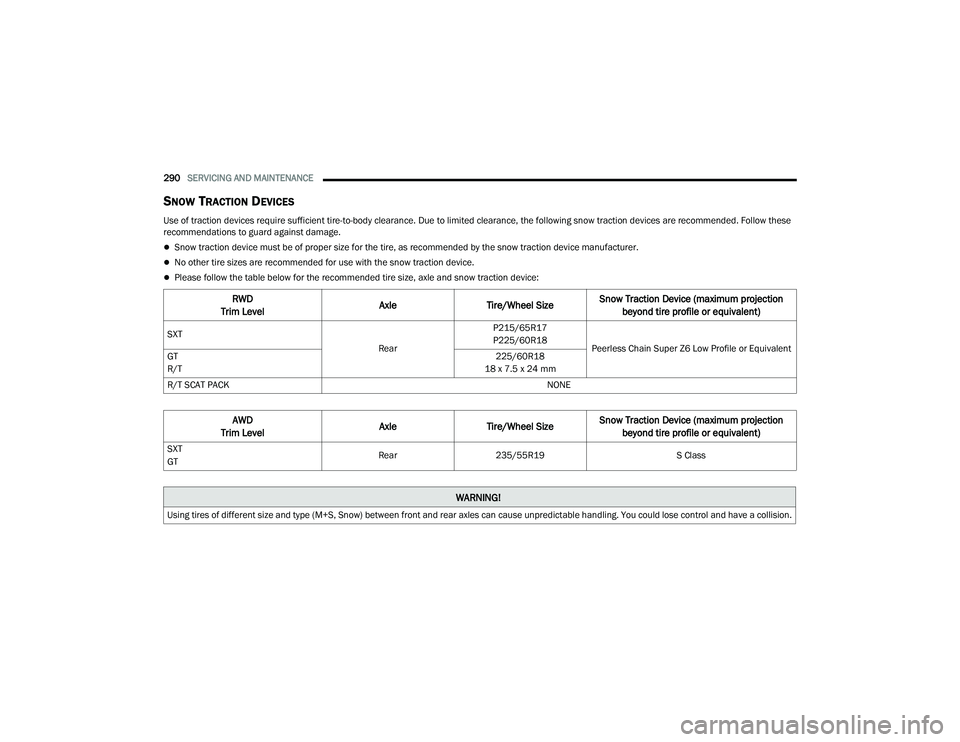
SNOW TRACTION DEVICES
Use of traction devices require sufficient tire-to-body clearance. Due to limited clearance, the following snow traction devices are recommended. Follow these
recommendations to guard against damage.
Snow traction device must be of proper size for the tire, as recommended by the snow traction device manufacturer.
No other tire sizes are recommended for use with the snow traction device.
Please follow the table below for the recommended tire size, axle and snow traction device:
RWD
Trim Level Axle
Tire/Wheel Size Snow Traction Device (maximum projection
beyond tire profile or equivalent)
SXT
RearP215/65R17
P225/60R18
Peerless Chain Super Z6 Low Profile or Equivalent
GT
R/T 225/60R18
18 x 7.5 x 24 mm
R/T SCAT PACK NONE
AWD
Trim Level Axle
Tire/Wheel Size Snow Traction Device (maximum projection
beyond tire profile or equivalent)
SXT
GT Rear
235/55R19 S Class
WARNING!
Using tires of different size and type (M+S, Snow) between front and rear axles can cause unpredictable handling. You could lose control and have a collision.
21_LD_OM_EN_USC_t.book Page 290
Page 294 of 320
292SERVICING AND MAINTENANCE
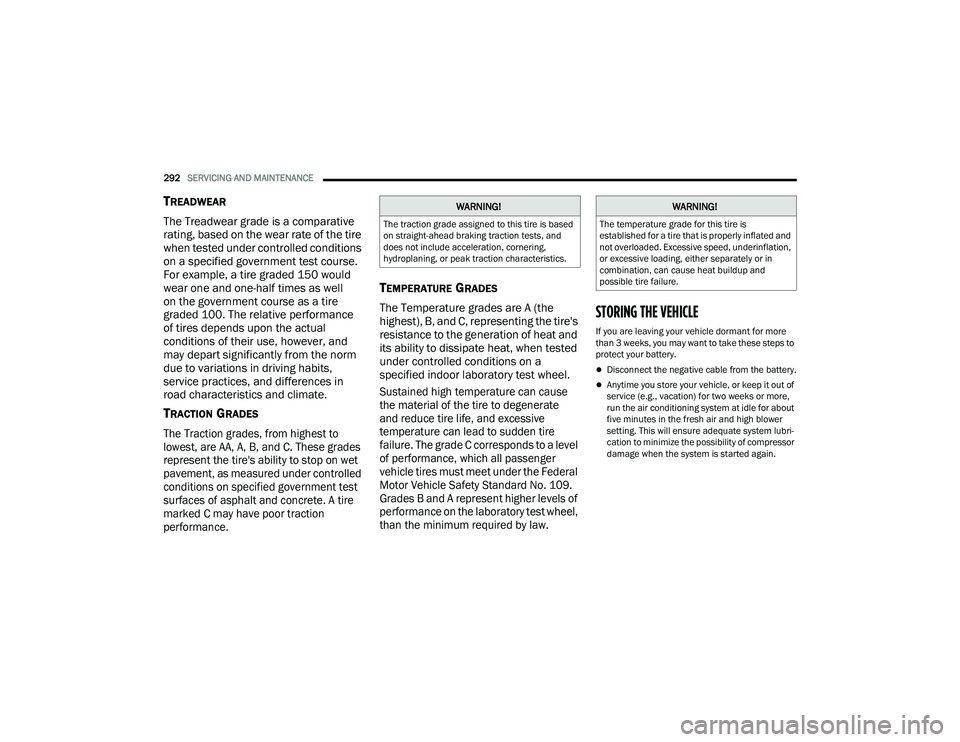
TREADWEAR
The Treadwear grade is a comparative
rating, based on the wear rate of the tire
when tested under controlled conditions
on a specified government test course.
For example, a tire graded 150 would
wear one and one-half times as well
on the government course as a tire
graded 100. The relative performance
of tires depends upon the actual
conditions of their use, however, and
may depart significantly from the norm
due to variations in driving habits,
service practices, and differences in
road characteristics and climate.
TRACTION GRADES
The Traction grades, from highest to
lowest, are AA, A, B, and C. These grades
represent the tire's ability to stop on wet
pavement, as measured under controlled
conditions on specified government test
surfaces of asphalt and concrete. A tire
marked C may have poor traction
performance.
TEMPERATURE GRADES
The Temperature grades are A (the
highest), B, and C, representing the tire's
resistance to the generation of heat and
its ability to dissipate heat, when tested
under controlled conditions on a
specified indoor laboratory test wheel.
Sustained high temperature can cause
the material of the tire to degenerate
and reduce tire life, and excessive
temperature can lead to sudden tire
failure. The grade C corresponds to a level
of performance, which all passenger
vehicle tires must meet under the Federal
Motor Vehicle Safety Standard No. 109.
Grades B and A represent higher levels of
performance on the laboratory test wheel,
than the minimum required by law.
STORING THE VEHICLE
If you are leaving your vehicle dormant for more
than 3 weeks, you may want to take these steps to
protect your battery.
Disconnect the negative cable from the battery.
Anytime you store your vehicle, or keep it out of
service (e.g., vacation) for two weeks or more,
run the air conditioning system at idle for about
five minutes in the fresh air and high blower
setting. This will ensure adequate system lubri-
cation to minimize the possibility of compressor
damage when the system is started again.
WARNING!
The traction grade assigned to this tire is based
on straight-ahead braking traction tests, and
does not include acceleration, cornering,
hydroplaning, or peak traction characteristics.
WARNING!
The temperature grade for this tire is
established for a tire that is properly inflated and
not overloaded. Excessive speed, underinflation,
or excessive loading, either separately or in
combination, can cause heat buildup and
possible tire failure.
21_LD_OM_EN_USC_t.book Page 292
Page 313 of 320
311
Oil Temperature Warning
............................ 76Park...................................................... 43, 80Passing........................................................ 43Reading....................................................... 45Seat Belt Reminder..................................... 76Security Alarm............................................. 77Service...................................................... 271Service Adaptive Cruise Control (ACC) Warning.................................................. 78Service Forward Collision Warning (FCW).... 78Service LaneSense Warning........................ 77Sport Mode Indicator.................................. 80Traction Control......................................... 183Transmission Temperature Warning........... 76Trunk Open Warning................................... 77Turn Signals......................... 42, 44, 80, 222Vanity Mirror................................................ 36Warning Instrument Cluster Descriptions..................................... 76, 80Load Shed Battery Saver On............................ 73Load Shed Electrical Load Reduction.............. 73Load Shed Intelligent Battery Sensor.............. 73Loading Vehicle................................... 114, 115Capacities................................................. 115Tires.......................................................... 280LocksAuto Unlock................................................. 24Automatic Door........................................... 24Child Protection........................................... 24Power Door.................................................. 21
Low Tire Pressure System............................. 190Lubrication, Body.......................................... 256Lug Nuts/Bolts.............................................. 296
M
Maintenance.................................................... 61Maintenance Free Battery............................ 252Maintenance Schedule........................ 245, 246Malfunction Indicator Light
(Check Engine).......................................... 78, 82ManualService..................................................... 305Media Hub....................................................... 56Media Mode.................................................. 150Memory Seat................................................... 27Memory Settings.............................................. 27Methanol...................................................... 298Mirrors............................................................. 36Electric Powered.......................................... 37Electric Remote........................................... 37Heated......................................................... 38Outside........................................................ 37Rearview.............................................36, 223Vanity.......................................................... 36Modifications/AlterationsVehicle........................................................... 9Monitor, Tire Pressure System...................... 190Mopar Parts.................................................. 304MP3 Control..................................................... 56Multi-Function Control Lever............................ 42
N
New Vehicle Break-In Period............................86
O
Occupant Restraints..................................... 193Octane Rating, Gasoline (Fuel)............. 297, 300Oil Change Indicator.........................................69Reset...........................................................69Oil Filter, Change........................................... 254Oil Filter, Selection........................................ 254Oil Pressure Light.............................................76Oil, Engine............................................ 253, 300Capacity.................................................... 299Checking................................................... 251Dipstick..................................................... 251Disposal.................................................... 254Filter................................................ 254, 300Filter Disposal........................................... 254Identification Logo.................................... 253Materials Added To................................... 254Pressure Warning Light................................76Recommendation............................ 253, 299Synthetic................................................... 253Viscosity.................................................... 299Onboard Diagnostic System.............................81Operating Precautions.....................................81Operator ManualOwner's Manual........................................ 305Outside Rearview Mirrors.................................37Overheating, Engine...................................... 239
11
21_LD_OM_EN_USC_t.book Page 311
Page 316 of 320
314 Starting Procedures
......................................... 83Steering........................................................... 25Column Lock............................................... 25Power.......................................................... 94Tilt Column.................................................. 25Wheel, Heated............................................. 25Wheel, Tilt................................................... 25Steering Wheel Audio Controls...................... 141Steering Wheel Mounted Sound System.......141Storage................................................... 55, 292Storage, Vehicle...................................... 54, 292Store Radio Presets....................................... 148Storing Your Vehicle...................................... 292Stuck, Freeing............................................... 242Sun Roof................................................... 60, 61Sunglasses Storage......................................... 56Supplemental Restraint System – Air Bag..... 201Symbol Glossary................................................ 9Synthetic Engine Oil....................................... 253System, Remote Starting................................. 17
T
Telescoping Steering Column.......................... 25Temperature Control, Automatic (ATC)............ 53Tilt Steering Column........................................ 25Time Delay Headlight..................................................... 44Tire And Loading Information Placard........... 280Tire Markings................................................. 275Tire Safety Information.................................. 275
Tire Service Kit............................ 231, 232, 233Tires...................................221, 283, 287, 291Aging (Life Of Tires).................................. 285Air Pressure.............................................. 283Chains...................................................... 290Changing.................................................. 226Compact Spare......................................... 287General Information........................ 283, 287High Speed............................................... 284Inflation Pressure..................................... 283Jacking..................................................... 226Life Of Tires.............................................. 285Load Capacity........................................... 280Pressure Monitoring System (TPMS)..78, 190Quality Grading......................................... 291Radial....................................................... 284Replacement............................................ 286Rotation.................................................... 291Safety.............................................. 275, 283Sizes......................................................... 276Snow Tires................................................ 287Spare Tires............................. 227, 287, 288Spinning................................................... 285Trailer Towing........................................... 119Tread Wear Indicators.............................. 285Wheel Nut Torque..................................... 296To Open Hood.................................................. 62Tongue Weight/Trailer Weight...................... 118
Towing........................................................... 115Behind A Motorhome................................ 121Disabled Vehicle....................................... 243Guide........................................................ 117Recreational............................................. 121Weight...................................................... 117Towing Behind A Motorhome........................ 121Traction......................................................... 122Traction Control............................................ 185Trailer Towing................................................ 115Hitches..................................................... 117Minimum Requirements........................... 118Tips........................................................... 121Trailer And Tongue Weight........................ 118Wiring....................................................... 120Trailer Towing Guide..................................... 117Trailer Weight................................................ 117Transfer CaseFluid.......................................................... 301Transmission....................................................89Automatic.......................................... 89, 263Fluid.......................................................... 301Maintenance............................................ 263Shifting........................................................88Transporting Pets.......................................... 220Tread Wear Indicators................................... 285Trunk Lid (Deck Lid).........................................63Trunk Release Remote Control........................63Turn Signals..............................................44, 80
21_LD_OM_EN_USC_t.book Page 314