power steering DODGE CHARGER 2021 Owner's Manual
[x] Cancel search | Manufacturer: DODGE, Model Year: 2021, Model line: CHARGER, Model: DODGE CHARGER 2021Pages: 320, PDF Size: 20.61 MB
Page 183 of 320
SAFETY181
ELECTRONIC BRAKE CONTROL (EBC)
S
YSTEM
Your vehicle is equipped with an advanced Electronic
Brake Control (EBC) system. This system includes
Electronic Brake Force Distribution (EBD), Anti-Lock
Brake System (ABS), Brake Assist System (BAS), Hill
Start Assist (HSA), Traction Control System (TCS),
Electronic Stability Control (ESC), and Electronic Roll
Mitigation (ERM). These systems work together to
enhance both vehicle stability and control in various
driving conditions.
Your vehicle may also be equipped with Ready
Alert Braking (RAB) and Rain Brake Support (RBS).
Brake System Warning Light
The red Brake System Warning Light will turn on
when the ignition is placed in the ON/RUN mode
and may stay on for as long as four seconds.
If the Brake System Warning Light remains on
or comes on while driving, it indicates that the
brake system is not functioning properly and that
immediate service is required. If the Brake System
Warning Light does not come on when the ignition
is placed in the ON/RUN mode, have the light
repaired as soon as possible.
Brake Assist System (BAS)
The BAS is designed to optimize the vehicle’s
braking capability during emergency braking
maneuvers. The system detects an emergency
braking situation by sensing the rate and amount
of brake application and then applies optimum
pressure to the brakes. This can help reduce
braking distances. The BAS complements the
Anti-Lock Brake System (ABS). Applying the brakes
very quickly results in the best BAS assistance.
To receive the benefit of the system, you must
apply continuous braking pressure during the
stopping sequence (do not “pump” the brakes).
Do not reduce brake pedal pressure unless
braking is no longer desired. Once the brake
pedal is released, the BAS is deactivated.
Electronic Brake Force Distribution (EBD)
EBD manages the distribution of the braking
torque between the front and rear axles by limiting
braking pressure to the rear axle. This is done to
prevent overslip of the rear wheels to avoid vehicle
instability, and to prevent the rear axle from
entering ABS before the front axle.
Electronic Roll Mitigation (ERM)
ERM anticipates the potential for wheel lift by
monitoring the driver’s steering wheel input and
the speed of the vehicle. When ERM determines
that the rate of change of the steering wheel angle
and vehicle’s speed are sufficient to potentially
cause wheel lift, it then applies the appropriate
brake and may also reduce engine power to lessen
the chance that wheel lift will occur. ERM can only
reduce the chance of wheel lift occurring during
severe or evasive driving maneuvers; it cannot
prevent wheel lift due to other factors, such as
road conditions, leaving the roadway, striking
objects or other vehicles.
NOTE:ERM is disabled any time the ESC is in “Full Off”
mode (if equipped). See Ú page 182 for a
complete explanation of the available ESC modes.
WARNING!
The Brake Assist System (BAS) cannot prevent the
natural laws of physics from acting on the vehicle,
nor can it increase the traction afforded by prevailing
road conditions. BAS cannot prevent collisions,
including those resulting from excessive speed in
turns, driving on very slippery surfaces, or
hydroplaning. The capabilities of a BAS-equipped
vehicle must never be exploited in a reckless or
dangerous manner, which could jeopardize the
user's safety or the safety of others.
6
21_LD_OM_EN_USC_t.book Page 181
Page 184 of 320
182SAFETY
(Continued)
Electronic Stability Control (ESC)
ESC enhances directional control and stability
of the vehicle under various driving conditions.
ESC corrects for oversteering or understeering
of the vehicle by applying the brake of the
appropriate wheel(s) to counteract the above
conditions. Engine power may also be reduced to
help the vehicle maintain the desired path.
Oversteer — when the vehicle is turning more
than appropriate for the steering wheel position.
Understeer — when the vehicle is turning less
than appropriate for the steering wheel position.
ESC uses sensors in the vehicle to determine the
vehicle path intended by the driver and compares
it to the actual path of the vehicle. When the actual
path does not match the intended path, ESC
applies the brake of the appropriate wheel to
assist in counteracting the above conditions.
The ESC Activation/Malfunction Indicator Light
located in the instrument cluster will start to flash as
soon as the ESC system becomes active. The ESC
Activation/Malfunction Indicator Light also flashes
when the TCS is active. If the ESC Activation/
Malfunction Indicator Light begins to flash during
acceleration, ease up on the accelerator and apply
as little throttle as possible. Be sure to adapt your
speed and driving to the prevailing road conditions.
ESC Operating Modes
Depending upon model and mode of operation, the
ESC system may have multiple operating modes.
"ESC On"
This is the normal operating mode for the ESC.
Whenever the vehicle is started, the ESC system
will be in this mode. This mode should be used for
most driving conditions. Alternate ESC modes
should only be used for specific reasons as noted
in the following paragraphs.
WARNING!
Many factors, such as vehicle loading, road
conditions and driving conditions, influence the
chance that wheel lift or rollover may occur. ERM
cannot prevent all wheel lift or roll overs, especially
those that involve leaving the roadway or striking
objects or other vehicles. The capabilities of an
ERM-equipped vehicle must never be exploited
in a reckless or dangerous manner which could
jeopardize the user's safety or the safety of others.
WARNING!
Electronic Stability Control (ESC) cannot
prevent the natural laws of physics from
acting on the vehicle, nor can it increase the
traction afforded by prevailing road conditions.
ESC cannot prevent accidents, including those
resulting from excessive speed in turns, driving
on very slippery surfaces, or hydroplaning. ESC
also cannot prevent accidents resulting from
loss of vehicle control due to inappropriate
driver input for the conditions. Only a safe,
attentive, and skillful driver can prevent acci
-
dents. The capabilities of an ESC equipped
vehicle must never be exploited in a reckless or
dangerous manner which could jeopardize the
user’s safety or the safety of others.
Vehicle modifications, or failure to properly
maintain your vehicle, may change the
handling characteristics of your vehicle, and
may negatively affect the performance of the
ESC system. Changes to the steering system,
suspension, braking system, tire type and size
or wheel size may adversely affect ESC perfor -
mance. Improperly inflated and unevenly worn
tires may also degrade ESC performance. Any
vehicle modification or poor vehicle mainte -
nance that reduces the effectiveness of the
ESC system can increase the risk of loss of
vehicle control, vehicle rollover, personal
injury and death.
WARNING!
21_LD_OM_EN_USC_t.book Page 182
Page 203 of 320
SAFETY201
Air Bag Warning Light
The Occupant Restraint Controller (ORC)
monitors the readiness of the electronic
parts of the air bag system whenever the
ignition switch is in the START or ON/RUN
position. If the ignition switch is in the OFF position
or in the ACC position, the air bag system is not on
and the air bags will not inflate.
The ORC contains a backup power supply system
that may deploy the air bag system even if the
battery loses power or it becomes disconnected
prior to deployment.
The ORC turns on the Air Bag Warning Light in the
instrument panel for approximately four to eight
seconds for a self-check when the ignition switch is
first in the ON/RUN position. After the self-check,
the Air Bag Warning Light will turn off. If the ORC
detects a malfunction in any part of the system,
it turns on the Air Bag Warning Light, either
momentarily or continuously. A single chime will
sound to alert you if the light comes on again after
initial startup.
The ORC also includes diagnostics that will
illuminate the instrument panel Air Bag Warning
Light if a malfunction is detected that could affect
the air bag system. The diagnostics also record the
nature of the malfunction. While the air bag system
is designed to be maintenance free, if any of the following occurs, have an authorized dealer
service the air bag system immediately.The Air Bag Warning Light does not come on
during the four to eight seconds when the igni
-
tion switch is first in the ON/RUN position.
The Air Bag Warning Light remains on after the
four to eight-second interval.
The Air Bag Warning Light comes on intermit -
tently or remains on while driving.
NOTE:If the speedometer, tachometer, or any engine
related gauges are not working, the Occupant
Restraint Controller (ORC) may also be disabled.
In this condition the air bags may not be ready to
inflate for your protection. Have an authorized
dealer service the air bag system immediately.
Redundant Air Bag Warning Light
If a fault with the Air Bag Warning Light
is detected, which could affect the
Supplemental Restraint System (SRS), the
Redundant Air Bag Warning Light will
illuminate on the instrument panel. The Redundant
Air Bag Warning Light will stay on until the fault is
cleared. In addition, a single chime will sound to
alert you that the Redundant Air Bag Warning Light
has come on and a fault has been detected. If the
Redundant Air Bag Warning Light comes on
intermittently or remains on while driving have an
authorized dealer service the vehicle immediately
Ú
page 74.
Front Air Bags
This vehicle has front air bags and lap/shoulder
belts for both the driver and front passenger.
The front air bags are a supplement to the seat
belt restraint systems. The driver front air bag is
mounted in the center of the steering wheel. The
passenger front air bag is mounted in the instrument
panel, above the glove compartment. The words
“SRS AIRBAG” or “AIRBAG” are embossed on the air
bag covers.
WARNING!
Ignoring the Air Bag Warning Light in your
instrument panel could mean you won’t have the
air bag system to protect you in a collision. If the
light does not come on as a bulb check when the
ignition is first turned on, stays on after you start
the vehicle, or if it comes on as you drive, have
an authorized dealer service the air bag system
immediately.
6
21_LD_OM_EN_USC_t.book Page 201
Page 209 of 320
SAFETY207
(Continued)
Enhanced Accident Response System
In the event of an impact, if the communication
network remains intact, and the power remains
intact, depending on the nature of the event, the
Occupant Restraint Controller (ORC) will determine
whether to have the Enhanced Accident Response
System perform the following functions:
Cut off fuel to the engine (if equipped).
Cut off battery power to the electric motor
(if equipped).
Flash hazard lights as long as the battery has
power.
Turn on the interior lights, which remain on as
long as the battery has power or for 15 minutes
from the intervention of the Enhanced Accident
Response System.
Unlock the power door locks.
Your vehicle may also be designed to perform any
of these other functions in response to the
Enhanced Accident Response System:
Turn off the Fuel Filter Heater, Turn off the HVAC
Blower Motor, Close the HVAC Circulation Door
Cut off battery power to the:
Engine
Electric Motor (if equipped)
Electric power steering
Brake booster
Electric park brake
Automatic transmission gear selector
Horn
Front wiper
Headlamp washer pump
NOTE:
After an accident, remember to cycle the ignition to
the STOP (OFF/LOCK) position and remove the key
from the ignition switch to avoid draining the battery.
Carefully check the vehicle for fuel leaks in the
engine compartment and on the ground near the
engine compartment and fuel tank before resetting
the system and starting the engine. If there are no
fuel leaks or damage to the vehicle electrical devices
(e.g. headlights) after an accident, reset the system
by following the procedure described below. If you
have any doubt, contact an authorized dealer.
Enhanced Accident Response System
Reset Procedure
In order to reset the Enhanced Accident Response
System functions after an event, the ignition switch
must be changed from ignition START or ON/RUN to
ignition OFF. Carefully check the vehicle for fuel leaks in
the engine compartment and on the ground near the
engine compartment and fuel tank before resetting the
system and starting the engine. After an accident, if the vehicle will not start after
performing the reset procedure, the vehicle must be
towed to an authorized dealer to be inspected and to
have the Enhanced Accident Response System reset.
Maintaining Your Air Bag System
WARNING!
Modifications to any part of the air bag system
could cause it to fail when you need it. You
could be injured if the air bag system is not
there to protect you. Do not modify the compo
-
nents or wiring, including adding any kind of
badges or stickers to the steering wheel hub
trim cover or the upper passenger side of the
instrument panel. Do not modify the front
fascia/bumper, vehicle body structure, or add
aftermarket side steps or running boards.
It is dangerous to try to repair any part of the
air bag system yourself. Be sure to tell anyone
who works on your vehicle that it has an air
bag system.
6
21_LD_OM_EN_USC_t.book Page 207
Page 247 of 320
245
SERVICING AND MAINTENANCE
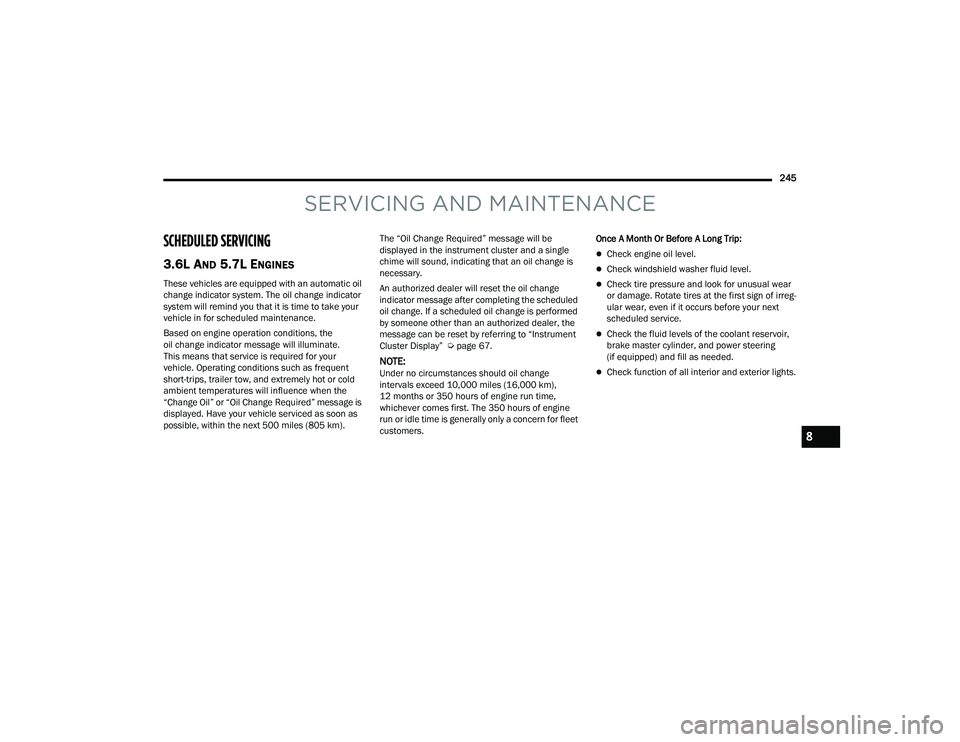
SCHEDULED SERVICING
3.6L AND 5.7L ENGINES
These vehicles are equipped with an automatic oil
change indicator system. The oil change indicator
system will remind you that it is time to take your
vehicle in for scheduled maintenance.
Based on engine operation conditions, the
oil change indicator message will illuminate.
This means that service is required for your
vehicle. Operating conditions such as frequent
short-trips, trailer tow, and extremely hot or cold
ambient temperatures will influence when the
“Change Oil” or “Oil Change Required” message is
displayed. Have your vehicle serviced as soon as
possible, within the next 500 miles (805 km).The “Oil Change Required” message will be
displayed in the instrument cluster and a single
chime will sound, indicating that an oil change is
necessary.
An authorized dealer will reset the oil change
indicator message after completing the scheduled
oil change. If a scheduled oil change is performed
by someone other than an authorized dealer, the
message can be reset by referring to “Instrument
Cluster Display” Ú
page 67.
NOTE:Under no circumstances should oil change
intervals exceed 10,000 miles (16,000 km),
12 months or 350 hours of engine run time,
whichever comes first. The 350 hours of engine
run or idle time is generally only a concern for fleet
customers. Once A Month Or Before A Long Trip:
Check engine oil level.
Check windshield washer fluid level.
Check tire pressure and look for unusual wear
or damage. Rotate tires at the first sign of irreg
-
ular wear, even if it occurs before your next
scheduled service.
Check the fluid levels of the coolant reservoir,
brake master cylinder, and power steering
(if equipped) and fill as needed.
Check function of all interior and exterior lights.
8
21_LD_OM_EN_USC_t.book Page 245
Page 266 of 320

264SERVICING AND MAINTENANCE
FUSES
GENERAL INFORMATION
The fuses protect electrical systems against
excessive current.
When a device does not work, you must check the fuse
element inside the blade fuse for a break/melt.
Also, please be aware that when using power
outlets for extended periods of time with the
engine off may result in vehicle battery discharge.
Blade Fuses
UNDERHOOD FUSES
The Front Power Distribution Center is located in
the engine compartment. This module contains
fuses and relays. Fuse cavity location and
descriptions are printed on the inside of the power
distribution center cover.
Front Power Distribution Center
WARNING!
When replacing a blown fuse, always use an
appropriate replacement fuse with the same
amp rating as the original fuse. Never replace
a fuse with another fuse of higher amp rating.
Never replace a blown fuse with metal wires or
any other material. Do not place a fuse inside
a circuit breaker cavity or vice versa. Failure
to use proper fuses may result in serious
personal injury, fire and/or property damage.
Before replacing a fuse, make sure that the
ignition is off and that all the other services
are switched off and/or disengaged.
If the replaced fuse blows again, contact an
authorized dealer.
If a general protection fuse for safety systems
(air bag system, braking system), power unit
systems (engine system, transmission
system) or steering system blows, contact an
authorized dealer.
1 — Fuse Element
2 — Blade Fuse with a good/functional fuse element
3 — Blade fuse with a bad/not functional fuse
element (blown fuse)
CAUTION!
When installing the power distribution center
cover, it is important to ensure the cover is
properly positioned and fully latched. Failure
to do so may allow water to get into the power
distribution center and possibly result in an
electrical system failure.
When replacing a blown fuse, it is important to
use only a fuse having the correct amperage
rating. The use of a fuse with a rating other
than indicated may result in a dangerous elec
-
trical system overload. If a properly rated fuse
continues to blow, it indicates a problem in the
circuit that must be corrected.
21_LD_OM_EN_USC_t.book Page 264
Page 267 of 320
SERVICING AND MAINTENANCE265
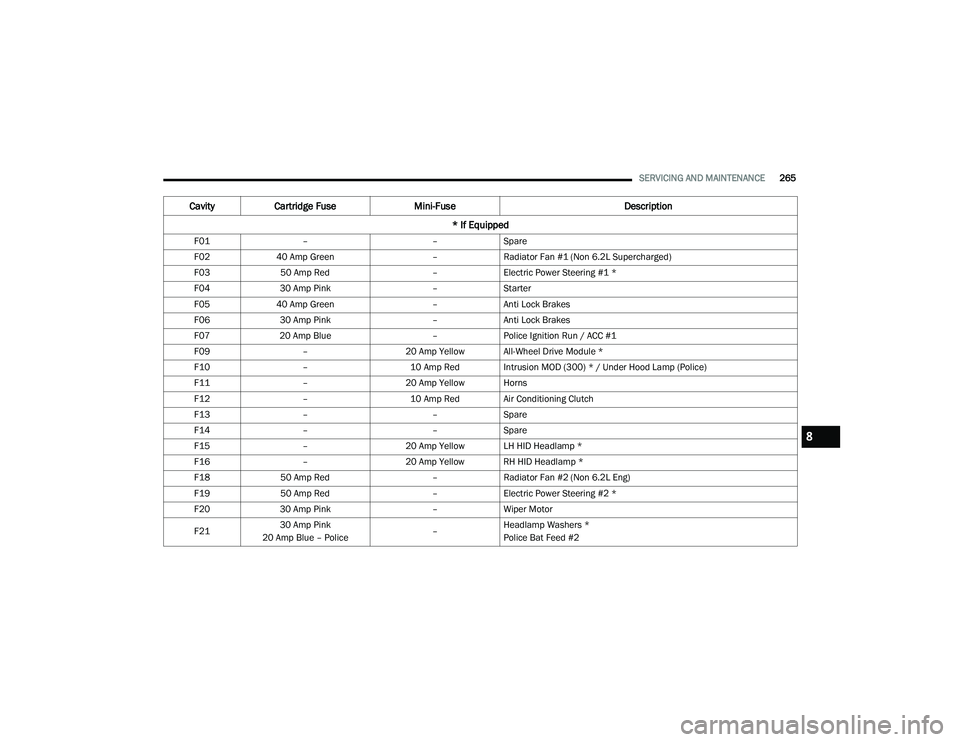
CavityCartridge Fuse Mini-Fuse Description
* If Equipped
F01 – –Spare
F02 40 Amp Green –Radiator Fan #1 (Non 6.2L Supercharged)
F03 50 Amp Red –Electric Power Steering #1 *
F04 30 Amp Pink –Starter
F05 40 Amp Green –Anti Lock Brakes
F06 30 Amp Pink –Anti Lock Brakes
F07 20 Amp Blue –Police Ignition Run / ACC #1
F09 –20 Amp Yellow All-Wheel Drive Module *
F10 –10 Amp Red Intrusion MOD (300) * / Under Hood Lamp (Police)
F11 –20 Amp Yellow Horns
F12 –10 Amp Red Air Conditioning Clutch
F13 – –Spare
F14 – –Spare
F15 –20 Amp Yellow LH HID Headlamp *
F16 –20 Amp Yellow RH HID Headlamp *
F18 50 Amp Red –Radiator Fan #2 (Non 6.2L Eng)
F19 50 Amp Red –Electric Power Steering #2 *
F20 30 Amp Pink –Wiper Motor
F21 30 Amp Pink
20 Amp Blue – Police –Headlamp Washers *
Police Bat Feed #2
8
21_LD_OM_EN_USC_t.book Page 265
Page 270 of 320
268SERVICING AND MAINTENANCE
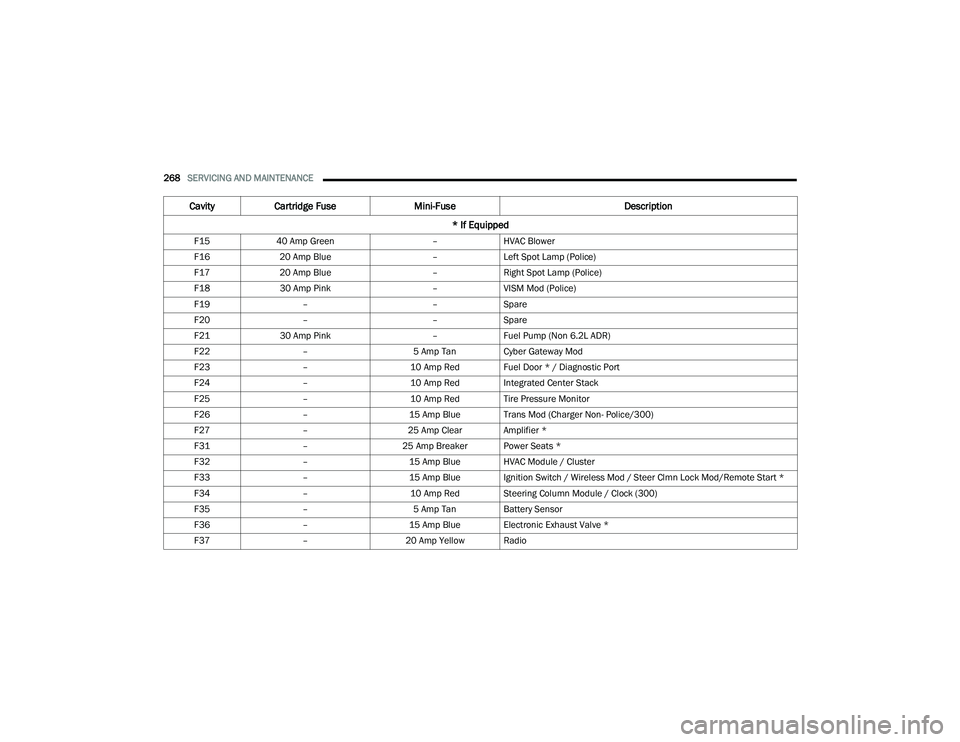
F15 40 Amp Green –HVAC Blower
F16 20 Amp Blue –Left Spot Lamp (Police)
F17 20 Amp Blue –Right Spot Lamp (Police)
F18 30 Amp Pink –VISM Mod (Police)
F19 – –Spare
F20 – –Spare
F21 30 Amp Pink –Fuel Pump (Non 6.2L ADR)
F22 – 5 Amp Tan Cyber Gateway Mod
F23 –10 Amp Red Fuel Door * / Diagnostic Port
F24 –10 Amp Red Integrated Center Stack
F25 –10 Amp Red Tire Pressure Monitor
F26 –15 Amp Blue Trans Mod (Charger Non- Police/300)
F27 –25 Amp Clear Amplifier *
F31 –25 Amp Breaker Power Seats *
F32 –15 Amp Blue HVAC Module / Cluster
F33 –15 Amp Blue Ignition Switch / Wireless Mod / Steer Clmn Lock Mod/Remote Start *
F34 –10 Amp Red Steering Column Module / Clock (300)
F35 – 5 Amp Tan Battery Sensor
F36 –15 Amp Blue Electronic Exhaust Valve *
F37 –20 Amp Yellow Radio
CavityCartridge Fuse Mini-Fuse Description
* If Equipped
21_LD_OM_EN_USC_t.book Page 268
Page 312 of 320

310 I
Ignition
............................................................ 16Switch......................................................... 16Indicator Lights Blue............................................................. 81Green.......................................................... 80White........................................................... 80Yellow.......................................................... 79Information Center, Vehicle............................. 68Inside Rearview Mirror............................ 36, 223Instrument Cluster.................................... 65, 67Descriptions................................................ 80Display................................................. 67, 70Instrument Panel Lens Cleaning.................... 295Interior Appearance Care............................... 294Interior Lights.................................................. 45
J
Jack Location................................................. 227Jump Starting...................................... 236, 237
K
Key FobArm The System
.......................................... 20Programming Additional Key Fobs.............. 15Unlatch The Trunk....................................... 14Key Fob Battery Service
(Remote Keyless Entry)................................... 14Key Fob Programming
(Remote Keyless Entry)................................... 15
Keyless Enter 'n Go™................................ 22, 85Enter The Trunk........................................... 14Passive Entry............................................... 22Passive Entry Programming......................... 22Keys................................................................. 13
L
Lane Change And Turn Signals........................ 44Lane Change Assist......................................... 44LaneSense.................................................... 109Lap/Shoulder Belts....................................... 195Latches......................................................... 222Hood............................................................ 62Lead Free Gasoline....................................... 297Leaks, Fluid.................................................. 222Life Of Tires................................................... 285Light Bulbs........................................... 222, 271Lights............................................................ 222Adaptive Cruise Control (ACC) Set With Target Vehicle................................. 80Adaptive Cruise Control (ACC) Set Without Target Vehicle............................ 80Air Bag...................................... 74, 201, 220Automatic Headlights.................................. 43Brake Assist Warning............................... 183Brake Warning....................................74, 296Bulb Replacement.................................... 271Cruise.......................................................... 80Daytime Running......................................... 42
Dimmer Switch, Headlight.................... 42, 43ECO Mode Indicator.....................................80Electric Power Steering Fault.......................75Electronic Stability Control (ESC) Active Warning........................................77Electronic Stability Program(ESP) Indicator..................................................76Exterior.............................................. 41, 222Fog...............................................................44Forward Collision Warning (FCW) OFF Indicator..................................................79Front Fog Indicator......................................80Hazard Warning Flasher........................... 223Headlight Switch..........................................41Headlights............................................ 41, 44Headlights On With Wipers..........................43High Beam...................................................43High Beam Indicator....................................81High Beam/Low Beam Select......................43Instrument Cluster.......................................41Intensity Control..........................................46Interior.........................................................45LaneSense Indicator....................................80License..................................................... 274Lights On Reminder.....................................44Low Fuel......................................................78Low Washer Fluid Warning..........................78Malfunction Indicator (Check Engine)..........78
21_LD_OM_EN_USC_t.book Page 310
Page 314 of 320
312 P
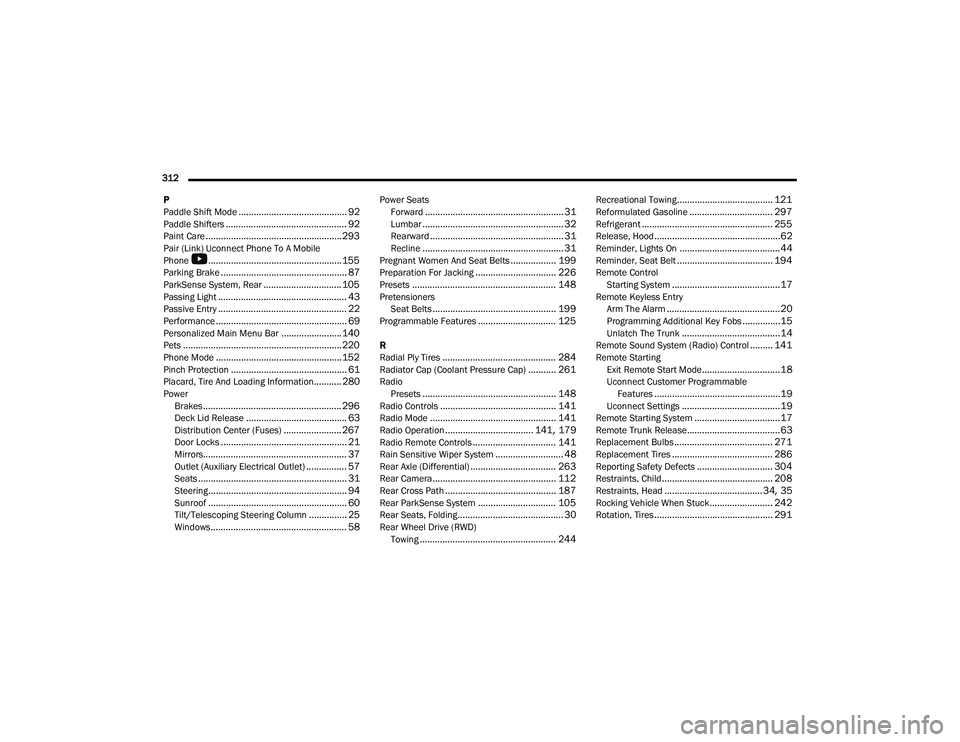
Paddle Shift Mode
........................................... 92Paddle Shifters................................................ 92Paint Care...................................................... 293Pair (Link) Uconnect Phone To A Mobile
Phone
b
..................................................... 155Parking Brake.................................................. 87ParkSense System, Rear............................... 105Passing Light................................................... 43Passive Entry................................................... 22Performance.................................................... 69Personalized Main Menu Bar........................ 140Pets............................................................... 220Phone Mode.................................................. 152Pinch Protection.............................................. 61Placard, Tire And Loading Information........... 280Power Brakes....................................................... 296Deck Lid Release........................................ 63Distribution Center (Fuses)....................... 267Door Locks.................................................. 21Mirrors......................................................... 37Outlet (Auxiliary Electrical Outlet)................ 57Seats........................................................... 31Steering....................................................... 94Sunroof....................................................... 60Tilt/Telescoping Steering Column............... 25Windows...................................................... 58
Power SeatsForward....................................................... 31Lumbar........................................................ 32Rearward..................................................... 31Recline........................................................ 31Pregnant Women And Seat Belts.................. 199Preparation For Jacking................................ 226Presets......................................................... 148PretensionersSeat Belts................................................. 199Programmable Features............................... 125
R
Radial Ply Tires............................................. 284Radiator Cap (Coolant Pressure Cap)........... 261RadioPresets..................................................... 148Radio Controls.............................................. 141Radio Mode.................................................. 141Radio Operation................................... 141, 179Radio Remote Controls................................. 141Rain Sensitive Wiper System........................... 48Rear Axle (Differential).................................. 263Rear Camera................................................. 112Rear Cross Path............................................ 187Rear ParkSense System............................... 105Rear Seats, Folding.......................................... 30Rear Wheel Drive (RWD)Towing...................................................... 244
Recreational Towing...................................... 121Reformulated Gasoline................................. 297Refrigerant.................................................... 255Release, Hood..................................................62Reminder, Lights On........................................44Reminder, Seat Belt...................................... 194Remote ControlStarting System...........................................17Remote Keyless EntryArm The Alarm.............................................20Programming Additional Key Fobs...............15Unlatch The Trunk.......................................14Remote Sound System (Radio) Control......... 141Remote StartingExit Remote Start Mode...............................18Uconnect Customer Programmable Features..................................................19Uconnect Settings.......................................19Remote Starting System..................................17Remote Trunk Release.....................................63Replacement Bulbs....................................... 271Replacement Tires........................................ 286Reporting Safety Defects.............................. 304Restraints, Child............................................ 208Restraints, Head.......................................34, 35Rocking Vehicle When Stuck......................... 242Rotation, Tires............................................... 291
21_LD_OM_EN_USC_t.book Page 312