reset DODGE CHARGER 2021 Owner's Manual
[x] Cancel search | Manufacturer: DODGE, Model Year: 2021, Model line: CHARGER, Model: DODGE CHARGER 2021Pages: 320, PDF Size: 20.61 MB
Page 149 of 320
MULTIMEDIA147
Preset Selection
A preset can be selected by pressing any of the
listed Presets, or by pushing the Enter/Browse
button on the Tune/Scroll knob to select the
currently highlighted Preset. When selected, the
Radio tunes to the station stored in the Preset.
Deleting A Preset
A preset can be deleted in the Presets Browse
screen by pressing the Trash Can icon for the
corresponding preset.
Favorites
Press the Favorites button on the Browse screen.
The Favorites menu provides a means to edit the
Favorites list and to configure the Alert Settings,
along with providing a list of Channels currently
airing any of the items in the Favorites list.
You can scroll the Favorites list by pressing the Up
and Down arrows located at the right side of the
screen. Scrolling can also be done by operating the
Tune/Scroll knob as well.
Remove Favorites
Press the Remove Favorites tab at the top of
the screen. Press the Delete All button on the
touchscreen to delete all of the Favorites or press
the Trash Can icon next to the Favorite to be
deleted. Alert Settings
Press the Alert Settings tab at the top of the
Favorites screen. The Alert Settings menu allows
you to choose from a visual alert or audible and
visual alert when one of your favorites is airing on
any of the SiriusXM® channels.
Game Zone
Press the Game Zone button, located at the left of
the Browse screen. This feature provides you with
the ability to select teams, edit the selection, and
set alerts.
On-Air
Press the On-Air tab at the top of the screen.
The On-Air list provides a list of Channels currently
airing any of the items in the Selections list, and
pressing any of the items in the list tunes the radio
to that channel.
Select Team — If Equipped
Press the Select Team button on the touchscreen
to activate the League Scroll list. Press the chosen
league and a scroll list of all teams within the
league will appear, then you can select a team by
pressing the corresponding box. A check mark
appears for all teams that are chosen.
Remove Selection/Trash Can Icon
Press the Remove Selection tab at the top of
the screen. Press the Delete All button on the
touchscreen to delete all of the selections or press
the Trash Can icon next to the selection to be
deleted.
Alert Settings
Press the Alert Setting tab at the top of the screen.
The Alert Settings menu allows you to choose from
“Alert me to on-air games upon start” or “Alert
upon score update” or both when one or more of
your selections is airing on any of the SiriusXM®
channels.
Tune Start
Tune Start begins playing the current song from
the beginning when you tune to a music channel
using one of the 12 presets. This feature occurs
the first time the preset is selected during that
current song.
5
21_LD_OM_EN_USC_t.book Page 147
Page 150 of 320
148MULTIMEDIA
Setting Presets
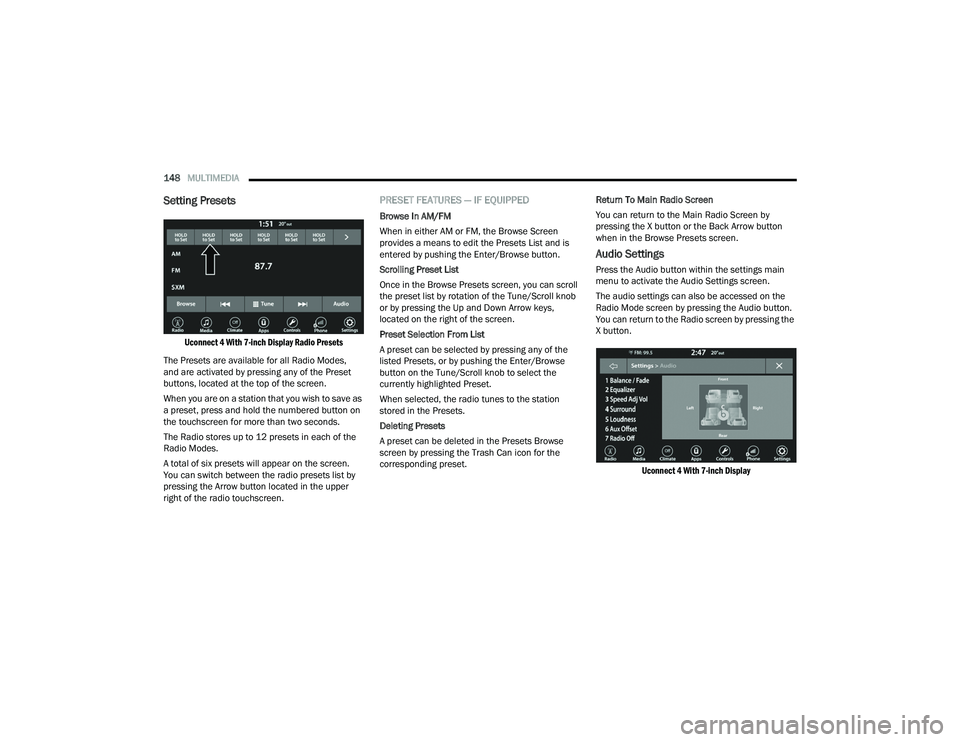
Uconnect 4 With 7-inch Display Radio Presets
The Presets are available for all Radio Modes,
and are activated by pressing any of the Preset
buttons, located at the top of the screen.
When you are on a station that you wish to save as
a preset, press and hold the numbered button on
the touchscreen for more than two seconds.
The Radio stores up to 12 presets in each of the
Radio Modes.
A total of six presets will appear on the screen.
You can switch between the radio presets list by
pressing the Arrow button located in the upper
right of the radio touchscreen.
PRESET FEATURES — IF EQUIPPED
Browse In AM/FM
When in either AM or FM, the Browse Screen
provides a means to edit the Presets List and is
entered by pushing the Enter/Browse button.
Scrolling Preset List
Once in the Browse Presets screen, you can scroll
the preset list by rotation of the Tune/Scroll knob
or by pressing the Up and Down Arrow keys,
located on the right of the screen.
Preset Selection From List
A preset can be selected by pressing any of the
listed Presets, or by pushing the Enter/Browse
button on the Tune/Scroll knob to select the
currently highlighted Preset.
When selected, the radio tunes to the station
stored in the Presets.
Deleting Presets
A preset can be deleted in the Presets Browse
screen by pressing the Trash Can icon for the
corresponding preset. Return To Main Radio Screen
You can return to the Main Radio Screen by
pressing the X button or the Back Arrow button
when in the Browse Presets screen.
Audio Settings
Press the Audio button within the settings main
menu to activate the Audio Settings screen.
The audio settings can also be accessed on the
Radio Mode screen by pressing the Audio button.
You can return to the Radio screen by pressing the
X button.
Uconnect 4 With 7-inch Display
21_LD_OM_EN_USC_t.book Page 148
Page 175 of 320
MULTIMEDIA173
G-FORCE
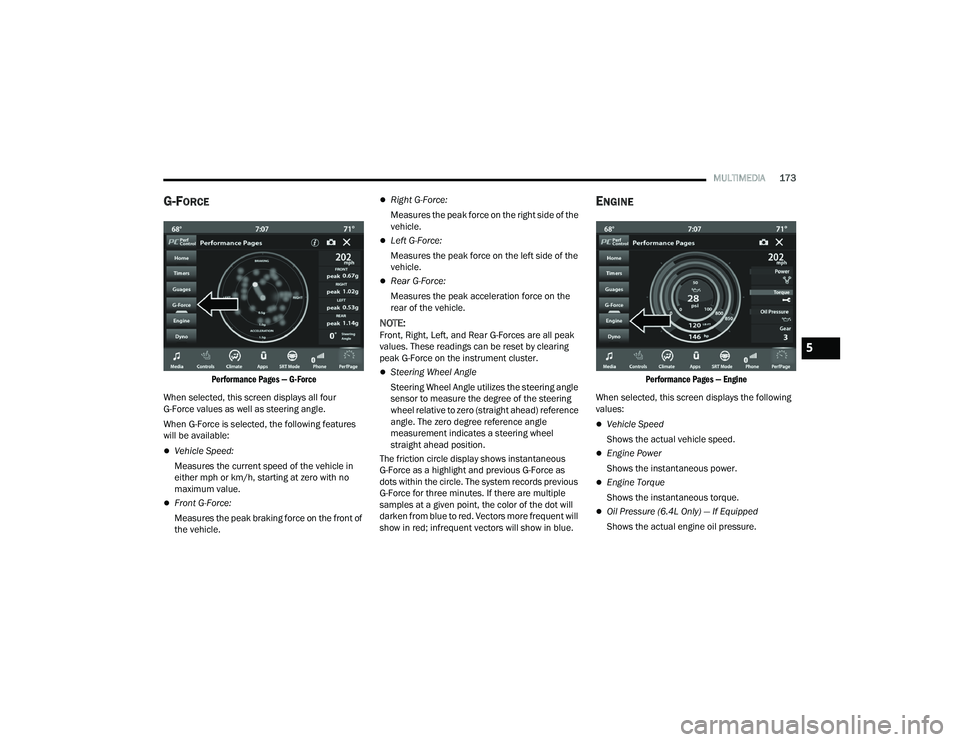
Performance Pages — G-Force
When selected, this screen displays all four
G-Force values as well as steering angle.
When G-Force is selected, the following features
will be available:
Vehicle Speed:
Measures the current speed of the vehicle in
either mph or km/h, starting at zero with no
maximum value.
Front G-Force:
Measures the peak braking force on the front of
the vehicle.
Right G-Force:
Measures the peak force on the right side of the
vehicle.
Left G-Force:
Measures the peak force on the left side of the
vehicle.
Rear G-Force:
Measures the peak acceleration force on the
rear of the vehicle.
NOTE:Front, Right, Left, and Rear G-Forces are all peak
values. These readings can be reset by clearing
peak G-Force on the instrument cluster.
Steering Wheel Angle
Steering Wheel Angle utilizes the steering angle
sensor to measure the degree of the steering
wheel relative to zero (straight ahead) reference
angle. The zero degree reference angle
measurement indicates a steering wheel
straight ahead position.
The friction circle display shows instantaneous
G-Force as a highlight and previous G-Force as
dots within the circle. The system records previous
G-Force for three minutes. If there are multiple
samples at a given point, the color of the dot will
darken from blue to red. Vectors more frequent will
show in red; infrequent vectors will show in blue.
ENGINE
Performance Pages — Engine
When selected, this screen displays the following
values:
Vehicle Speed
Shows the actual vehicle speed.
Engine Power
Shows the instantaneous power.
Engine Torque
Shows the instantaneous torque.
Oil Pressure (6.4L Only) — If Equipped
Shows the actual engine oil pressure.
5
21_LD_OM_EN_USC_t.book Page 173
Page 181 of 320
MULTIMEDIA179
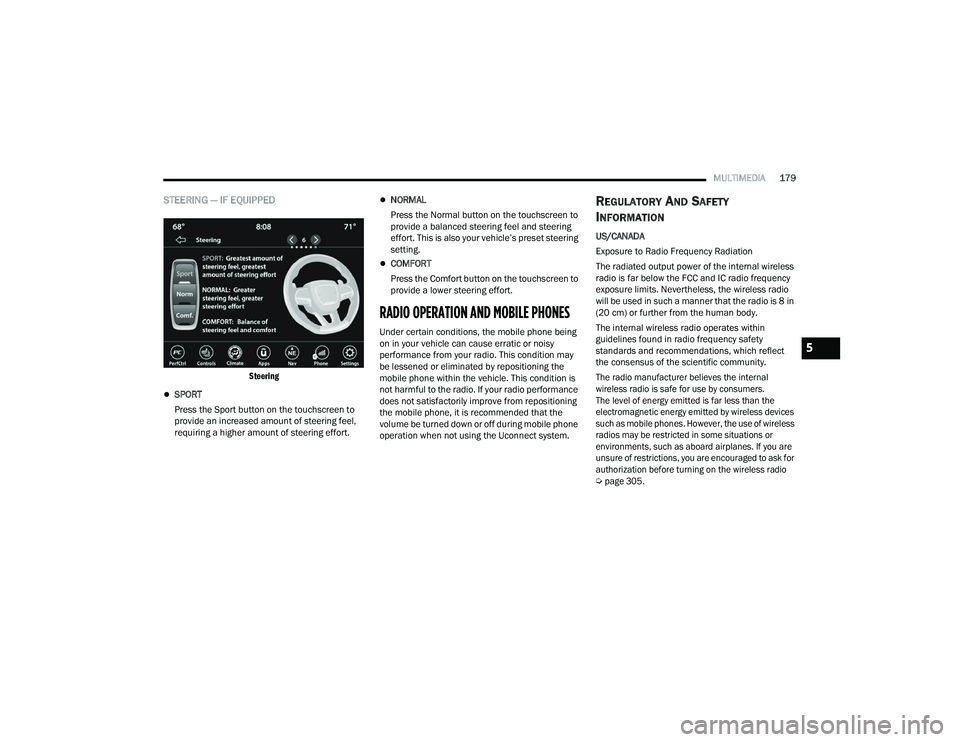
STEERING — IF EQUIPPED
Steering
SPORT
Press the Sport button on the touchscreen to
provide an increased amount of steering feel,
requiring a higher amount of steering effort.
NORMAL
Press the Normal button on the touchscreen to
provide a balanced steering feel and steering
effort. This is also your vehicle’s preset steering
setting.
COMFORT
Press the Comfort button on the touchscreen to
provide a lower steering effort.
RADIO OPERATION AND MOBILE PHONES
Under certain conditions, the mobile phone being
on in your vehicle can cause erratic or noisy
performance from your radio. This condition may
be lessened or eliminated by repositioning the
mobile phone within the vehicle. This condition is
not harmful to the radio. If your radio performance
does not satisfactorily improve from repositioning
the mobile phone, it is recommended that the
volume be turned down or off during mobile phone
operation when not using the Uconnect system.
REGULATORY AND SAFETY
I
NFORMATION
US/CANADA
Exposure to Radio Frequency Radiation
The radiated output power of the internal wireless
radio is far below the FCC and IC radio frequency
exposure limits. Nevertheless, the wireless radio
will be used in such a manner that the radio is 8 in
(20 cm) or further from the human body.
The internal wireless radio operates within
guidelines found in radio frequency safety
standards and recommendations, which reflect
the consensus of the scientific community.
The radio manufacturer believes the internal
wireless radio is safe for use by consumers.
The level of energy emitted is far less than the
electromagnetic energy emitted by wireless devices
such as mobile phones. However, the use of wireless
radios may be restricted in some situations or
environments, such as aboard airplanes. If you are
unsure of restrictions, you are encouraged to ask for
authorization before turning on the wireless radio
Ú
page 305.
5
21_LD_OM_EN_USC_t.book Page 179
Page 209 of 320
SAFETY207
(Continued)
Enhanced Accident Response System
In the event of an impact, if the communication
network remains intact, and the power remains
intact, depending on the nature of the event, the
Occupant Restraint Controller (ORC) will determine
whether to have the Enhanced Accident Response
System perform the following functions:
Cut off fuel to the engine (if equipped).
Cut off battery power to the electric motor
(if equipped).
Flash hazard lights as long as the battery has
power.
Turn on the interior lights, which remain on as
long as the battery has power or for 15 minutes
from the intervention of the Enhanced Accident
Response System.
Unlock the power door locks.
Your vehicle may also be designed to perform any
of these other functions in response to the
Enhanced Accident Response System:
Turn off the Fuel Filter Heater, Turn off the HVAC
Blower Motor, Close the HVAC Circulation Door
Cut off battery power to the:
Engine
Electric Motor (if equipped)
Electric power steering
Brake booster
Electric park brake
Automatic transmission gear selector
Horn
Front wiper
Headlamp washer pump
NOTE:
After an accident, remember to cycle the ignition to
the STOP (OFF/LOCK) position and remove the key
from the ignition switch to avoid draining the battery.
Carefully check the vehicle for fuel leaks in the
engine compartment and on the ground near the
engine compartment and fuel tank before resetting
the system and starting the engine. If there are no
fuel leaks or damage to the vehicle electrical devices
(e.g. headlights) after an accident, reset the system
by following the procedure described below. If you
have any doubt, contact an authorized dealer.
Enhanced Accident Response System
Reset Procedure
In order to reset the Enhanced Accident Response
System functions after an event, the ignition switch
must be changed from ignition START or ON/RUN to
ignition OFF. Carefully check the vehicle for fuel leaks in
the engine compartment and on the ground near the
engine compartment and fuel tank before resetting the
system and starting the engine. After an accident, if the vehicle will not start after
performing the reset procedure, the vehicle must be
towed to an authorized dealer to be inspected and to
have the Enhanced Accident Response System reset.
Maintaining Your Air Bag System
WARNING!
Modifications to any part of the air bag system
could cause it to fail when you need it. You
could be injured if the air bag system is not
there to protect you. Do not modify the compo
-
nents or wiring, including adding any kind of
badges or stickers to the steering wheel hub
trim cover or the upper passenger side of the
instrument panel. Do not modify the front
fascia/bumper, vehicle body structure, or add
aftermarket side steps or running boards.
It is dangerous to try to repair any part of the
air bag system yourself. Be sure to tell anyone
who works on your vehicle that it has an air
bag system.
6
21_LD_OM_EN_USC_t.book Page 207
Page 243 of 320
IN CASE OF EMERGENCY241
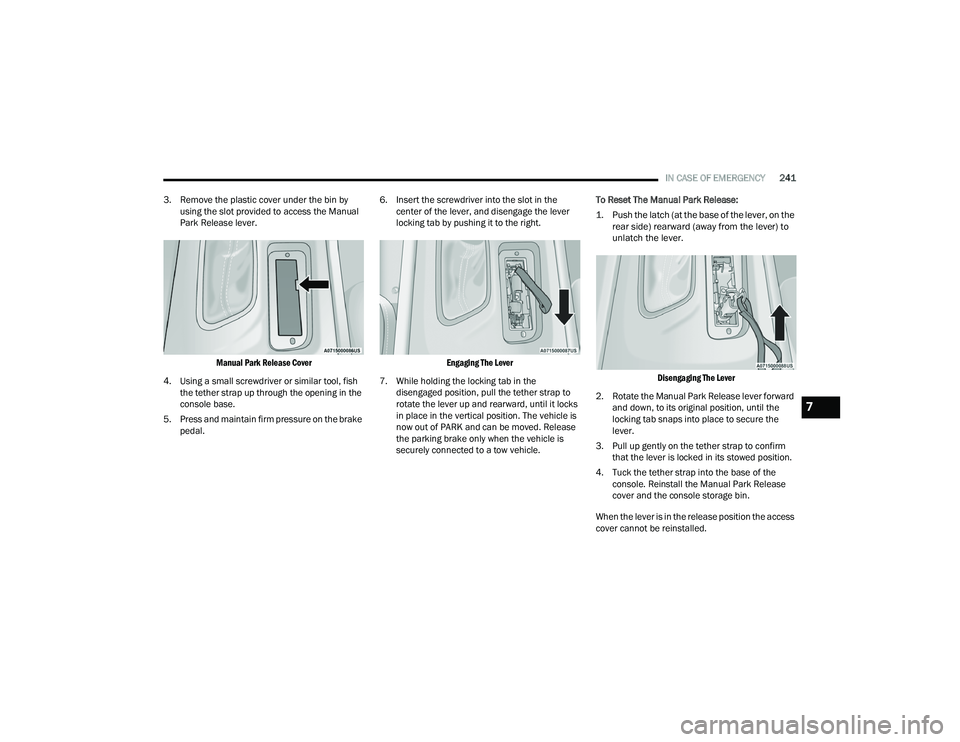
3. Remove the plastic cover under the bin by using the slot provided to access the Manual
Park Release lever.
Manual Park Release Cover
4. Using a small screwdriver or similar tool, fish the tether strap up through the opening in the
console base.
5. Press and maintain firm pressure on the brake pedal. 6. Insert the screwdriver into the slot in the
center of the lever, and disengage the lever
locking tab by pushing it to the right.
Engaging The Lever
7. While holding the locking tab in the disengaged position, pull the tether strap to
rotate the lever up and rearward, until it locks
in place in the vertical position. The vehicle is
now out of PARK and can be moved. Release
the parking brake only when the vehicle is
securely connected to a tow vehicle. To Reset The Manual Park Release:
1. Push the latch (at the base of the lever, on the
rear side) rearward (away from the lever) to
unlatch the lever.
Disengaging The Lever
2. Rotate the Manual Park Release lever forward and down, to its original position, until the
locking tab snaps into place to secure the
lever.
3. Pull up gently on the tether strap to confirm that the lever is locked in its stowed position.
4. Tuck the tether strap into the base of the console. Reinstall the Manual Park Release
cover and the console storage bin.
When the lever is in the release position the access
cover cannot be reinstalled.
7
21_LD_OM_EN_USC_t.book Page 241
Page 247 of 320
245
SERVICING AND MAINTENANCE
SCHEDULED SERVICING
3.6L AND 5.7L ENGINES
These vehicles are equipped with an automatic oil
change indicator system. The oil change indicator
system will remind you that it is time to take your
vehicle in for scheduled maintenance.
Based on engine operation conditions, the
oil change indicator message will illuminate.
This means that service is required for your
vehicle. Operating conditions such as frequent
short-trips, trailer tow, and extremely hot or cold
ambient temperatures will influence when the
“Change Oil” or “Oil Change Required” message is
displayed. Have your vehicle serviced as soon as
possible, within the next 500 miles (805 km).The “Oil Change Required” message will be
displayed in the instrument cluster and a single
chime will sound, indicating that an oil change is
necessary.
An authorized dealer will reset the oil change
indicator message after completing the scheduled
oil change. If a scheduled oil change is performed
by someone other than an authorized dealer, the
message can be reset by referring to “Instrument
Cluster Display” Ú
page 67.
NOTE:Under no circumstances should oil change
intervals exceed 10,000 miles (16,000 km),
12 months or 350 hours of engine run time,
whichever comes first. The 350 hours of engine
run or idle time is generally only a concern for fleet
customers. Once A Month Or Before A Long Trip:
Check engine oil level.
Check windshield washer fluid level.
Check tire pressure and look for unusual wear
or damage. Rotate tires at the first sign of irreg
-
ular wear, even if it occurs before your next
scheduled service.
Check the fluid levels of the coolant reservoir,
brake master cylinder, and power steering
(if equipped) and fill as needed.
Check function of all interior and exterior lights.
8
21_LD_OM_EN_USC_t.book Page 245
Page 265 of 320

SERVICING AND MAINTENANCE263
AUTOMATIC TRANSMISSION
Special Additives
The manufacturer strongly recommends against
using any special additives in the transmission.
Automatic Transmission Fluid (ATF) is an engineered
product and its performance may be impaired by
supplemental additives. Therefore, do not add any
fluid additives to the transmission. Avoid using
transmission sealers as they may adversely
affect seals.
Fluid Level Check
The fluid level is preset at the factory and does
not require adjustment under normal operating
conditions. Routine fluid level checks are not
required; therefore the transmission has no dipstick.
An authorized dealer can check your transmission
fluid level using special service tools. If you notice
fluid leakage or transmission malfunction, visit
an authorized dealer immediately to have the
transmission fluid level checked. Operating the
vehicle with an improper fluid level can cause
severe transmission damage.
Fluid And Filter Changes — Eight-Speed
Transmission
Under normal operating conditions, the fluid
installed at the factory will provide satisfactory
lubrication for the life of the vehicle.
Routine fluid and filter changes are not required.
However, change the fluid and filter if the fluid
becomes contaminated (with water, etc.), or if the
transmission is disassembled for any reason.
Selection Of Lubricant
It is important to use the proper transmission fluid
to ensure optimum transmission performance
and life. Use only the manufacturer's specified
transmission fluid Úpage 300. It is important to
maintain the transmission fluid at the correct level
using the recommended fluid.
NOTE:
No chemical flushes should be used in any trans -
mission; only the approved lubricant should be used.
REAR AXLE
For normal service, periodic fluid level checks are
not required. When the vehicle is serviced for other
reasons the exterior surfaces of the axle assembly
should be inspected. If gear oil leakage is
suspected inspect the fluid level Ú page 300.
Overfilling the brake fluid reservoir can result in
spilling brake fluid on hot engine parts, causing
the brake fluid to catch fire. Brake fluid can also
damage painted and vinyl surfaces, care should
be taken to avoid its contact with these surfaces.
Do not allow petroleum based fluid to contaminate
the brake fluid. Brake seal components could be
damaged, causing partial or complete brake
failure. This could result in a collision.
CAUTION!
Do not use chemical flushes in your
transmission as the chemicals can damage your
transmission components. Such damage is not
covered by the New Vehicle Limited Warranty.
WARNING!
CAUTION!
If a transmission fluid leak occurs, visit an
authorized dealer immediately. Severe transmission
damage may occur. An authorized dealer has the
proper tools to adjust the fluid level accurately.
CAUTION!
Using a transmission fluid other than the
manufacturer’s recommended fluid may cause
deterioration in transmission shift quality and/or
torque converter shudder Úpage 300.
8
21_LD_OM_EN_USC_t.book Page 263
Page 310 of 320
308 Pressure Cap
............................................. 261Radiator Cap............................................. 261Selection Of Coolant (Antifreeze)........................ 260, 299, 300Corrosion Protection...................................... 293Cruise Control (Speed Control)................. 95, 96Cruise Light..................................................... 80Customer Assistance..................................... 302Customer Programmable Features................125Cybersecurity................................................. 124
D
Daytime Running Lights................................... 42Deck LidPower Release............................................ 63Defroster, Windshield.................................... 220De-Icer, Remote Start...................................... 19Deleting A Phone........................................... 157Diagnostic System, Onboard........................... 81Dimmer SwitchHeadlight..................................................... 43DipsticksOil (Engine)................................................ 251Disabled Vehicle Towing................................ 243Disc Drive...................................................... 150Disconnecting................................................ 157DisposalAntifreeze (Engine Coolant)....................... 261Disturb........................................................... 159Door Ajar.......................................................... 75
Door Ajar Light................................................. 75Door LocksAutomatic.................................................... 24Child-Protection Door Lock — Rear Doors.... 24Doors............................................................... 21Drag & Drop.................................................. 140Drive Modes.................................................. 174Driver Memory Presets................................. 148Driver’s Seat Back Tilt...................................... 29DrivingThrough Flowing, Rising, Or Shallow Standing Water
.................................... 122
E
Electric Brake Control System....................... 181Anti-Lock Brake System............................ 180Electronic Roll Mitigation................. 181, 185Electric Remote Mirrors................................... 37Electronic Power Distribution
Center (Fuses).............................................. 264Electronic Speed Control (Cruise Control)........ 95Electronic Stability Control (ESC).................. 182Electronic Throttle Control Warning Light......... 75Emergency Gas Can Refueling...................... 238Emergency, In Case OfFreeing Vehicle When Stuck..................... 242Hazard Warning Flasher........................... 223Jacking..................................................... 226Jump Starting.................................. 236, 237Towing...................................................... 243
Emission Control System Maintenance............82Engine.................................................. 249, 250Air Cleaner................................................ 254Block Heater................................................86Break-In Recommendations........................86Checking Oil Level.................................... 251Compartment.................................. 249, 250Compartment Identification...................... 249Coolant (Antifreeze)......................... 260, 300Cooling...................................................... 259Exhaust Gas Caution................................ 222Fails To Start................................................85Flooded, Starting.........................................85Fuel Requirements.......................... 297, 299Jump Starting.................................. 236, 237Oil...........................................253, 299, 300Oil Filler Cap............................................. 249Oil Filter.................................................... 254Oil Selection..................................... 253, 299Oil Synthetic.............................................. 253Overheating.............................................. 239Starting........................................................83Enhanced Accident Response
Feature................................................ 207, 244Ethanol.......................................................... 298Exhaust Gas Cautions................................... 222Exhaust System................................... 222, 258Exterior Lighting...............................................41Exterior Lights........................................ 41, 222
21_LD_OM_EN_USC_t.book Page 308
Page 313 of 320
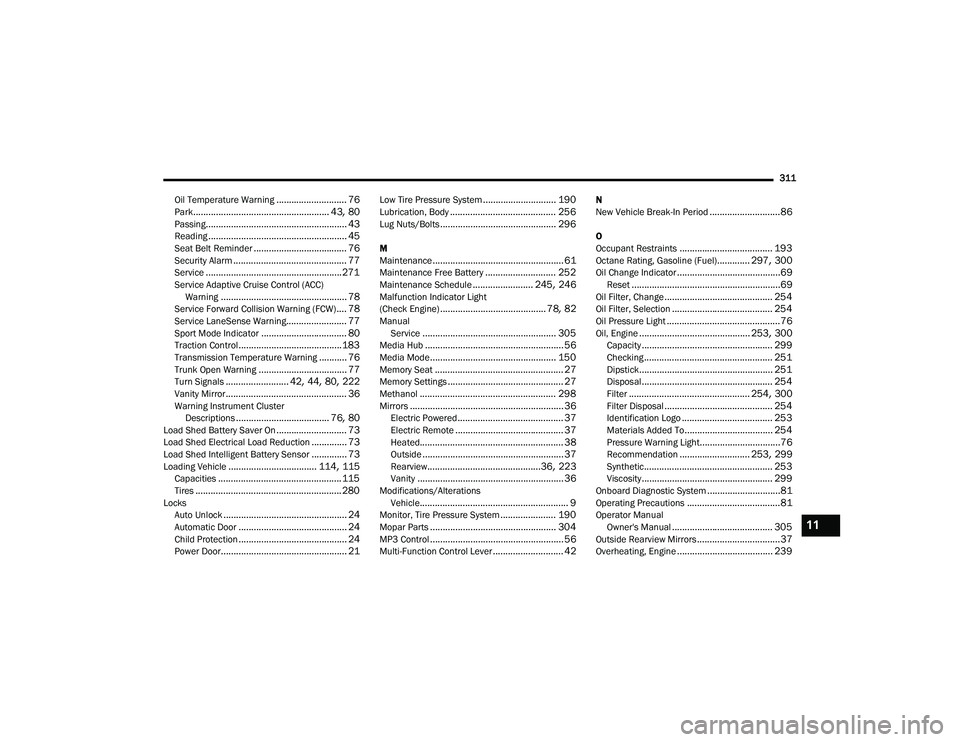
311
Oil Temperature Warning
............................ 76Park...................................................... 43, 80Passing........................................................ 43Reading....................................................... 45Seat Belt Reminder..................................... 76Security Alarm............................................. 77Service...................................................... 271Service Adaptive Cruise Control (ACC) Warning.................................................. 78Service Forward Collision Warning (FCW).... 78Service LaneSense Warning........................ 77Sport Mode Indicator.................................. 80Traction Control......................................... 183Transmission Temperature Warning........... 76Trunk Open Warning................................... 77Turn Signals......................... 42, 44, 80, 222Vanity Mirror................................................ 36Warning Instrument Cluster Descriptions..................................... 76, 80Load Shed Battery Saver On............................ 73Load Shed Electrical Load Reduction.............. 73Load Shed Intelligent Battery Sensor.............. 73Loading Vehicle................................... 114, 115Capacities................................................. 115Tires.......................................................... 280LocksAuto Unlock................................................. 24Automatic Door........................................... 24Child Protection........................................... 24Power Door.................................................. 21
Low Tire Pressure System............................. 190Lubrication, Body.......................................... 256Lug Nuts/Bolts.............................................. 296
M
Maintenance.................................................... 61Maintenance Free Battery............................ 252Maintenance Schedule........................ 245, 246Malfunction Indicator Light
(Check Engine).......................................... 78, 82ManualService..................................................... 305Media Hub....................................................... 56Media Mode.................................................. 150Memory Seat................................................... 27Memory Settings.............................................. 27Methanol...................................................... 298Mirrors............................................................. 36Electric Powered.......................................... 37Electric Remote........................................... 37Heated......................................................... 38Outside........................................................ 37Rearview.............................................36, 223Vanity.......................................................... 36Modifications/AlterationsVehicle........................................................... 9Monitor, Tire Pressure System...................... 190Mopar Parts.................................................. 304MP3 Control..................................................... 56Multi-Function Control Lever............................ 42
N
New Vehicle Break-In Period............................86
O
Occupant Restraints..................................... 193Octane Rating, Gasoline (Fuel)............. 297, 300Oil Change Indicator.........................................69Reset...........................................................69Oil Filter, Change........................................... 254Oil Filter, Selection........................................ 254Oil Pressure Light.............................................76Oil, Engine............................................ 253, 300Capacity.................................................... 299Checking................................................... 251Dipstick..................................................... 251Disposal.................................................... 254Filter................................................ 254, 300Filter Disposal........................................... 254Identification Logo.................................... 253Materials Added To................................... 254Pressure Warning Light................................76Recommendation............................ 253, 299Synthetic................................................... 253Viscosity.................................................... 299Onboard Diagnostic System.............................81Operating Precautions.....................................81Operator ManualOwner's Manual........................................ 305Outside Rearview Mirrors.................................37Overheating, Engine...................................... 239
11
21_LD_OM_EN_USC_t.book Page 311