service indicator DODGE CHARGER 2022 User Guide
[x] Cancel search | Manufacturer: DODGE, Model Year: 2022, Model line: CHARGER, Model: DODGE CHARGER 2022Pages: 312, PDF Size: 18.99 MB
Page 116 of 312
114STARTING AND OPERATING
VEHICLE LOADING
The load carrying capacity of your vehicle is shown
on the Vehicle Certification Label. This information
should be used for passenger and luggage loading
as indicated.
Do not exceed the specified Gross Vehicle Weight
Rating (GVWR) or the Gross Axle Weight Rating
(GAWR).
VEHICLE CERTIFICATION LABEL
Your vehicle has a Vehicle Certification Label
affixed to the driver’s side B-pillar or the rear of the
driver’s door.
The label contains the following information:
Name of manufacturer.
Month and year of manufacture.
Gross Vehicle Weight Rating (GVWR).
Gross Axle Weight Rating (GAWR) front.
Gross Axle Weight Rating (GAWR) rear.
Vehicle Identification Number (VIN).
Type of vehicle.
Month, Day, and Hour (MDH) of manufacture.
The bar code allows a computer scanner to read
the VIN.
GROSS VEHICLE WEIGHT RATING
(GVWR)
The GVWR is the total allowable weight of your
vehicle. This includes driver, passengers, and
cargo. The total load must be limited so that you do
not exceed the GVWR.
GROSS AXLE WEIGHT RATING (GAWR)
The GAWR is the maximum capacity of the front
and rear axles. Distribute the load over the front
and rear axles evenly. Make sure that you do not
exceed either front or rear GAWR.
OVERLOADING
The load carrying components (axle, springs, tires,
wheels, etc.) of your vehicle will provide
satisfactory service as long as you do not exceed
the GVWR and the front and rear GAWR.
The best way to figure out the total weight of your
vehicle is to weigh it when it is fully loaded and
ready for operation. Weigh it on a commercial scale
to ensure that it is not over the GVWR.
Figure out the weight on the front and rear of the
vehicle separately. It is important that you
distribute the load evenly over the front and rear
axles.
Never add fuel when the engine is running.
This is in violation of most state and federal
fire regulations and may cause the Malfunc -
tion Indicator Light to turn on.
A fire may result if fuel is pumped into a
portable container that is inside of a vehicle.
You could be burned. Always place fuel
containers on the ground while filling.
CAUTION!
To avoid fuel spillage and overfilling, do not “top
off” the fuel tank after filling.
WARNING!
WARNING!
Because the front wheels steer the vehicle, it is
important that you do not exceed the maximum
front or rear GAWR. A dangerous driving
condition can result if either rating is exceeded.
You could lose control of the vehicle and have a
collision.
22_LD_OM_EN_USC_t.book Page 114
Page 230 of 312
228IN CASE OF EMERGENCY
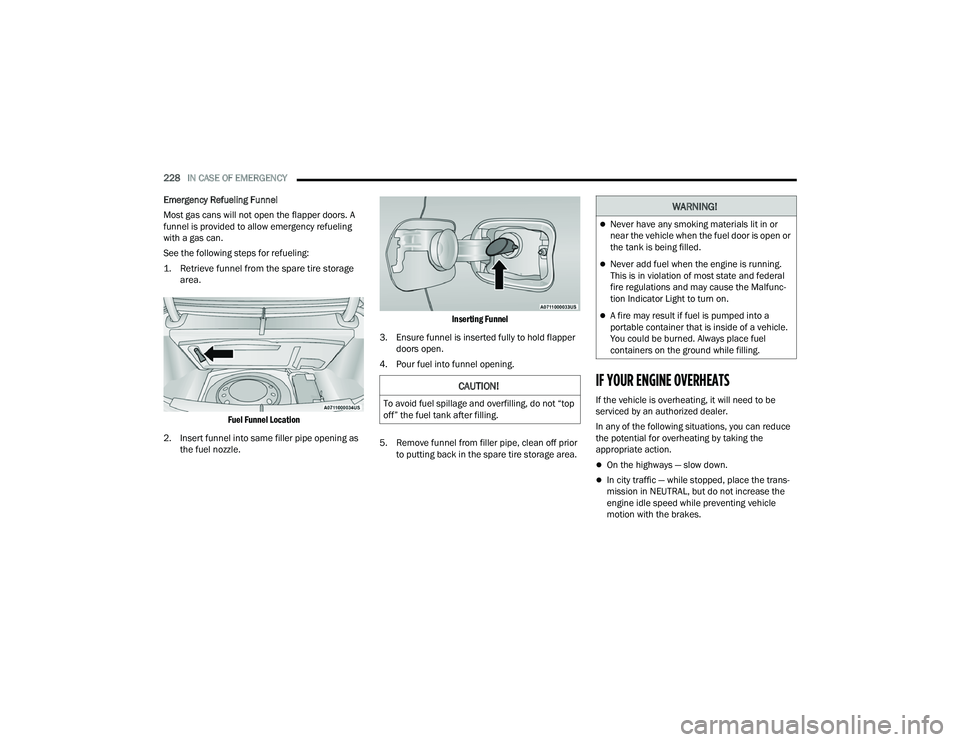
Emergency Refueling Funnel
Most gas cans will not open the flapper doors. A
funnel is provided to allow emergency refueling
with a gas can.
See the following steps for refueling:
1. Retrieve funnel from the spare tire storage area.
Fuel Funnel Location
2. Insert funnel into same filler pipe opening as the fuel nozzle.
Inserting Funnel
3. Ensure funnel is inserted fully to hold flapper doors open.
4. Pour fuel into funnel opening.
5. Remove funnel from filler pipe, clean off prior to putting back in the spare tire storage area.
IF YOUR ENGINE OVERHEATS
If the vehicle is overheating, it will need to be
serviced by an authorized dealer.
In any of the following situations, you can reduce
the potential for overheating by taking the
appropriate action.
On the highways — slow down.
In city traffic — while stopped, place the trans -
mission in NEUTRAL, but do not increase the
engine idle speed while preventing vehicle
motion with the brakes.
CAUTION!
To avoid fuel spillage and overfilling, do not “top
off” the fuel tank after filling.
WARNING!
Never have any smoking materials lit in or
near the vehicle when the fuel door is open or
the tank is being filled.
Never add fuel when the engine is running.
This is in violation of most state and federal
fire regulations and may cause the Malfunc -
tion Indicator Light to turn on.
A fire may result if fuel is pumped into a
portable container that is inside of a vehicle.
You could be burned. Always place fuel
containers on the ground while filling.
22_LD_OM_EN_USC_t.book Page 228
Page 236 of 312
234
SERVICING AND MAINTENANCE
SCHEDULED SERVICING
3.6L AND 5.7L ENGINES
These vehicles are equipped with an automatic oil
change indicator system. The oil change indicator
system will remind you that it is time to take your
vehicle in for scheduled maintenance.
Based on engine operation conditions, the oil
change indicator message will illuminate. This
means that service is required for your vehicle.
Operating conditions such as frequent short-trips,
trailer tow, and extremely hot or cold ambient
temperatures will influence when the “Change Oil”
or “Oil Change Required” message is displayed.
Have your vehicle serviced as soon as possible,
within the next 500 miles (805 km).
The “Oil Change Required” message will be
displayed in the instrument cluster and a single
chime will sound, indicating that an oil change is
necessary. An authorized dealer will reset the oil change
indicator message after completing the scheduled
oil change. If a scheduled oil change is performed
by someone other than an authorized dealer, the
message can be reset by referring to “Instrument
Cluster Display” Ú
page 69.
NOTE:Under no circumstances should oil change
intervals exceed 10,000 miles (16,000 km),
12 months or 350 hours of engine run time,
whichever comes first. The 350 hours of engine
run or idle time is generally only a concern for fleet
customers.
Once A Month Or Before A Long Trip:
Check engine oil level.
Check windshield washer fluid level.
Check tire pressure and look for unusual wear
or damage. Rotate tires at the first sign of irreg -
ular wear, even if it occurs before your next
scheduled service.
Check the fluid levels of the coolant reservoir,
brake master cylinder, and power steering (if
equipped) and fill as needed.
Check function of all interior and exterior lights.
Maintenance Plan — 3.6L And 5.7L
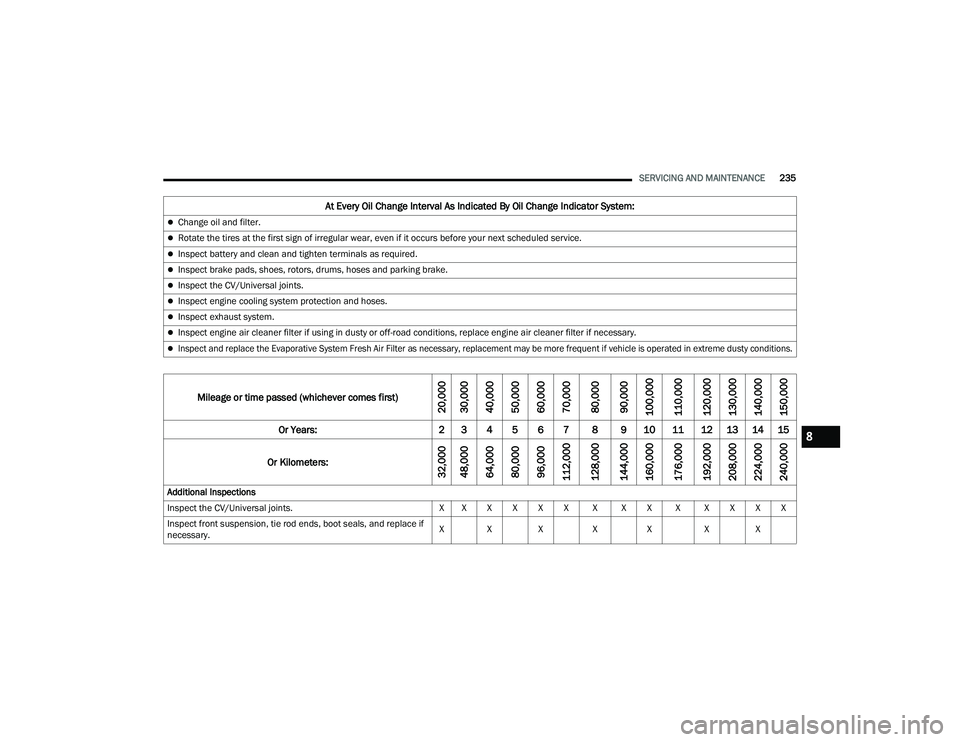
Required Maintenance Intervals:
Refer to the maintenance schedules on the
following page for the required maintenance
intervals. More frequent maintenance may be
needed in severe conditions, such as dusty areas
and very short trip driving. In some extreme
conditions, additional maintenance not specified
in the maintenance schedule may be required.
22_LD_OM_EN_USC_t.book Page 234
Page 237 of 312
SERVICING AND MAINTENANCE235
At Every Oil Change Interval As Indicated By Oil Change Indicator System:
Change oil and filter.
Rotate the tires at the first sign of irregular wear, even if it occurs before your next scheduled service.
Inspect battery and clean and tighten terminals as required.
Inspect brake pads, shoes, rotors, drums, hoses and parking brake.
Inspect the CV/Universal joints.
Inspect engine cooling system protection and hoses.
Inspect exhaust system.
Inspect engine air cleaner filter if using in dusty or off-road conditions, replace engine air cleaner filter if necessary.
Inspect and replace the Evaporative System Fresh Air Filter as necessary, replacement may be more frequent if vehicle is operated in extreme dusty conditions.
Mileage or time passed (whichever comes first)
20,000
30,000
40,000
50,000
60,000
70,000
80,000
90,000
100,000
110,000
120,000
130,000
140,000
150,000
Or Years: 2 3 4 5 6 7 8 9 10 11 12 13 14 15
Or Kilometers:
32,000
48,000
64,000
80,000
96,000
112,000
128,000
144,000
160,000
176,000
192,000
208,000
224,000
240,000
Additional Inspections
Inspect the CV/Universal joints. X X X X X X X X X X X X X X
Inspect front suspension, tie rod ends, boot seals, and replace if
necessary. X X X
XX X X
8
22_LD_OM_EN_USC_t.book Page 235
Page 244 of 312
242SERVICING AND MAINTENANCE
NOTE:Intentional tampering with emissions control
systems may void your warranty and could result in
civil penalties being assessed against you.
ENGINE OIL
Engine Oil Selection — 3.6L/5.7L Engines
Use only the manufacturer's recommended fluids
Úpage 291.
NOTE:
Hemi engines at times can tick right after startup
and then quiet down after approximately 30
seconds. This is normal and will not harm the
engine. This characteristic can be caused by short
drive cycles. For example, if the vehicle is started
then shut off after driving a short distance. Upon
restarting, you may experience a ticking sound.
Other causes could be if the vehicle is unused for an
extended period of time, incorrect oil, extended oil
changes or extended idling. If the engine continues
to tick or if the Malfunction Indicator Light (MIL)
comes on, see the nearest authorized dealer.
American Petroleum Institute (API)
Approved Engine Oil
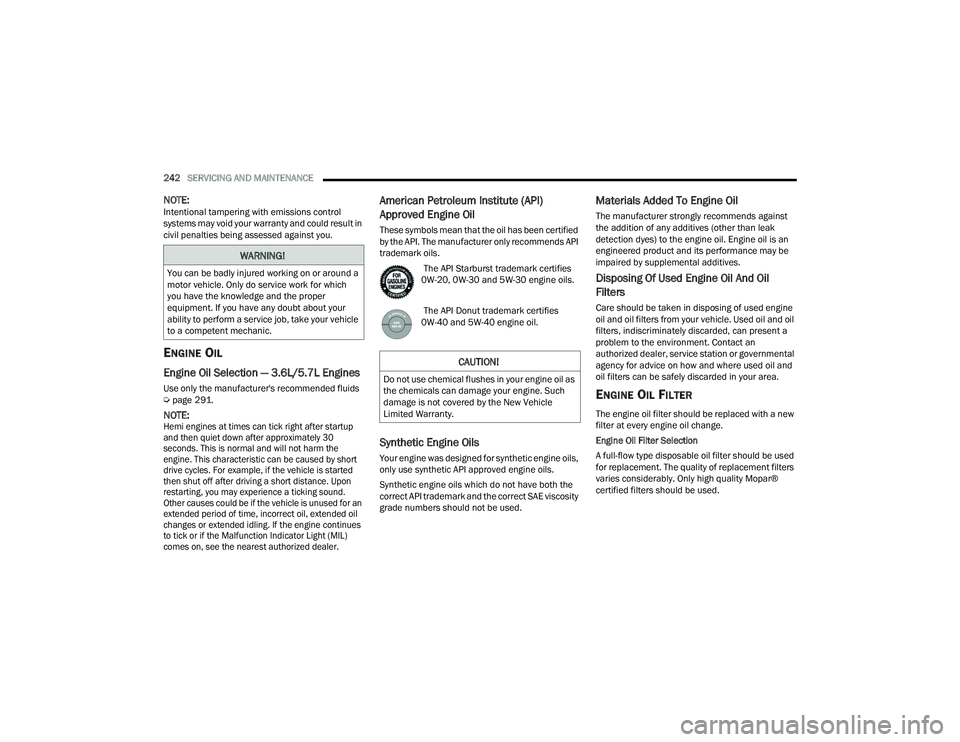
These symbols mean that the oil has been certified
by the API. The manufacturer only recommends API
trademark oils.
The API Starburst trademark certifies
0W-20, 0W-30 and 5W-30 engine oils.
The API Donut trademark certifies
0W-40 and 5W-40 engine oil.
Synthetic Engine Oils
Your engine was designed for synthetic engine oils,
only use synthetic API approved engine oils.
Synthetic engine oils which do not have both the
correct API trademark and the correct SAE viscosity
grade numbers should not be used.
Materials Added To Engine Oil
The manufacturer strongly recommends against
the addition of any additives (other than leak
detection dyes) to the engine oil. Engine oil is an
engineered product and its performance may be
impaired by supplemental additives.
Disposing Of Used Engine Oil And Oil
Filters
Care should be taken in disposing of used engine
oil and oil filters from your vehicle. Used oil and oil
filters, indiscriminately discarded, can present a
problem to the environment. Contact an
authorized dealer, service station or governmental
agency for advice on how and where used oil and
oil filters can be safely discarded in your area.
ENGINE OIL FILTER
The engine oil filter should be replaced with a new
filter at every engine oil change.
Engine Oil Filter Selection
A full-flow type disposable oil filter should be used
for replacement. The quality of replacement filters
varies considerably. Only high quality Mopar®
certified filters should be used.
WARNING!
You can be badly injured working on or around a
motor vehicle. Only do service work for which
you have the knowledge and the proper
equipment. If you have any doubt about your
ability to perform a service job, take your vehicle
to a competent mechanic.
CAUTION!
Do not use chemical flushes in your engine oil as
the chemicals can damage your engine. Such
damage is not covered by the New Vehicle
Limited Warranty.
22_LD_OM_EN_USC_t.book Page 242
Page 264 of 312
262SERVICING AND MAINTENANCE
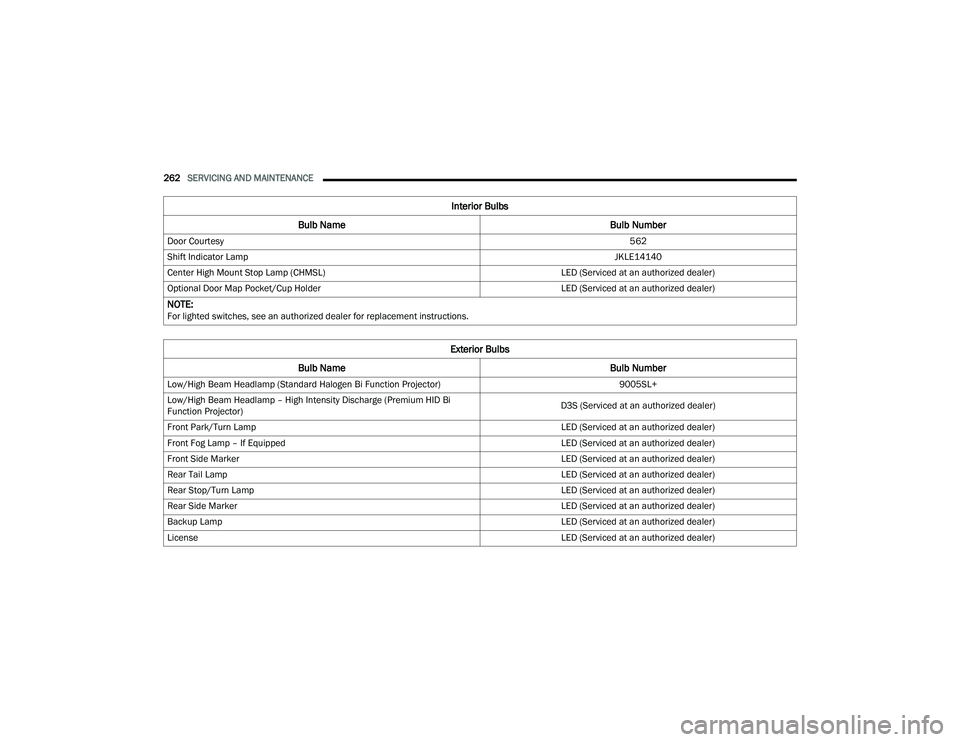
Door Courtesy 562
Shift Indicator Lamp JKLE14140
Center High Mount Stop Lamp (CHMSL) LED (Serviced at an authorized dealer)
Optional Door Map Pocket/Cup Holder LED (Serviced at an authorized dealer)
NOTE:For lighted switches, see an authorized dealer for replacement instructions.
Exterior Bulbs
Bulb Name Bulb Number
Low/High Beam Headlamp (Standard Halogen Bi Function Projector) 9005SL+
Low/High Beam Headlamp – High Intensity Discharge (Premium HID Bi
Function Projector) D3S (Serviced at an authorized dealer)
Front Park/Turn Lamp LED (Serviced at an authorized dealer)
Front Fog Lamp – If Equipped LED (Serviced at an authorized dealer)
Front Side Marker LED (Serviced at an authorized dealer)
Rear Tail Lamp LED (Serviced at an authorized dealer)
Rear Stop/Turn Lamp LED (Serviced at an authorized dealer)
Rear Side Marker LED (Serviced at an authorized dealer)
Backup Lamp LED (Serviced at an authorized dealer)
License LED (Serviced at an authorized dealer)
Interior Bulbs
Bulb Name Bulb Number
22_LD_OM_EN_USC_t.book Page 262
Page 277 of 312
SERVICING AND MAINTENANCE275
Run Flat Tires — If Equipped
Run Flat tires allow you the capability to drive
50 miles (80 km) at 50 mph (80 km/h) after a
rapid loss of inflation pressure. This rapid loss of
inflation is referred to as the Run Flat mode. A Run
Flat mode occurs when the tire inflation pressure is
of/or below 14 psi (96 kPa). Once a Run Flat tire
reaches the Run Flat mode it has limited driving
capabilities and needs to be replaced immediately.
A Run Flat tire is not repairable. When a Run Flat
tire is changed after driving with underinflated tire
condition, please replace the TPMS sensor as it is
not designed to be reused when driven under Run
Flat mode 14 psi (96 kPa) condition.
NOTE:TPMS Sensor must be replaced after driving the
vehicle on a flat tire condition.
It is not recommended driving a vehicle loaded at
full capacity or to tow a trailer while a tire is in the
Run Flat mode.
See the Tire Pressure Monitoring System section
for more information.
Tire Spinning
When stuck in mud, sand, snow, or ice conditions,
do not spin your vehicle's wheels above 30 mph
(48 km/h) or for longer than 30 seconds
continuously without stopping.
For further information Úpage 231.
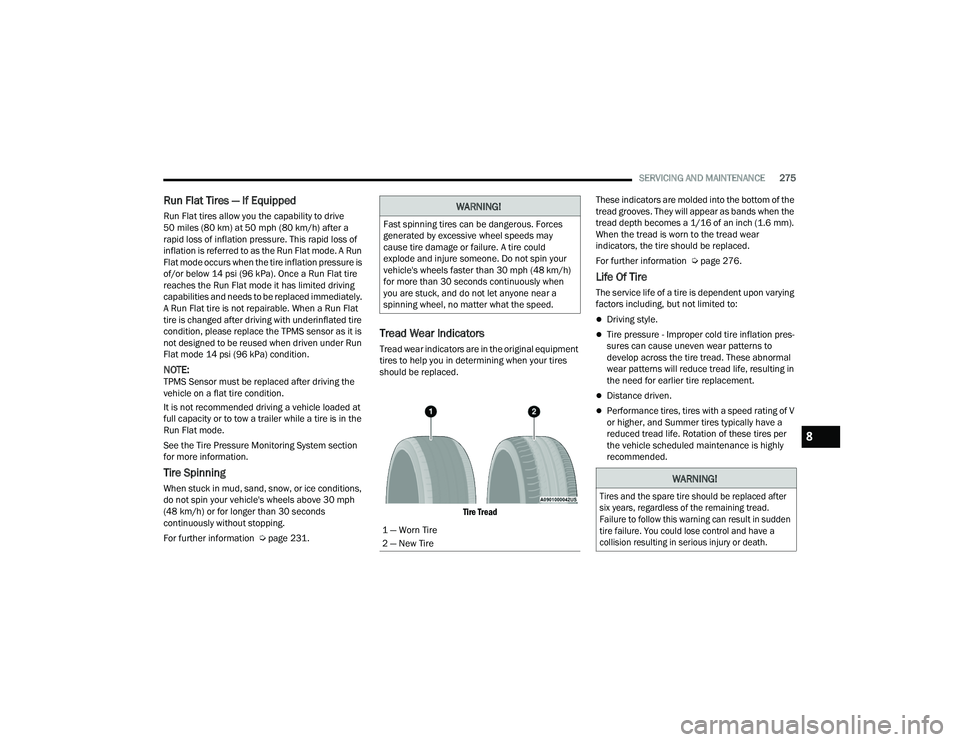
Tread Wear Indicators
Tread wear indicators are in the original equipment
tires to help you in determining when your tires
should be replaced.
Tire Tread
These indicators are molded into the bottom of the
tread grooves. They will appear as bands when the
tread depth becomes a 1/16 of an inch (1.6 mm).
When the tread is worn to the tread wear
indicators, the tire should be replaced.
For further information Ú
page 276.
Life Of Tire
The service life of a tire is dependent upon varying
factors including, but not limited to:
Driving style.
Tire pressure - Improper cold tire inflation pres -
sures can cause uneven wear patterns to
develop across the tire tread. These abnormal
wear patterns will reduce tread life, resulting in
the need for earlier tire replacement.
Distance driven.
Performance tires, tires with a speed rating of V
or higher, and Summer tires typically have a
reduced tread life. Rotation of these tires per
the vehicle scheduled maintenance is highly
recommended.
WARNING!
Fast spinning tires can be dangerous. Forces
generated by excessive wheel speeds may
cause tire damage or failure. A tire could
explode and injure someone. Do not spin your
vehicle's wheels faster than 30 mph (48 km/h)
for more than 30 seconds continuously when
you are stuck, and do not let anyone near a
spinning wheel, no matter what the speed.
1 — Worn Tire
2 — New Tire
WARNING!
Tires and the spare tire should be replaced after
six years, regardless of the remaining tread.
Failure to follow this warning can result in sudden
tire failure. You could lose control and have a
collision resulting in serious injury or death.
8
22_LD_OM_EN_USC_t.book Page 275
Page 300 of 312
298 AWD Towing
....................................................... 233Axle Fluid....................................................... 292Axle Lubrication............................................. 292
B
Back-Up......................................................... 112Battery.................................................... 76, 241Charging System Light................................. 76Keyless Key Fob Replacement.................... 14Location.................................................... 241Battery Saver Feature...................................... 47Belts, Seat..................................................... 210BluetoothConnecting To A Particular Mobile Phone Or Audio Device After Pairing
..................... 156Body Mechanism Lubrication........................ 245B-Pillar Location............................................. 270Brake Assist System...................................... 169Brake Control System.................................... 169Brake Fluid.......................................... 251, 292Brake System...................................... 251, 286Fluid Check..................................... 251, 292Master Cylinder......................................... 251Parking........................................................ 88Warning Light..................................... 76, 286
Brake/Transmission Interlock......................... 90Break-In Recommendations, New Vehicle....... 87Brightness, Interior Lights................................ 49Bulb Replacement........................................ 261Bulbs, Light.......................................... 211, 261
C
Camera, Rear................................................ 112Capacities, Fluid........................................... 290Caps, FillerOil (Engine)............................................... 238Radiator (Coolant Pressure)..................... 249Car Washes................................................... 283Carbon Monoxide Warning................... 211, 212CargoVehicle Loading........................................ 114CD................................................................. 150Certification Label......................................... 114Chains, Tire................................................... 280Chart, Tire Sizing........................................... 266Check Engine Light
(Malfunction Indicator Light)............................ 83Checking Your Vehicle For Safety................. 209Checks, Safety.............................................. 209Child Restraint.............................................. 198
Child RestraintsBooster Seats........................................... 200Child Seat Installation............................... 207How To Stow An unused ALR Seat Belt..... 205Infant And Child Restraints....................... 199Lower Anchors And Tethers For Children.. 202Older Children And Child Restraints.......... 200Seating Positions...................................... 201Child Safety Locks............................................26Clean Air Gasoline......................................... 288CleaningWheels...................................................... 279Climate Control................................................51Automatic....................................................51Manual........................................................53Coin Holder......................................................58Cold Weather Operation...................................87Compact Spare Tire...................................... 277ConsoleFloor............................................................58Contract, Service........................................... 294Controls........................................................ 142Cooling Pressure Cap (Radiator Cap)............ 249
22_LD_OM_EN_USC_t.book Page 298
Page 303 of 312
301
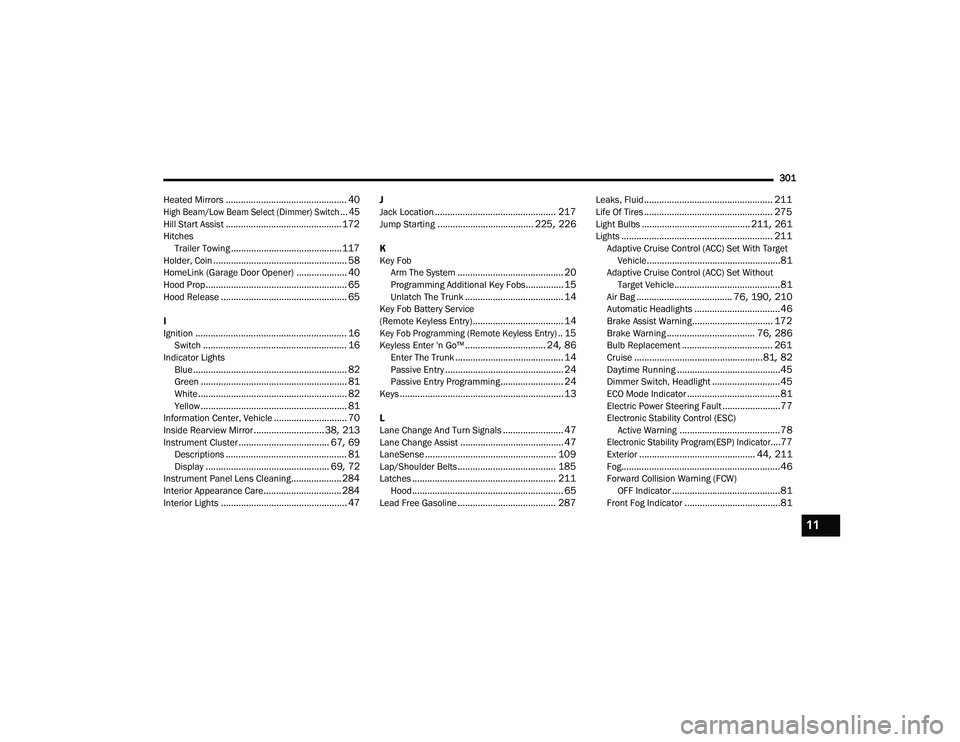
Heated Mirrors
................................................ 40
High Beam/Low Beam Select (Dimmer) Switch... 45
Hill Start Assist.............................................. 172Hitches Trailer Towing............................................ 117Holder, Coin..................................................... 58HomeLink (Garage Door Opener).................... 40Hood Prop........................................................ 65Hood Release.................................................. 65
I
Ignition............................................................ 16Switch......................................................... 16Indicator LightsBlue............................................................. 82Green.......................................................... 81White........................................................... 82Yellow.......................................................... 81Information Center, Vehicle............................. 70Inside Rearview Mirror............................ 38, 213Instrument Cluster.................................... 67, 69Descriptions................................................ 81Display................................................. 69, 72Instrument Panel Lens Cleaning.................... 284Interior Appearance Care............................... 284Interior Lights.................................................. 47
J
Jack Location................................................ 217Jump Starting...................................... 225, 226
K
Key FobArm The System
.......................................... 20Programming Additional Key Fobs............... 15Unlatch The Trunk....................................... 14Key Fob Battery Service
(Remote Keyless Entry).................................... 14
Key Fob Programming (Remote Keyless Entry).. 15
Keyless Enter 'n Go™................................ 24, 86Enter The Trunk........................................... 14Passive Entry............................................... 24Passive Entry Programming......................... 24Keys................................................................. 13
L
Lane Change And Turn Signals........................ 47Lane Change Assist......................................... 47LaneSense.................................................... 109Lap/Shoulder Belts....................................... 185Latches......................................................... 211Hood............................................................ 65Lead Free Gasoline....................................... 287
Leaks, Fluid................................................... 211Life Of Tires................................................... 275Light Bulbs........................................... 211, 261Lights............................................................ 211Adaptive Cruise Control (ACC) Set With Target Vehicle.....................................................81Adaptive Cruise Control (ACC) Set WithoutTarget Vehicle..........................................81Air Bag...................................... 76, 190, 210Automatic Headlights..................................46Brake Assist Warning................................ 172Brake Warning................................... 76, 286Bulb Replacement.................................... 261Cruise...................................................81, 82Daytime Running.........................................45Dimmer Switch, Headlight...........................45ECO Mode Indicator.....................................81Electric Power Steering Fault.......................77Electronic Stability Control (ESC)Active Warning........................................78
Electronic Stability Program(ESP) Indicator....77
Exterior.............................................. 44, 211Fog...............................................................46Forward Collision Warning (FCW) OFF Indicator...........................................81Front Fog Indicator......................................81
11
22_LD_OM_EN_USC_t.book Page 301
Page 304 of 312
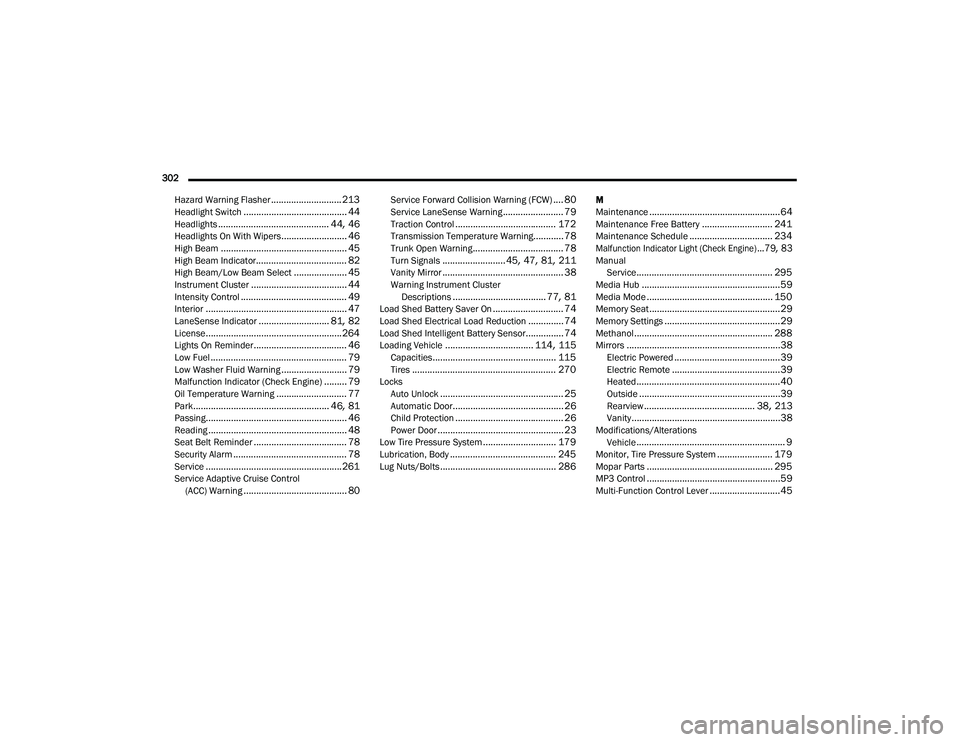
302 Hazard Warning Flasher
............................ 213Headlight Switch......................................... 44Headlights............................................ 44, 46Headlights On With Wipers.......................... 46High Beam.................................................. 45High Beam Indicator.................................... 82High Beam/Low Beam Select..................... 45Instrument Cluster...................................... 44Intensity Control.......................................... 49Interior........................................................ 47LaneSense Indicator............................ 81, 82License...................................................... 264Lights On Reminder..................................... 46Low Fuel...................................................... 79Low Washer Fluid Warning.......................... 79Malfunction Indicator (Check Engine)......... 79Oil Temperature Warning............................ 77Park...................................................... 46, 81Passing........................................................ 46Reading....................................................... 48Seat Belt Reminder..................................... 78Security Alarm............................................. 78Service...................................................... 261Service Adaptive Cruise Control (ACC) Warning......................................... 80
Service Forward Collision Warning (FCW).... 80Service LaneSense Warning........................ 79Traction Control........................................ 172Transmission Temperature Warning............ 78Trunk Open Warning.................................... 78Turn Signals.........................45, 47, 81, 211Vanity Mirror................................................ 38Warning Instrument Cluster Descriptions..................................... 77, 81Load Shed Battery Saver On............................ 74Load Shed Electrical Load Reduction.............. 74Load Shed Intelligent Battery Sensor............... 74Loading Vehicle................................... 114, 115Capacities................................................. 115Tires......................................................... 270LocksAuto Unlock................................................. 25Automatic Door............................................ 26Child Protection........................................... 26Power Door.................................................. 23Low Tire Pressure System............................. 179Lubrication, Body.......................................... 245Lug Nuts/Bolts.............................................. 286
M
Maintenance....................................................64Maintenance Free Battery............................ 241Maintenance Schedule................................. 234
Malfunction Indicator Light (Check Engine)...79, 83
ManualService...................................................... 295Media Hub.......................................................59Media Mode.................................................. 150Memory Seat....................................................29Memory Settings..............................................29Methanol....................................................... 288Mirrors.............................................................38Electric Powered..........................................39Electric Remote...........................................39Heated.........................................................40Outside........................................................39Rearview............................................ 38, 213Vanity...........................................................38Modifications/AlterationsVehicle........................................................... 9Monitor, Tire Pressure System...................... 179Mopar Parts.................................................. 295MP3 Control.....................................................59Multi-Function Control Lever............................45
22_LD_OM_EN_USC_t.book Page 302