change wheel DODGE CHARGER 2022 Owner's Manual
[x] Cancel search | Manufacturer: DODGE, Model Year: 2022, Model line: CHARGER, Model: DODGE CHARGER 2022Pages: 312, PDF Size: 18.99 MB
Page 224 of 312
222IN CASE OF EMERGENCY
(Continued)
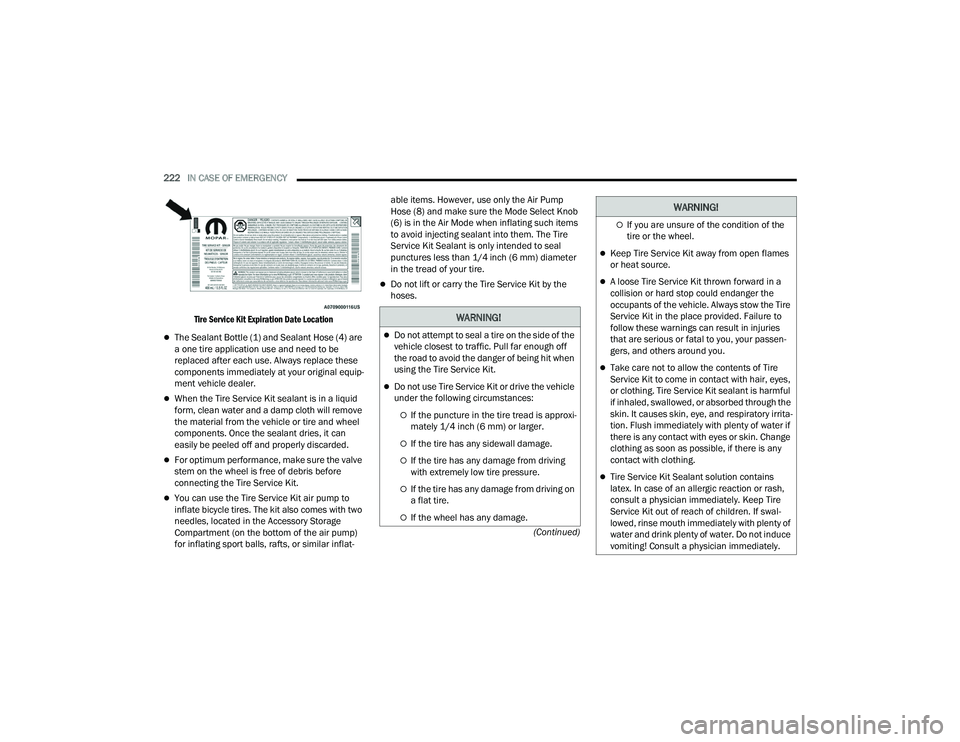
Tire Service Kit Expiration Date Location
The Sealant Bottle (1) and Sealant Hose (4) are
a one tire application use and need to be
replaced after each use. Always replace these
components immediately at your original equip
-
ment vehicle dealer.
When the Tire Service Kit sealant is in a liquid
form, clean water and a damp cloth will remove
the material from the vehicle or tire and wheel
components. Once the sealant dries, it can
easily be peeled off and properly discarded.
For optimum performance, make sure the valve
stem on the wheel is free of debris before
connecting the Tire Service Kit.
You can use the Tire Service Kit air pump to
inflate bicycle tires. The kit also comes with two
needles, located in the Accessory Storage
Compartment (on the bottom of the air pump)
for inflating sport balls, rafts, or similar inflat -able items. However, use only the Air Pump
Hose (8) and make sure the Mode Select Knob
(6) is in the Air Mode when inflating such items
to avoid injecting sealant into them. The Tire
Service Kit Sealant is only intended to seal
punctures less than 1/4 inch (6 mm) diameter
in the tread of your tire.
Do not lift or carry the Tire Service Kit by the
hoses.
WARNING!
Do not attempt to seal a tire on the side of the
vehicle closest to traffic. Pull far enough off
the road to avoid the danger of being hit when
using the Tire Service Kit.
Do not use Tire Service Kit or drive the vehicle
under the following circumstances:
If the puncture in the tire tread is approxi -
mately 1/4 inch (6 mm) or larger.
If the tire has any sidewall damage.
If the tire has any damage from driving
with extremely low tire pressure.
If the tire has any damage from driving on
a flat tire.
If the wheel has any damage.
If you are unsure of the condition of the
tire or the wheel.
Keep Tire Service Kit away from open flames
or heat source.
A loose Tire Service Kit thrown forward in a
collision or hard stop could endanger the
occupants of the vehicle. Always stow the Tire
Service Kit in the place provided. Failure to
follow these warnings can result in injuries
that are serious or fatal to you, your passen -
gers, and others around you.
Take care not to allow the contents of Tire
Service Kit to come in contact with hair, eyes,
or clothing. Tire Service Kit sealant is harmful
if inhaled, swallowed, or absorbed through the
skin. It causes skin, eye, and respiratory irrita -
tion. Flush immediately with plenty of water if
there is any contact with eyes or skin. Change
clothing as soon as possible, if there is any
contact with clothing.
Tire Service Kit Sealant solution contains
latex. In case of an allergic reaction or rash,
consult a physician immediately. Keep Tire
Service Kit out of reach of children. If swal -
lowed, rinse mouth immediately with plenty of
water and drink plenty of water. Do not induce
vomiting! Consult a physician immediately.
WARNING!
22_LD_OM_EN_USC_t.book Page 222
Page 238 of 312
236SERVICING AND MAINTENANCE
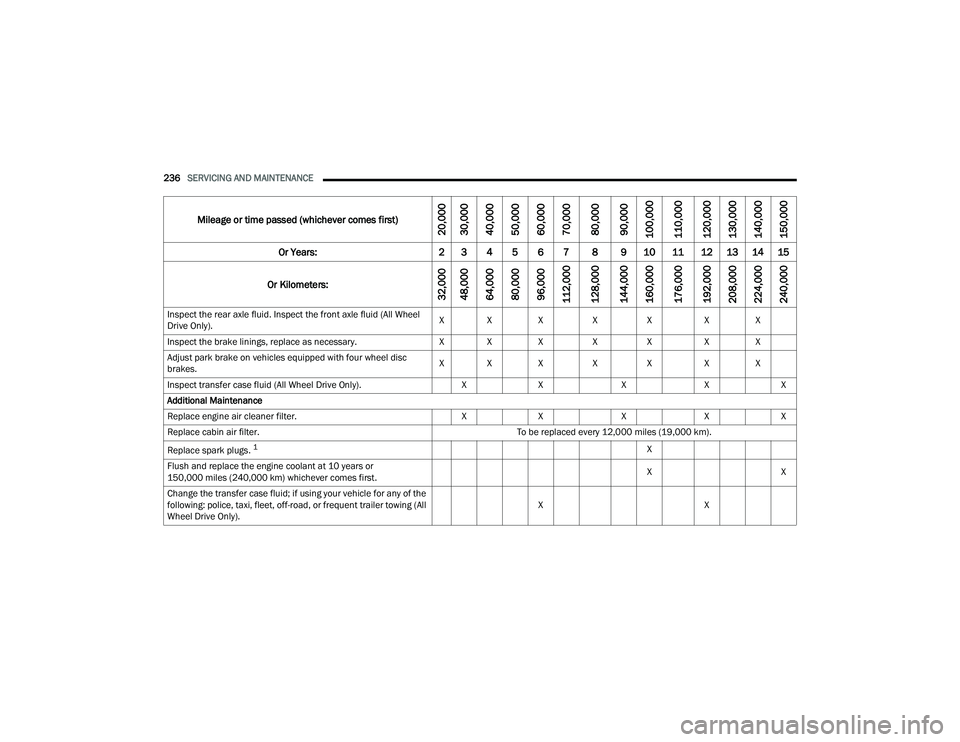
Inspect the rear axle fluid. Inspect the front axle fluid (All Wheel
Drive Only). X X X
XX X X
Inspect the brake linings, replace as necessary. X X XXX X X
Adjust park brake on vehicles equipped with four wheel disc
brakes. X X X
XX X X
Inspect transfer case fluid (All Wheel Drive Only). XX XXX
Additional Maintenance
Replace engine air cleaner filter. XX XXX
Replace cabin air filter. To be replaced every 12,000 miles (19,000 km).
Replace spark plugs.
1X
Flush and replace the engine coolant at 10 years or
150,000 miles (240,000 km) whichever comes first. X
X
Change the transfer case fluid; if using your vehicle for any of the
following: police, taxi, fleet, off-road, or frequent trailer towing (All
Wheel Drive Only). X
X
Mileage or time passed (whichever comes first)
20,000
30,000
40,000
50,000
60,000
70,000
80,000
90,000
100,000
110,000
120,000
130,000
140,000
150,000
Or Years: 2 3 4 5 6 7 8 9 10 11 12 13 14 15
Or Kilometers:
32,000
48,000
64,000
80,000
96,000
112,000
128,000
144,000
160,000
176,000
192,000
208,000
224,000
240,000
22_LD_OM_EN_USC_t.book Page 236
Page 239 of 312
SERVICING AND MAINTENANCE237
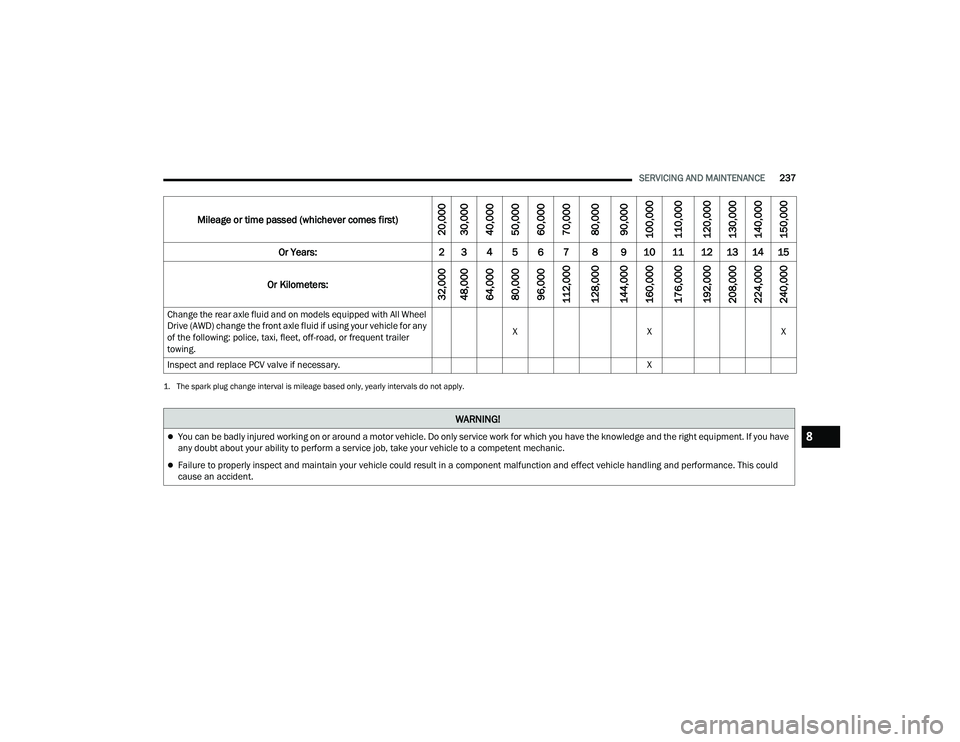
Change the rear axle fluid and on models equipped with All Wheel
Drive (AWD) change the front axle fluid if using your vehicle for any
of the following: police, taxi, fleet, off-road, or frequent trailer
towing. X
XX
Inspect and replace PCV valve if necessary. X
1. The spark plug change interval is mileage based only, yearly intervals do not apply.
Mileage or time passed (whichever comes first)
20,000
30,000
40,000
50,000
60,000
70,000
80,000
90,000
100,000
110,000
120,000
130,000
140,000
150,000
Or Years: 2 3 4 5 6 7 8 9 10 11 12 13 14 15
Or Kilometers:
32,000
48,000
64,000
80,000
96,000
112,000
128,000
144,000
160,000
176,000
192,000
208,000
224,000
240,000
WARNING!
You can be badly injured working on or around a motor vehicle. Do only service work for which you have the knowledge and the right equipment. If you have
any doubt about your ability to perform a service job, take your vehicle to a competent mechanic.
Failure to properly inspect and maintain your vehicle could result in a component malfunction and effect vehicle handling and performance. This could
cause an accident.
8
22_LD_OM_EN_USC_t.book Page 237
Page 277 of 312
SERVICING AND MAINTENANCE275
Run Flat Tires — If Equipped
Run Flat tires allow you the capability to drive
50 miles (80 km) at 50 mph (80 km/h) after a
rapid loss of inflation pressure. This rapid loss of
inflation is referred to as the Run Flat mode. A Run
Flat mode occurs when the tire inflation pressure is
of/or below 14 psi (96 kPa). Once a Run Flat tire
reaches the Run Flat mode it has limited driving
capabilities and needs to be replaced immediately.
A Run Flat tire is not repairable. When a Run Flat
tire is changed after driving with underinflated tire
condition, please replace the TPMS sensor as it is
not designed to be reused when driven under Run
Flat mode 14 psi (96 kPa) condition.
NOTE:TPMS Sensor must be replaced after driving the
vehicle on a flat tire condition.
It is not recommended driving a vehicle loaded at
full capacity or to tow a trailer while a tire is in the
Run Flat mode.
See the Tire Pressure Monitoring System section
for more information.
Tire Spinning
When stuck in mud, sand, snow, or ice conditions,
do not spin your vehicle's wheels above 30 mph
(48 km/h) or for longer than 30 seconds
continuously without stopping.
For further information Úpage 231.
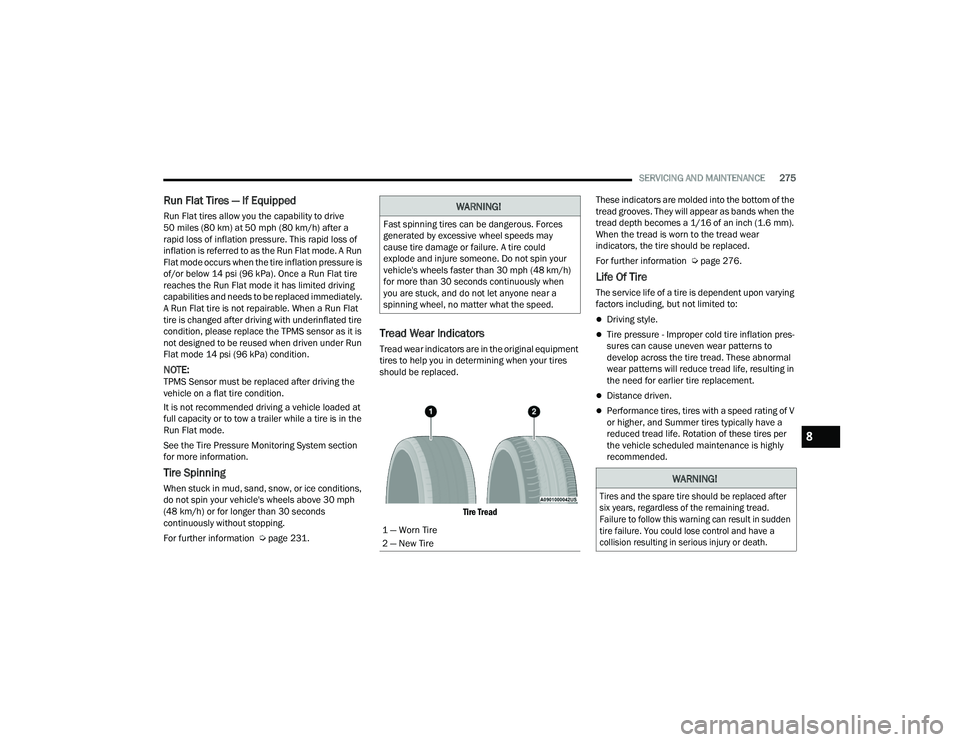
Tread Wear Indicators
Tread wear indicators are in the original equipment
tires to help you in determining when your tires
should be replaced.
Tire Tread
These indicators are molded into the bottom of the
tread grooves. They will appear as bands when the
tread depth becomes a 1/16 of an inch (1.6 mm).
When the tread is worn to the tread wear
indicators, the tire should be replaced.
For further information Ú
page 276.
Life Of Tire
The service life of a tire is dependent upon varying
factors including, but not limited to:
Driving style.
Tire pressure - Improper cold tire inflation pres -
sures can cause uneven wear patterns to
develop across the tire tread. These abnormal
wear patterns will reduce tread life, resulting in
the need for earlier tire replacement.
Distance driven.
Performance tires, tires with a speed rating of V
or higher, and Summer tires typically have a
reduced tread life. Rotation of these tires per
the vehicle scheduled maintenance is highly
recommended.
WARNING!
Fast spinning tires can be dangerous. Forces
generated by excessive wheel speeds may
cause tire damage or failure. A tire could
explode and injure someone. Do not spin your
vehicle's wheels faster than 30 mph (48 km/h)
for more than 30 seconds continuously when
you are stuck, and do not let anyone near a
spinning wheel, no matter what the speed.
1 — Worn Tire
2 — New Tire
WARNING!
Tires and the spare tire should be replaced after
six years, regardless of the remaining tread.
Failure to follow this warning can result in sudden
tire failure. You could lose control and have a
collision resulting in serious injury or death.
8
22_LD_OM_EN_USC_t.book Page 275
Page 278 of 312
276SERVICING AND MAINTENANCE
NOTE:Wheel valve stem must be replaced as well when
installing new tires due to wear and tear in existing
tires.
Keep dismounted tires in a cool, dry place with as
little exposure to light as possible. Protect tires
from contact with oil, grease, and gasoline.
Replacement Tires
The tires on your new vehicle provide a balance of
many characteristics. They should be inspected
regularly for wear and correct cold tire inflation
pressures. The manufacturer strongly
recommends that you use tires equivalent to the
originals in size, quality and performance when
replacement is needed Úpage 275. Refer to the
Tire and Loading Information placard or the
Vehicle Certification Label for the size designation
of your tire. The Load Index and Speed Symbol for
your tire will be found on the original equipment
tire sidewall.
See the Tire Sizing Chart example found in the “Tire
Safety Information” section of this manual for
more information relating to the Load Index and
Speed Symbol of a tire Ú page 264.
It is recommended to replace the two front tires or
two rear tires as a pair. Replacing just one tire can
seriously affect your vehicle’s handling. If you ever
replace a wheel, make sure that the wheel’s
specifications match those of the original wheels. It is recommended you contact an authorized tire
dealer or original equipment dealer with any
questions you may have on tire specifications or
capability. Failure to use equivalent replacement
tires may adversely affect the safety, handling, and
ride of your vehicle.
TIRE TYPES
All Season Tires — If Equipped
All Season tires provide traction for all seasons
(Spring, Summer, Autumn, and Winter). Traction
levels may vary between different all season tires.
All season tires can be identified by the M+S, M&S,
M/S or MS designation on the tire sidewall. Use all
season tires only in sets of four; failure to do so
may adversely affect the safety and handling of
your vehicle.
Summer Or Three Season Tires —
If Equipped
Summer tires provide traction in both wet and dry
conditions, and are not intended to be driven in
snow or on ice. If your vehicle is equipped with
Summer tires, be aware these tires are not
designed for Winter or cold driving conditions.
Install Winter tires on your vehicle when ambient
temperatures are less than 40°F (5°C) or if roads
are covered with ice or snow. For more
information, contact an authorized dealer.
WARNING!
Do not use a tire, wheel size, load rating, or
speed rating other than that specified for your
vehicle. Some combinations of unapproved
tires and wheels may change suspension
dimensions and performance characteristics,
resulting in changes to steering, handling, and
braking of your vehicle. This can cause unpre
-
dictable handling and stress to steering and
suspension components. You could lose
control and have a collision resulting in
serious injury or death. Use only the tire and
wheel sizes with load ratings approved for
your vehicle.
Never use a tire with a smaller load index or
capacity, other than what was originally
equipped on your vehicle. Using a tire with a
smaller load index could result in tire over -
loading and failure. You could lose control and
have a collision.
Failure to equip your vehicle with tires having
adequate speed capability can result in
sudden tire failure and loss of vehicle control.
CAUTION!
Replacing original tires with tires of a different
size may result in false speedometer and
odometer readings.
22_LD_OM_EN_USC_t.book Page 276
Page 299 of 312
297
INDEX
A
About Your Brakes......................................... 286
Adaptive Cruise Control (ACC) (Cruise Control)... 96
Adding Engine Coolant (Antifreeze)............... 249Adding Fuel.................................................... 113Adding Washing Fluid.................................... 240Additives, Fuel............................................... 288AdjustForward....................................................... 33Rearward..................................................... 33Advance Phone Connectivity......................... 160Air Bag........................................................... 191Advance Front Air Bag............................... 191Air Bag Operation...................................... 192Air Bag Warning Light................................ 190Driver Knee Air Bag................................... 193Enhanced Accident Response......... 196, 233Event Data Recorder (EDR)....................... 233Front Air Bag............................................. 191If Deployment Occurs................................ 195Knee Impact Bolsters................................ 192Maintaining Your Air Bag System.............. 197Maintenance............................................. 197Redundant Air Bag Warning Light.............191Side Air Bags............................................. 193Air Bag Light..................................76, 190, 210
Air Cleaner, Engine (Engine Air Cleaner Filter)... 243
Air Conditioner Maintenance........................ 243Air Conditioner Refrigerant........................... 243Air Conditioner System................................. 243Air Conditioning......................................... 51, 53Air Conditioning Filter..............................57, 244Air Conditioning, Operating Tips....................... 56Air Filter........................................................ 243Air PressureTires......................................................... 273AlarmArm The System................................... 20, 21Rearm The System...................................... 21Security Alarm...................................... 20, 78Alarm SystemSecurity Alarm............................................. 20All Wheel DriveTowing...................................................... 233Alterations/ModificationsVehicle........................................................... 9Android Auto........................................ 162, 164Android Auto™
b
....................................... 162Antifreeze (Engine Coolant)................. 248, 290Disposal................................................... 250Anti-Lock Brake System (ABS)...................... 168Anti-Lock Warning Light................................... 78
Apple CarPlay....................................... 162, 166Apple CarPlay®
b
...................................... 165Arming SystemSecurity Alarm.............................................20Assist, Hill Start............................................. 172Audio Settings............................................... 148Audio Systems (Radio).................................. 123Auto Down Power Windows..............................62Automatic Door Locks...............................25, 26Automatic Headlights.......................................46Automatic High Beams.....................................45Automatic Temperature Control (ATC).......51, 56Automatic Transmission......................... 90, 252Adding Fluid..................................... 252, 292Fluid And Filter Change............................. 252Fluid Change............................................. 252Fluid Level Check............................. 251, 252Fluid Type........................................ 252, 292Special Additives...................................... 251
Automatic Transmission Limp Home Mode...25, 92
AutoPark..........................................................85AutostickOperation.....................................................92AUX............................................................... 209AUX Cord..........................................................59Auxiliary Electrical Outlet (Power Outlet)..........60
11
22_LD_OM_EN_USC_t.book Page 297