torque DODGE CHARGER 2023 User Guide
[x] Cancel search | Manufacturer: DODGE, Model Year: 2023, Model line: CHARGER, Model: DODGE CHARGER 2023Pages: 292, PDF Size: 13.05 MB
Page 169 of 292
SAFETY167
(Continued)
NOTE:
For vehicles with multiple partial ESC modes, the push
and release of the button will toggle the ESC modes.
Multiple attempts may be required to return to
"ESC On" mode.
Trailer Sway Control (TSC) is disabled when the
ESC system is in the “Partial Off” mode.
If Equipped — "ESC Sport" and "ESC Track" are
ESC “Partial Off” mode(s).
“Full Off” – If Equipped
This mode is intended for off-highway or off-road use only
and should not be used on any public roadways. In this
mode, TCS and ESC features are turned off. To enter the
“Full Off” mode, push and hold the ESC OFF button for five
seconds while the vehicle is stopped with the engine
running. After five seconds, a chime will sound, the ESC
OFF Indicator Light will illuminate, and the ESC OFF
message will display in the instrument cluster. To turn ESC
on again, momentarily push the ESC OFF button.
ESC Activation/Malfunction Indicator Light
And ESC OFF Indicator Light
The ESC Activation/Malfunction Indicator Light
in the instrument cluster will come on when the
ignition is placed in the ON/RUN mode. It
should go out with the engine running. If the
ESC Activation/Malfunction Indicator Light comes on
continuously with the engine running, a malfunction has
been detected in the ESC system. If this light remains on
after several ignition cycles, and the vehicle has been
driven several miles (kilometers) at speeds greater than
30 mph (48 km/h), see an authorized dealer as soon as possible to have the problem diagnosed and corrected.
The ESC Activation/Malfunction Indicator Light (located in
the instrument cluster) starts to flash as soon as the tires
lose traction and the ESC system becomes active. The ESC
Activation/Malfunction Indicator Light also flashes when
TCS is active. If the ESC Activation/Malfunction Indicator Light begins to
flash during acceleration, ease up on the accelerator and
apply as little throttle as possible. Be sure to adapt your
speed and driving to the prevailing road conditions.
The ESC OFF Indicator Light indicates the
customer has elected to have the Electronic
Stability Control (ESC) in a reduced mode.
NOTE:
The ESC Activation/Malfunction Indicator Light and the
ESC OFF Indicator Light come on momentarily each
time the ignition is placed in the ON mode.
Each time the ignition is placed in the ON mode, the
ESC system will be on even if it was turned off previ -
ously.
The ESC system will make buzzing or clicking sounds
when it is active. This is normal; the sounds will stop
when ESC becomes inactive following the maneuver
that caused the ESC activation.
Hill Start Assist (HSA)
HSA is designed to mitigate roll back from a complete stop
while on an incline. If the driver releases the brake while
stopped on an incline, HSA will continue to hold the brake
pressure for a short period. If the driver does not apply the
throttle before this time expires, the system will release
brake pressure and the vehicle will roll down the hill as
normal.WARNING!
In the ESC “Full Off” mode, the engine torque reduc -
tion and stability features are disabled. Therefore,
enhanced vehicle stability offered by the ESC system
is unavailable. In an emergency evasive maneuver,
the ESC system will not engage to assist in main -
taining stability. ESC “Full Off” mode is intended for
off-highway or off-road use only.
The Electronic Stability Control (ESC) cannot prevent
the natural laws of physics from acting on the
vehicle, nor can it increase the traction afforded by
prevailing road conditions. ESC cannot prevent all
accidents, including those resulting from excessive
speed in turns, driving on very slippery surfaces, or
hydroplaning. ESC also cannot prevent collisions.
WARNING!
6
23_LD_OM_EN_USC_t.book Page 167
Page 203 of 292

SAFETY201
PERIODIC SAFETY CHECKS YOU SHOULD
M
AKE OUTSIDE THE VEHICLE
Tires
Examine tires for excessive tread wear and uneven wear
patterns. Check for stones, nails, glass, or other objects
lodged in the tread or sidewall. Inspect the tread for cuts
and cracks. Inspect sidewalls for cuts, cracks, and bulges.
Check the lug nuts/bolt torque for tightness. Check the
tires (including spare) for proper cold inflation pressure.
Lights
Have someone observe the operation of brake lights and
exterior lights while you work the controls. Check turn
signal and high beam indicator lights on the instrument
panel.
Door Latches
Check for proper closing, latching, and locking.
Fluid Leaks
Check area under the vehicle after overnight parking for
fuel, coolant, oil, or other fluid leaks. Also, if gasoline
fumes are detected or if fuel or brake fluid leaks are
suspected, the cause should be located and corrected
immediately.
EXHAUST GAS
The best protection against carbon monoxide entry into
the vehicle body is a properly maintained engine exhaust
system. Whenever a change is noticed in the sound of the exhaust
system, when exhaust fumes can be detected inside the
vehicle, or when the underside or rear of the vehicle is
damaged, have an authorized dealer inspect the complete
exhaust system and adjacent body areas for broken,
damaged, deteriorated, or mispositioned parts. Open
seams or loose connections could permit exhaust fumes
to seep into the passenger compartment. In addition,
inspect the exhaust system each time the vehicle is raised
for lubrication or oil change. Replace as required.
CARBON MONOXIDE WARNINGS
It is recommended to only use mild soap and water
to clean your floor mats. After cleaning, always check
your floor mat has been properly installed and is
secured to your vehicle using the floor mat fasteners
by lightly pulling mat.
WARNING!
WARNING!
Exhaust gases can injure or kill. They contain carbon
monoxide (CO), which is colorless and odorless.
Breathing it can make you unconscious and can
eventually poison you. To avoid breathing (CO), follow
these safety tips:
Do not run the engine in a closed garage or in
confined areas any longer than needed to move your
vehicle in or out of the area.
If you are required to drive with the trunk/liftgate/
rear doors open, make sure that all windows are
closed and the climate control BLOWER switch is set
at high speed. DO NOT use the recirculation mode.
If it is necessary to sit in a parked vehicle with the
engine running, adjust your heating or cooling
controls to force outside air into the vehicle. Set the
blower at high speed.
WARNING!
Carbon monoxide (CO) in exhaust gases is deadly.
Follow the precautions below to prevent carbon
monoxide poisoning:
Do not inhale exhaust gases. They contain carbon
monoxide, a colorless and odorless gas, which can
kill. Never run the engine in a closed area, such as a
garage, and never sit in a parked vehicle with the
engine running for an extended period. If the vehicle
is stopped in an open area with the engine running
for more than a short period, adjust the ventilation
system to force fresh, outside air into the vehicle.
Guard against carbon monoxide with proper mainte -
nance. Have the exhaust system inspected every
time the vehicle is raised. Have any abnormal condi -
tions repaired promptly. Until repaired, drive with all
side windows fully open.
6
23_LD_OM_EN_USC_t.book Page 201
Page 211 of 292
IN CASE OF EMERGENCY209
5. Raise the vehicle just enough to remove the flat tire
and install the spare tire.
6. Remove the lug nuts and tire.
7. Mount the spare tire.
Mounting Spare Tire
NOTE:
For vehicles so equipped, do not attempt to install a center
cap or wheel cover on the compact spare Úpage 259.
8. Install the lug nuts with the cone shaped end of the lug nut toward the wheel. Lightly tighten the lug nuts.
9. Lower the vehicle to the ground by turning the jack handle counterclockwise.
10. Finish tightening the wheel bolts. Push down on the wrench while at the end of the handle for increased
leverage. Tighten the wheel bolts in a star pattern
until each wheel bolt has been tightened twice. If in
doubt about the correct tightness, have them
checked with a torque wrench by an authorized
dealer or at a service station
Úpage 267.
11. Stow the wheel chocks, jack, tools and flat tire. Make sure the base of the jack faces the front of the vehicle
before tightening down the fastener.
TIRE SERVICE KIT — IF EQUIPPED
Use this QR code to access your digital
experience.
Small punctures up to 1/4 inch (6 mm)
in the tire tread can be sealed with Tire
Service Kit. Foreign objects (e.g.,
screws or nails) should not be removed
from the tire. Tire Service Kit can be
used in outside temperatures down to
approximately -4°F (-20°C).
This kit will provide a temporary tire seal, allowing you to
drive your vehicle up to 100 miles (160 km) with a
maximum speed of 50 mph (80 km/h).
TIRE SERVICE KIT STORAGE
The Tire Service Kit is located in the trunk.
Tire Service Kit Location
WARNING!
Raising the vehicle higher than necessary can make the
vehicle less stable. It could slip off the jack and hurt
someone near it. Raise the vehicle only enough to
remove the tire.
CAUTION!
Be sure to mount the spare tire with the valve stem
facing outward. The vehicle could be damaged if the
spare tire is mounted incorrectly.
WARNING!
To avoid the risk of forcing the vehicle off the jack, do
not tighten the wheel nuts fully until the vehicle has
been lowered. Failure to follow this warning may result
in serious injury.
WARNING!
A loose tire or jack thrown forward in a collision or hard
stop could endanger the occupants of the vehicle.
Always stow the jack parts and the spare tire in the
places provided. Have the deflated (flat) tire repaired or
replaced immediately.
7
23_LD_OM_EN_USC_t.book Page 209
Page 239 of 292

SERVICING AND MAINTENANCE237
AUTOMATIC TRANSMISSION
Special Additives
The manufacturer strongly recommends against using any
special additives in the transmission. Automatic
Transmission Fluid (ATF) is an engineered product and its
performance may be impaired by supplemental additives.
Therefore, do not add any fluid additives to the
transmission. Avoid using transmission sealers as they
may adversely affect seals.
Fluid Level Check
The fluid level is preset at the factory and does not require
adjustment under normal operating conditions. Routine
fluid level checks are not required; therefore the
transmission has no dipstick. An authorized dealer can
check your transmission fluid level using special service
tools. If you notice fluid leakage or transmission
malfunction, visit an authorized dealer immediately to
have the transmission fluid level checked. Operating the
vehicle with an improper fluid level can cause severe
transmission damage.
Fluid And Filter Changes — 8-Speed
Transmission
Under normal operating conditions, the fluid installed at
the factory will provide satisfactory lubrication for the life
of the vehicle. Routine fluid and filter changes are not required. However,
change the fluid and filter if the fluid becomes
contaminated (with water, etc.), or if the transmission is
disassembled for any reason.
Selection Of Lubricant
It is important to use the proper transmission fluid to
ensure optimum transmission performance and life.
Use only the manufacturer's specified transmission fluid
Úpage 271. It is important to maintain the transmission
fluid at the correct level using the recommended fluid.
NOTE:No chemical flushes should be used in any transmission;
only the approved lubricant should be used.
REAR AXLE
For normal service, periodic fluid level checks are not
required. When the vehicle is serviced for other reasons
the exterior surfaces of the axle assembly should be
inspected. If gear oil leakage is suspected inspect the fluid
level
Úpage 271.
To avoid contamination from foreign matter or mois -
ture, use only new brake fluid or fluid that has been
in a tightly closed container. Keep the master
cylinder reservoir cap secured at all times. Brake
fluid in an open container absorbs moisture from the
air resulting in a lower boiling point. This may cause
it to boil unexpectedly during hard or prolonged
braking, resulting in sudden brake failure. This could
result in a collision.
Overfilling the brake fluid reservoir can result in
spilling brake fluid on hot engine parts, causing the
brake fluid to catch fire. Brake fluid can also damage
painted and vinyl surfaces, care should be taken to
avoid its contact with these surfaces.
Do not allow petroleum based fluid to contaminate
the brake fluid. Brake seal components could be
damaged, causing partial or complete brake failure.
This could result in a collision.
WARNING!CAUTION!
Do not use chemical flushes in your transmission as the
chemicals can damage your transmission components.
Such damage is not covered by the New Vehicle Limited
Warranty.
CAUTION!
If a transmission fluid leak occurs, visit an authorized
dealer immediately. Severe transmission damage may
occur. An authorized dealer has the proper tools to
adjust the fluid level accurately.
CAUTION!
Using a transmission fluid other than the
manufacturer’s recommended fluid may cause
deterioration in transmission shift quality and/or torque
converter shudder
Úpage 271.
8
23_LD_OM_EN_USC_t.book Page 237
Page 269 of 292
267
TECHNICAL SPECIFICATIONS
VEHICLE IDENTIFICATION NUMBER (VIN)
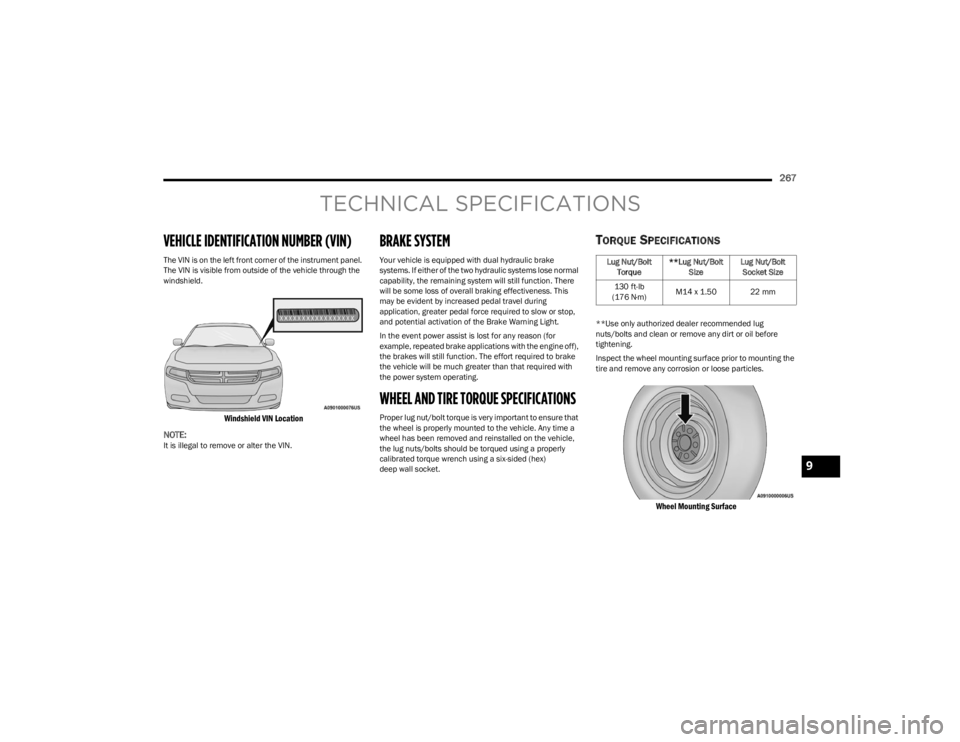
The VIN is on the left front corner of the instrument panel.
The VIN is visible from outside of the vehicle through the
windshield.
Windshield VIN Location
NOTE:
It is illegal to remove or alter the VIN.
BRAKE SYSTEM
Your vehicle is equipped with dual hydraulic brake
systems. If either of the two hydraulic systems lose normal
capability, the remaining system will still function. There
will be some loss of overall braking effectiveness. This
may be evident by increased pedal travel during
application, greater pedal force required to slow or stop,
and potential activation of the Brake Warning Light.
In the event power assist is lost for any reason (for
example, repeated brake applications with the engine off),
the brakes will still function. The effort required to brake
the vehicle will be much greater than that required with
the power system operating.
WHEEL AND TIRE TORQUE SPECIFICATIONS
Proper lug nut/bolt torque is very important to ensure that
the wheel is properly mounted to the vehicle. Any time a
wheel has been removed and reinstalled on the vehicle,
the lug nuts/bolts should be torqued using a properly
calibrated torque wrench using a six-sided (hex)
deep wall socket.
TORQUE SPECIFICATIONS
**Use only authorized dealer recommended lug
nuts/bolts and clean or remove any dirt or oil before
tightening.
Inspect the wheel mounting surface prior to mounting the
tire and remove any corrosion or loose particles.
Wheel Mounting Surface
Lug Nut/Bolt Torque **Lug Nut/Bolt
Size Lug Nut/Bolt
Socket Size
130 ft-lb
(176 N·m) M14 x 1.50 22 mm
9
23_LD_OM_EN_USC_t.book Page 267
Page 270 of 292
268TECHNICAL SPECIFICATIONS
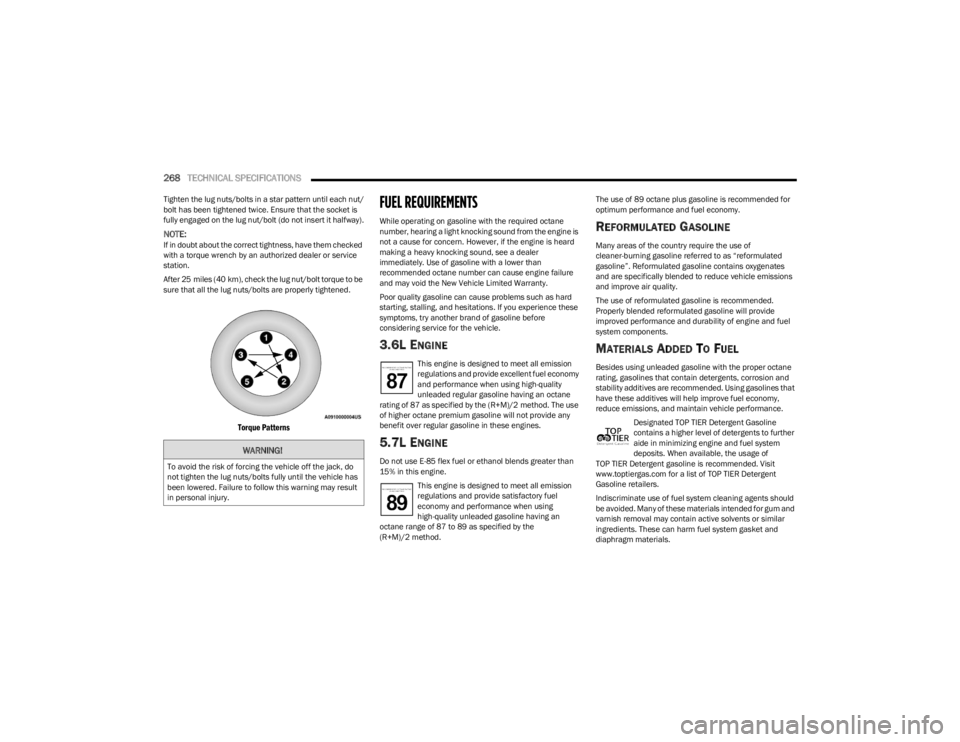
Tighten the lug nuts/bolts in a star pattern until each nut/
bolt has been tightened twice. Ensure that the socket is
fully engaged on the lug nut/bolt (do not insert it halfway).
NOTE:If in doubt about the correct tightness, have them checked
with a torque wrench by an authorized dealer or service
station.
After 25 miles (40 km), check the lug nut/bolt torque to be
sure that all the lug nuts/bolts are properly tightened.
Torque Patterns
FUEL REQUIREMENTS
While operating on gasoline with the required octane
number, hearing a light knocking sound from the engine is
not a cause for concern. However, if the engine is heard
making a heavy knocking sound, see a dealer
immediately. Use of gasoline with a lower than
recommended octane number can cause engine failure
and may void the New Vehicle Limited Warranty.
Poor quality gasoline can cause problems such as hard
starting, stalling, and hesitations. If you experience these
symptoms, try another brand of gasoline before
considering service for the vehicle.
3.6L ENGINE
This engine is designed to meet all emission
regulations and provide excellent fuel economy
and performance when using high-quality
unleaded regular gasoline having an octane
rating of 87 as specified by the (R+M)/2 method. The use
of higher octane premium gasoline will not provide any
benefit over regular gasoline in these engines.
5.7L ENGINE
Do not use E-85 flex fuel or ethanol blends greater than
15% in this engine.
This engine is designed to meet all emission
regulations and provide satisfactory fuel
economy and performance when using
high-quality unleaded gasoline having an
octane range of 87 to 89 as specified by the
(R+M)/2 method. The use of 89 octane plus gasoline is recommended for
optimum performance and fuel economy.
REFORMULATED GASOLINE
Many areas of the country require the use of
cleaner-burning gasoline referred to as “reformulated
gasoline”. Reformulated gasoline contains oxygenates
and are specifically blended to reduce vehicle emissions
and improve air quality.
The use of reformulated gasoline is recommended.
Properly blended reformulated gasoline will provide
improved performance and durability of engine and fuel
system components.
MATERIALS ADDED TO FUEL
Besides using unleaded gasoline with the proper octane
rating, gasolines that contain detergents, corrosion and
stability additives are recommended. Using gasolines that
have these additives will help improve fuel economy,
reduce emissions, and maintain vehicle performance.
Designated TOP TIER Detergent Gasoline
contains a higher level of detergents to further
aide in minimizing engine and fuel system
deposits. When available, the usage of
TOP TIER Detergent gasoline is recommended. Visit
www.toptiergas.com for a list of TOP TIER Detergent
Gasoline retailers.
Indiscriminate use of fuel system cleaning agents should
be avoided. Many of these materials intended for gum and
varnish removal may contain active solvents or similar
ingredients. These can harm fuel system gasket and
diaphragm materials.
WARNING!
To avoid the risk of forcing the vehicle off the jack, do
not tighten the lug nuts/bolts fully until the vehicle has
been lowered. Failure to follow this warning may result
in personal injury.
23_LD_OM_EN_USC_t.book Page 268
Page 287 of 292

285
T
Telescoping Steering Column .................................24, 25
Temperature Control, Automatic (ATC) ..........................51
Tilt Steering Column ................................................ 24
, 25
Time Delay Headlight ....................................................................42
Tire And Loading Information Placard ........................ 252
Tire Markings................................................................ 248
Tire Safety Information ................................................ 248
Tire Service Kit ...........................................209
, 210, 211
Tire Service Kit — If Equipped
b
............................... 209
Tires .................................................. 201, 255, 259, 263
Aging (Life Of Tires)................................................. 257 Air Pressure ............................................................. 255
Chains...................................................................... 262Changing ................................................................. 205
Compact Spare ....................................................... 259
General Information ...................................... 255
, 259
High Speed .............................................................. 256
Inflation Pressure ................................................... 255
Jacking..................................................................... 205
Life Of Tires ............................................................. 257
Load Capacity.......................................................... 252
Pressure Monitoring System (TPMS) .............. 72
, 174
Quality Grading ....................................................... 263
Radial ...................................................................... 256 Replacement ........................................................... 258
Rotation ................................................................... 263
Safety.............................................................. 248
, 255
Sizes ........................................................................ 249
Snow Tires ............................................................... 259 Spare Tires ............................................206
, 259, 260
Spinning .................................................................. 257 Trailer Towing .......................................................... 107
Tread Wear Indicators ............................................. 257
Wheel Nut Torque....................................................267
To Open Hood ................................................................. 59
Tongue Weight/Trailer Weight ..................................... 106
Towing ...........................................................................103 Behind A Motorhome .............................................. 109Disabled Vehicle ...................................................... 219
Guide ........................................................................ 105
Recreational ............................................................109Weight ...................................................................... 105
Towing Behind A Motorhome ....................................... 109
Traction ......................................................................... 109
Traction Control ............................................................168
Trailer Towing ................................................................ 103 Hitches .....................................................................105
Minimum Requirements ......................................... 106
Tips ...........................................................................108Trailer And Tongue Weight...................................... 106Wiring ....................................................................... 107
Trailer Towing Guide ..................................................... 105
Trailer Weight ................................................................ 105
Transfer Case Fluid.......................................................................... 272
Transmission................................................................... 81 Automatic ..........................................................81
, 237
Fluid.......................................................................... 272 Maintenance............................................................237Shifting ....................................................................... 80
Transporting Pets ......................................................... 199
Tread Wear Indicators ..................................................257
Trunk Lid (Deck Lid)........................................................ 59
Trunk Release Remote Control...................................... 59 Turn Signals ............................................................. 43
, 74
UUconnect Phone Call Features................................................ 145Things You Should Know About Your Uconnect Phone................................................. 147
Uconnect Settings ..................................................... 18
Uconnect Phone ........................................ 141
, 142, 143
Answer Or Ignore An Incoming Call — Call Currently In Progress .................................. 146
Answer Or Ignore An Incoming Call — No Call Currently In Progress ............................ 146
Bluetooth Communication Link.............................. 149
Call Continuation..................................................... 147
Call Controls ............................................................ 145
Call Termination ...................................................... 147
Cancel Command.................................................... 142
Connecting To A Particular Mobile Phone Or Audio Device After Pairing ............................ 143
Help Command ....................................................... 142 Join Calls.................................................................. 147
Making A Phone Or Audio Device A Favorite ......... 144
Making A Second Call While Current Call Is In Progress ......................................................... 147
Managing Your Favorites ........................................ 145 Natural Speech ....................................................... 141Operation ................................................................. 141
Overview .................................................................. 140
Pair (Link) Uconnect Phone To A Mobile Phone.... 142
Pair A Bluetooth Streaming Audio Device ............. 143Phonebook Download............................................. 144
Place/Retrieve A Call From Hold............................ 146
11
23_LD_OM_EN_USC_t.book Page 285