lock DODGE DAKOTA 2008 3.G Owner's Manual
[x] Cancel search | Manufacturer: DODGE, Model Year: 2008, Model line: DAKOTA, Model: DODGE DAKOTA 2008 3.GPages: 426, PDF Size: 6.39 MB
Page 32 of 426
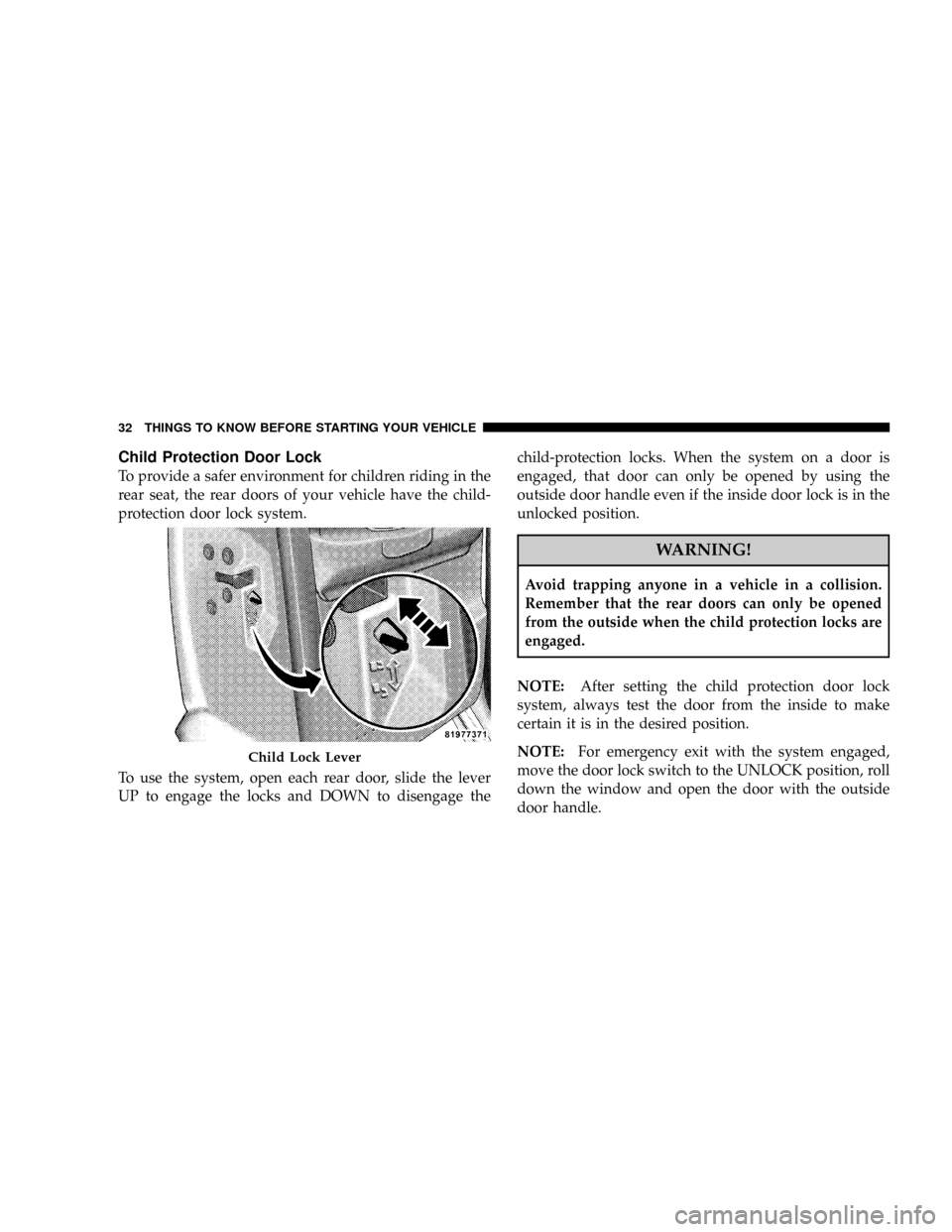
Child Protection Door Lock
To provide a safer environment for children riding in the
rear seat, the rear doors of your vehicle have the child-
protection door lock system.
To use the system, open each rear door, slide the lever
UP to engage the locks and DOWN to disengage thechild-protection locks. When the system on a door is
engaged, that door can only be opened by using the
outside door handle even if the inside door lock is in the
unlocked position.
WARNING!
Avoid trapping anyone in a vehicle in a collision.
Remember that the rear doors can only be opened
from the outside when the child protection locks are
engaged.
NOTE:After setting the child protection door lock
system, always test the door from the inside to make
certain it is in the desired position.
NOTE:For emergency exit with the system engaged,
move the door lock switch to the UNLOCK position, roll
down the window and open the door with the outside
door handle.
Child Lock Lever
32 THINGS TO KNOW BEFORE STARTING YOUR VEHICLE
Page 34 of 426

Auto Down (Driver's Side Only)
The driver's window switch has an Auto Down feature.
Push the window switch past the first detent, release, and
the window will go down automatically. To cancel the
Auto Down movement, operate the switch in either the
up or down direction and release the switch.
Window Lockout Switch
The window lockout switch on the driver's door allows
you to disable the window control on the other doors. To
disable the window controls on the other doors, press the
window lock button. To enable the window controls,
press the window control button again.
WIND BUFFETING
Wind buffeting can be described as the perception of
pressure on the ears or a helicopter type sound in the
ears. Your vehicle may exhibit wind buffeting with the
windows down or partially open. This is a normal
occurrence and can be minimized. If the buffeting occurs
Power Window Lock Out Switch
34 THINGS TO KNOW BEFORE STARTING YOUR VEHICLE
Page 36 of 426

of ejection and the risk of injury caused by striking the
inside of the vehicle.Everyonein a motor vehicle should
be belted at all times.
Lap/Shoulder Belts
All seating positions except the front center seating
position (with full bench seat) have combination lap/
shoulder belts. The belt webbing retractor is designed to
lock during very sudden stops or collisions. This feature
allows the shoulder part of the belt to move freely with
you under normal conditions. But in a collision, the belt
will lock and reduce the risk of your striking the inside of
the vehicle or being thrown out.
WARNING!
It is extremely dangerous to ride in a cargo area,
inside or outside of a vehicle. In a collision, people
riding in these areas are more likely to be seriously
injured or killed.
Do not allow people to ride in any area of your
vehicle that is not equipped with seats and seat belts.
Be sure everyone in your vehicle is in a seat and
using a seat belt properly.
36 THINGS TO KNOW BEFORE STARTING YOUR VEHICLE
Page 41 of 426

As a guide, if you are shorter than average, you will
prefer a lower position, and if you are taller than average,
you'll prefer a higher position. When you release the
anchorage, try to move it up or down to make sure that
it is locked in the desired position.
The adjuster has an easy up (EZ Up) feature, which will
allow it to be moved up without engaging the button.
Automatic Locking Retractors (ALR) Mode ± If
Equipped
In this mode, the shoulder belt is automatically pre-
locked. The belt will still retract to remove any slack in
the shoulder belt. The automatic locking mode is avail-
able on all passenger seating positions with a combina-
tion lap/shoulder belt.
When To Use The Automatic Locking Mode
Anytime a child safety seat is installed in a passenger
seating position. Children 12 years old and under should
be properly restrained in the rear seat whenever possible.
How To Use The Automatic Locking Mode
1. Buckle the combination lap/shoulder belt.
2. Grasp the shoulder portion and pull downward until
the entire belt is extracted.
THINGS TO KNOW BEFORE STARTING YOUR VEHICLE 41
2
Page 42 of 426

3. Allow the belt to retract. As the belt retracts, you will
hear a clicking sound. This indicates the safety belt is
now in the automatic locking mode.
How To Disengage The Automatic Locking Mode
Disconnect the combination lap/shoulder belt and allow
it to retract completely to disengage the automatic lock-
ing mode and activate the vehicle sensitive (emergency)
locking mode.
Center Lap Belts
The center seat position on the front seat bench has a lap
belt only. To fasten the lap belt, slide the latch plate into
the buckle until you hear a ªclick.º To lengthen the lap
belt, tilt the latch plate and pull. To remove slack, pull the
loose end of the webbing. Wear the lap belt snug against
the hips. Sit back and erect in the seat, then adjust the belt
as tightly as is comfortable.
Seat Belt Pretensioners
The seat belts for front outboard seating positions are
equipped with pretensioning devices that are designed to
remove any slack from the seat belt system in the event of
a collision. These devices improve the performance of the
seat belt by assuring that the belt is tight about the
occupant early in a collision. Pretensioners work for all
size occupants, including those in child restraints.
NOTE:These devices are not a substitute for proper seat
belt placement by the occupant. The seat belt still must be
worn snugly and positioned properly.
The pretensioners are triggered by the Occupant Re-
straint Controller (ORC). Like the airbags, the pretension-
ers are single use items. After a collision that is severe
enough to deploy the airbags and pretensioners, both
must be replaced.
42 THINGS TO KNOW BEFORE STARTING YOUR VEHICLE
Page 46 of 426
WARNING!
²Do not put anything on or around the front airbag
covers or attempt to manually open them. You may
damage the airbags and you could be injured
because the airbags are no longer functional. These
protective covers for the airbag cushions are de-
signed to open only when the airbags are inflating.
²If your vehicle is equipped with window bags, do
not stack luggage or other cargo up high enough to
block the location of the window bag. The area
where the window bag is located should remain
free from any obstructions.
²If your vehicle is equipped with window bags, do
not have any accessory items installed which will
alter the roof, including adding a sunroof to your
vehicle. Do not add roof racks that require perma-
nent attachments (bolts or screws) for installation
on the vehicle roof. Do not drill into the roof of the
vehicle for any reason.
NOTE:Do not use a clothing bar mounted to the coat
hooks in this vehicle. A clothing bar will impede the
proper performance of the window bags.
Along with the seat belts, front airbags work with the
instrument panel knee bolsters to provide improved
protection for the driver and front passenger. Window
bags also work with seat belts to improve occupant
protection.
The seat belts are designed to protect you in many types
of collisions. The front airbags deploy in moderate to
severe frontal collisions.
If your vehicle is so equipped, the window bag on the
crash side of the vehicle is triggered in moderate to
severe side collisions. But even in collisions where the
airbags work, you need the seat belts to keep you in the
right position for the airbags to protect you properly.
46 THINGS TO KNOW BEFORE STARTING YOUR VEHICLE
Page 53 of 426

NOTE:Perchlorate Material ± special handling may ap-
ply, See www.dtsc.ca.gov/hazardouswaste/perchlorate.
Enhanced Accident Response System
If the airbags deploy after an impact and the electrical
system remains functional, vehicles equipped with
power door locks will unlock automatically. In addition,
approximately 5 seconds after the vehicle has stopped
moving, the interior lights will light until the ignition
switch is turned off.
Airbag Light
You will want to have the airbags ready to
inflate for your protection in an impact. While
the airbag system is designed to be mainte-
nance free, if any of the following occurs, have
an authorized dealer service the system promptly:
²The airbag light does not come on or flickers during
the 6 to 8 seconds when the ignition switch is first
turned on.
²The light remains on or flickers after the 6 to 8 second
interval.
²The light flickers or comes on and remains on while
driving.
NOTE:If the speedometer, tachometer or any engine
related gauges are not working, the airbag control mod-
ule may also be disabled. The airbags may not be ready
to inflate for your protection. Promptly check the fuse
block for blown fuses. Refer to the label located on the
inside of the fuse block cover for the proper airbag fuses.
See your dealer if the fuse is good.
Event Data Recorder (EDR)
In the event of an accident, your vehicle is designed to
record up to 5-seconds of specific vehicle data parameters
(see the following list) in an event data recorder prior to
the moment of airbag deployment, and up to a quarter
second of high-speed deceleration data during and/or
THINGS TO KNOW BEFORE STARTING YOUR VEHICLE 53
2
Page 58 of 426
WARNING!
²Improper installation can lead to failure of an
infant or child restraint. It could come loose in a
collision. The child could be badly injured or
killed. Follow the manufacturer's directions ex-
actly when installing an infant or child restraint.
²A rearward facing infant restraint should only be
used in a rear seat of a vehicle that does not have
an airbag off switch. A rearward facing infant
restraint in the front seat may be struck by a
deploying passenger airbag which may cause se-
vere or fatal to the infant.
Here are some tips for getting the most out of your child
restraint:
²Before buying any restraint system, make sure that it
has a label certifying that it meets all applicable SafetyStandards. The manufacturer recommends that you
try a child restraint in the vehicle seats where you will
use it before you buy it.
²The restraint must be appropriate for your child's
weight and height. Check the label on the restraint for
weight and height limits.
²Carefully follow the instructions that come with the
restraint. If you install the restraint improperly, it may
not work when you need it.
²The Extended Cab first and Club/Crew Cab second
row outside seating positions have cinching latch
plates. These are designed to keep the lap portion tight
around the child restraint so that it is not necessary to
use a locking clip. If the seat belt has a cinching latch
plate, pulling up on the shoulder portion of the
lap/shoulder belt will tighten the belt. The cinching
latch plate will keep the belt tight, however, any seat
58 THINGS TO KNOW BEFORE STARTING YOUR VEHICLE
Page 63 of 426

Installing Child Restraints Using the Vehicle Seat
Belt
The passenger seat belts are equipped with either cinch-
ing latch plates or automatic locking retractors, which are
designed to keep the lap portion tight around the child
restraint so that it should not be necessary to use a
locking clip. If the seat belt has a cinching latch plate,
pulling up on the shoulder portion of the lap/shoulder
belt will tighten the belt. The cinching latch plate will
keep the belt tight; however, any seat belt system will
loosen with time, so check the belt occasionally and pull
it tight if necessary. If the seat belt has an automatic
locking retractor, it will have a distinctive label. Pull the
belt from the retractor until there is enough to allow you
to pass through the child restraint and slide the latch
plate into the buckle. Then, pull the belt until it is all
extracted from the retractor. Allow the belt to return to
the retractor, pulling on the excess webbing to tighten the
lap portion about the child restraint. For automaticlocking retractor seat belts, refer to9Automatic Locking
Mode9earlier in this section. If you have trouble tighten-
ing the lap/shoulder belt on the child restraint because
the buckle or latch plate is too close to the belt path
opening on the restraint, follow these steps. If the buckle
is webbing mounted, disconnect the latch plate from the
buckle and twist the short buckle-end belt to shorten it.
Insert the latch plate into the buckle with the release
button facing out. If the belt still can't be tightened, the
buckle is not webbing mounted, or if by pulling and
pushing on the restraint loosens the belt, you may need
to do something more. Disconnect the latch plate from
the buckle, turn the latch plate around, and insert the
latch plate into the buckle again. If you still can't make
the child restraint secure, try a different seating position
or use the locking clip provided with your child restraint.
See the section9Child Restraint Tether Anchor9to com-
plete the child seat installation.
THINGS TO KNOW BEFORE STARTING YOUR VEHICLE 63
2
Page 71 of 426

Lights
Check the operation of all exterior lights. Check turn
signal and high beam indicator lights on the instrument
panel.
Door Latches
Check for positive closing, latching and locking.
Fluid Leaks
Check area under vehicle after overnight parking for fuel,
water, oil, or other fluid leaks. Also, if fuel fumes are
detected the cause should be located and corrected.
THINGS TO KNOW BEFORE STARTING YOUR VEHICLE 71
2