recommended oil DODGE DAKOTA 2008 3.G Owners Manual
[x] Cancel search | Manufacturer: DODGE, Model Year: 2008, Model line: DAKOTA, Model: DODGE DAKOTA 2008 3.GPages: 426, PDF Size: 6.39 MB
Page 68 of 426

WARNING!
An incorrectly anchored tether strap could lead to
seat failure and injury to the child. In a collision, the
seat could come loose and allow the child to crash
into the inside of the vehicle or other passengers, or
even be thrown from the vehicle. Use only the anchor
positions directly behind the child restraint to secure
a child restraint top tether strap. See your dealer for
help if necessary.
Transporting Pets
Airbags deploying in the front seat could harm your pet.
An unrestrained pet will be thrown about and possibly
injured, or injure a passenger during panic braking or in
a collision. Pets should be restrained in the rear seat in
pet harnesses or pet carriers that are secured by seat belts.
ENGINE BREAK-IN RECOMMENDATIONS
A long break-in period is not required for the engine in
your new vehicle. Drive moderately during the first 300
miles (500 km). After the initial 60 miles (100 km), speeds
up to 50 or 55 mph (80 or 90 km/h) are desirable. While
cruising, brief full-throttle acceleration, within the limits
of local traffic laws, contributes to a good break-in.
Avoid wide open throttle acceleration in low gear.
The engine oil installed in the engine at the factory is a
high-quality, energy-conserving type lubricant. Oil
changes should be consistent with anticipated climate
conditions under which vehicle operations will occur.
The recommended viscosity and quality grades are
shown in Section 7.
NON-DETERGENT OR STRAIGHT MINERAL OILS
MUST NEVER BE USED.
68 THINGS TO KNOW BEFORE STARTING YOUR VEHICLE
Page 214 of 426

Summer Operation
Air conditioned vehicles must be protected with a high
quality antifreeze coolant during summer to provide
proper corrosion protection and to raise the boiling point
of the coolant for protection against overheating. A 50%
concentration of engine coolant to distilled water is
recommended. See ªCooling Systemº in the Maintaining
Your Vehicle section of your Owner's Manual.
When using the air conditioner in extremely heavy traffic
in hot weather especially when towing a trailer, addi-
tional engine cooling may be required. If this situation is
encountered, operate the transmission in a lower gearand set the air conditioner to recirculation mode. Oper-
ating the air conditioner in recirculation mode provides
the maximum performance from your air conditioning.
When stopped in heavy traffic, it may be necessary to
shift into NEUTRAL and depress the accelerator slightly
for fast idle operation.
Winter Operation
When operating the system during the winter months,
make sure the air intake, located directly in front of the
windshield, is free of ice, slush, snow, or other obstruc-
tions. This will help prevent snow going into the ducts.
214 INSTRUMENT PANEL AND CONTROLS
Page 286 of 426

For best results, a refueling pattern that alternates be-
tween E-85 and unleaded gasoline should be avoided.
When you do switch fuels, it is recommended that
²you do not switch when the fuel gauge indicates less
than 1/4 full
²you do not add less than 5 gallons when refueling
²you operate the vehicle immediately after refueling for
a period of at least 5 minutes
Observing these precautions will avoid possible hard
starting and/or significant deterioration in driveability
during warm up.
NOTE:When the ambient temperature is above 90ÉF,
you may experience hard starting and rough idle follow-
ing start up even if the above recommendations are
followed.
Selection Of Engine Oil For Flexible Fuel Vehicles
(E-85) and Gasoline Vehicles
FFV vehicles operated on E85 require specially formu-
lated engine oils. These special requirements are included
in Mopartengine oils, and in equivalent oils meeting
DaimlerChrysler Specification MS-6395. The manufac-
turer only recommends engine oils that are API Certified
and meet the requirements of Material Standard MS-
6395. MS-6395 contains additional requirements, devel-
oped during extensive fleet testing, to provide additional
protection to DaimlerChrysler Corporation engines. Use
Mopartor an equivalent oil meeting the specification
MS-6395.
Starting
The characteristics of E-85 fuel make it unsuitable for use
when ambient temperatures fall below 0 F (-18 C). In the
range of 0 F (-18 C) to 32 F (0 C), you may experience an
286 STARTING AND OPERATING
Page 340 of 426

Dusty Conditions
Driving through dust-laden air increases the problems of
keeping abrasive materials out of the engine. Under these
conditions, special attention should be given to the
engine air cleaner. The crankcase ventilation system
should also be checked periodically. Make sure that these
units are always clean. This will tend to reduce to a
minimum the amount of abrasive material that may enter
the engine.
Engine Oil Selection
For best performance and maximum protection under all
types of operating conditions, the manufacture only
recommends engine oils that are API certified and meet
the requirements of DaimlerChrysler Material Standard
MS-6395.
American Petroleum Institute (API) Engine Oil
Identification Symbol
This symbol means that the oil has
been certified by the American
Petroleum Institute (API). The
manufacturer only recommends
API Certified engine oils.
Engine Oil Viscosity (SAE Grade)
SAE 5W-20 engine oil is recommended for all operating
temperatures. This engine oil improves low tempera-
ture starting and vehicle fuel economy. The engine oil
filler cap also shows the recommended engine oil
viscosity for your vehicle.
340 MAINTAINING YOUR VEHICLE
Page 341 of 426

For information on engine oil filler cap location, see the
Engine Compartment illustration in this section.
Lubricants which do not have both, the engine oil certi-
fication mark and the correct SAE viscosity grade num-
ber should not be used.
Synthetic Engine Oils
You may use synthetic engine oils provided the recom-
mended oil quality requirements are met, and the recom-
mended maintenance intervals for oil and filter changes
are followed.
Materials Added to Engine Oils
The manufacture strongly recommends against the addi-
tion of any additives (other than leak detection dyes) to
the engine oil. Engine oil is an engineered product and
it's performance may be impaired by supplemental ad-
ditives.
Disposing of Used Engine Oil And Oil Filters
Care should be taken in disposing of used engine oil and
oil filters from your vehicle. Used oil and oil filters,
indiscriminately discarded, can present a problem to the
environment. Contact your dealer, service station, or
governmental agency for advice on how and where used
oil and oil filters can be safely discarded in your area.
Engine Oil Filter
The engine oil filter should be replaced at every engine
oil change.
Engine Oil Filter Selection
The manufacturer's engines have a full-flow type oil
filter. Use a filter of this type for replacement. The quality
of replacement filters varies considerably. Only high
quality filters should be used to assure most efficient
service. MopartEngine Oil Filters are a high quality oil
filter and are recommended.
MAINTAINING YOUR VEHICLE 341
7
Page 357 of 426

attempt to clean the oil PCV valve!Check ventilating
hose for indication of damage or plugging with deposits.
Replace if necessary.
Brake System
Power Disc Brakes (Front)
Disc brakes do not require adjustment; however, several
hard stops during the break-in period are recommended
to seat the linings and wear off any foreign material.
Brake Master Cylinders
The fluid level in the master cylinders should be checked
whenever the vehicle is serviced, or immediately if the
brake system warning light is on. If necessary, add fluid
to bring level to the full mark on the side of the reservoir
of the brake master cylinder. Be sure to clean the top of
the master cylinder area before removing the cap. With
disc brakes, fluid level can be expected to fall as the brakepads wear. Brake fluid level should be checked when
pads are replaced. If the brake fluid level is abnormally
low, check system for leaks.
Refer to Fluids, Lubricants and Genuine Parts for correct
fluid type.
WARNING!
Use of brake fluid that may have a lower initial
boiling point, or is unidentified as to specifications,
may result in sudden brake failure during hard
prolonged braking. You could have an accident.
MAINTAINING YOUR VEHICLE 357
7
Page 362 of 426

Transfer Case
Inspect the transfer case for fluid leaks. If a fluid leak is
evident the transfer case fluid level may be low. Have the
transfer case serviced immediately.
CAUTION!
Damage may result from operation of the vehicle
with low transfer case fluid.
The transfer case fluid should be drained and refilled at
the intervals specified.
Lubricant Selection
Refer to Fluids, Lubricants and Genuine Parts for correct
fluid type.
Axles
Refer to Fluids, Lubricants and Genuine Parts for correct
fluid type.
The manufacturer does not recommend regularly sched-
uled oil changes for axles in vehicles whose operation is
classified as normal truck service.
NOTE:The presence of water in the gear lubricant will
result in corrosion and possible failure of differential
components. Operation of the vehicle in water, as may be
encountered in some off-highway types of service, will
require draining and refilling the axle to avoid damage.
Rear Axle
Rear Axle Limited-slip differentials require the use of
Mopar limited-slip additive. Refer to Recommended Flu-
ids, Lubricants and Genuine Parts for correct fluid type.
This should be added to the gear lubricant whenever a
fluid change is made, when equipped with limited-slip
362 MAINTAINING YOUR VEHICLE
Page 365 of 426

²If a lot of driving is done on gravel roads, consider
mud or stone shields behind each wheel.
²Use Moparttouch up paint on scratches as soon as
possible. Your dealer has touch up paint to match the
color of your vehicle.
Wheel and Wheel Trim Care
All wheels and wheel trim, especially aluminum and
chrome plated wheels should be cleaned regularly with a
mild soap and water to prevent corrosion. To remove
heavy soil, use Mopar Wheel Cleaner or select a nonabra-
sive, non-acidic cleaner. Do not use scouring pads, steel
wool, a bristle brush or metal polishes. Only Mopar
cleaners are recommended. Do not use oven cleaner.
Avoid automatic car washes that use acidic solutions or
harsh brushes that may damage the wheels' protective
finish.
YES EssentialstFabric Cleaning Procedure ± If
Equipped
YES Essentialstseats may be cleaned in the following
manner:
²Remove as much of the stain as possible by blotting
with a clean, dry towel.
²Blot any remaining stain with a clean, damp towel.
²For tough stains, apply Mopar Total Clean or a mild
soap solution to a clean, damp cloth and remove stain.
Use a fresh, damp towel to remove soap residue.
²For grease stains, apply Mopar Multi-purpose cleaner
to a clean, damp cloth and remove stain. Use a fresh,
damp towel to remove soap residue.
²Do not use any solvents or protectants on Yes Essen-
tials products.
MAINTAINING YOUR VEHICLE 365
7
Page 366 of 426

Interior Care
Use MopartFabric Cleaner to clean fabric upholstery
and carpeting.
Use MopartVinyl Cleaner to clean vinyl upholstery and
trim.
MopartTotal Clean is specifically recommended for
leather upholstery.
Your leather upholstery can be best preserved by regular
cleaning with a damp soft cloth. Small particles of dirt
can act as an abrasive and damage the leather upholstery
and should be removed promptly with a damp cloth.
Stubborn soils can be removed easily with a soft cloth
and MopartTotal Clean. Care should be taken to avoid
soaking your leather upholstery with any liquid. Please
do not use polishes, oils, cleaning fluids, solvents, deter-
gents, or ammonia based cleaners to clean your leather
upholstery. Application of a leather conditioner is not
required to maintain the original condition.WARNING!
Do not use volatile solvents for cleaning purposes.
Many are potentially flammable, and if used in
closed areas they may cause respiratory harm.
Glass Surfaces
All glass surfaces should be cleaned on a regular basis
with any commercial household-type glass cleaner.
Never use an abrasive type cleaner. Use caution when
cleaning inside rear windows equipped with electric
defrosters or windshields equipped with a windshield
wiper de-icer. Do not use scrapers or other sharp instru-
ments which may scratch the elements.
When cleaning the rear view mirror, spray cleaner on the
towel or rag that you are using. Do not spray cleaner
directly on the mirror.
366 MAINTAINING YOUR VEHICLE
Page 384 of 426
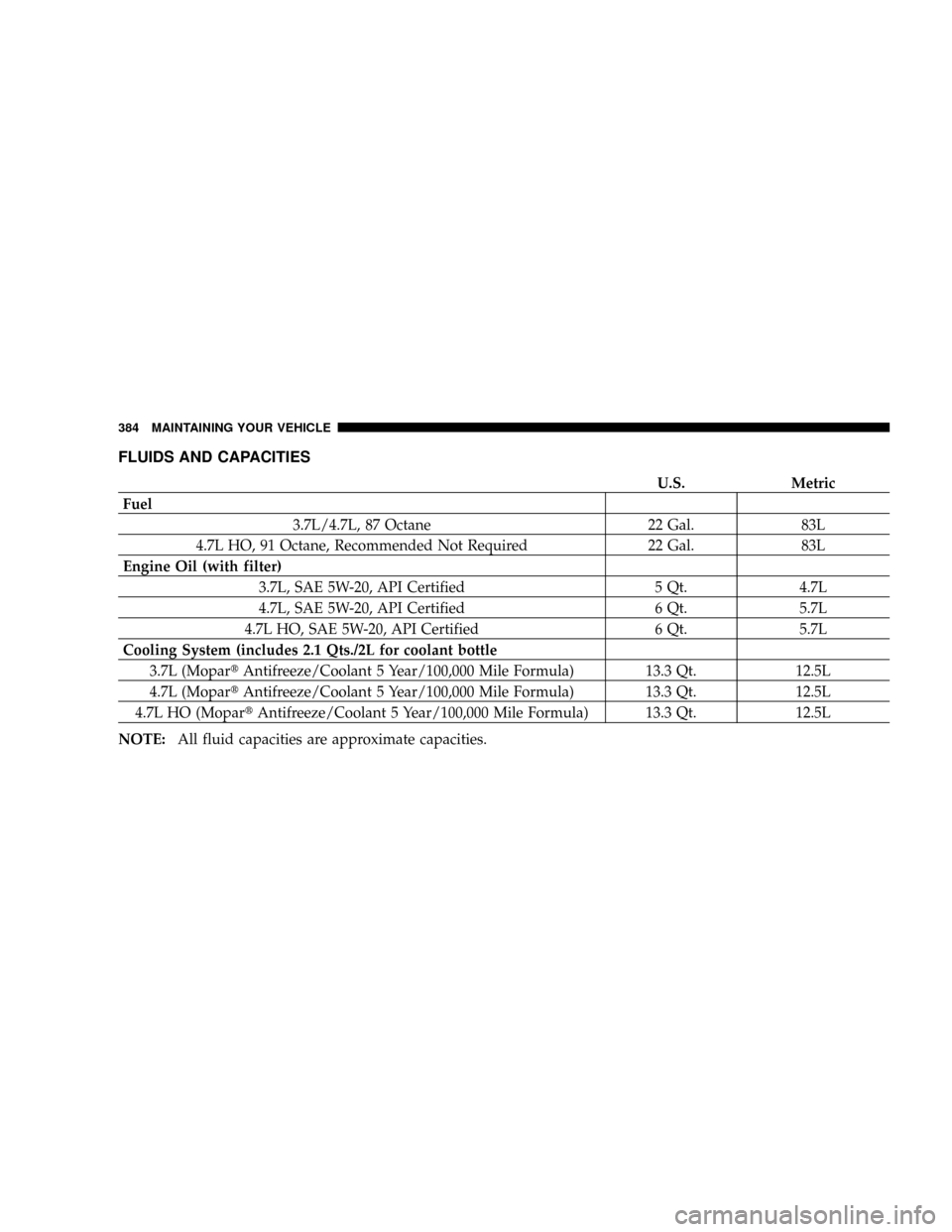
FLUIDS AND CAPACITIES
U.S. Metric
Fuel
3.7L/4.7L, 87 Octane 22 Gal. 83L
4.7L HO, 91 Octane, Recommended Not Required 22 Gal. 83L
Engine Oil (with filter)
3.7L, SAE 5W-20, API Certified 5 Qt. 4.7L
4.7L, SAE 5W-20, API Certified 6 Qt. 5.7L
4.7L HO, SAE 5W-20, API Certified 6 Qt. 5.7L
Cooling System (includes 2.1 Qts./2L for coolant bottle
3.7L (MopartAntifreeze/Coolant 5 Year/100,000 Mile Formula) 13.3 Qt. 12.5L
4.7L (MopartAntifreeze/Coolant 5 Year/100,000 Mile Formula) 13.3 Qt. 12.5L
4.7L HO (MopartAntifreeze/Coolant 5 Year/100,000 Mile Formula) 13.3 Qt. 12.5L
NOTE:All fluid capacities are approximate capacities.
384 MAINTAINING YOUR VEHICLE