fuel DODGE DAKOTA 2009 3.G User Guide
[x] Cancel search | Manufacturer: DODGE, Model Year: 2009, Model line: DAKOTA, Model: DODGE DAKOTA 2009 3.GPages: 449, PDF Size: 10.96 MB
Page 239 of 449
NTire Pressures For High Speed Operation.... 282
NRadial Ply Tires...................... 283
NCompact Spare Tire Ð If Equipped........ 284
NLimited-Use Spare Ð If Equipped......... 284
NTire Spinning....................... 285
NTread Wear Indicators................. 286
NLife Of Tire......................... 286
NReplacement Tires.................... 287
NAlignment And Balance................ 288
mSupplemental Tire Pressure Information Ð If
Equipped............................ 289
mTire Chains.......................... 289
mSnow Tires.......................... 291mTire Rotation Recommendations............ 291
mTire Pressure Monitor System (TPMS) Ð If
Equipped............................ 292
NBase System ± If Equipped.............. 295
NGeneral Information................... 297
mFuel Requirements..................... 297
NReformulated Gasoline................. 298
NGasoline/Oxygenate Blends............. 298
NE-85 Usage In Non-Flex Fuel Vehicles...... 299
NMMT In Gasoline.................... 300
NMaterials Added To Fuel............... 300
NFuel System Cautions.................. 300
NCarbon Monoxide Warnings............. 302
STARTING AND OPERATING 237
5
Page 240 of 449
mFlexible Fuel (4.7L Engine Only) Ð If Equipped. . 302
NE-85 General Information............... 302
NEthanol Fuel (E-85)................... 304
NFuel Requirements.................... 304
NSelection Of Engine Oil For Flexible Fuel
Vehicles (E-85) And Gasoline Vehicles...... 305
NStarting........................... 305
NCruising Range...................... 305
NReplacement Parts.................... 305
mAdding Fuel......................... 306
NFuel Filler Cap (Gas Cap)............... 306
mVehicle Loading....................... 308
NCertification Label.................... 308
NCurb Weight........................ 309NLoading........................... 309
mTrailer Towing........................ 310
NCommon Towing Definitions............ 311
NTrailer Hitch Classification.............. 315
NTrailer Towing Weights (Maximum Trailer
Weight Ratings)...................... 316
NTrailer And Tongue Weight.............. 316
NTowing Requirements................. 317
NTowing Tips........................ 322
mSnowplow........................... 323
mRecreational Towing (Behind Motorhome,
Etc.)................................ 324
N2WD Models........................ 324
N4WD Models........................ 324
238 STARTING AND OPERATING
Page 242 of 449
Normal Starting
NOTE:Normal starting of either a warm or cold engine
is obtained without pumping or depressing the accelera-
tor pedal.
Turn the ignition switch to the START position and
release when the engine starts. If the engine fails to start
within 10 seconds, turn the key to the OFF position, wait
5 seconds, then repeat the starting procedure.
Extreme Cold Weather (below ±20ÉF or ±29ÉC)
To insure reliable starting at these temperatures, use of an
externally powered electric engine block heater (available
from your dealer) is recommended.
If Engine Fails To Start
WARNING!
²Never pour fuel or other flammable liquids into
the throttle body air inlet opening in an attempt to
start the vehicle. This could result in a flash fire
causing serious personal injury.
²Do not attempt to push or tow your vehicle to get
it started. Vehicles equipped with an automatic
transmission cannot be started this way. Unburned
fuel could enter the catalytic converter and once
the engine has started, ignite and damage the
converter and vehicle. If the vehicle has a dis-
charged battery, booster cables may be used to
obtain a start from a booster battery or the battery
in another vehicle. This type of start can be dan-
gerous if done improperly. Refer to ªJump-
Startingº in Section 6 and follow them carefully.
240 STARTING AND OPERATING
Page 243 of 449
If the engine fails to start after you have followed the
normal starting procedure, it may be flooded. Push the
accelerator pedal all the way to the floor and hold it there
while cranking the engine. This should clear any excess
fuel, in case the engine is flooded.
CAUTION!
To prevent damage to the starter, do not crank the
engine for more than 15 seconds at a time. Wait 10 to
15 seconds before trying again.
If the engine has been flooded, it may start to run, but not
have enough power to continue running when the key is
released. If this occurs, continue cranking with the accel-
erator pedal pushed all the way to the floor. Release the
accelerator pedal and the key once the engine is running
smoothly.If the engine shows no sign of starting after two 15 sec-
ond periods of cranking with the accelerator pedal held
to the floor, the normal starting procedure should be
repeated.
After Starting
The idle speed is automatically controlled and will de-
crease as the engine warms up.
ENGINE BLOCK HEATER Ð IF EQUIPPED
The engine block heater warms engine coolant and
permits quicker starts in cold weather. Connect the cord
to a standard 110-115 Volt AC electrical outlet with a
grounded, three-wire extension cord.
The engine block heater cord is located at the right front
of the engine compartment for all engine applications.
STARTING AND OPERATING 241
5
Page 245 of 449
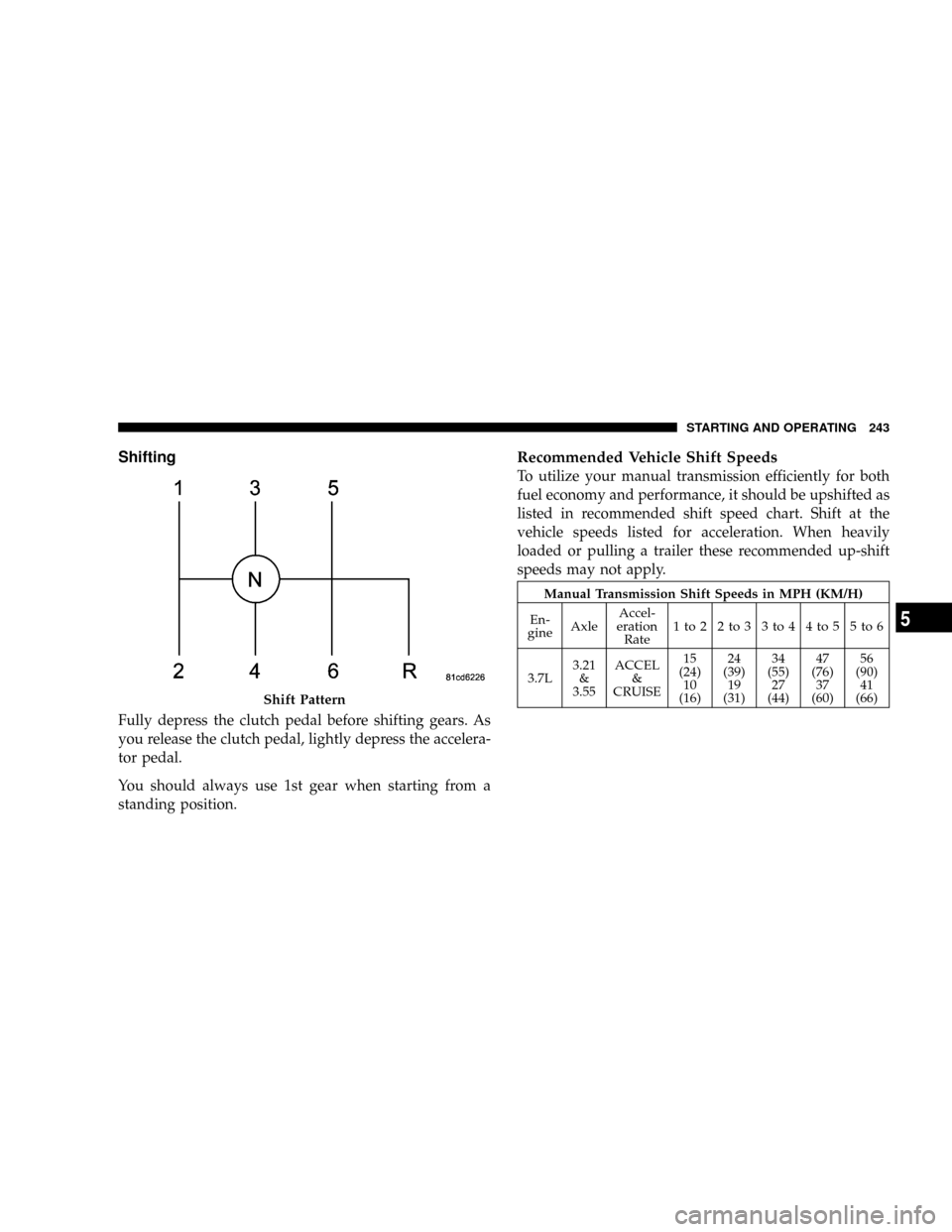
Shifting
Fully depress the clutch pedal before shifting gears. As
you release the clutch pedal, lightly depress the accelera-
tor pedal.
You should always use 1st gear when starting from a
standing position.
Recommended Vehicle Shift Speeds
To utilize your manual transmission efficiently for both
fuel economy and performance, it should be upshifted as
listed in recommended shift speed chart. Shift at the
vehicle speeds listed for acceleration. When heavily
loaded or pulling a trailer these recommended up-shift
speeds may not apply.
Manual Transmission Shift Speeds in MPH (KM/H)
En-
gineAxleAccel-
eration
Rate1to2 2to3 3to4 4to5 5to6
3.7L3.21
&
3.55ACCEL
&
CRUISE15
(24)
10
(16)24
(39)
19
(31)34
(55)
27
(44)47
(76)
37
(60)56
(90)
41
(66)
Shift Pattern
STARTING AND OPERATING 243
5
Page 252 of 449
operating in TOW/HAUL mode, 5th gear (if equipped) is
disabled and 2-3 and 3-4 shift patterns are modified.
Shifts into Overdrive (4th gear) are allowed during
steady cruise (for improved fuel economy), and auto-
matic closed-throttle downshifts to 3rd gear (for im-
proved braking) will occur during steady braking.
The TOW/HAUL light will illuminate in the instrument
cluster to indicate when the switch has been activated.
Pressing the switch a second time restores normal opera-
tion. If the TOW/HAUL mode is desired, the switch must
be pressed each time the engine is started.
Torque Converter Clutch
A feature designed to improve fuel economy is included
in all automatic transmissions. A clutch, within the
torque converter, engages automatically at a calibrated
speed at light throttle. It engages at higher speeds under
heavier acceleration. This may result in a slightly differ-
ent feeling or response during normal operation in highgear. When the vehicle speed drops below a calibrated
speed, or during acceleration, the clutch automatically
and smoothly disengages. The feature is operational in
Overdrive and in Drive.
NOTE:The torque converter clutch will not engage
until the transmission fluid and engine coolant are warm
(usually after 1-3 miles [1.6 - 4.8 km] of driving). Because
the engine speed is higher when the torque converter
clutch is not engaged, it may seem as if the transmission
is not shifting into Overdrive when cold. This is normal.
Pressing the TOW/HAUL switch, when the transmission
is sufficiently warm, will demonstrate that the transmis-
sion is able to shift into, and out of, Overdrive.
NOTE:If the vehicle has not been driven in several
days, the first few seconds of operation after shifting the
transmission into gear may seem sluggish. This is due to
the fluid partially draining from the torque converter into
the transmission. This condition is normal and will not
250 STARTING AND OPERATING
Page 283 of 449
WARNING! (Continued)
²Unequal tire pressures from one side of the ve-
hicle to the other can cause the vehicle to drift to
the right or left.
²Always drive with each tire inflated to the recom-
mended cold tire inflation pressure.
Economy
Improper inflation pressures can cause uneven wear
patterns to develop across the tire tread. These abnormal
wear patterns will reduce tread life resulting in a need for
earlier tire replacement. Under-inflation also increases
tire rolling resistance and results in higher fuel
consumption.
Ride Comfort and Vehicle Stability
Proper tire inflation contributes to a comfortable ride.
Over-inflation produces a jarring and uncomfortable
ride.
Tire Inflation Pressures
The proper cold tire inflation pressure is listed either on
the face of the driver's door or on the driver's side ªBº
pillar.
Some vehicles may have Supplemental Tire Pressure
Information for vehicle loads that are less than the
maximum loaded vehicle condition. These pressure con-
ditions will be found in the ªSupplemental Tire Pressure
Informationº section of this manual.
The pressure should be checked and adjusted as well as
inspecting for signs of tire wear or visible damage at least
once a month. Use a good quality pocket-type gauge to
check tire pressure. DO NOT make a visual judgement
when determining proper inflation. Radial tires may look
properly inflated even when they are under-inflated.
STARTING AND OPERATING 281
5
Page 296 of 449
CAUTION!
²The TPMS has been optimized for the original
equipment tires and wheels. TPMS pressures have
been established for the tire size equipped on your
vehicle. Undesirable system operation or sensor
damage may result when using replacement
equipment that is not of the same size, type, and/or
style. Aftermarket wheels can cause sensor dam-
age. Do not use aftermarket tire sealants or balance
beads if your vehicle is equipped with a TPMS, as
damage to the sensors may result.
²After inspecting or adjusting the tire pressure
always reinstall the valve stem cap. This will
prevent moisture and dirt from entering the valve
stem, which could damage the tire pressure moni-
toring sensor.NOTE:
²The TPMS is not intended to replace normal tire care
and maintenance, or to provide warning of a tire
failure or condition.
²The TPMS should not be used as a tire pressure gauge
while adjusting your tire pressure.
²Driving on a significantly under-inflated tire causes
the tire to overheat and can lead to tire failure.
Under-inflation also reduces fuel efficiency and tire
tread life, and may affect the vehicle's handling and
stopping ability.
²The TPMS is not a substitute for proper tire mainte-
nance, and it is the driver 's responsibility to maintain
correct tire pressure using an accurate tire gauge, even
if under-inflation has not reached the level to trigger
illumination of the Tire Pressure Monitoring Telltale
Lamp.
294 STARTING AND OPERATING
Page 299 of 449
General Information
This device complies with part 15 of the FCC rules and
RSS 210 of Industry Canada. Operation is subject to the
following conditions:
²This device may not cause harmful interference.
²This device must accept any interference received,
including interference that may cause undesired
operation.
The tire pressure sensors are covered under one of the
following licenses:
United States.....................KR5S120123
Canada........................2671-S120123
FUEL REQUIREMENTS
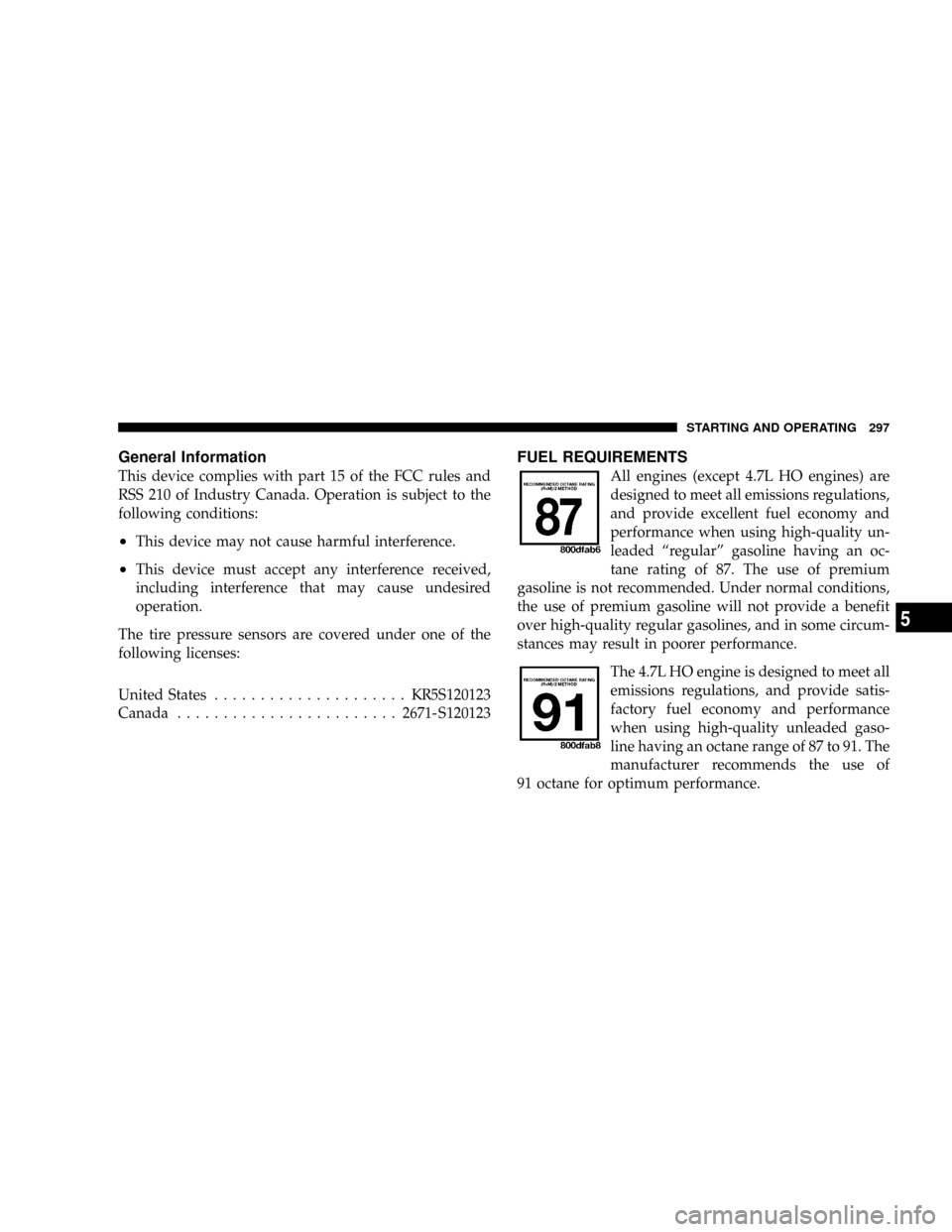
All engines (except 4.7L HO engines) are
designed to meet all emissions regulations,
and provide excellent fuel economy and
performance when using high-quality un-
leaded ªregularº gasoline having an oc-
tane rating of 87. The use of premium
gasoline is not recommended. Under normal conditions,
the use of premium gasoline will not provide a benefit
over high-quality regular gasolines, and in some circum-
stances may result in poorer performance.
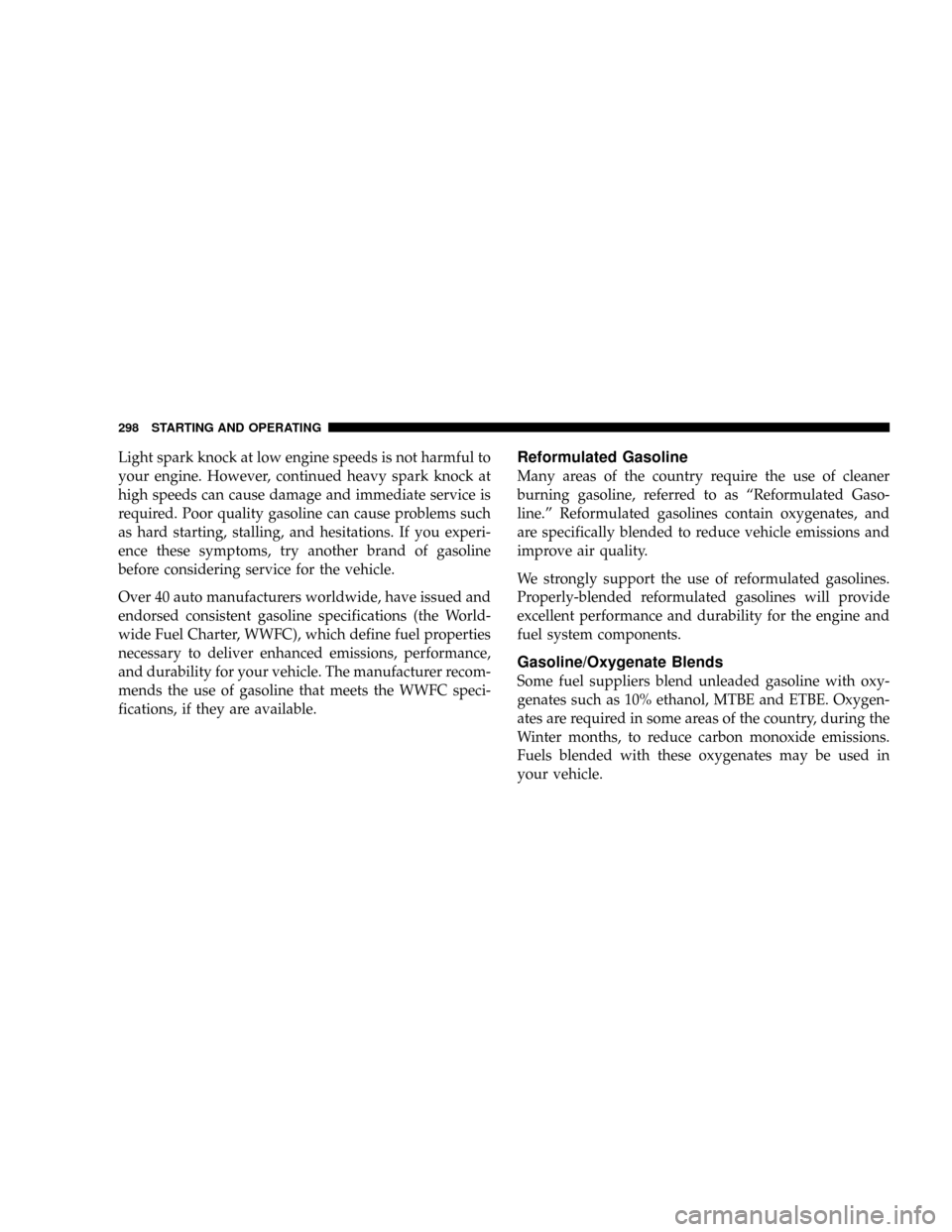
The 4.7L HO engine is designed to meet all
emissions regulations, and provide satis-
factory fuel economy and performance
when using high-quality unleaded gaso-
line having an octane range of 87 to 91. The
manufacturer recommends the use of
91 octane for optimum performance.
STARTING AND OPERATING 297
5
Page 300 of 449
Light spark knock at low engine speeds is not harmful to
your engine. However, continued heavy spark knock at
high speeds can cause damage and immediate service is
required. Poor quality gasoline can cause problems such
as hard starting, stalling, and hesitations. If you experi-
ence these symptoms, try another brand of gasoline
before considering service for the vehicle.
Over 40 auto manufacturers worldwide, have issued and
endorsed consistent gasoline specifications (the World-
wide Fuel Charter, WWFC), which define fuel properties
necessary to deliver enhanced emissions, performance,
and durability for your vehicle. The manufacturer recom-
mends the use of gasoline that meets the WWFC speci-
fications, if they are available.Reformulated Gasoline
Many areas of the country require the use of cleaner
burning gasoline, referred to as ªReformulated Gaso-
line.º Reformulated gasolines contain oxygenates, and
are specifically blended to reduce vehicle emissions and
improve air quality.
We strongly support the use of reformulated gasolines.
Properly-blended reformulated gasolines will provide
excellent performance and durability for the engine and
fuel system components.
Gasoline/Oxygenate Blends
Some fuel suppliers blend unleaded gasoline with oxy-
genates such as 10% ethanol, MTBE and ETBE. Oxygen-
ates are required in some areas of the country, during the
Winter months, to reduce carbon monoxide emissions.
Fuels blended with these oxygenates may be used in
your vehicle.
298 STARTING AND OPERATING