oil temperature DODGE DAKOTA 2009 3.G Owners Manual
[x] Cancel search | Manufacturer: DODGE, Model Year: 2009, Model line: DAKOTA, Model: DODGE DAKOTA 2009 3.GPages: 449, PDF Size: 10.96 MB
Page 174 of 449
CHAngE OIL and the outside temperature on vehicles
that are not equipped with the Overhead Console with
Compass/Temperature Mini-Trip Computer.
If the vehicle diagnostic system determines that the fuel
filler cap is loose, improperly installed, or damaged,
ªGASCAPº will be displayed in the instrument cluster.
Tighten the fuel filler cap properly and press the odom-
eter RESET button to turn the ªGASCAPº message off. If
the problem continues, the message will appear the next
time the vehicle is started.
Change Oil Message
Your vehicle is equipped with an engine oil change
indicator system. The ªCHAngE OILº message will flash
in the instrument cluster odometer for approximately
12 seconds after a single chime has sounded, to indicate
the next scheduled oil change interval. The engine oil
change indicator system is duty cycle based, which
means the engine oil change interval may fluctuate
dependent upon your personal driving style.Unless reset, this message will continue to display each
time you turn the ignition switch to the ON/RUN
position. To turn off the message temporarily, press and
release the Trip Odometer button on the instrument
cluster. To reset the oil change indicator system (after
performing the scheduled maintenance) refer to the fol-
lowing procedure.
1. Turn the ignition switch to the ON position(do not
start the engine).
2. Fully depress the accelerator pedal slowly three
times within 10 seconds.
3. Turn the ignition switch to the OFF/LOCK position.
NOTE:If the indicator message illuminates when you
start the vehicle, the oil change indicator system did not
reset. If necessary, repeat this procedure.
172 UNDERSTANDING YOUR INSTRUMENT PANEL
Page 235 of 449
As the temperature gets colder it may be necessary to
direct air onto the windshield by using MIX Mode
position on the control. Adjust the temperature control
and blower speed to maintain comfort. High blower
speeds will reduce fogging. Interior fogging on the
windshield can be quickly removed by selecting the
defrost mode.
Regular cleaning of the inside of the windows with a
non-filming cleaning solution (vinegar and water works
very well) will help prevent contaminates (cigarette
smoke, perfumes, etc.) from sticking to the windows.
Contaminates on the inside of windows can increase the
rate of window fogging.
Summer Operation
Air conditioned vehicles must be protected with a high
quality antifreeze coolant during summer, to provide
proper corrosion protection and to raise the boiling point
of the coolant for protection against overheating. A 50%concentration of engine coolant to distilled water is
recommended. Refer to ªCooling Systemº under ªMain-
tenance Proceduresº in Section 7.
When using the air conditioner in extremely heavy
traffic, in hot weather, especially when towing a trailer,
additional engine cooling may be required. If this situa-
tion is encountered, operate the transmission in a lower
gear and set the air conditioner to recirculation mode.
Operating the air conditioner in recirculation mode pro-
vides the maximum performance from your air condi-
tioning. When stopped in heavy traffic, it may be neces-
sary to shift into NEUTRAL and depress the accelerator
slightly for fast idle operation.
Winter Operation
When operating the system during the winter months,
make sure the air intake, located directly in front of the
windshield, is free of ice, slush, snow, or other obstruc-
tions. This will help prevent snow going into the ducts.
UNDERSTANDING YOUR INSTRUMENT PANEL 233
4
Page 307 of 449
Selection Of Engine Oil For Flexible Fuel Vehicles
(E-85) and Gasoline Vehicles
FFV vehicles operated on E-85 require specially formu-
lated engine oils. These special requirements are included
in MOPARtengine oils, and in equivalent oils meeting
Chrysler Specification MS-6395. The manufacturer only
recommends engine oils that are API Certified and meet
the requirements of Material Standard MS-6395. MS-6395
contains additional requirements, developed during ex-
tensive fleet testing, to provide additional protection to
Chrysler LLC engines. Use MOPARtor an equivalent oil
meeting the specification MS-6395.
Starting
The characteristics of E-85 fuel make it unsuitable for use
when ambient temperatures fall below 0ÉF (-18ÉC). In the
range of 0ÉF (-18ÉC) to 32ÉF (0ÉC), you may experience an
increase in the time it takes for your engine to start, and
a deterioration in drivability (sags and/or hesitations)
until the engine is fully warmed up.
CAUTION!
Do not use ethanol mixture greater than 85% in your
vehicle. It will cause difficulty in cold starting and
may affect drivability.
Cruising Range
Because E-85 fuel contains less energy per gallon/Liter
than gasoline, you will experience an increase in fuel
consumption. You can expect your miles per gallon
(mpg)/miles per liter and your driving range to decrease
by about 30%, compared to gasoline operation.
Replacement Parts
Many components in your Flexible Fuel Vehicle (FFV) are
designed to be compatible with ethanol. Always be sure
that your vehicle is serviced with correct ethanol, com-
patible parts.
STARTING AND OPERATING 305
5
Page 359 of 449
Checking the oil while the vehicle is on level ground will
improve the accuracy of the oil level readings. Always
maintain the oil level within the SAFE zone on the
dipstick. Adding one quart/liter of oil when the reading
is at the bottom of the SAFE zone will result in a reading
at the top of the safe zone on these engines.
CAUTION!
Overfilling or underfilling the crankcase will cause
oil aeration or loss of oil pressure. This could damage
your engine.
Change Engine Oil
Refer to the ªMaintenance Scheduleº in Section 8 for
proper maintenance intervals.
Engine Oil Selection
For best performance and maximum protection under all
types of operating conditions, the manufacturer onlyrecommends engine oils that are API certified and meet
the requirements of Chrysler Material Standard MS-6395.
American Petroleum Institute (API) Engine Oil
Identification Symbol
This symbol means that the oil has
been certified by the American
Petroleum Institute (API). The
manufacturer only recommends
API Certified engine oils.
Engine Oil Viscosity (SAE Grade)
SAE 5W-20 engine oil is recommended for all operating
temperatures. This engine oil improves low temperature
starting and vehicle fuel economy.
MAINTAINING YOUR VEHICLE 357
7
Page 365 of 449
Windshield Washers
The fluid reservoir should be checked for fluid level at
regular intervals. When freezing weather is anticipated,
flush out the water in the reservoir by operating the
system. Fill the reservoir with windshield washer anti-
freeze (not radiator antifreeze), and operate the system
for a few seconds to flush out the residual water.
To prevent freeze-up of your windshield washer system
in cold weather, select a solution or mixture that meets or
exceeds the temperature range of your climate. This
rating information can be found on most washer fluid
containers.
WARNING!
Commercially available windshield washer solvents
are flammable. They could ignite and burn you. Care
must be exercised when filling or working around
the washer solution.
Exhaust System
The best protection against carbon monoxide entry into
the vehicle body is a properly maintained engine exhaust
system.
Whenever a change is noticed in the sound of the exhaust
system, when exhaust fumes can be detected inside the
vehicle, or when the underside or rear of the vehicle is
damaged, have a competent mechanic inspect the com-
plete exhaust system and adjacent body areas for broken,
damaged, deteriorated, or mispositioned parts. Open
seams or loose connections could permit exhaust fumes
to seep into the passenger compartment. In addition,
inspect the exhaust system each time the vehicle is raised
for lubrication or oil change. Replace as required.
MAINTAINING YOUR VEHICLE 363
7
Page 375 of 449
To check the automatic transmission fluid level properly,
the following procedure must be used:
1. Operate the engine at idle speed and normal operating
temperature.
2. The vehicle must be on level ground.
3. Fully apply the parking brake and press the brake
pedal.
4. Place the gear selector momentarily in each gear
position, ending with the lever in PARK.
5. Remove the dipstick, wipe it clean and reinsert it until
seated.
6. Remove the dipstick again and note the fluid level on
both sides. The fluid level should be between the ªHOTº
(upper) reference holes on the dipstick at normal operat-
ing temperature. Verify that solid coating of oil is seen on
both sides of the dipstick. If the fluid is low, add asrequired into the dipstick tube.Do not overfill.After
adding any quantity of oil through the oil fill tube, wait
a minimum of two minutes for the oil to fully drain into
the transmission before rechecking the fluid level.
NOTE:If it is necessary to check the transmissionbelow
the operating temperature, the fluid level should be
between the two ªCOLDº (lower) holes on the dipstick
with the fluid at approximately 70É F (21É C) (room
temperature). If the fluid level is correctly established at
room temperature, it should be between the ªHOTº
(upper) reference holes when the transmission reaches
180É F (82É C). Remember it is best to check the level at
the normal operating temperature.
MAINTAINING YOUR VEHICLE 373
7
Page 434 of 449
Exhaust Gas Caution..................71,302
Flooded, Starting...................... 240
Fuel Requirements..................... 396
Jump Starting......................... 343
Oil ...........................356,396,397
Oil Filler Cap......................... 357
Oil Selection.......................... 396
Oil Synthetic......................... 358
Starting............................. 239
Temperature Gauge..................... 168
Entry System, Illuminated.................. 20
Event Data Recorder...................... 56
Exhaust Gas Caution................71,302,364
Exhaust System.......................71,363
Extender, Seat Belt........................ 45
Exterior Lighting........................ 125
Fabric Care............................ 379Filters
Air Cleaner.......................... 359
Engine Oil........................358,397
Engine Oil Disposal.................... 358
Flashers
Hazard Warning....................... 332
Turn Signal.....................127,168,389
Flat Tire Stowage........................ 343
Flexible Fuel Vehicles
Cruising Range........................ 305
Engine Oil........................... 305
Fuel Requirements..................302,304
Replacement Parts..................... 305
Starting............................. 305
Flooded Engine Starting................... 240
Floor Console.......................... 154
Fluid, Brake........................... 398
Fluid Capacities......................... 396
432 INDEX
Page 435 of 449
Fluid Level Checks
Automatic Transmission................. 372
Brake............................... 371
Engine Oil........................... 356
Power Steering........................ 266
Transfer Case......................... 375
Fluids, Lubricants and Genuine Parts.......... 397
Fog Lights..........................126,395
Four Wheel Drive....................... 251
Operation........................... 251
Four-Way Hazard Flasher.................. 332
Freeing A Stuck Vehicle................... 346
Front Axle (Differential)................... 376
Fuel................................. 297
Adding............................. 306
Gauge.............................. 168
Octane Rating......................297,397
Requirements......................297,396
Tank Capacity........................ 396Fuel, Flexible.............See Flexible Fuel Vehicles
Fueling............................... 306
Fuses................................ 381
Garage Door Opener (HomeLinkt) ........... 142
Gas Cap (Fuel Filler Cap)...............306,353
Gas Gauge (Fuel Gauge)................... 168
Gasoline (Fuel)......................... 297
Gasoline, Reformulated................... 298
Gauges
Coolant Temperature.................... 168
Fuel................................ 168
Odometer.........................171,173
Speedometer......................... 170
Tachometer.......................... 171
Gear Ranges........................243,246
General Information................... 110,297
Glass Cleaning.......................... 380
Grocery Bag Retainer..................... 153
INDEX 433
10
Page 443 of 449
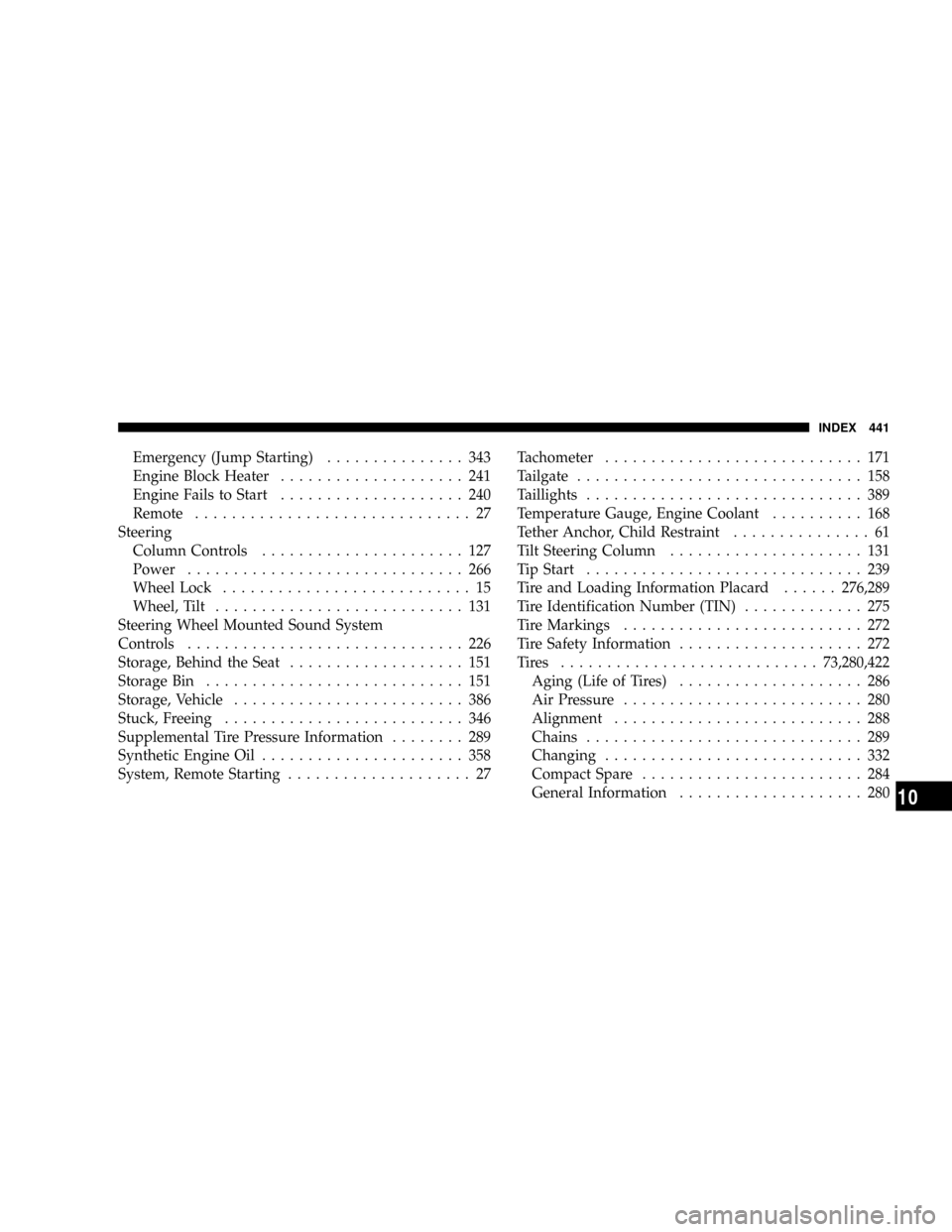
Emergency (Jump Starting)............... 343
Engine Block Heater.................... 241
Engine Fails to Start.................... 240
Remote.............................. 27
Steering
Column Controls...................... 127
Power.............................. 266
Wheel Lock........................... 15
Wheel, Tilt........................... 131
Steering Wheel Mounted Sound System
Controls.............................. 226
Storage, Behind the Seat................... 151
Storage Bin............................ 151
Storage, Vehicle......................... 386
Stuck, Freeing.......................... 346
Supplemental Tire Pressure Information........ 289
Synthetic Engine Oil...................... 358
System, Remote Starting.................... 27Tachometer............................ 171
Tailgate............................... 158
Taillights.............................. 389
Temperature Gauge, Engine Coolant.......... 168
Tether Anchor, Child Restraint............... 61
Tilt Steering Column..................... 131
Tip Start.............................. 239
Tire and Loading Information Placard......276,289
Tire Identification Number (TIN)............. 275
Tire Markings.......................... 272
Tire Safety Information.................... 272
Tires ............................73,280,422
Aging (Life of Tires).................... 286
Air Pressure.......................... 280
Alignment........................... 288
Chains.............................. 289
Changing............................ 332
Compact Spare........................ 284
General Information.................... 280
INDEX 441
10
Page 447 of 449

INTRODUCTION INTRODUCTION HOW TO USE THIS MANUAL WARNINGS AND CAUTIONS VEHICLE IDENTIFICATION NUMBER VEHICLE MODIFICATIONS/ALTERATIONS THINGS TO KNOW BEFORE STARTING YOUR VEHICLE A WORD ABOUT YOUR KEYS
Ignition Key RemovalLocking Doors With The KeySTEERING WHEEL LOCK - IF EQUIPPED If You Wish To Manually Lock The Steering WheelTo Release The SteeringWheel LockAutomatic Transmission Ignition Interlock SystemSENTRY KEY IMMOBILIZER SYSTEM
- IF EQUIPPED Replacement KeysCustomer Key ProgrammingVEHICLE SECURITY ALARM SYSTEM - IF EQUIPPED To Set the AlarmTo Disarm the SystemILLUMINATED ENTRY Vehicles Equipped With Power Door LocksREMOTE KEYLESS ENTRY To Unlock The
DoorsTo Lock The DoorsUsing The Panic AlarmGeneral InformationProgramming Additional TransmittersBattery ReplacementREMOTE STARTING SYSTEM -IF EQUIPPED DOOR LOCKS Manual Door LocksPower Door LocksChild Protection Door LockWINDOWS Power
WindowsAuto Down (Drivers Side Only)Window Lockout SwitchWind BuffetingOCCUPANT RESTRAINTS Lap/Shoulder BeltsAdjustable Upper Shoulder Belt AnchorageAutomatic Locking Retractors (ALR) Mode - If EquippedCenter Lap BeltsSeat Belt Pretensioners
Enhanced Driver Seat Belt Reminder System (BeltAlert) Seat Belts And Pregnant WomenSeat Belt ExtenderDriver And Right Front Passenger Supplemental Restraint System (SRS) - AirbagsEvent Data Recorder (EDR)Child RestraintENGINE BREAK-IN
RECOMMENDATIONS SAFETY TIPS Exhaust SystemSafety Checks You Should Make Inside The VehicleSafety Checks You Should Make Outside The VehicleUNDERSTANDING THE FEATURES OF YOUR VEHICLE MIRRORS Inside Day/Night MirrorOutside Mirrors
Outside Mirrors Folding Feature - If EquippedPower MirrorsHANDS-FREE COMMUNICATION (UConnect) - IF EQUIPPED OperationPhone Call FeaturesUConnect System FeaturesAdvanced Phone ConnectivityThings You Should Know About Your UConnect System
General InformationVOICE RECOGNITION SYSTEM (VR) - IF EQUIPPED Voice Recognition System (VR) OperationCommandsVoice TrainingSEATS Manual Seat AdjustmentFront Seats Manual Seat ReclinersManual Lumbar Support Adjustment - If EquippedAdjustable
Head Restraints - Front Seating PositionsSix-Way Power Seat Adjuster - Drivers Side OnlyExtended Cab/Crew Cab Rear SeatHeated Seats - If EquippedTOOPEN AND CLOSE THE HOOD LIGHTS Interior LightsBattery SaverHeadlight DelayHeadlights, Parking Lights
And Panel LightsDaytime Running Lights (Canada - Standard and U.S. Fleet Vehicles) - If EquippedLights-on ReminderFog Lights - If EquippedCargo Light - If EquippedMultifunction LeverWINDSHIELD WIPERS AND WASHERS Windshield WipersWindshield Washers
TILT STEERING COLUMN ELECTRONIC SPEED CONTROL - IF EQUIPPED To ActivateTo Set At A Desired SpeedTo DeactivateTo Resume SpeedTo Vary The Speed SettingTo Accelerate For PassingOVERHEAD CONSOLE Courtesy/Reading Lights
COMPASS/TEMPERATURE MINI-TRIP COMPUTER US/M ButtonRESET ButtonSTEP ButtonAverage Fuel Economy (AVG ECO)Distance To Empty (DTE)Trip Odometer (ODO)Elapsed Time (ET)C/T ButtonGlobal ResetCompass/Temperature DisplayAutomatic Compass
CalibrationManual Compass CalibrationTo Put Into a Calibration ModeOutside TemperatureGARAGE DOOR OPENER - IF EQUIPPED Programming HomeLinkGate Operator/Canadian ProgrammingUsing HomeLinkReprogramming A Single HomeLink ButtonSecurity
Troubleshooting TipsGeneral InformationELECTRICAL POWER OUTLETS Electrical Outlet Use With Engine OFF (Battery Fed Configuration)CUPHOLDERS REAR STORAGE - IF EQUIPPED Rear Convenience Storage CratesPlastic Grocery Bag Retainers FLOOR
CONSOLE - IF EQUIPPED Floor Console FeaturesREAR CARGO AREA UTILITY RAILS REAR WINDOW FEATURES Rear Window Defroster - If EquippedSliding Rear Window - If EquippedSLIDE-IN CAMPERS Camper ApplicationsGeneral InformationCarbon Monoxide
Warning-Vehicles Equipped With A Cap or Slide-In CampersTAILGATE Tailgate RemovalTwo-Position Tailgate/Upper Load PlatformUNDERSTANDING YOURINSTRUMENT PANEL INSTRUMENTS AND CONTROLS INSTRUMENT CLUSTER INSTRUMENT CLUSTER
DESCRIPTION ELECTRONIC DIGITAL CLOCK Clock Setting ProcedureSALES CODE REQ - AM/FM STEREO RADIO AND 6-DISC CD/DVD CHANGER (MP3/WMA AUX JACK) Operating Instructions - Radio ModeOperation Instructions - (DISC MODE for CD and
MP3/WMA Audio Play, DVD-VIDEO)Notes On Playing MP3/WMA FilesLIST Button (DISC Mode for MP3/WMA Play)INFO Button (DISC Mode for MP3/WMA Play)AM/FM/CD/DVD MULTIMEDIA SYSTEM RADIO (RER/REN) - IF EQUIPPED Operating Instructions - Voice
Recognition System (VR) - If EquippedOperating Instructions - Hands-Free Communication (UConnect) - If EquippedClock Setting ProcedureSALES CODE RES - AM/FM STEREO RADIO WITH CD PLAYER (MP3 AUX JACK) Operating Instructions - Radio ModeOperation
Instructions - CD MODE For CD And MP3 Audio PlayNotes on Playing MP3 FilesOperation Instructions - Auxiliary ModeSALES CODE RES/RSC - AM/FM STEREO RADIO WITH CD PLAYER (MP3 AUX JACK) AND SIRIUS RADIO Operating Instructions - Radio Mode
Operation Instructions - CD MODE for CD and MP3 Audio PlayNotes On Playing MP3 FilesLIST Button (CD Mode for MP3 Play)INFO Button (CD Mode for MP3 Play)SOUND BOX OPERATION SATELLITE RADIO - IF EQUIPPED (REN/REQ/RER/RES/REU RADIOS ONLY)
System ActivationElectronic Serial Number/Sirius Identification Number (ESN/SID)Selecting Satellite ModeSatellite AntennaReception QualityOperating Instructions - Satellite ModeOperating Instructions - Hands-Free Phone (If Equipped)Operating Instructions - Video
Entertainment System (VES) (If Equipped)REMOTE SOUND SYSTEM CONTROLS - IF EQUIPPED Radio OperationCD PlayerCD/DVD MAINTENANCE RADIO OPERATION AND CELLULAR PHONES CLIMATE CONTROLS Air Conditioning And Heater Operating Tips
Operation Tips Chart STARTING AND OPERATING STARTING PROCEDURES Manual TransmissionAutomatic TransmissionNormal StartingExtreme Cold Weather(below -20 degrees F or -29 degrees C)If Engine Fails To StartAfter StartingENGINE BLOCK HEATER -
IF EQUIPPED MANUAL TRANSMISSION Shifting DownshiftingReverse ShiftingAUTOMATIC TRANSMISSION Brake/Transmission Interlock SystemAutomatic TransmissionFOUR-WHEEL DRIVE OPERATION NV233/243 GII Transfer Case Operating Information/
PrecautionsShifting Procedure - NV233/243 Transfer Case NV 244 Generation II Transfer Case Operating Information / PrecautionsShifting Procedure - NV 244 Generation II Transfer Case LIMITED-SLIP REAR AXLE DIFFERENTIAL - IF EQUIPPED DRIVING ON SLIPPERY
SURFACES DRIVING THROUGH WATER Flowing/Rising WaterShallow Standing WaterPOWER STEERING Power Steering Fluid CheckPARKING BRAKE BRAKE SYSTEM Rear-Wheel Anti-Lock Brake System (ABS) - If EquippedFour-Wheel Anti-Lock Brake System
(ABS)TIRE SAFETY INFORMATION Tire Markings Tire Identification Number (TIN)Tire Loading and Tire PressureTIRES - GENERAL INFORMATION Tire PressureTire Inflation PressuresTire Pressures for High Speed OperationRadial Ply TiresCompact Spare Tire - If
EquippedLimited-Use Spare - If EquippedTire SpinningTread Wear IndicatorsLife of TireReplacement TiresAlignment And BalanceSUPPLEMENTAL TIREPRESSURE
INFORMATION - IF EQUIPPED TIRE CHAINS SNOW TIRES TIRE ROTATION RECOMMENDATIONS TIRE PRESSURE MONITOR SYSTEM (TPMS) - IF EQUIPPED Base System - If EquippedGeneral InformationFUEL REQUIREMENTS Reformulated Gasoline
Gasoline/Oxygenate BlendsE-85 Usage In Non-Flex Fuel VehiclesMMT In GasolineMaterials Added To FuelFuel System CautionsCarbon Monoxide WarningsFLEXIBLE FUEL (4.7L ENGINE ONLY) - IF EQUIPPED E-85 General InformationETHANOL FUEL (E-85)Fuel
RequirementsSelection Of Engine Oil For Flexible Fuel Vehicles (E-85) and Gasoline VehiclesStartingCruising RangeReplacement PartsADDING FUELFuel Filler Cap (Gas Cap)VEHICLE LOADING Certification LabelCurb WeightLoadingTRAILER TOWING Common Towing
DefinitionsTrailer Hitch ClassificationTrailer Towing Weights (Maximum Trailer Weight Ratings)Trailer and Tongue WeightTowing RequirementsTowing TipsSNOWPLOW RECREATIONAL TOWING (BEHIND MOTORHOME, ETC.) 2WD Models4WD ModelsWHAT TO DO
IN EMERGENCIES HAZARD WARNING FLASHER CHANGING A FLAT TIRE Jack LocationRemoving The Spare TireTire Changing ProcedurePreparationsInstructionsTo Stow the Flat or SpareJUMP-STARTING FREEING A STUCK VEHICLE EMERGENCY TOW HOOKS
- IF EQUIPPED TOWING A DISABLED VEHICLE Four-Wheel Drive VehiclesTwo-Wheel Drive VehiclesMAINTAINING YOUR VEHICLE ENGINE COMPARTMENT - 3.7L ENGINE COMPARTMENT - 4.7L ONBOARD DIAGNOSTIC SYSTEM - OBD II Loose Fuel Filler Cap
MessageEMISSIONS INSPECTION AND MAINTENANCE PROGRAMS REPLACEMENT PARTS DEALER SERVICE MAINTENANCE PROCEDURES Engine OilEngine Oil FilterEngine Air Cleaner FilterMaintenance-Free BatteryAir Conditioner MaintenanceDrive Shaft
Constant Velocity JointsBody LubricationWindshield Wiper BladesWindshield WashersExhaust SystemCooling SystemBrake SystemClutch HydraulicSystemManual TransmissionAutomatic TransmissionTransfer CaseAxlesAppearance Care and Protection from Corrosion
FUSES Underhood Fuses (Power Distribution Center)VEHICLE STORAGE REPLACEMENT LIGHT BULBS BULB REPLACEMENT Headlight (Halogen)/Front Park And Turn LightsRear Side Marker, Taillamps/Stop Lamps, And Turn Signal Bulbs - ReplacementCenter
High-Mounted Stop Light And Cargo LampLicense LampsFog LightsFLUIDS AND CAPACITIES FLUIDS, LUBRICANTS AND GENUINE PARTS EngineChassisMAINTENANCE SCHEDULES EMISSIONS CONTROL SYSTEM MAINTENANCE MAINTENANCE SCHEDULE
Required Maintenance IntervalsIF YOU NEED CONSUMER ASSISTANCE SUGGESTIONS FOR OBTAINING SERVICE FOR YOUR VEHICLE Prepare For The AppointmentPrepare A ListBe Reasonable With RequestsWARRANTY INFORMATION (U.S. Vehicles Only)
MOPAR PARTS REPORTING SAFETY DEFECTS In The 50 United States And Washington, D.CIn CanadaPUBLICATION ORDER FORMS DEPARTMENT OF TRANSPORTATION UNIFORM TIRE QUALITY GRADES TreadwearTraction GradesTemperature GradesIF YOU
NEED ASSISTANCE Chrysler LLC Customer CenterChrysler Canada Inc. Customer CenterIn Mexico contactCustomer Assistance For The Hearing Or Speech Impaired (TDD/TTY)Service ContractINDEX