manual transmission DODGE DAKOTA 2009 3.G User Guide
[x] Cancel search | Manufacturer: DODGE, Model Year: 2009, Model line: DAKOTA, Model: DODGE DAKOTA 2009 3.GPages: 449, PDF Size: 10.96 MB
Page 320 of 449
WARNING! (Continued)
Make certain that the load is secured in the trailer
and will not shift during travel. When trailering
cargo that is not fully secured, dynamic load shifts
can occur that may be difficult for the driver to
control. You could lose control of your vehicle and
have an accident.
²When hauling cargo or towing a trailer, do not over-
load your vehicle or trailer. Overloading can cause a
loss of control, poor performance or damage to brakes,
axle, engine, transmission, steering, suspension, chas-
sis structure or tires.
²Safety chains must always be used between your
vehicle and trailer. Always connect the chains to the
frame or hook retainers of the vehicle hitch. Cross the
chains under the trailer tongue and allow enough
slack for turning corners.
²Vehicles with trailers should not be parked on a grade.
When parking, apply the parking brake on the tow
vehicle. Put the tow vehicle automatic transmission in
PARK. With a manual transmission, shift the transmis-
sion into REVERSE. For four-wheel drive vehicles,
make sure the transfer case is not in NEUTRAL.
Always, block or9chock9the trailer wheels.
²GCWR must not be exceeded.
²Total weight must be distributed between the tow
vehicle and the trailer so that the following four
ratings are not exceeded:
1. GVWR
2. GTW
3. GAWR
318 STARTING AND OPERATING
Page 324 of 449
Towing Tips
Before setting out on a trip, practice turning, stopping
and backing the trailer in an area away from heavy
traffic.
If using a manual transmission vehicle for trailer towing,
all starts must be in 1st gear to avoid excessive clutch
slippage.
Towing Tips Ð Automatic Transmission
The ªDº range can be selected when towing. However, if
frequent shifting occurs while in this range, the TOW/
HAUL feature should be selected.
NOTE:Using the TOW/HAUL feature while operating
the vehicle under heavy operating conditions will im-
prove performance and extend transmission life by re-
ducing excessive shifting and heat build up. This action
will also provide better engine braking.The automatic transmission fluid and filter should be
changed if you REGULARLY tow a trailer for more than
45 minutes of continuous operation. Refer to the ªMain-
tenance Scheduleº in Section 8 for proper maintenance
intervals.
NOTE:Check the automatic transmission fluid level
before towing.
Towing Tips Ð Tow/Haul (If Equipped)
To reduce potential for automatic transmission overheat-
ing, turn the TOW/HAUL feature ON when driving in
hilly areas or shift the transmission to Drive position 2 on
more severe grades.
Towing Tips Ð Electronic Speed Control (If
Equipped)
þ
Do not use in hilly terrain or with heavy loads.
322 STARTING AND OPERATING
Page 326 of 449
RECREATIONAL TOWING (BEHIND
MOTORHOME, ETC.)
2WD Models
Recreational towing of 2WD models is not allowable.
Towing the vehicle with the transmission in NEUTRAL
can cause severe transmission damage. Removal of the
driveshaft for towing is not recommended, since this
would allow fluid to drain from the transmission.
4WD Models
CAUTION!
²Internal damage to the transfer case will occur if a
front or rear wheel lift is used when recreational
towing.
(Continued)
CAUTION! (Continued)
²The transfer case must be shifted into NEUTRAL
for recreational towing. The NEUTRAL selection
button is located on the lower left hand corner of
the 4WD Control Switch. Shifts into and out of
transfer case NEUTRAL can take place with the
selector switch in any mode position.
²Automatic transmissions must be placed in PARK
position for recreational towing.
²Manual transmissions must be placed in gear (for
example, 4th gear) for recreational towing. Failure
to follow these procedures can cause severe trans-
mission and/or transfer case damage.
324 STARTING AND OPERATING
Page 327 of 449
Recreational Towing Procedure
Use the following procedure to prepare your vehicle for
recreational towing.
CAUTION!
It is necessary to follow these steps to be certain that
the transfer case is fully in NEUTRAL before recre-
ational towing to prevent damage to internal parts.
1. Bring vehicle to a complete stop.
2. Shut engine OFF.
3. Turn the ignition key to the ON position but do not
start the engine.
4. Depress brake pedal.
5. Shift automatic transmission into NEUTRAL, or de-
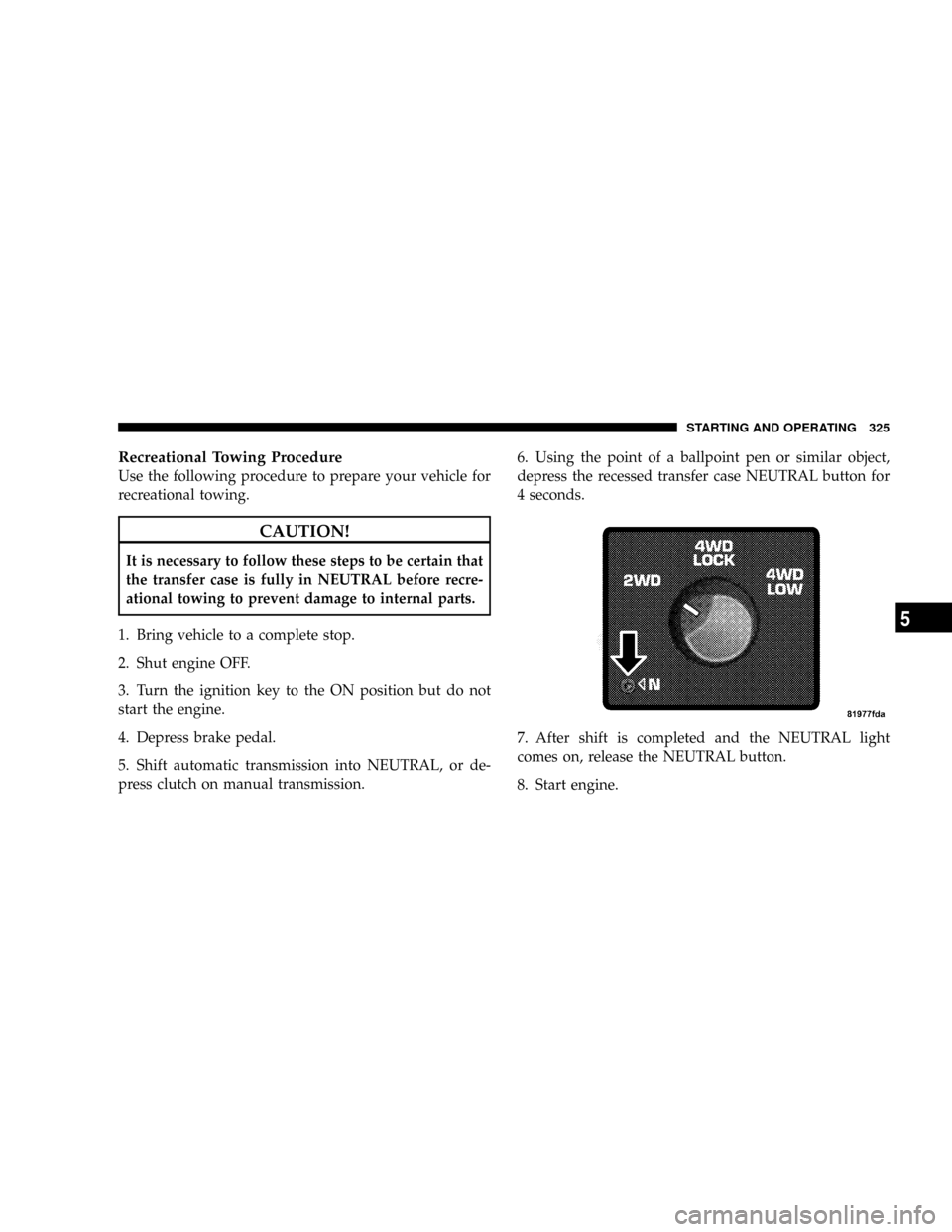
press clutch on manual transmission.6. Using the point of a ballpoint pen or similar object,
depress the recessed transfer case NEUTRAL button for
4 seconds.
7. After shift is completed and the NEUTRAL light
comes on, release the NEUTRAL button.
8. Start engine.
STARTING AND OPERATING 325
5
Page 328 of 449
9. Shift automatic transmission into REVERSE.
10. Release brake pedal for five seconds and ensure that
there is no vehicle movement.
11. Repeat steps 9 and 10 with the transmission in
DRIVE.
12. Shut engine OFF and place ignition key to the
unlocked OFF position.
13. Shift automatic transmission into PARK. Shift
manual transmissions into 4th gear.
14. Attach vehicle to tow vehicle with tow bar.
15. Disconnect the negative battery cable.
NOTE:
²Steps 1 through 5 are requirements that must be met
prior to depressing the NEUTRAL selection button,
and must continue to be met until the 4 seconds elapse
and the shift has been completed. If any of theserequirements (with the exception of 3 - Key ON) are
not met prior to depressing the NEUTRAL button or
are no longer met during the 4 second timer, then the
NEUTRAL indicator light will flash continuously until
all requirements are met or until the NEUTRAL button
is released.
²The ignition key must be ON for a shift to take place
and for the position indicator lights to be operable. If
the key in not ON, the shift will not take place and no
position indicator lights will be on or flashing.
²Flashing NEUTRAL position indicator light indicates
that shift requirements have not been met.
326 STARTING AND OPERATING
Page 329 of 449
CAUTION!
Damage to the transmission may occur if the trans-
mission is shifted into PARK with the transfer case in
NEUTRAL and the engine running. With the transfer
case in NEUTRAL, ensure that the engine is off prior
to shifting the transmission into PARK.
Returning to Normal Operation
Use the following procedure to prepare your vehicle for
normal usage.
1. Reconnect the negative battery cable.
2. The vehicle must be at a complete stop.
3. Place the ignition key in the OFF position (if it has
been moved or the engine has been started).
4. Place ignition key in the ON position (engine off).
5. Depress brake pedal.6. Shift automatic transmission into NEUTRAL, or de-
press clutch on manual transmission.
7. Using the point of a ballpoint pen or similar object,
depress the recessed transfer case NEUTRAL button for
1 second.
8. After the NEUTRAL indicator light turns off, release
the NEUTRAL button.
9. After the NEUTRAL button has been released, the
transfer case will shift to the position identified by the
selector switch.
10. Start the engine. Shift the automatic transmission into
DRIVE, or place the manual transmission in 1st gear and
momentarily release the clutch, to verify that the transfer
case has engaged.
11. Set parking brake. Shift automatic transmission into
PARK or shift manual transmission into NEUTRAL.
STARTING AND OPERATING 327
5
Page 340 of 449
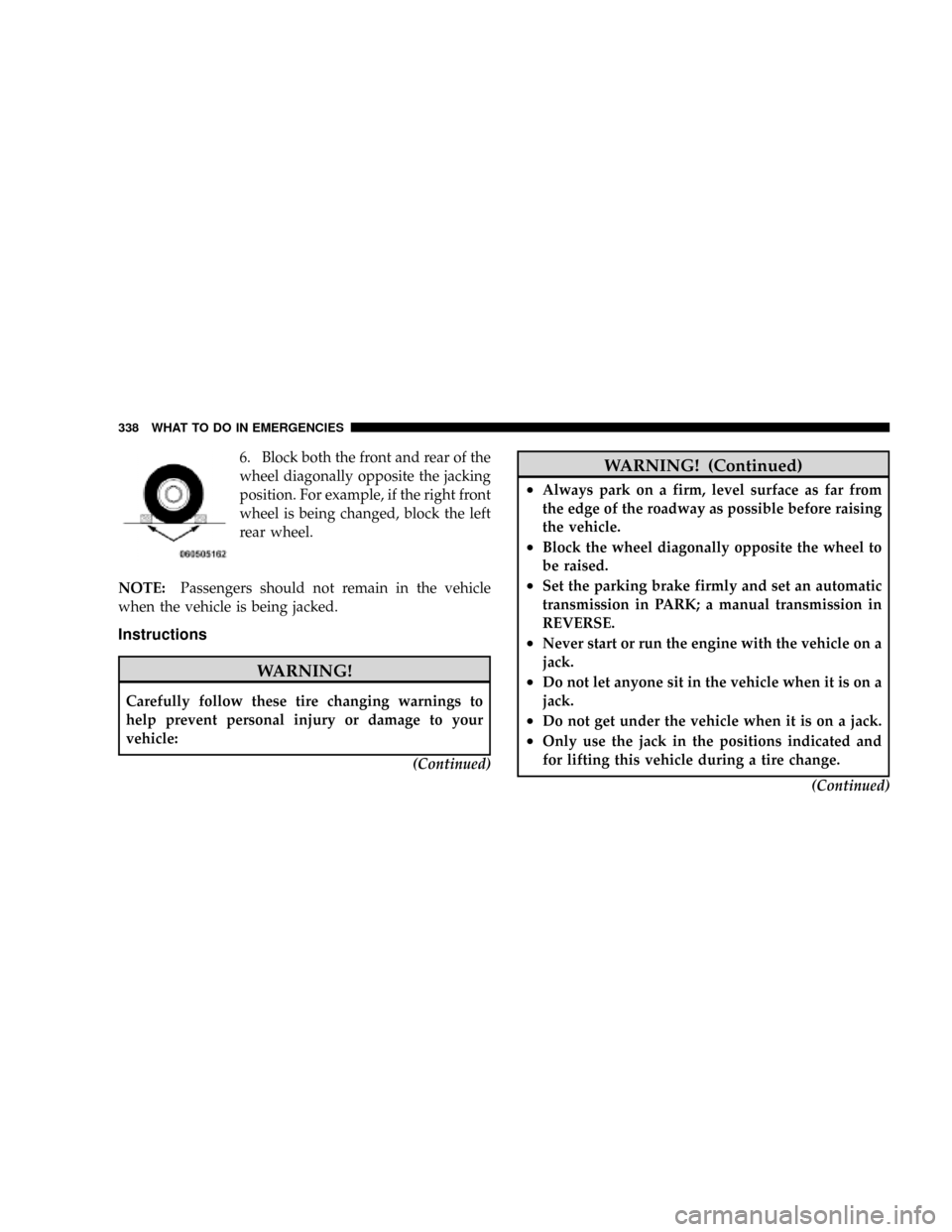
6. Block both the front and rear of the
wheel diagonally opposite the jacking
position. For example, if the right front
wheel is being changed, block the left
rear wheel.
NOTE:Passengers should not remain in the vehicle
when the vehicle is being jacked.
Instructions
WARNING!
Carefully follow these tire changing warnings to
help prevent personal injury or damage to your
vehicle:
(Continued)
WARNING! (Continued)
²Always park on a firm, level surface as far from
the edge of the roadway as possible before raising
the vehicle.
²Block the wheel diagonally opposite the wheel to
be raised.
²Set the parking brake firmly and set an automatic
transmission in PARK; a manual transmission in
REVERSE.
²Never start or run the engine with the vehicle on a
jack.
²Do not let anyone sit in the vehicle when it is on a
jack.
²Do not get under the vehicle when it is on a jack.
²Only use the jack in the positions indicated and
for lifting this vehicle during a tire change.
(Continued)
338 WHAT TO DO IN EMERGENCIES
Page 352 of 449
NExhaust System...................... 363
NCooling System...................... 366
NBrake System....................... 371
NClutch Hydraulic System............... 372
NManual Transmission.................. 372
NAutomatic Transmission................ 372
NTransfer Case....................... 375
NAxles............................. 375
NAppearance Care And Protection From
Corrosion.......................... 376
mFuses.............................. 381
NUnderhood Fuses (Power Distribution
Center)............................ 381
mVehicle Storage....................... 386mReplacement Light Bulbs................. 387
mBulb Replacement..................... 387
NHeadlight (Halogen)/Front Park And Turn
Lights............................. 387
NRear Side Marker, Taillamps/Stop Lamps,
And Turn Signal Bulbs Ð Replacement..... 389
NCenter High-Mounted Stop Light And Cargo
Lamp............................. 391
NLicense Lamps...................... 394
NFog Lights......................... 395
mFluids And Capacities................... 396
mFluids, Lubricants And Genuine Parts....... 397
NEngine............................ 397
NChassis............................ 398
350 MAINTAINING YOUR VEHICLE
Page 353 of 449
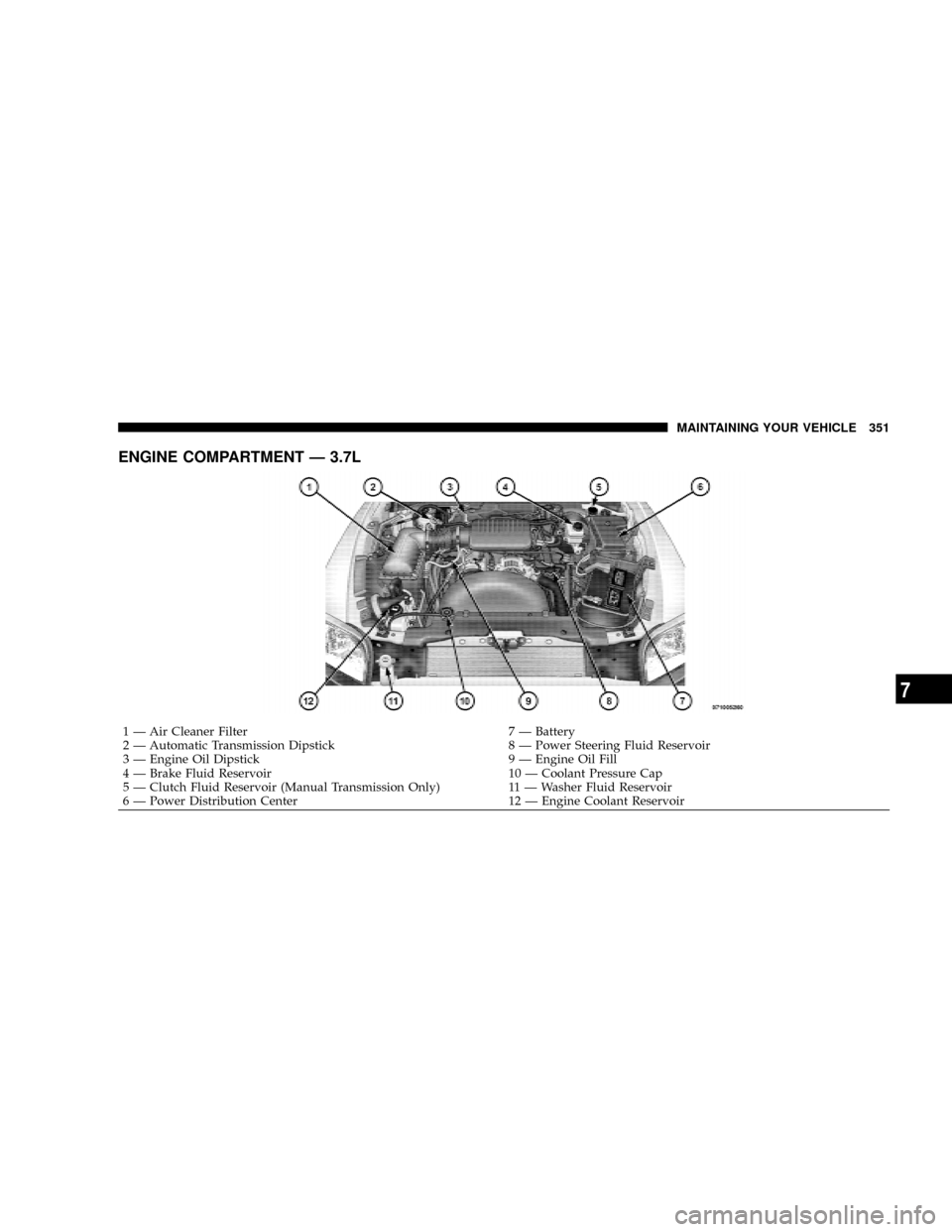
ENGINE COMPARTMENT Ð 3.7L
1 Ð Air Cleaner Filter 7 Ð Battery
2 Ð Automatic Transmission Dipstick 8 Ð Power Steering Fluid Reservoir
3 Ð Engine Oil Dipstick 9 Ð Engine Oil Fill
4 Ð Brake Fluid Reservoir 10 Ð Coolant Pressure Cap
5 Ð Clutch Fluid Reservoir (Manual Transmission Only) 11 Ð Washer Fluid Reservoir
6 Ð Power Distribution Center 12 Ð Engine Coolant ReservoirMAINTAINING YOUR VEHICLE 351
7
Page 374 of 449
Use only brake fluid that has been in a tightly closed
container to avoid contamination from foreign matter or
moisture.
CAUTION!
Do not allow a petroleum-base fluid to contaminate
the brake fluid. Seal damage may result.
Clutch Hydraulic System
The clutch hydraulic system is a sealed maintenance-free
system. In the event of leakage or other malfunction, the
system must be replaced.
Manual Transmission
Fluid Level Check
This fluid should be checked whenever other underhood
services are performed. The fluid level is checked by
removing the fill plug. If the level of the lubricant is more
than 1/4 in (6.35 mm) below the bottom of the filler holewhile the vehicle is level, enough lubricant should be
added to bring the level to the bottom of the filler hole.
This fluid does not require periodic changing. However,
if it becomes necessary to add or replace the fluid in these
transmissions, refer to ªFluids, Lubricants, and Genuine
Partsº in this section for the correct fluid type.
Automatic Transmission
NOTE:If equipped with a dipstick, use the following
procedure. If your vehicle has a capped dipstick, it is
sealed and should not be tampered with. Your authorized
dealer has the proper tools to ensure that the fluid level
is set properly.
Fluid Level Check
Check the fluid level while the transmission is at normal
operating temperature 180É F (82É C). This occurs after at
least 15 miles (24 km) of driving. At normal operating
temperature the fluid cannot be held comfortably be-
tween the fingertips.
372 MAINTAINING YOUR VEHICLE