check engine DODGE DAKOTA 2009 3.G Owner's Manual
[x] Cancel search | Manufacturer: DODGE, Model Year: 2009, Model line: DAKOTA, Model: DODGE DAKOTA 2009 3.GPages: 449, PDF Size: 10.96 MB
Page 372 of 449
of this. As long as the engine operating temperature is
satisfactory, the coolant recovery bottle need only be
checked once a month.
When additional engine coolant (antifreeze) is needed to
maintain the proper level, it should be added to the
coolant recovery bottle. Do not overfill.
Points to Remember
NOTE:When the vehicle is stopped after a few miles
(kilometers) of operation, you may observe vapor coming
from the front of the engine compartment. This is nor-
mally a result of moisture from rain, snow, or high
humidity accumulating on the radiator and being vapor-
ized when the thermostat opens, allowing hot coolant to
enter the radiator.
If an examination of your engine compartment shows no
evidence of radiator or hose leaks, the vehicle may be
safely driven. The vapor will soon dissipate.
²Do not overfill the coolant recovery bottle.
²Check coolant freeze point in the radiator and in the
coolant recovery bottle. If antifreeze needs to be
added, contents of coolant recovery bottle must also be
protected against freezing.
²If frequent engine coolant (antifreeze) additions are
required, or if the level in the coolant recovery bottle
does not drop when the engine cools, the cooling
system should be pressure tested for leaks.
²Maintain engine coolant (antifreeze) concentration at
50% HOAT engine coolant (antifreeze) (minimum)
and distilled/deionized water for proper corrosion
protection of your engine, which contains aluminum
components.
²Make sure that the radiator and coolant recovery
bottle overflow hoses are not kinked or obstructed.
370 MAINTAINING YOUR VEHICLE
Page 373 of 449
²Keep the front of the radiator clean. If your vehicle is
equipped with air conditioning, also keep the front of
the condenser clean.
²Do not change the thermostat for Summer or Winter
operation. If replacement is ever necessary, install
ONLY the correct type thermostat. Other designs may
result in unsatisfactory engine coolant (antifreeze)
performance, poor gas mileage, and increased
emissions.
Brake System
Fluid Level Check Ð Brake Master Cylinder
The fluid level in the master cylinder should be checked
whenever the vehicle is serviced, or immediately if the
brake system warning light is on. If necessary, add fluid
to bring level to the full mark on the side of the reservoir
of the brake master cylinder. Be sure to clean the top of
the master cylinder area before removing the cap. With
disc brakes, fluid level can be expected to fall as the brakepads wear. Brake fluid level should be checked when
pads are replaced. If the brake fluid level is abnormally
low, check system for leaks.
Refer to ªFluids, Lubricants, and Genuine Partsº in this
section for the correct fluid type.
WARNING!
²Use of brake fluid that may have a lower initial
boiling point, or is unidentified as to specifica-
tions, may result in sudden brake failure during
hard prolonged braking. You could have an acci-
dent.
²Overfilling the brake fluid reservoir can result in
spilling brake fluid on hot engine parts and the
brake fluid catching fire.
MAINTAINING YOUR VEHICLE 371
7
Page 375 of 449
To check the automatic transmission fluid level properly,
the following procedure must be used:
1. Operate the engine at idle speed and normal operating
temperature.
2. The vehicle must be on level ground.
3. Fully apply the parking brake and press the brake
pedal.
4. Place the gear selector momentarily in each gear
position, ending with the lever in PARK.
5. Remove the dipstick, wipe it clean and reinsert it until
seated.
6. Remove the dipstick again and note the fluid level on
both sides. The fluid level should be between the ªHOTº
(upper) reference holes on the dipstick at normal operat-
ing temperature. Verify that solid coating of oil is seen on
both sides of the dipstick. If the fluid is low, add asrequired into the dipstick tube.Do not overfill.After
adding any quantity of oil through the oil fill tube, wait
a minimum of two minutes for the oil to fully drain into
the transmission before rechecking the fluid level.
NOTE:If it is necessary to check the transmissionbelow
the operating temperature, the fluid level should be
between the two ªCOLDº (lower) holes on the dipstick
with the fluid at approximately 70É F (21É C) (room
temperature). If the fluid level is correctly established at
room temperature, it should be between the ªHOTº
(upper) reference holes when the transmission reaches
180É F (82É C). Remember it is best to check the level at
the normal operating temperature.
MAINTAINING YOUR VEHICLE 373
7
Page 376 of 449
CAUTION!
Be aware that if the fluid temperature is below 50É F
(10É C) it may not register on the dipstick. Do not add
fluid until the temperature is elevated enough to
produce an accurate reading.
7. Check for leaks. Release parking brake.
To prevent dirt and water from entering the transmission
after checking or replenishing fluid, make certain that the
dipstick cap is properly reseated. It is normal for the
dipstick cap to spring back slightly from its fully-seated
position, as long as its seal remains engaged in the
dipstick tube.
Selection of Lubricant
It is important that the proper lubricant is used in the
transmission to assure optimum transmission perfor-
mance. Use only the manufacturer 's recommended trans-
mission fluid. Refer to ªFluids, Lubricants, and Genuine
Partsº in this section for the correct fluid type. It is
important that the transmission fluid be maintained at
the prescribed level using the recommended fluid.
Special Additives
Automatic Transmission Fluid (ATF) is an engineered
product and its performance may be impaired by supple-
mental additives. Therefore, do not add any fluid addi-
tives to the transmission. The only exception to this
policy is the use of special dyes to aid in detecting fluid
leaks. In addition, avoid using transmission sealers as
they may adversely affect seals.
374 MAINTAINING YOUR VEHICLE
Page 403 of 449
²Change your engine oil more often if you drive your
vehicle off-road for an extended period of time.
²Under no circumstances should oil change intervals
exceed 6,000 miles (10,000 km) or 6 months, whichever
comes first.
Your authorized dealer will reset the oil change indicator
message after completing the scheduled oil change. If this
scheduled oil change is performed by someone other
than your authorized dealer the message can be reset by
referring to the steps described under ªOil Change
Requiredº in ªUse Factory Settingsº of the EVIC section
in this manual, or under ªOdometer/Trip Odometerº in
the ªInstrument Cluster Descriptions section of this
manual.
At Each Stop for Fuel
²Check the engine oil level about five minutes after a
fully warmed engine is shut off. Checking the oil levelwhile the vehicle is on level ground will improve the
accuracy of the oil level reading. Add oil only when
the level is at or below the ADD or MIN mark.
²Check the windshield washer solvent and add if
required.
Once a Month
²Check tire pressure and look for unusual wear or
damage.
²Inspect the battery, and clean and tighten the terminals
as required.
²Check the fluid levels of coolant reservoir, brake
master cylinder, power steering and transmission, and
add as needed.
²Check all lights and other electrical items for correct
operation.
MAINTENANCE SCHEDULES 401
8
M
A
I
N
T
E
N
A
N
C
E
S
C
H
E
D
U
L
E
S
Page 404 of 449
At Each Oil Change
²Change the engine oil filter.
²Inspect the brake hoses and lines.
²Check the manual transmission fluid level.
CAUTION!
Failure to perform the required maintenance items
may result in damage to the vehicle.
Required Maintenance Intervals
NOTE:** Vehicles built with the 4.7L engine are
equipped with sixteen spark plugs, one set is located on
the top of the engine under the coils, and the second set
is located on the side of the engine.
The spark plugs located under the coils are a standard
plug, and must be changed every 30,000 miles
(50 000 km).
The spark plugs located on the side of the engine are a
premium plug, and must be changed every 102,000 miles
(170 000 km).
402 MAINTENANCE SCHEDULES
8
M
A
I
N
T
E
N
A
N
C
E
S
C
H
E
D
U
L
E
S
Page 430 of 449
Adding Fuel........................... 306
Air Cleaner, Engine (Engine Air Cleaner Filter) . . . 359
Air Conditioner Maintenance............... 360
Air Conditioning........................ 229
Air Conditioning, Operating Tips..........229,232
Air Conditioning Refrigerant.............360,361
Air Conditioning System................229,360
Air Filter.............................. 359
Air Pressure, Tires....................281,289
Airbag.............................46,178
Airbag Light..........................55,72
Alarm, Panic............................ 24
Alarm (Security Alarm).................19,170
Alarm System (Security Alarm)............... 19
Alignment and Balance................... 288
Alterations/Modifications, Vehicle............. 7
Antenna, Satellite Radio................... 222
Antifreeze (Engine Coolant)..............367,396
Disposal............................ 369Anti-Lock Brake System (ABS)............269,270
Anti-Lock Warning Light.................. 170
Anti-Theft Security Alarm (Theft Alarm)........ 19
Anti-Theft System.....................19,170
Appearance Care........................ 376
Assistance Towing........................ 96
Auto Unlock, Doors....................... 31
Automatic Door Locks..................... 30
Automatic Transaxle....................12,245
Interlock System........................ 15
Automatic Transmission.............239,246,372
Adding Fluid......................... 373
Fluid Level Check...................... 372
Fluid Type........................... 398
Gear Ranges.......................... 246
Special Additives...................... 374
Torque Converter...................... 250
Axle Fluid............................. 398
Axle Lubrication (Axle Fluid)............... 375
428 INDEX
Page 431 of 449
Battery............................... 359
Charging............................ 343
Emergency Starting..................... 343
Gas Caution.......................... 343
Keyless Transmitter Replacement (RKE)....... 26
Saving Feature (Protection)............... 124
Belts, Seat.............................. 37
Body Mechanism Lubrication............... 362
Box, Sound............................ 220
B-Pillar Location........................ 276
Brake Fluid............................ 398
Brake System........................269,371
Anti-Lock (ABS)....................269,270
Fluid Check.......................... 371
Master Cylinder....................... 371
Parking............................. 267
Warning Light.....................170,174
Brake/Transmission Interlock............... 246
Break-In Recommendations, New Vehicle........ 70Bulb Replacement....................... 387
Bulbs, Light............................ 387
Calibration, Compass..................... 140
Camper............................... 157
Capacities, Fluid........................ 396
Caps, Filler
Oil (Engine).......................... 357
Power Steering........................ 266
Radiator (Coolant Pressure)............... 368
Car Washes............................ 377
Carbon Monoxide Warning..............158,302
Cargo Light............................ 126
Cargo (Vehicle Loading)................... 308
Cellular Phone........................82,228
Center High Mounted Stop Light............ 391
Certification Label....................... 308
Changing A Flat Tire..................... 332
Charging.............................. 343
INDEX 429
10
Page 432 of 449
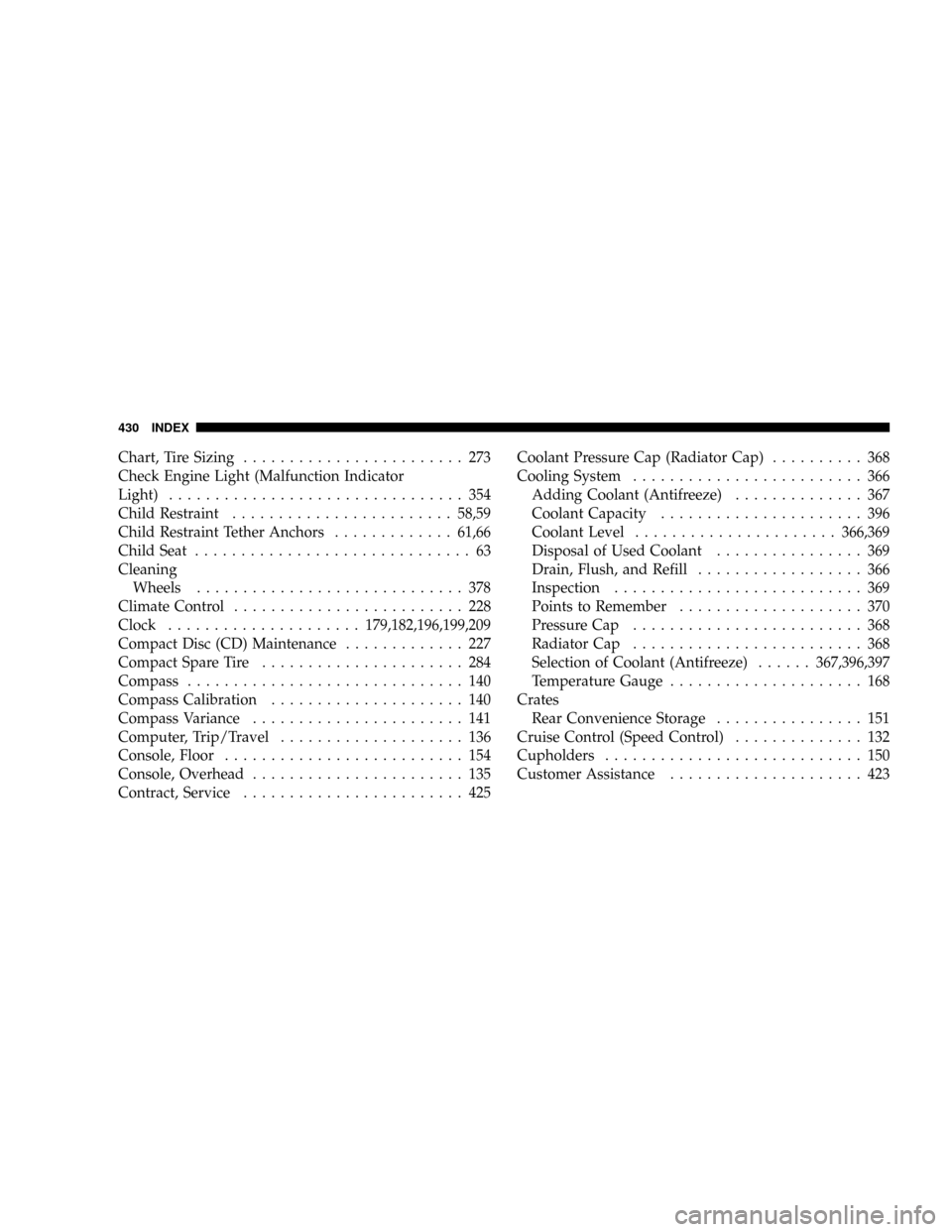
Chart, Tire Sizing........................ 273
Check Engine Light (Malfunction Indicator
Light)................................ 354
Child Restraint........................58,59
Child Restraint Tether Anchors.............61,66
Child Seat.............................. 63
Cleaning
Wheels............................. 378
Climate Control......................... 228
Clock.....................179,182,196,199,209
Compact Disc (CD) Maintenance............. 227
Compact Spare Tire...................... 284
Compass.............................. 140
Compass Calibration..................... 140
Compass Variance....................... 141
Computer, Trip/Travel.................... 136
Console, Floor.......................... 154
Console, Overhead....................... 135
Contract, Service........................ 425Coolant Pressure Cap (Radiator Cap).......... 368
Cooling System......................... 366
Adding Coolant (Antifreeze).............. 367
Coolant Capacity...................... 396
Coolant Level......................366,369
Disposal of Used Coolant................ 369
Drain, Flush, and Refill.................. 366
Inspection........................... 369
Points to Remember.................... 370
Pressure Cap......................... 368
Radiator Cap......................... 368
Selection of Coolant (Antifreeze)......367,396,397
Temperature Gauge..................... 168
Crates
Rear Convenience Storage................ 151
Cruise Control (Speed Control).............. 132
Cupholders............................ 150
Customer Assistance..................... 423
430 INDEX
Page 435 of 449
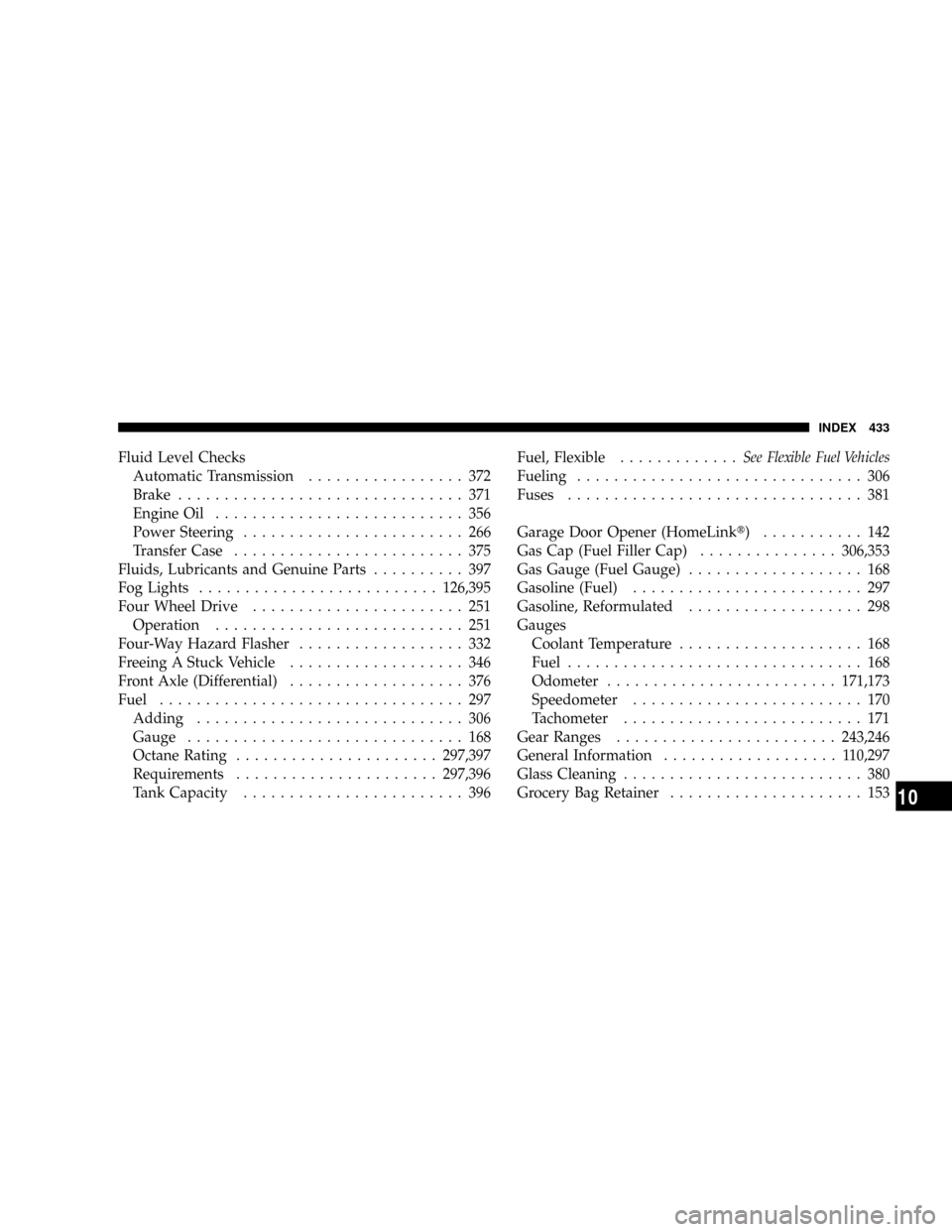
Fluid Level Checks
Automatic Transmission................. 372
Brake............................... 371
Engine Oil........................... 356
Power Steering........................ 266
Transfer Case......................... 375
Fluids, Lubricants and Genuine Parts.......... 397
Fog Lights..........................126,395
Four Wheel Drive....................... 251
Operation........................... 251
Four-Way Hazard Flasher.................. 332
Freeing A Stuck Vehicle................... 346
Front Axle (Differential)................... 376
Fuel................................. 297
Adding............................. 306
Gauge.............................. 168
Octane Rating......................297,397
Requirements......................297,396
Tank Capacity........................ 396Fuel, Flexible.............See Flexible Fuel Vehicles
Fueling............................... 306
Fuses................................ 381
Garage Door Opener (HomeLinkt) ........... 142
Gas Cap (Fuel Filler Cap)...............306,353
Gas Gauge (Fuel Gauge)................... 168
Gasoline (Fuel)......................... 297
Gasoline, Reformulated................... 298
Gauges
Coolant Temperature.................... 168
Fuel................................ 168
Odometer.........................171,173
Speedometer......................... 170
Tachometer.......................... 171
Gear Ranges........................243,246
General Information................... 110,297
Glass Cleaning.......................... 380
Grocery Bag Retainer..................... 153
INDEX 433
10