warning DODGE DAKOTA 2009 3.G Owner's Guide
[x] Cancel search | Manufacturer: DODGE, Model Year: 2009, Model line: DAKOTA, Model: DODGE DAKOTA 2009 3.GPages: 449, PDF Size: 10.96 MB
Page 72 of 449
WARNING!
An incorrectly anchored tether strap could lead to
seat failure and injury to the child. In a collision, the
seat could come loose and allow the child to crash
into the inside of the vehicle or other passengers, or
even be thrown from the vehicle. Use only the anchor
positions directly behind the child restraint to secure
a child restraint top tether strap. See your authorized
dealer for help, if necessary.
Transporting Pets
Airbags deploying in the front seat could harm your pet.
An unrestrained pet will be thrown about and possibly
injured, or injure a passenger during panic braking or in
a collision. Pets should be restrained in the rear seat in
pet harnesses or pet carriers that are secured by seat belts.
ENGINE BREAK-IN RECOMMENDATIONS
A long break-in period is not required for the engine in
your vehicle.
Drive moderately during the first 300 miles (500 km).
After the initial 60 miles (100 km), speeds up to 50 or
55 mph (80 or 90 km/h) are desirable.
While cruising, brief full-throttle acceleration within the
limits of local traffic laws, contributes to a good break-in.
Wide-open throttle acceleration in low gear can be detri-
mental and should be avoided.
The engine oil installed in the engine at the factory is a
high-quality energy conserving type lubricant. Oil
changes should be consistent with anticipated climate
conditions under which vehicle operations will occur.
The recommended viscosity and quality grades are
70 THINGS TO KNOW BEFORE STARTING YOUR VEHICLE
Page 73 of 449
shown under ªEngine Oilº, under ªMaintenance Proce-
duresº in section 7 of this manual. NON-DETERGENT
OR STRAIGHT MINERAL OILS MUST NEVER BE
USED.
A new engine may consume some oil during its first few
thousand miles (kilometers) of operation. This should be
considered as a normal part of the break-in and not
interpreted as an indication of difficulty.
SAFETY TIPS
Exhaust System
WARNING!
Exhaust gases contain carbon monoxide, an ex-
tremely toxic gas that by itself is colorless and
odorless. To avoid inhaling these gases, the following
precautions should be observed:
²Do not run the engine in a closed garage or in confined
areas any longer than needed to move your vehicle in
or out of the area.
²It may be necessary to sit in a parked vehicle with the
engine running for more than a short period. If so,
adjust your climate control system to force outside air
into the vehicle. Set the blower at high speed and the
controls in any position except Off or Recirculation.
²The best protection against carbon monoxide entry
into the vehicle body is a properly maintained engine
exhaust system.
Be aware of changes in the sound of the exhaust system,
exhaust fumes detected inside the vehicle, or damage to
the underside or rear of the vehicle. Have a competent
mechanic inspect the complete exhaust system and adja-
cent body areas for broken, damaged, deteriorated or
mispositioned parts. Open seams or loose connections
could permit exhaust fumes to seep into the passenger
THINGS TO KNOW BEFORE STARTING YOUR VEHICLE 71
2
Page 74 of 449
compartment. In addition, inspect the exhaust system
each time the vehicle is raised for lubrication or oil
change. Replace or adjust as required.
Safety Checks You Should Make Inside The
Vehicle
Heater Defroster Ducts
Inspect the heater defroster ducts for proper operation.
Check for proper airflow through all defroster ducts. If
there is any question regarding the operation of your
heater defroster ducts, have the system checked by an
authorized dealer
Seat Belts
Inspect the seat belt system periodically, checking for
cuts, frays and loose parts. Damaged parts must be
replaced immediately. Do not disassemble or modify the
system.Seat belt assemblies must be replaced after an accident if
they have been damaged (bent retractor, torn webbing,
etc.) or if the front airbags have deployed. If there is any
question regarding seat belt or retractor condition, re-
place the seat belt.
Airbag Warning Light
The airbag warning light should come on, and remain on,
for six to eight seconds as a bulb check when the ignition
switch is first turned ON. If the light is not lit during
starting, see your authorized dealer. If the light stays on,
flickers or comes on while driving, have the system
checked by an authorized dealer. If there is a problem
with the airbag warning light, the seat belt light will
flash.
72 THINGS TO KNOW BEFORE STARTING YOUR VEHICLE
Page 80 of 449
mGarage Door Opener Ð If Equipped........ 142
NProgramming HomeLinkt.............. 144
NGate Operator/Canadian Programming..... 146
NUsing HomeLinkt.................... 147
NReprogramming A Single HomeLinkt
Button............................ 147
NSecurity........................... 148
NTroubleshooting Tips.................. 148
NGeneral Information................... 148
mElectrical Power Outlets................. 149
NElectrical Outlet Use With Engine Off
(Battery Fed Configuration)............. 150
mCupholders.......................... 150
mRear Storage Ð If Equipped.............. 151NRear Convenience Storage Crates......... 151
NPlastic Grocery Bag Retainers............ 153
mFloor Console Ð If Equipped............. 154
NFloor Console Features................. 154
mRear Cargo Area Utility Rails............. 155
mRear Window Features.................. 156
NRear Window Defroster Ð If Equipped..... 156
NSliding Rear Window Ð If Equipped....... 157
mSlide-In Campers...................... 157
NCamper Applications.................. 157
NGeneral Information................... 158
NCarbon Monoxide Warning-Vehicles
Equipped With A Cap Or Slide-In Campers . . 158
78 UNDERSTANDING THE FEATURES OF YOUR VEHICLE
Page 84 of 449
WARNING!
Vehicles and other objects seen in the right-side
convex mirror will look smaller and farther away
than they really are. Relying too much on your right
side mirror could cause you to collide with another
vehicle or other object. Use your inside mirror when
judging the size or distance of a vehicle seen in the
right-side mirror.
HANDS-FREE COMMUNICATION (UConnectT)Ð
IF EQUIPPED
NOTE: The sales code RER and REU radios contain an
integrated Hands-Free Communication (UConnectt)
system. Refer to your ªNavigation User's Manualº for
UConnecttsystem operating instructions for these
radios.UConnecttis a voice-activated, hands-free, in-vehicle
communications system. UConnecttallows you to dial a
phone number with your cellular phone using simple
voice commands (e.g.,9Callº{ªMikeº{ºWork9or9Dialº
{ª248-555-12129). Your cellular phone's audio is trans-
mitted through your vehicle's audio system; the system
will automatically mute your radio when using the
UConnecttsystem.
NOTE:The UConnecttsystem requires a cellular phone
equipped with the Bluetootht9Hands-Free Profile,9Ve r -
sion 0.96 or higher. See the UConnecttwebsite for
supported phones.
NOTE:For UConnecttcustomer support, visit the
following websites:
²www.chrysler.com/uconnect
²www.dodge.com/uconnect
²www.jeep.com/uconnect
82 UNDERSTANDING THE FEATURES OF YOUR VEHICLE
Page 98 of 449
the paired cellular phone to call the emergency num-
ber. This feature is supported in the U.S., Canada, and
Mexico.
NOTE:
²The emergency number dialed is based on the country
where the vehicle is purchased (911 for the U.S. and
Canada and 060 for Mexico). The number dialed may
not be applicable with the available cellular service
and area.
²If supported, this number may be programmable on
some systems. To do this, press `Phone' button and say
`Setup', followed by `Emergency'.
²The UConnecttsystem does slightly lower your
chances of successfully making a phone call as to that
for the cell phone directly.
WARNING!
Your phone must be turned on and paired to the
UConnecttsystem to allow use of this vehicle feature
in emergency situations, when the cell phone has
network coverage and stays paired to the UConnectt
system.
Towing Assistance
If you need towing assistance:
²Press the PHONE button to begin.
²After the9Ready9prompt and the following beep, say
9Towing Assistance.9
96 UNDERSTANDING THE FEATURES OF YOUR VEHICLE
Page 112 of 449
General Information
This device complies with Part 15 of the FCC rules and
RSS 210 of Industry Canada. Operation is subject to the
following conditions:
²Changes or modifications not expressly approved by
the party responsible for compliance could void the
user's authority to operate the equipment.
²This device may not cause harmful interference.
²This device must accept any interference received,
including interference that may cause undesired
operation.
VOICE RECOGNITION SYSTEM (VR) Ð IF
EQUIPPED
Voice Recognition System (VR) Operation
This Voice Recognition System allows you to
control your AM, FM radio, satellite radio, disc
player, and a memo recorder.
NOTE:Take care to speak into the Voice Interface
System as calmly and normally as possible. The ability of
the Voice Interface System to recognize user voice com-
mands may be negatively affected by rapid speaking or a
raised voice level.
WARNING!
Any voice commanded system should be used only
in safe driving conditions and all attention should be
kept on the roadway ahead. Failure to do so may
result in an accident causing serious injury or death.
110 UNDERSTANDING THE FEATURES OF YOUR VEHICLE
Page 118 of 449
WARNING!
Adjusting a seat while the vehicle is moving is
dangerous. The sudden movement of the seat could
cause you to lose control. The seat belt might not be
properly adjusted and you could be injured. Adjust
any seat only while the vehicle is parked.
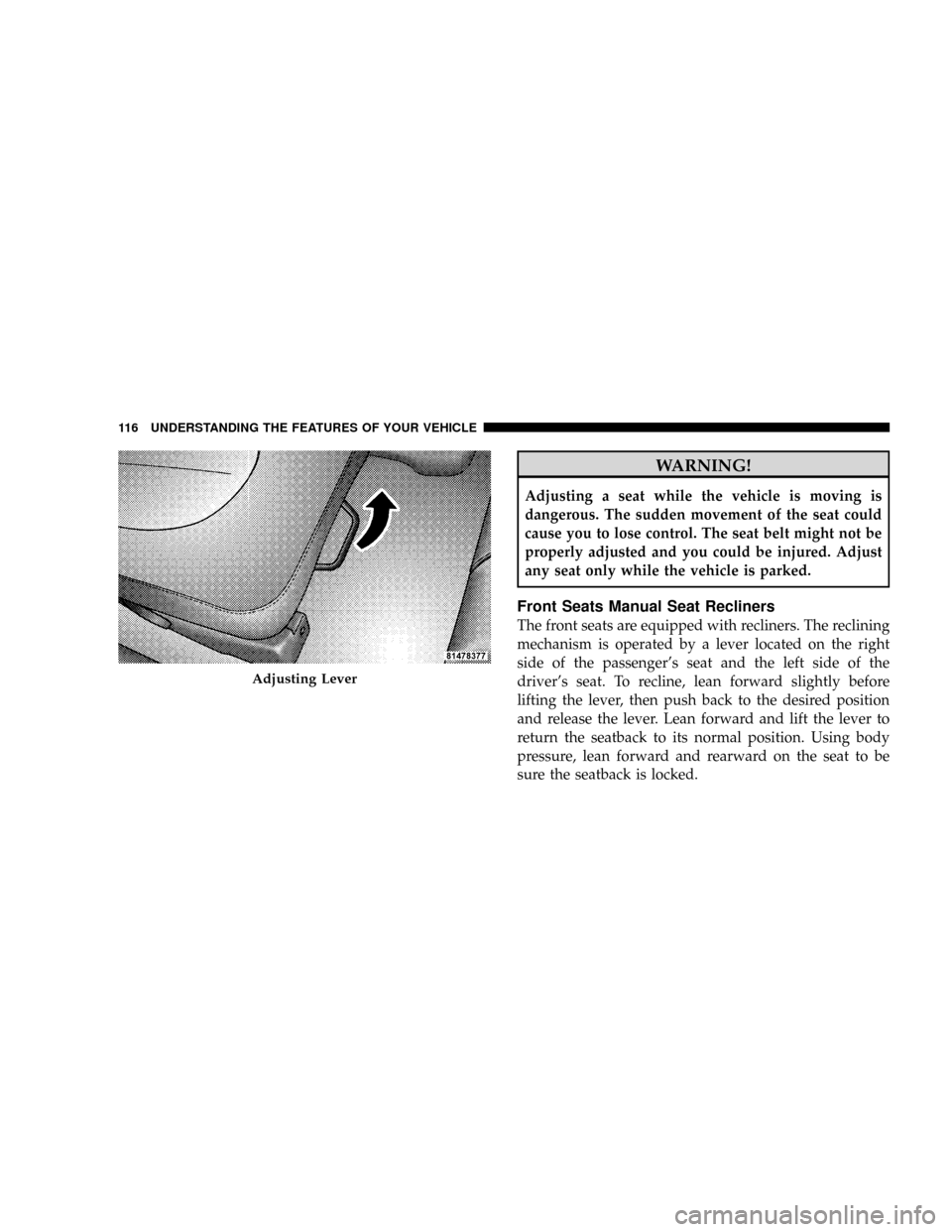
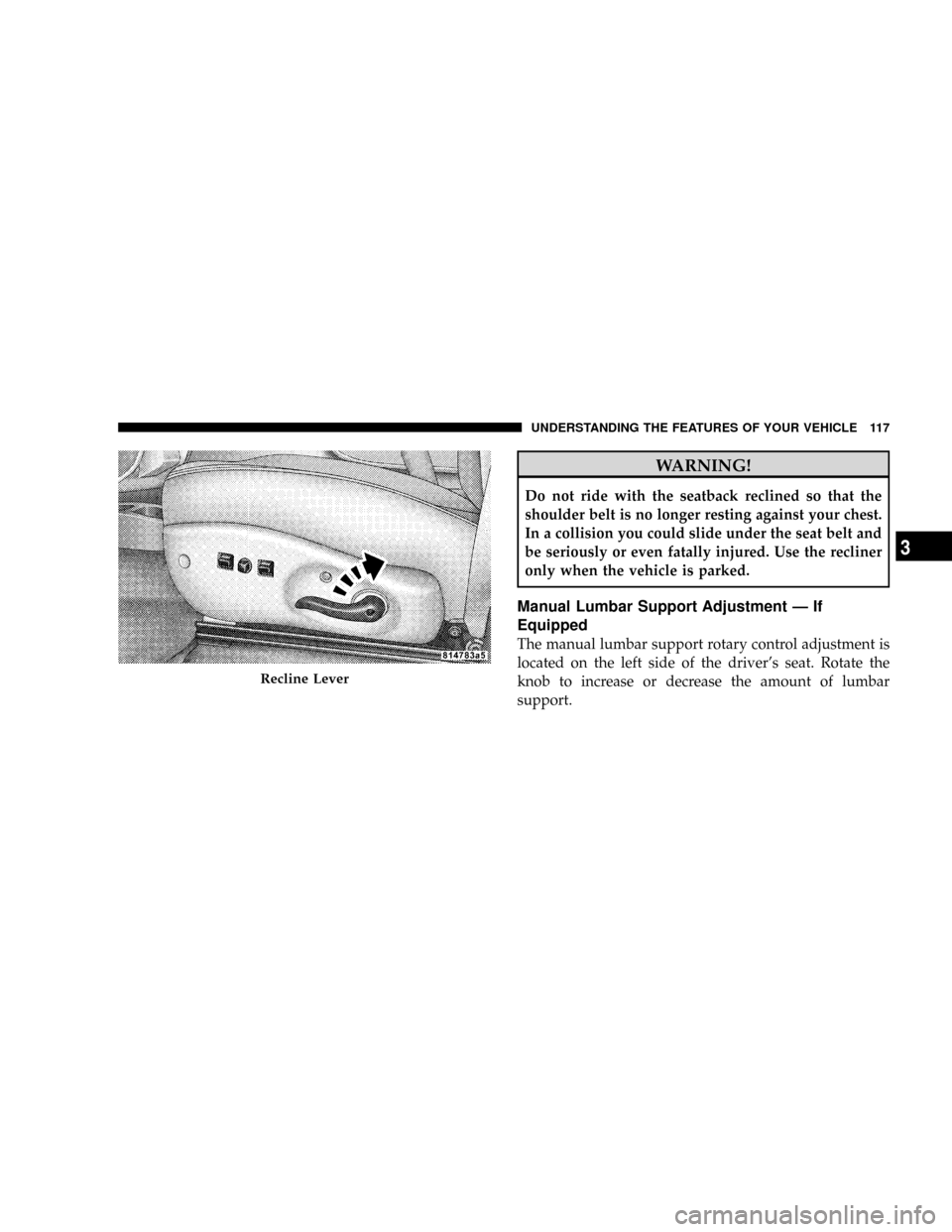
Front Seats Manual Seat Recliners
The front seats are equipped with recliners. The reclining
mechanism is operated by a lever located on the right
side of the passenger's seat and the left side of the
driver's seat. To recline, lean forward slightly before
lifting the lever, then push back to the desired position
and release the lever. Lean forward and lift the lever to
return the seatback to its normal position. Using body
pressure, lean forward and rearward on the seat to be
sure the seatback is locked.
Adjusting Lever
116 UNDERSTANDING THE FEATURES OF YOUR VEHICLE
Page 119 of 449
WARNING!
Do not ride with the seatback reclined so that the
shoulder belt is no longer resting against your chest.
In a collision you could slide under the seat belt and
be seriously or even fatally injured. Use the recliner
only when the vehicle is parked.
Manual Lumbar Support Adjustment Ð If
Equipped
The manual lumbar support rotary control adjustment is
located on the left side of the driver's seat. Rotate the
knob to increase or decrease the amount of lumbar
support.
Recline Lever
UNDERSTANDING THE FEATURES OF YOUR VEHICLE 117
3
Page 123 of 449
WARNING!
²Persons who are unable to feel pain to the skin
because of advanced age, chronic illness, diabetes,
spinal cord injury, medication, alcohol use, ex-
haustion or other physical condition must exercise
care when using the seat heater. It may cause burns
even at low temperatures, especially if used for
long periods of time.
²Do not place anything on the seat that insulates
against heat, such as a blanket or cushion. This
may cause the seat heater to overheat.
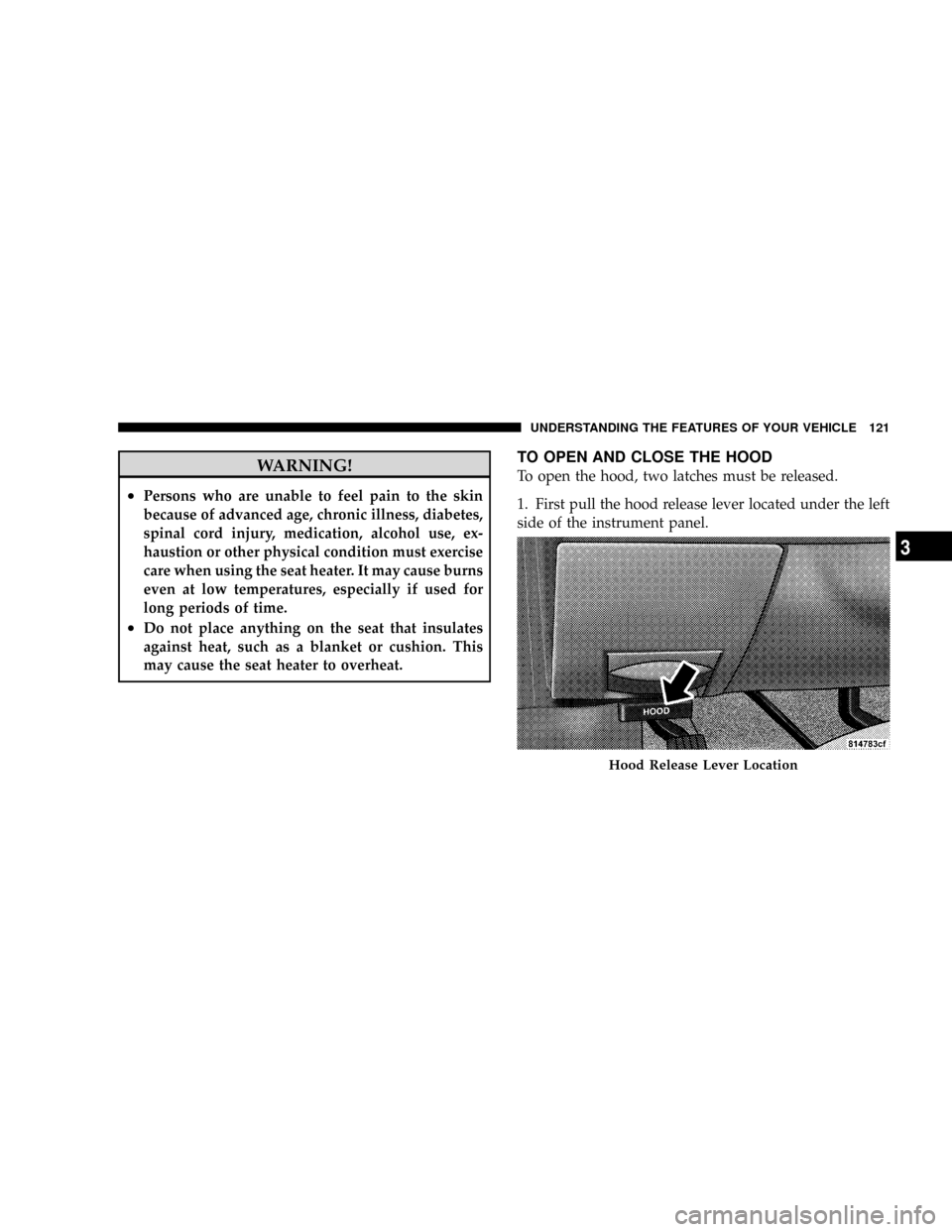
TO OPEN AND CLOSE THE HOOD
To open the hood, two latches must be released.
1. First pull the hood release lever located under the left
side of the instrument panel.
Hood Release Lever Location
UNDERSTANDING THE FEATURES OF YOUR VEHICLE 121
3