child lock DODGE DAKOTA 2009 3.G Owners Manual
[x] Cancel search | Manufacturer: DODGE, Model Year: 2009, Model line: DAKOTA, Model: DODGE DAKOTA 2009 3.GPages: 449, PDF Size: 10.96 MB
Page 12 of 449
mRemote Keyless Entry.................... 21
NTo Unlock The Doors................... 22
NTo Lock The Doors.................... 22
NUsing The Panic Alarm................. 24
NGeneral Information.................... 24
NProgramming Additional Transmitters....... 25
NBattery Replacement................... 26
mRemote Starting System Ð If Equipped....... 27
mDoor Locks........................... 29
NManual Door Locks.................... 29
NPower Door Locks..................... 29
NChild Protection Door Lock.............. 32
mWindows............................. 34NPower Windows...................... 34
NAuto Down (Driver's Side Only)........... 35
NWindow Lockout Switch................ 35
NWind Buffeting....................... 35
mOccupant Restraints..................... 36
NLap/Shoulder Belts.................... 37
NAdjustable Upper Shoulder Belt Anchorage . . . 42
NAutomatic Locking Retractors (ALR) Mode ±
If Equipped.......................... 43
NCenter Lap Belts...................... 43
NSeat Belt Pretensioners.................. 44
NEnhanced Driver Seat Belt Reminder System
(BeltAlertt).......................... 44
NSeat Belts And Pregnant Women........... 45
10 THINGS TO KNOW BEFORE STARTING YOUR VEHICLE
Page 15 of 449
NOTE:If you try to remove the key before you place the
shift lever in PARK, the key may become temporarily
trapped in the ignition cylinder. If this occurs, rotate thekey to the right slightly, then remove the key as de-
scribed. If a malfunction occurs, the system will trap the
key in the ignition cylinder to warn you that this safety
feature is inoperable. The engine can be started and
stopped, but the key cannot be removed until you obtain
service.
WARNING!
Never leave children alone in a vehicle. Leaving
unattended children in a vehicle is dangerous for a
number of reasons. A child or others could be seri-
ously or fatally injured. Don't leave the key in the
ignition. A child could operate power windows,
other controls, or move the vehicle.
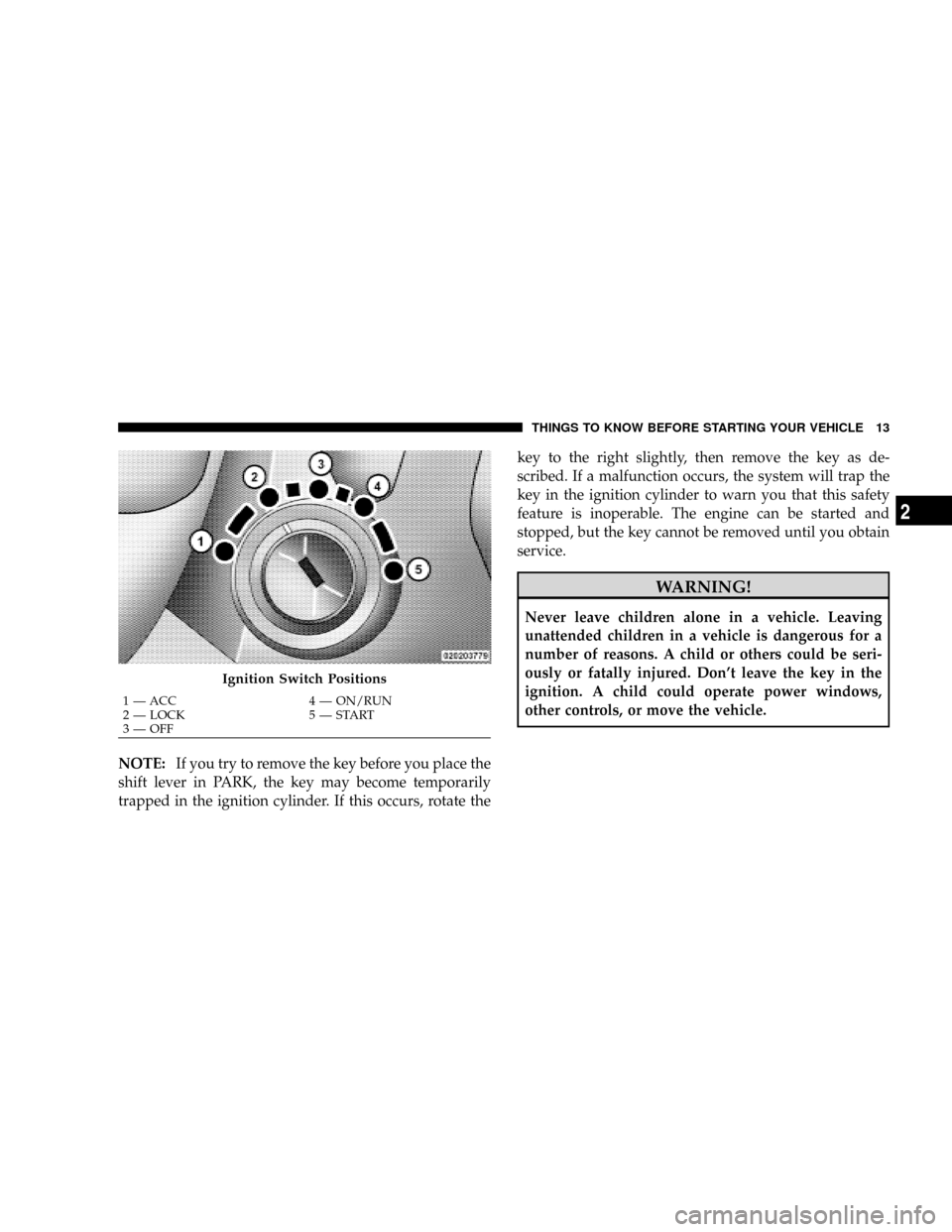
Ignition Switch Positions
1 Ð ACC 4 Ð ON/RUN
2 Ð LOCK 5 Ð START
3 Ð OFFTHINGS TO KNOW BEFORE STARTING YOUR VEHICLE 13
2
Page 31 of 449
The vehicle can be started remotely up to a maximum of
two times. The vehicle is also allowed a maximum of one
failed start, where the remote start sequence was initiated
but the engine stopped cranking without starting. After
either of these conditions, or if the Vehicle Security Alarm
System is activated, or if the PANIC button was pressed,
the vehicle must be reset by inserting a valid key into the
ignition and moving it to the RUN position, then back to
LOCK.
DOOR LOCKS
Manual Door Locks
All the doors can be manually locked from the inside by
pushing down the door lock plunger, located on the door
trim panel. Both front doors may be opened from the
inside with the door lock plunger in the down or locked
position.
WARNING!
²For personal security and safety in the event of an
accident, lock the vehicle doors as you drive, as
well as when you park and leave the vehicle.
²Never leave children alone in a vehicle. Leaving
unattended children in a vehicle is dangerous for a
number of reasons. A child or others could be
seriously or fatally injured. Don't leave the key in
the ignition. A child could operate power win-
dows, other controls, or move the vehicle.
Power Door Locks
A power door lock switch is on each front door trim
panel. Use this switch to lock or unlock the doors.
THINGS TO KNOW BEFORE STARTING YOUR VEHICLE 29
2
Page 34 of 449
5. Within 30 seconds, press the driver's door LOCK
switch in the UNLOCK direction.
6. A single chime will sound to indicate the feature has
been changed.
7. To reactivate the feature, repeat the above Steps.
8. If a chime is not heard, program mode was canceled
before the feature could be changed. If necessary, repeat
the above procedure.
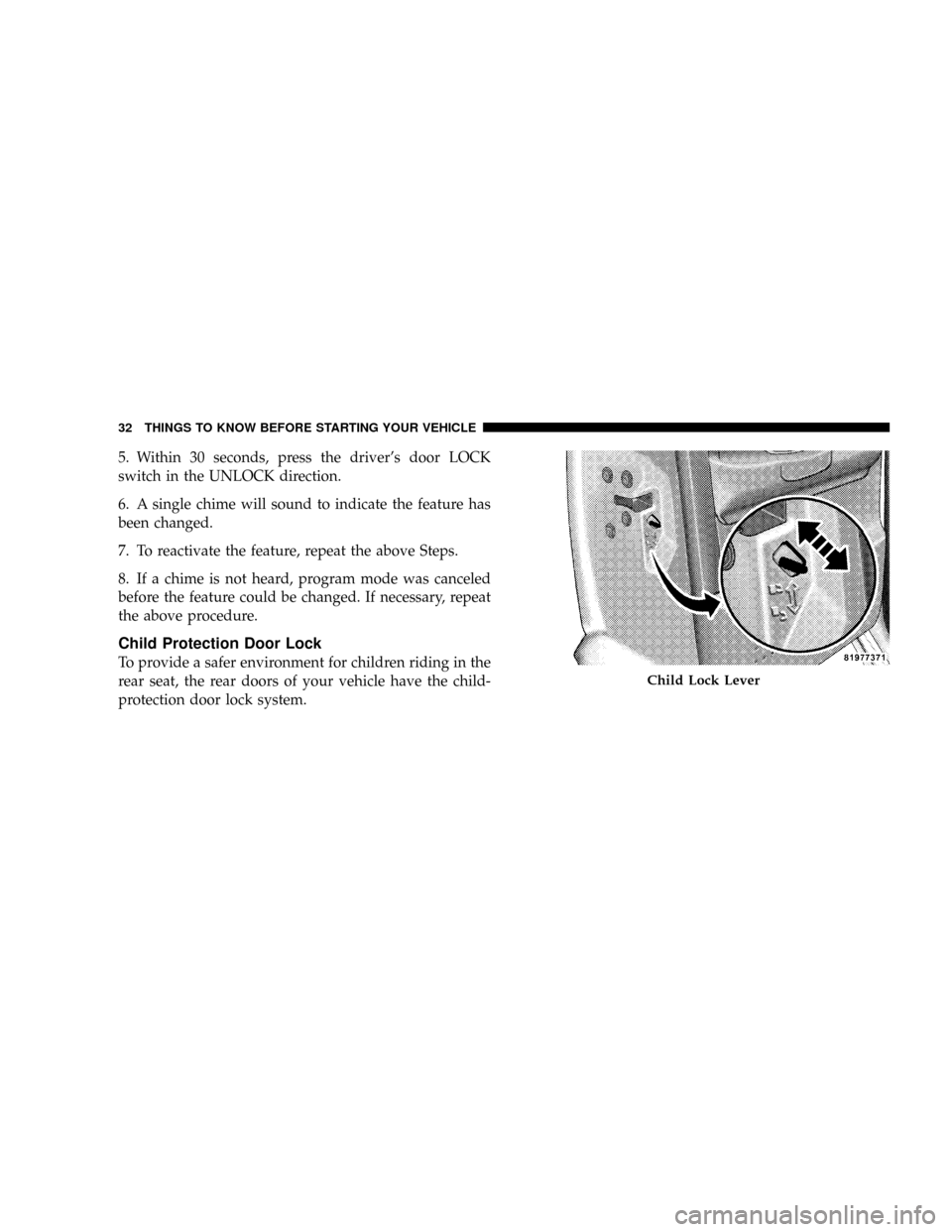
Child Protection Door Lock
To provide a safer environment for children riding in the
rear seat, the rear doors of your vehicle have the child-
protection door lock system.
Child Lock Lever
32 THINGS TO KNOW BEFORE STARTING YOUR VEHICLE
Page 35 of 449
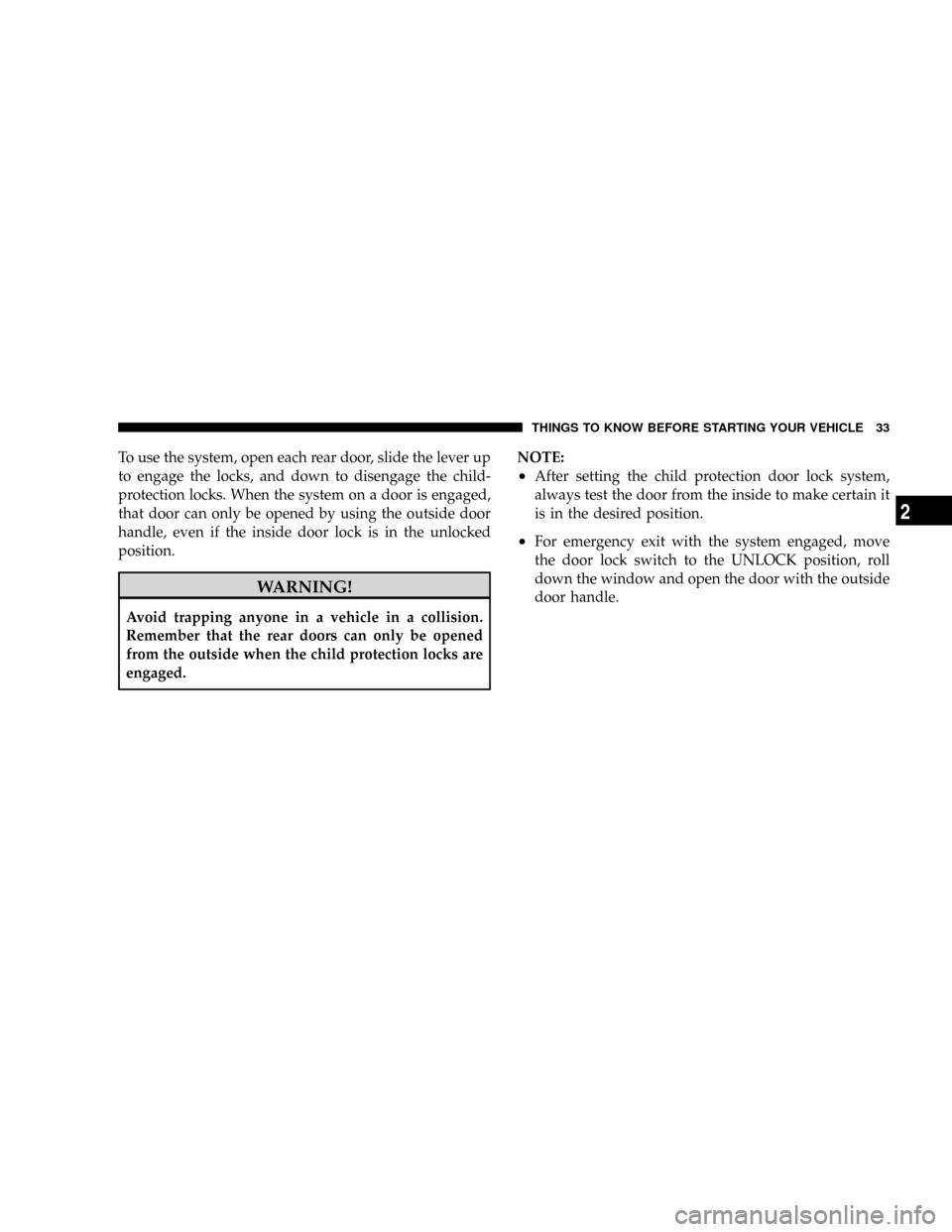
To use the system, open each rear door, slide the lever up
to engage the locks, and down to disengage the child-
protection locks. When the system on a door is engaged,
that door can only be opened by using the outside door
handle, even if the inside door lock is in the unlocked
position.
WARNING!
Avoid trapping anyone in a vehicle in a collision.
Remember that the rear doors can only be opened
from the outside when the child protection locks are
engaged.NOTE:
²After setting the child protection door lock system,
always test the door from the inside to make certain it
is in the desired position.
²For emergency exit with the system engaged, move
the door lock switch to the UNLOCK position, roll
down the window and open the door with the outside
door handle.
THINGS TO KNOW BEFORE STARTING YOUR VEHICLE 33
2
Page 37 of 449
WARNING!
Never leave children alone in a vehicle. Leaving
unattended children in a vehicle is dangerous for a
number of reasons. A child or others could be seri-
ously or fatally injured. Don't leave the key in the
ignition. A child could operate power windows,
other controls, or move the vehicle.
Auto Down (Driver's Side Only)
The driver's window switch has an Auto Down feature.
Push the window switch past the first detent, release, and
the window will go down automatically. To cancel the
Auto Down movement, operate the switch in either the
up or down direction and release the switch.
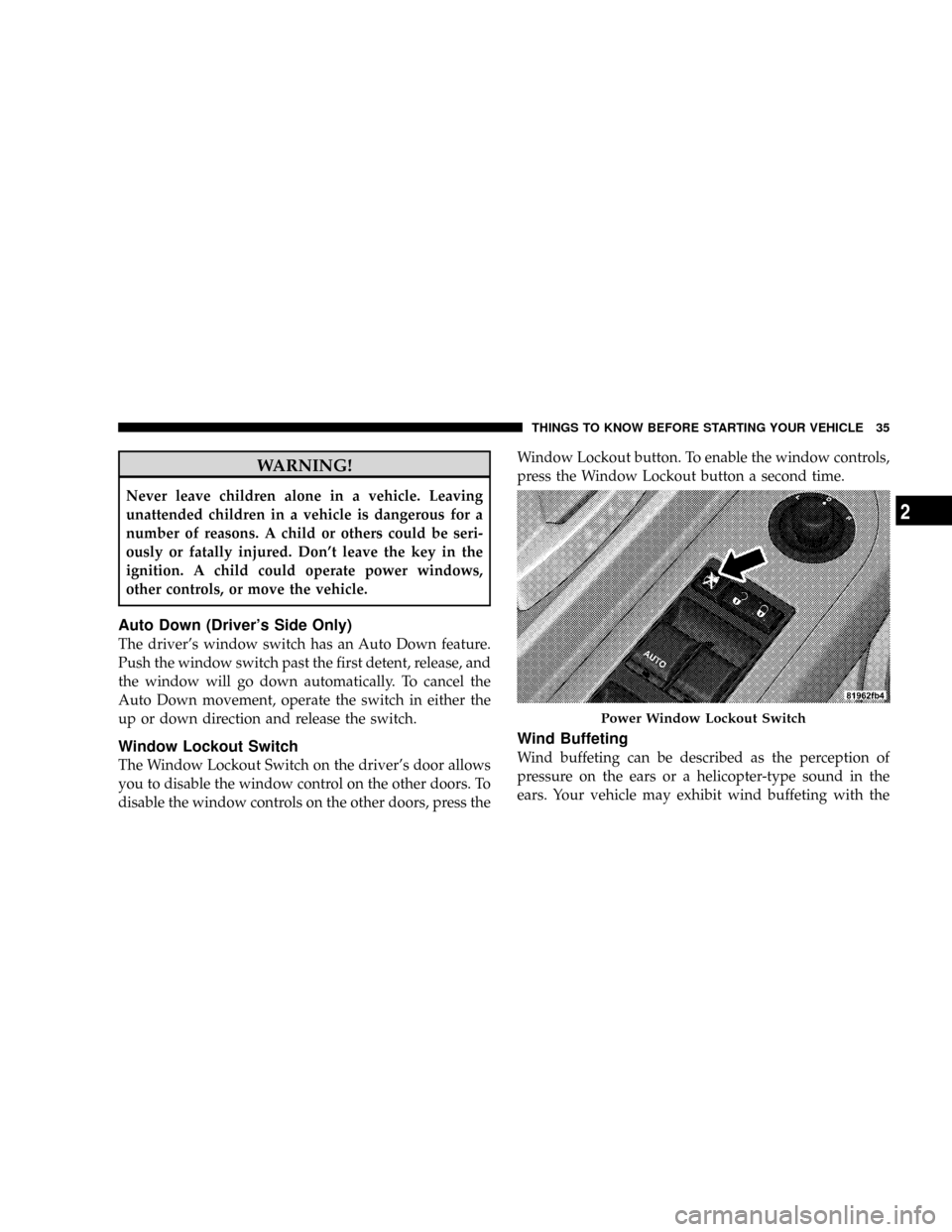
Window Lockout Switch
The Window Lockout Switch on the driver's door allows
you to disable the window control on the other doors. To
disable the window controls on the other doors, press theWindow Lockout button. To enable the window controls,
press the Window Lockout button a second time.
Wind Buffeting
Wind buffeting can be described as the perception of
pressure on the ears or a helicopter-type sound in the
ears. Your vehicle may exhibit wind buffeting with the
Power Window Lockout Switch
THINGS TO KNOW BEFORE STARTING YOUR VEHICLE 35
2
Page 45 of 449
The adjuster has an easy up (EZ Up) feature, which will
allow it to be moved up without engaging the button.
Automatic Locking Retractors (ALR) Mode ± If
Equipped
In this mode, the shoulder belt is automatically pre-
locked. The belt will still retract to remove any slack in
the shoulder belt. The automatic locking mode is avail-
able on all passenger seating positions with a combina-
tion lap/shoulder belt.
When to Use the Automatic Locking Mode
Use the Automatic Locking Mode anytime a child safety
seat is installed in a passenger seating position. Children
12 years old, and younger, should be properly restrained
in the rear seat, whenever possible.
How to Use the Automatic Locking Mode
1. Buckle the combination lap/shoulder belt.2. Grasp the shoulder portion and pull downward until
the entire belt is fully extended.
3. Allow the belt to retract. As the belt retracts, you will
hear a clicking sound. This indicates the safety belt is
now in the Automatic Locking mode.
How to Disengage the Automatic Locking Mode
To disengage the Automatic Locking Mode, disconnect
the combination lap/shoulder belt and allow it to retract
completely. The vehicle sensitive (emergency) locking
mode is automatically activated.
Center Lap Belts
The center seat position on the front seat bench has a lap
belt only. To fasten the lap belt, slide the latch plate into
the buckle until you hear a ªclick.º To lengthen the lap
belt, tilt the latch plate and pull. To remove slack, pull the
loose end of the webbing. Wear the lap belt snug against
the hips. Sit back and erect in the seat, then adjust the belt
as tightly as is comfortable.
THINGS TO KNOW BEFORE STARTING YOUR VEHICLE 43
2
Page 63 of 449
²Carefully follow the instructions that come with the
restraint. If you install the restraint improperly, it may
not work when you need it.
²The Extended Cab first, and Club/Crew Cab second
row outside seating positions, have cinching latch
plates. These are designed to keep the lap portion tight
around the child restraint so that it is not necessary to
use a locking clip. If the seat belt has a cinching latch
plate, pulling up on the shoulder portion of the
lap/shoulder belt will tighten the belt. The cinching
latch plate will keep the belt tight, however, any seat
belt system will loosen with time, so check the belt
occasionally and pull it tight, if necessary.
²Buckle the child into the restraint exactly as the
manufacturer's instructions tell you.
²When your child restraint is not in use, secure it in the
vehicle with the seat belt or remove it from the vehicle.Do not leave it loose in the vehicle. In a sudden stop or
collision, it could strike the occupants or seatbacks and
cause serious personal injury.
LATCH - Child Seat Anchorage System (Lower
Anchors and Tether for CHildren) Ð if equipped
Each vehicle is equipped with the child restraint anchor-
age system called LATCH, which stands for Lower
Anchors and Tethers for CHildren. The LATCH system
provides for the installation of the child restraint without
using the vehicle's seat belts, instead securing the child
restraint using lower anchorages and upper tether straps
from the child restraint to the vehicle structure. LATCH-
compatible child restraint systems are now available.
However, because the lower anchorages are to be intro-
duced over a period of years, child restraint systems
having attachments for those anchorages will continue to
also have features for installation using the vehicle's seat
belts. Child restraints having tether straps and hooks for
THINGS TO KNOW BEFORE STARTING YOUR VEHICLE 61
2
Page 67 of 449
reach. If the buckled seat belt interferes with the child
restraint installation, instead of tucking the seat belt
behind the child restraint, route the seat belt through the
child restraint belt path and then buckle it. This should
stow the seat belt out of the reach of an inquisitive child.
Remind all children in the vehicle that the seat belts are
not toys and should not be played with, and never leave
your child unattended in the vehicle.
WARNING!
Improper installation of a child restraint to the
LATCH anchorages can lead to failure of an infant or
child restraint. The child could be badly injured or
killed. Follow the manufacturer's directions exactly
when installing an infant or child restraint.
Installing Child Restraints Using the Vehicle Seat
Belt
The passenger seat belts are equipped with either cinch-
ing latch plates or automatic locking retractors, which are
designed to keep the lap portion tight around the child
restraint, so that it should not be necessary to use a
locking clip. If the seat belt has a cinching latch plate,
pulling up on the shoulder portion of the lap/shoulder
belt will tighten the belt. The cinching latch plate will
keep the belt tight; however, any seat belt system will
loosen with time, so check the belt occasionally and pull
it tight if necessary. If the seat belt has an automatic
locking retractor, it will have a distinctive label. Pull the
belt from the retractor until there is enough to allow you
to pass through the child restraint and slide the latch
plate into the buckle. Then, pull the belt until it is fully
extended from the retractor. Allow the belt to return to
the retractor, pulling on the excess webbing to tighten the
lap portion about the child restraint. For automatic
THINGS TO KNOW BEFORE STARTING YOUR VEHICLE 65
2
Page 68 of 449
locking retractor seat belts, refer to9Automatic Locking
Mode9in this section. If you have trouble tightening the
lap/shoulder belt on the child restraint because, the
buckle or latch plate is too close to the belt path opening
on the restraint, follow these steps. If the buckle is
webbing-mounted, disconnect the latch plate from the
buckle and twist the short buckle-end belt to shorten it.
Insert the latch plate into the buckle with the release
button facing out. If the belt still can't be tightened, the
buckle is not webbing-mounted, or if by pulling and
pushing on the restraint loosens the belt, you may need
to do something more. Disconnect the latch plate from
the buckle, turn the latch plate around, and insert the
latch plate into the buckle again. If you still can't make
the child restraint secure, try a different seating position
or use the locking clip provided with your child restraint.
To complete the child seat installation, refer to9Child
Restraint Tether Anchor9in this section.Child Restraint Tether Anchor
The Extended Cab model has one routing strap
located behind the passenger side, rear out-
board seating position. The tether anchor itself
is located in the center of vehicle, in between
the two seating positions. The front outboard passenger
seating position is also equipped with a child tether
anchorage, located at the base of the front seatback.
When there is a rear seat delete option, the tether
anchorage located on the cab back panel is designed to be
used for the front seat center seating position. The Crew
Cab model has three anchorages located behind each of
the rear seating positions (rear left, rear center, and rear
right).
66 THINGS TO KNOW BEFORE STARTING YOUR VEHICLE