tire pressure DODGE DART 2014 PF / 1.G Service Manual
[x] Cancel search | Manufacturer: DODGE, Model Year: 2014, Model line: DART, Model: DODGE DART 2014 PF / 1.GPages: 656, PDF Size: 4.73 MB
Page 524 of 656
WARNING!
To avoid the risk of forcing the vehicle off the jack,
do not tighten the lug nuts fully until the vehicle has
been lowered. Failure to follow this warning may
result in personal injury.
TIREFIT KIT — IF EQUIPPED
Small punctures up to ¼” (6 mm) in the tire tread can be
sealed with TIREFIT. Foreign objects (e.g., screws or nails)
should not be removed from the tire. TIREFIT can be used in
outside temperatures down to approximately -4°F (-20°C).
This kit will provide a temporary tire seal, allowing you
to drive your vehicle up to 100 miles (160 km) with a
maximum speed of 55 mph (90 km/h).
TIREFIT Storage
The TIREFIT kit is located in the trunk.
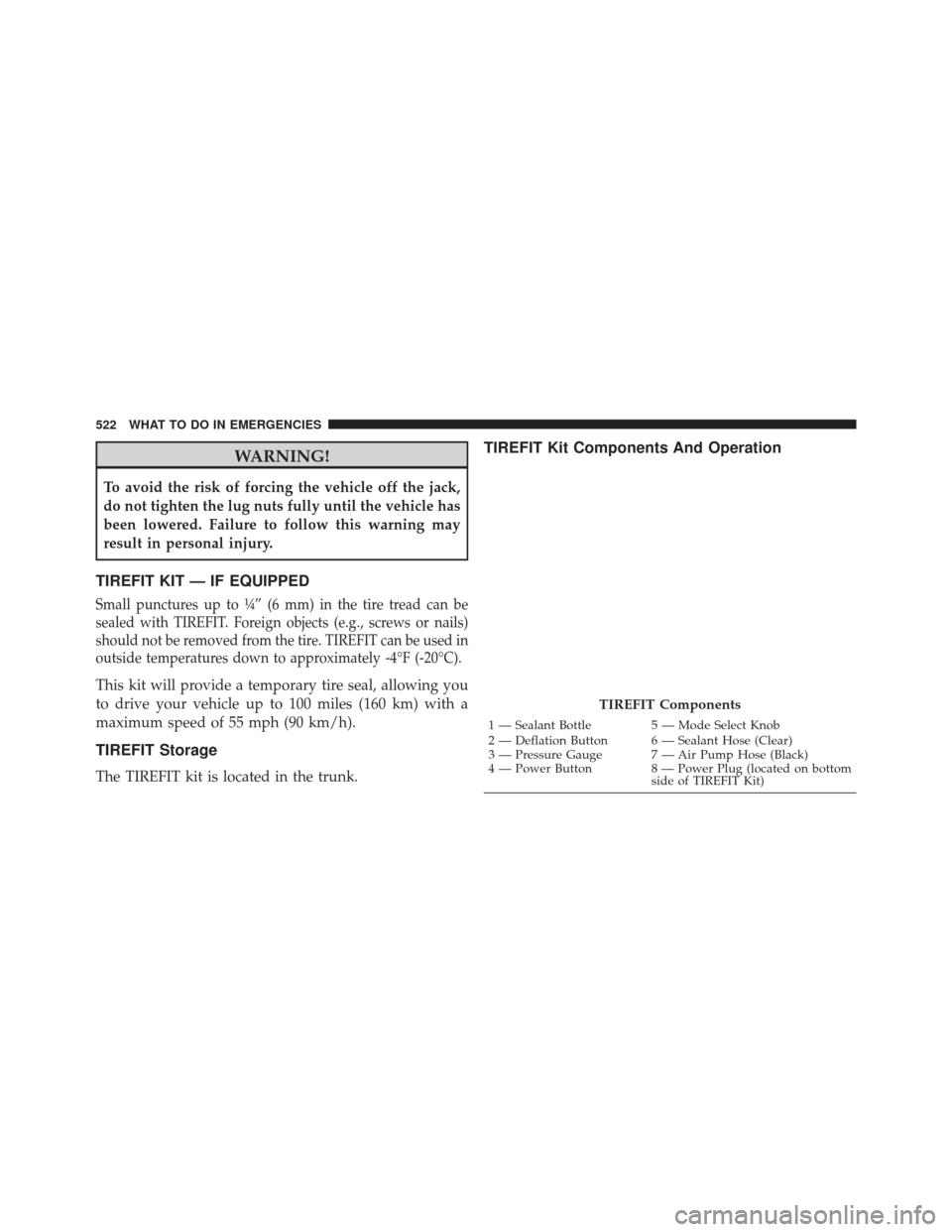
TIREFIT Kit Components And Operation
TIREFIT Components
1 — Sealant Bottle 5 — Mode Select Knob
2 — Deflation Button 6 — Sealant Hose (Clear)
3 — Pressure Gauge 7 — Air Pump Hose (Black)
4 — Power Button 8 — Power Plug (located on bottomside of TIREFIT Kit)
522 WHAT TO DO IN EMERGENCIES
Page 525 of 656
Using The Mode Select Knob And Hoses
Your TIREFIT kit is equipped with the following symbols
to indicate the air or sealant mode.
Selecting Air ModePush in the Mode Select Knob (5) and turn to
this position for air pump operation only. Use
the Black Air Pump Hose (7) when selecting
this mode.
Selecting Sealant Mode
Push in the Mode Select Knob (5) and
turn to this position to inject the TIRE-
FIT Sealant and to inflate the tire. Use
the Sealant Hose (clear hose) (6) when
selecting this mode. Using The Power ButtonPush and release the Power Button (4) once to
turn On the TIREFIT kit. Push and release the
Power Button (4) again to turn Off the TIREFIT
kit.
Using The Deflation Button
Press the Deflation Button (2) to reduce the air
pressure in the tire if it becomes over-inflated.
TIREFIT Usage Precautions
•Replace the TIREFIT Sealant Bottle (1) and Sealant
Hose (6) prior to the expiration date (printed at the
lower right hand corner on the bottle label) to assure
optimum operation of the system. Refer to “Sealing a
Tire with TIREFIT” section (F) “Sealant Bottle and
Hose Replacement”.
6
WHAT TO DO IN EMERGENCIES 523
Page 527 of 656
WARNING!
•Do not attempt to seal a tire on the side of the
vehicle closest to traffic. Pull far enough off the
road to avoid the danger of being hit when using
the TIREFIT kit.
• Do not use TIREFIT or drive the vehicle under the
following circumstances:
– If the puncture in the tire tread is approximately 1/4” (6 mm) or larger.
– If the tire has any sidewall damage.
– If the tire has any damage from driving with extremely low tire pressure.
– If the tire has any damage from driving on a flat tire.
– If the wheel has any damage.
– If you are unsure of the condition of the tire or the wheel.
(Continued)
WARNING! (Continued)
•Keep TIREFIT away from open flames or heat
source.
• A loose TIREFIT kit thrown forward in a collision
or hard stop could endanger the occupants of the
vehicle. Always stow the TIREFIT kit in the place
provided. Failure to follow these warnings can
result in injuries that are serious or fatal to you,
your passengers, and others around you.
• Take care not to allow the contents of TIREFIT to
come in contact with hair, eyes, or clothing. TIRE-
FIT is harmful if inhaled, swallowed, or absorbed
through the skin. It causes skin, eye, and respira-
tory irritation. Flush immediately with plenty of
water if there is any contact with eyes or skin.
Change clothing as soon as possible, if there is any
contact with clothing.
(Continued)
6
WHAT TO DO IN EMERGENCIES 525
Page 530 of 656
NOTE:If the Mode Select Knob (5) is on Air Mode and
the pump is operating, air will dispense from the Air
Pump Hose (7) only, not the Sealant Hose (6).
If the sealant (white fluid) does flow through the
Sealant Hose (6):
1.
Continue to operate the pump until sealant is no longer
flowing through hose (typically takes 30 - 70 seconds).
As the sealant flows through the Sealant Hose (6), the
Pressure Gauge (3) can read as high as 70 psi (4.8 Bar).
The Pressure Gauge (3) will decrease quickly from
approximately 70 psi (4.8 Bar) to the actual tire pressure
when the Sealant Bottle (1) is empty.
2. The pump will start to inject air into the tire immedi- ately after the Sealant Bottle (1) is empty. Continue to
operate the pump and inflate the tire to the pressure
indicated on the tire pressure label on the driver-side
latch pillar (recommended pressure). Check the tire
pressure by looking at the Pressure Gauge (3). If the tire does not inflate to at least 26 psi (1.8 Bar)
pressure within 15 minutes:
•
The tire is too badly damaged. Do not attempt to drive
the vehicle further. Call for assistance.
NOTE: If the tire becomes over-inflated, press the Defla-
tion Button to reduce the tire pressure to the recom-
mended inflation pressure before continuing.
If the tire inflates to the recommended pressure or is at
least 26 psi (1.8 Bar) pressure within 15 minutes:
1. Press the Power Button (4) to turn off the TIREFIT kit.
2. Remove the Speed Limit sticker from the top of the Sealant Bottle (1) and place the sticker on the instru-
ment panel.
528 WHAT TO DO IN EMERGENCIES
Page 532 of 656
(E) After Driving:
Pull over to a safe location. Refer to “Whenever You Stop
to Use TIREFIT” before continuing.
1. Push in the Mode Select Knob (5) and turn to the AirMode position.
2. Uncoil the power plug and insert the plug into the vehicle’s 12 Volt power outlet.
3. Uncoil the Air Pump Hose (7) (black in color) and screw the fitting at the end of hose (7) onto the valve
stem.
4. Check the pressure in the tire by reading the Pressure Gauge (3).
If tire pressure is less than 19 psi (1.3 Bar):
The tire is too badly damaged. Do not attempt to drive
the vehicle further. Call for assistance. If the tire pressure is 19 psi (1.3 Bar) or higher:
1. Press the Power Button (4) to turn on TIREFIT and
inflate the tire to the pressure indicated on the tire and
loading information label on the driver-side door
opening.
NOTE: If the tire becomes over-inflated, press the Defla-
tion Button to reduce the tire pressure to the recom-
mended inflation pressure before continuing.
2. Disconnect the TIREFIT kit from the valve stem, reinstall the cap on the valve stem and unplug from
12 Volt outlet.
3. Place the TIREFIT kit in its proper storage area in the vehicle.
4. Have the tire inspected and repaired or replaced at the earliest opportunity at an authorized dealer or tire
service center.
530 WHAT TO DO IN EMERGENCIES
Page 551 of 656
WARNING!
Fast spinning tires can be dangerous. Forces gener-
ated by excessive wheel speeds may cause damage, or
even failure, of the axle and tires. A tire could
explode and injure someone. Do not spin your vehi-
cle’s wheels faster than 30 mph (48 km/h) or for
longer than 30 seconds continuously without stop-
ping when you are stuck and do not let anyone near
a spinning wheel, no matter what the speed.
SHIFT LEVER OVERRIDE
If a malfunction occurs and the shift lever cannot be
moved out of the PARK position, you can use the
following procedure to temporarily move the shift lever:
1. Turn the engine OFF.
2. Firmly apply the parking brake.3. Remove the rubber storage tray liner from the center
console, then lift up the front of the shift lever bezel,
carefully disengage the bezel from the shift lever
housing, and slide it up to the top of the shift lever.
4. Press and maintain firm pressure on the brake pedal.
Shift Lever Bezel
6
WHAT TO DO IN EMERGENCIES 549
Page 570 of 656
Engine Air Cleaner Filter Selection
The quality of replacement engine air cleaner filters
varies considerably. Only high quality filters should be
used to assure most efficient service. MOPAR® engine air
cleaner filters are a high quality filter and are recom-
mended.
Tires
Checking For Tire Wear
Once a month, check the tire inflation pressures and look
for unusual wear or damage. Rotate at the first sign of
irregular wear, even if it occurs before the oil indicator
system turns on.
Maintenance-Free Battery
Your vehicle is equipped with a maintenance-free battery.
You will never have to add water, nor is periodic main-
tenance required.
WARNING!
•Battery fluid is a corrosive acid solution and can
burn or even blind you. Do not allow battery fluid
to contact your eyes, skin, or clothing. Do not lean
over a battery when attaching clamps. If acid
splashes in eyes or on skin, flush the area imme-
diately with large amounts of water. Refer to
“Jump-Starting Procedures” in “What To Do In
Emergencies” for further information.
• Battery gas is flammable and explosive. Keep
flame or sparks away from the battery. Do not use
a booster battery or any other booster source with
an output greater than 12 Volts. Do not allow cable
clamps to touch each other.
• Battery posts, terminals, and related accessories
contain lead and lead compounds. Wash hands
after handling.
(Continued)
568 MAINTAINING YOUR VEHICLE
Page 616 of 656
MAINTENANCE SCHEDULE
Your vehicle is equipped with an automatic oil change
indicator system. The oil change indicator system will
remind you that it is time to take your vehicle in for
scheduled maintenance.
Based on engine operation conditions, the oil change
indicator message will illuminate. This means that ser-
vice is required for your vehicle. Operating conditions
such as frequent short-trips, trailer tow, extremely hot or
cold ambient temperatures, and E85 fuel usage will
influence when the “Change Oil” message is displayed.
Severe Operating Conditions can cause the change oil
message to illuminate as early as 3,500 miles (5,600 km)
since last reset. Have your vehicle serviced as soon as
possible, within the next 500 miles (805 km).
NOTE:Under no circumstances should oil change inter-
vals exceed 10,000 miles (16,000 km) or twelve months,
whichever comes first. Severe Duty All Models
Change Engine Oil at 4000 miles (6,500 km) if the vehicle
is operated in a dusty and off road environment. This
type of vehicle use is considered Severe Duty.
•
Once A Month Or Before A Long Trip:
Check engine oil level.
Check windshield washer fluid level.
Check the tire inflation pressures and look for unusual
wear or damage.
Check the fluid levels of the coolant reservoir, and brake
master cylinder as needed.
Check function of all interior and exterior lights.
8
M A I
N T
E
N
A
N
C E
S
C
H E
D
U L
E
S614 MAINTENANCE SCHEDULES
Page 634 of 656
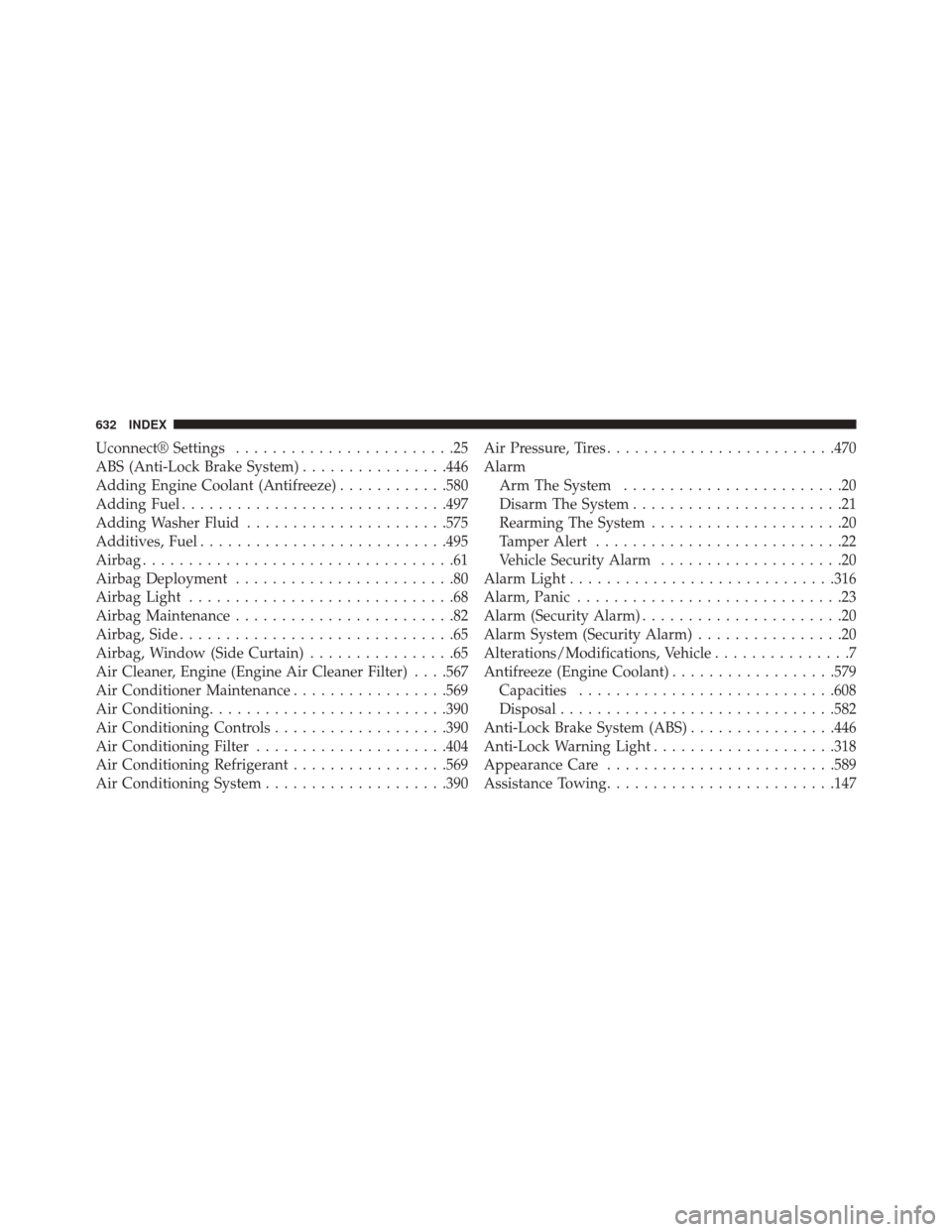
Uconnect® Settings........................25
ABS (Anti-Lock Brake System) ................446
Adding Engine Coolant (Antifreeze) ............580
Adding Fuel ............................ .497
Adding Washer Fluid ..................... .575
Additives, Fuel .......................... .495
Airbag ..................................61
Airbag Deployment ........................80
Airbag Light .............................68
Airbag Maintenance ........................82
Airbag, Side ..............................65
Airbag, Window (Side Curtain) ................65
Air Cleaner, Engine (Engine Air Cleaner Filter) . . . .567
Air Conditioner Maintenance .................569
Air Conditioning ..........................390
Air Conditioning Controls ...................390
Air Conditioning Filter .....................404
Air Conditioning Refrigerant .................569
Air Conditioning System ....................390 Air Pressure, Tires
........................ .470
Alarm Arm The System ........................20
Disarm The System .......................21
Rearming The System .....................20
Tamper Alert ...........................22
Vehicle Security Alarm ....................20
Alarm Light ............................ .316
Alarm, Panic .............................23
Alarm (Security Alarm) ......................20
Alarm System (Security Alarm) ................20
Alterations/Modifications, Vehicle ...............7
Antifreeze (Engine Coolant) ..................579
Capacities ............................608
Disposal ............................. .582
Anti-Lock Brake System (ABS) ................446
Anti-Lock Warning Light ....................318
Appearance Care ........................ .589
Assistance Towing ........................ .147
632 INDEX
Page 636 of 656
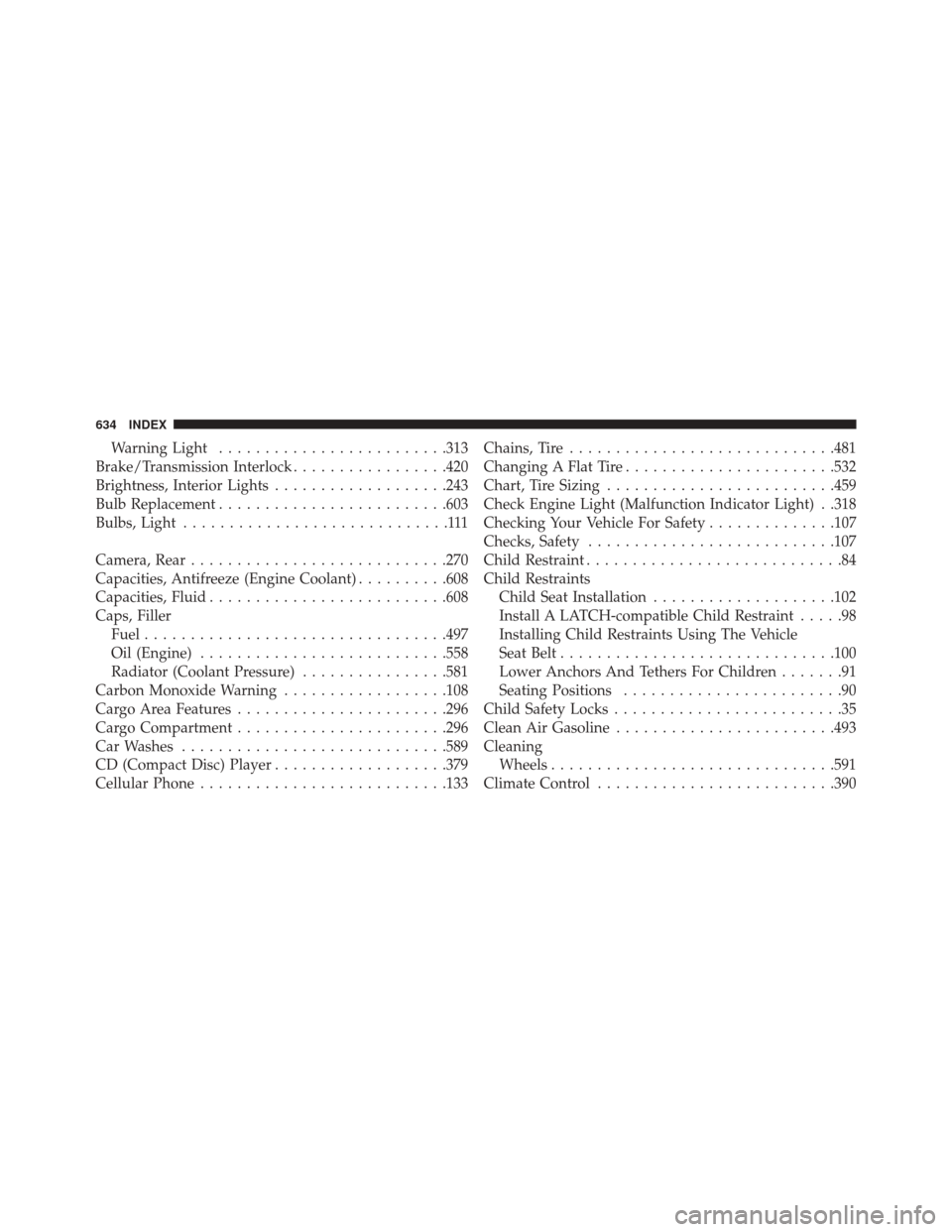
Warning Light........................ .313
Brake/Transmission Interlock .................420
Brightness, Interior Lights ...................243
Bulb Replacement ........................ .603
Bulbs, Light .............................111
Camera, Rear ............................270
Capacities, Antifreeze (Engine Coolant) ..........608
Capacities, Fluid ..........................608
Caps, Filler Fuel .................................497
Oil (Engine) .......................... .558
Radiator (Coolant Pressure) ................581
Carbon Monoxide Warning ..................108
Cargo Area Features .......................296
Cargo Compartment .......................296
Car Washes ............................ .589
CD (Compact Disc) Player ...................379
Cellular Phone .......................... .133Chains, Tire
............................ .481
Changing A Flat Tire .......................532
Chart, Tire Sizing ........................ .459
Check Engine Light (Malfunction Indicator Light) . .318
Checking Your Vehicle For Safety ..............107
Checks, Safety .......................... .107
Child Restraint ............................84
Child Restraints Child Seat Installation ....................102
Install A LATCH-compatible Child Restraint .....98
Installing Child Restraints Using The Vehicle
Seat Belt ............................. .100
Lower Anchors And Tethers For Children .......91
Seating Positions ........................90
Child Safety Locks .........................35
Clean Air Gasoline ........................493
Cleaning Wheels ...............................591
Climate Control ..........................390
634 INDEX