trailer DODGE DURANGO 2004 2.G User Guide
[x] Cancel search | Manufacturer: DODGE, Model Year: 2004, Model line: DURANGO, Model: DODGE DURANGO 2004 2.GPages: 386, PDF Size: 6.22 MB
Page 256 of 386

²Trailer brakes are recommended for trailers over 1,000
lbs (454 kg) and required for trailers in excess of 2,000
lbs. (907 kg).
²Use an approved trailer harness and connector. If a
hitch is ordered, the proper wiring will be provided.
²When hauling cargo or towing a trailer, do not over-
load your vehicle or trailer. Overloading can cause a
loss of control, poor performance or damage to brakes,
axle, engine, transmission, steering, suspension, chas-
sis structure or tires.
²Make certain that the load is secured in the trailer and
will not shift during travel. When trailering cargo that
cannot be fully secured, dynamic load shifts can occur
that may be difficult for the driver to control.
²All trailer hitches should be professionally installed on
your vehicle.
²Safety chains must always be used between your
vehicle and trailer.
²Connect trailer lighting and brakes using factory har-
nesses only. Do not cut or splice any wiring to the
brake circuits.
Trailer and Tongue Weight
Gross Trailer Weight (GTW) means the maximum allow-
able weight of the trailer plus the weight of all cargo and
equipment loaded on the trailer when in actual under-
way towing condition. The recommended way to mea-
sure GTW is to put your fully loaded trailer on a vehicle
scale. The entire weight of the trailer must be supported
by the scale.
Tongue Weight is the weight placed on the vehicle's
trailer hitch by the trailer. Always load a trailer with 60%
to 65% of the weight in the front of the trailer. This places
10% to 15% of the GTW on the tow hitch of your vehicle.
256 STARTING AND OPERATING
Page 257 of 386

Trailer sway control and equalizing hitch are required for
tongue weights above 350 lbs. (159 kg).
Also, there are maximum tongue weight ratings that are
not to be exceeded, as follows:
²Class IV (the receiver hitch type) 1200 lbs (544 kg)
Gross Combined Vehicle Weight Rating (GCWR)
The Gross Combined Vehicle Weight Rating (GCWR) is
theMAXIMUMallowable weight of the towing vehicle,
including passengers and cargo, and the weight of the
loaded trailer. Calculate the maximum trailer weight
(MTW) by subtracting the towing vehicle's weight, in-
cluding passengers, and cargo from GCWR.
Trailer TowingÐHitches:
With a Class IV Hitch, you can tow a trailer with a Gross
Trailer Weight of up to 8, 900 lbs. (4037 kg.) depending on
your vehicle equipment. The Trailer Tow Package in-
cludes the platform hitch receiver, and a 7 lead wiring
harness mounted on the hitch. Tongue weight must be
equal to at least 10% of GTW, but no more that 15% of
GTW.
NOTE: When towing a trailer, the following require-
ments must be adhered to:
²GCWR must not be exceeded
STARTING AND OPERATING 257
5
Page 258 of 386

²Total weight must be distributed between the tow
vehicle and the trailer such that the following four
(4) ratings are not exceeded:
1.GVWR
2.GTW
3.Tongue weight rating for the trailer hitch utilized
(This requirement may limit the ability to always
achieve the 10% to 15% range of tongue weight as a
percentage of total trailer weight.)
4.GAWR ratings
Trailer Towing Information (Maximum Trailer
Weight Ratings)
(Trailer Towing Guide(
NOTE:For trailer towing information (maximum trailer
weight ratings) refer to the following website address:
http:// www.dodge.com/towing.In Canada, refer to the following website address:http://
www.dodge.ca.
Trailer Towing Requirements
All Dodge Durango trucks are intended to tow trailers up
to 2,000 lbs. (907 kg) without added equipment or
alterations to standard equipment. Your vehicle may be
factory equipped for safe towing of trailers over 2,000 lbs.
(907 kg) with the trailer tow package.The electrical part of
this package includes an instruction sheet and wiring
pigtail for an aftermarket electric trailer brake controller.
These items are stored in the glove box.
If you regularly pull a trailer, regardless of the trailer size,
stop and turn signals on the trailer are recommended for
motoring safety.
When the additional trailer lighting is connected to the
vehicle, the flasher does not provide an indication of
258 STARTING AND OPERATING
Page 259 of 386
outside lamp/bulb failure. Therefore, an occasional vi-
sual check around the vehicle is recommended. Once the
trailer is removed the above indication will return to the
vehicle.
WARNING!
The direct connection of hydraulic brake lines from
vehicle brake system to trailer system is not accept-
able. The extra load may cause brake failure and you
may be injured.
All Durango models are equipped with an Anti-Lock
Brake System and require an electrically actuated electric
brake controller. A blue colored connector for electric
brake hookup is located under the instrument panel
above the brake pedal.Heavy trailer towing also may require breakaway electric
trailer brakes, anti-sway devices or equalizing hitches for
safe operation. Such devices are commonly required by
state law.
Trailer Tow Wiring
The Trailer Tow Package includes a 4 and 7 pin wiring
harness located at the rear underbody of the vehicle.
NOTE:Connect trailer lighting and brakes using factory
harnesses only. Do not cut or splice wiring to the brake
circuits.
STARTING AND OPERATING 259
5
Page 260 of 386

The electrical connections are all complete to the vehicle
but you must mate the harness to a trailer connector.
Refer to the following illustrations.
Cooling System TipsÐTrailer Towing
To reduce potential for engine and transmission over-
heating, take the following actions:
²City Driving
When stopped for short periods of time, put transmission
in neutral and increase engine idle speed.
4 - Pin Connector
7 - Pin Connector
260 STARTING AND OPERATING
Page 294 of 386

Frequency Of Oil Change
Road conditions and your style of driving affect the
interval at which your oil should be changed. Check the
following to determine ifANYapply to you:
²Day or night temperatures are below 32ÉF (0ÉC).
²Stop and Go driving.
²Extensive engine idling.
²Driving in dusty conditions.
²Short trips of less than 10 miles (16.2 km).
²More than 50% of your driving is at sustained high
speeds during hot weather, above 90ÉF (32ÉC).
²Trailer towing, Taxi, Police or delivery service (com-
mercial service).
²Off-Road or desert operation.
²If equipped for and operating with E-85 (ethanol)
fuel.
NOTE:IfANYof these apply to you then change your
engine oil every 3,000 miles (5 000 km) or 3 months,
whichever comes first and follow schedule ªBº of the
9Maintenance Schedules9section of this manual.
If none of these apply to you, then change your engine oil
at every interval shown on schedule9A9of the9Mainte-
nance Schedules9section of this manual.
4x4 Models, If Used Primarily For Off-Road Operation
Every 50 hours of use.
Dusty Conditions
Driving through dust-laden air increases the problems of
keeping abrasive materials out of the engine. Under these
conditions, special attention should be given to the
engine air cleaner and the crankcase inlet air cleaner. The
crankcase ventilation system should also be checked
294 MAINTAINING YOUR VEHICLE
Page 341 of 386
MAINTENANCE SCHEDULES
There are two maintenance schedules that show the
requiredservice for your vehicle.
First is ScheduleªBº. It is for vehicles that are operated
under the conditions that are listed below and at the
beginning of the schedule.
²Day or night temperatures are below 32É F (0É C).
²Stop and go driving.
²Extensive engine idling.
²Driving in dusty conditions.
²Short trips of less than 10 miles (16 km).
²More than 50% of your driving is at sustained high
speeds during hot weather, above 90É F (32É C).
²Trailer towing.
²Taxi, police, or delivery service (commercial service).
²Off-road or desert operation.
²If equipped for and operating with E-85 (ethanol)
fuel.
NOTE:IfANYof these apply to you then change your
engine oil every 3,000 miles (5 000 km) or 3 months,
whichever comes first and follow schedule ªBº of the
9Maintenance Schedules9section of this manual.
NOTE:Most vehicles are operated under the conditions
listed for Schedule9B9.
Second is ScheduleªAº. It is for vehicles that are not
operated under any of the conditions listed under Sched-
ule9B9.
Use the schedule that best describes your driving condi-
tions. Where time and mileage are listed, follow the
interval that occurs first.
NOTE:Under no circumstances should oil change in-
tervals exceed 6000 miles (10 000 km) or 6 months
whichever comes first.
MAINTENANCE SCHEDULES 341
8
M
A
I
N
T
E
N
A
N
C
E
S
C
H
E
D
U
L
E
S
Page 343 of 386
Schedule ªBº
Follow schedule ªBº if you usually operate your vehicle
under one or more of the following conditions.
²Day or night temperatures are below 32É F (0É C).
²Stop and go driving.
²Extensive engine idling.
²Driving in dusty conditions.
²Short trips of less than 10 miles (16 km).
²More than 50% of your driving is at sustained high
speeds during hot weather, above 90É F (32É C).
²Trailer towing.
²Taxi, police, or delivery service (commercial service).
²Off-road or desert operation.
²If equipped for and operating with E-85 (ethanol)
fuel.
NOTE:IfANYof these apply to you then change your
engine oil every 3,000 miles (5 000 km) or 3 months,
whichever comes first and follow schedule ªBº of the
9Maintenance Schedules9section of this manual.
SCHEDULE ªBº 343
8
M
A
I
N
T
E
N
A
N
C
E
S
C
H
E
D
U
L
E
S
Page 347 of 386
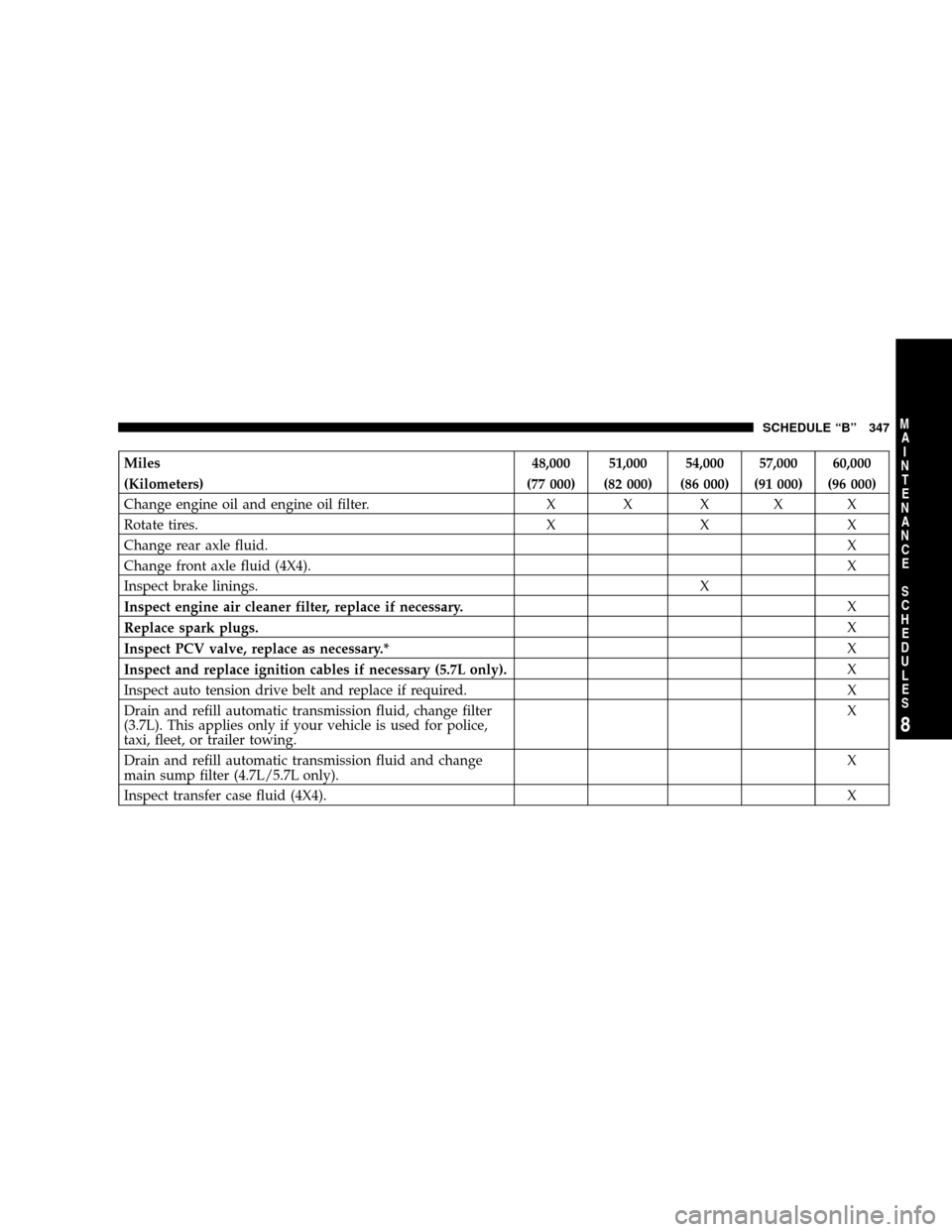
Miles 48,000 51,000 54,000 57,000 60,000
(Kilometers) (77 000) (82 000) (86 000) (91 000) (96 000)
Change engine oil and engine oil filter. X X X X X
Rotate tires. X X X
Change rear axle fluid.X
Change front axle fluid (4X4).X
Inspect brake linings. X
Inspect engine air cleaner filter, replace if necessary.X
Replace spark plugs.X
Inspect PCV valve, replace as necessary.*X
Inspect and replace ignition cables if necessary (5.7L only).X
Inspect auto tension drive belt and replace if required. X
Drain and refill automatic transmission fluid, change filter
(3.7L). This applies only if your vehicle is used for police,
taxi, fleet, or trailer towing.X
Drain and refill automatic transmission fluid and change
main sump filter (4.7L/5.7L only).X
Inspect transfer case fluid (4X4).X
SCHEDULE ªBº 347
8
M
A
I
N
T
E
N
A
N
C
E
S
C
H
E
D
U
L
E
S
Page 352 of 386
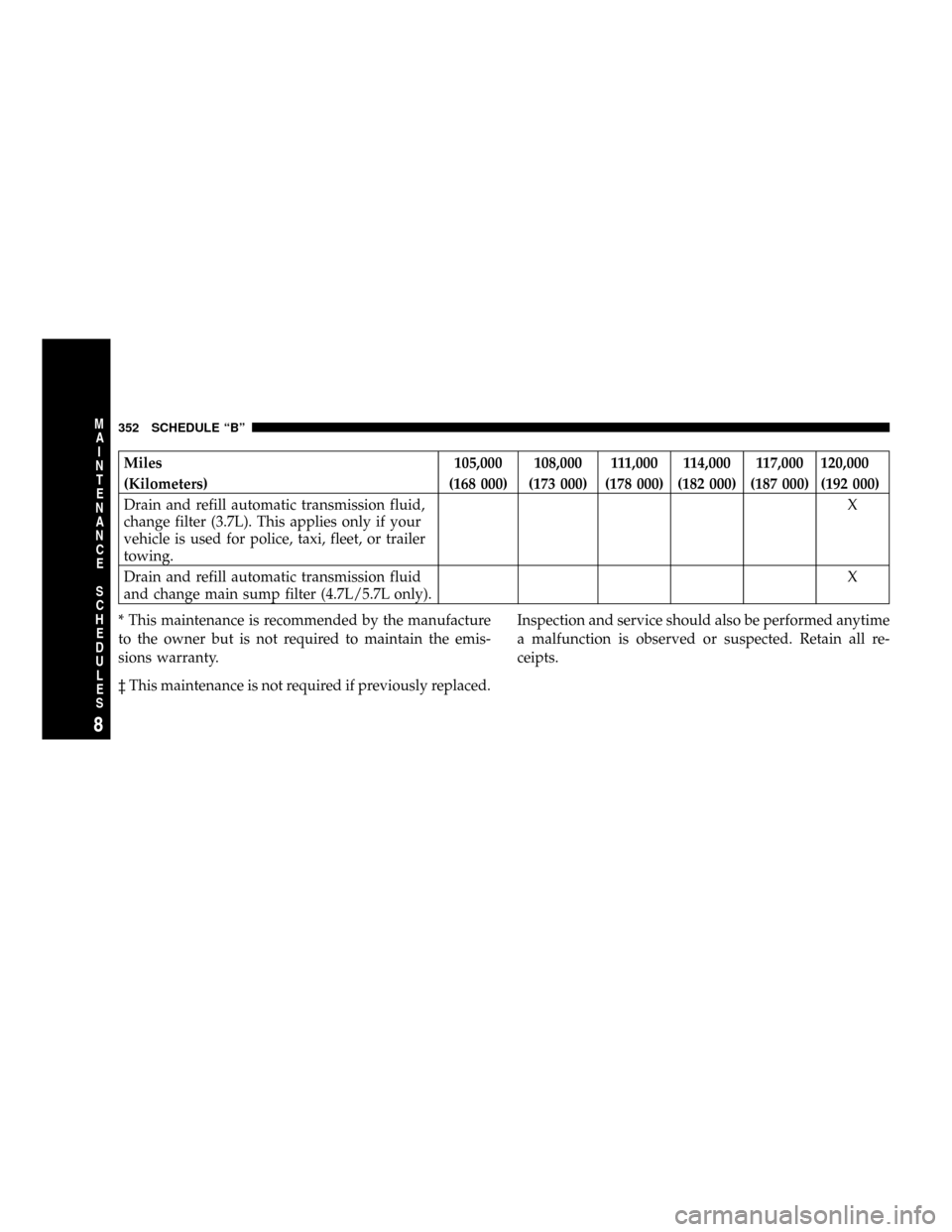
Miles 105,000 108,000 111,000 114,000 117,000 120,000
(Kilometers) (168 000) (173 000) (178 000) (182 000) (187 000) (192 000)
Drain and refill automatic transmission fluid,
change filter (3.7L). This applies only if your
vehicle is used for police, taxi, fleet, or trailer
towing.X
Drain and refill automatic transmission fluid
and change main sump filter (4.7L/5.7L only).X
* This maintenance is recommended by the manufacture
to the owner but is not required to maintain the emis-
sions warranty.
³ This maintenance is not required if previously replaced.Inspection and service should also be performed anytime
a malfunction is observed or suspected. Retain all re-
ceipts.
352 SCHEDULE ªBº
8
M
A
I
N
T
E
N
A
N
C
E
S
C
H
E
D
U
L
E
S