steering DODGE DURANGO 2004 2.G Owner's Manual
[x] Cancel search | Manufacturer: DODGE, Model Year: 2004, Model line: DURANGO, Model: DODGE DURANGO 2004 2.GPages: 386, PDF Size: 6.22 MB
Page 238 of 386
WARNING!
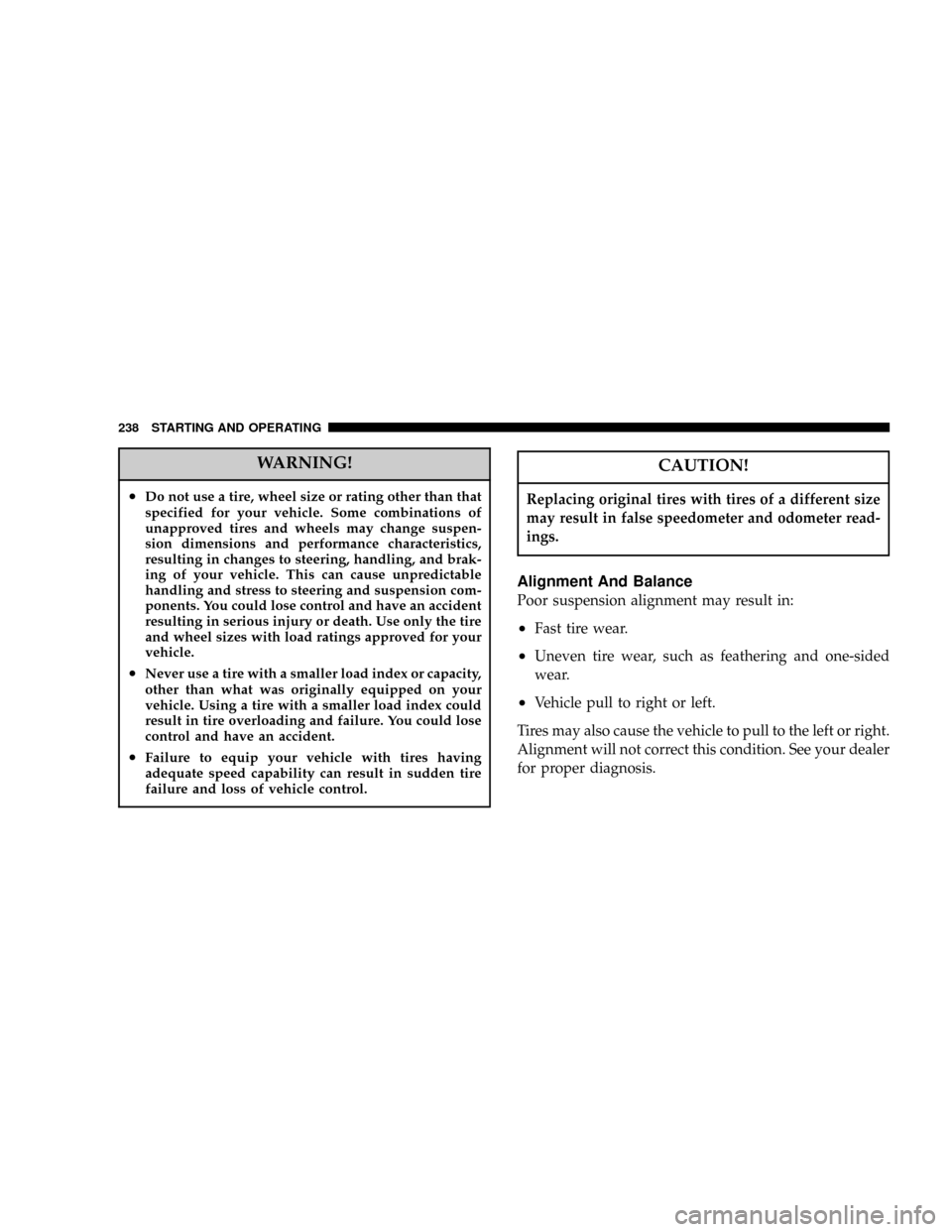
²Do not use a tire, wheel size or rating other than that
specified for your vehicle. Some combinations of
unapproved tires and wheels may change suspen-
sion dimensions and performance characteristics,
resulting in changes to steering, handling, and brak-
ing of your vehicle. This can cause unpredictable
handling and stress to steering and suspension com-
ponents. You could lose control and have an accident
resulting in serious injury or death. Use only the tire
and wheel sizes with load ratings approved for your
vehicle.
²Never use a tire with a smaller load index or capacity,
other than what was originally equipped on your
vehicle. Using a tire with a smaller load index could
result in tire overloading and failure. You could lose
control and have an accident.
²Failure to equip your vehicle with tires having
adequate speed capability can result in sudden tire
failure and loss of vehicle control.
CAUTION!
Replacing original tires with tires of a different size
may result in false speedometer and odometer read-
ings.
Alignment And Balance
Poor suspension alignment may result in:
²Fast tire wear.
²Uneven tire wear, such as feathering and one-sided
wear.
²Vehicle pull to right or left.
Tires may also cause the vehicle to pull to the left or right.
Alignment will not correct this condition. See your dealer
for proper diagnosis.
238 STARTING AND OPERATING
Page 241 of 386

TIRE ROTATION RECOMMENDATIONS
Tires on the front and rear axles of vehicles operate at
different loads and perform different steering, driving,
and braking functions. For these reasons, they wear at
unequal rates and tend to develop irregular wear pat-
terns. These effects can be reduced by timely rotation of
tires. The benefits of rotation are especially worthwhile
with aggressive tread designs such as those on all season
type tires. Rotation will increase tread life, help to main-
tain mud, snow and wet traction levels, and contribute to
a smooth, quiet ride.
Follow the recommended tire rotation frequency for your
type of driving found in the ªMaintenance Schedulesº
Section of this manual. More frequent rotation is permis-
sible if desired. The reasons for any rapid or unusual
wear should be corrected prior to rotation being per-
formed.
STARTING AND OPERATING 241
5
Page 256 of 386

²Trailer brakes are recommended for trailers over 1,000
lbs (454 kg) and required for trailers in excess of 2,000
lbs. (907 kg).
²Use an approved trailer harness and connector. If a
hitch is ordered, the proper wiring will be provided.
²When hauling cargo or towing a trailer, do not over-
load your vehicle or trailer. Overloading can cause a
loss of control, poor performance or damage to brakes,
axle, engine, transmission, steering, suspension, chas-
sis structure or tires.
²Make certain that the load is secured in the trailer and
will not shift during travel. When trailering cargo that
cannot be fully secured, dynamic load shifts can occur
that may be difficult for the driver to control.
²All trailer hitches should be professionally installed on
your vehicle.
²Safety chains must always be used between your
vehicle and trailer.
²Connect trailer lighting and brakes using factory har-
nesses only. Do not cut or splice any wiring to the
brake circuits.
Trailer and Tongue Weight
Gross Trailer Weight (GTW) means the maximum allow-
able weight of the trailer plus the weight of all cargo and
equipment loaded on the trailer when in actual under-
way towing condition. The recommended way to mea-
sure GTW is to put your fully loaded trailer on a vehicle
scale. The entire weight of the trailer must be supported
by the scale.
Tongue Weight is the weight placed on the vehicle's
trailer hitch by the trailer. Always load a trailer with 60%
to 65% of the weight in the front of the trailer. This places
10% to 15% of the GTW on the tow hitch of your vehicle.
256 STARTING AND OPERATING
Page 270 of 386

HAZARD WARNING FLASHER
The flasher switch is on the top of the steering column,
just behind the steering wheel. Press the flasher switch
and all front and rear directional signals will flash
intermittently.
Press the switch a second time to turn off the emergency
flashers.This is an emergency warning system and should not be
used when the vehicle is in motion. Use it when your
vehicle is disabled and is creating a safety hazard for
other motorists.
If it is necessary to leave the vehicle to go for service, the
flasher system will continue to operate with the ignition
key removed and the vehicle locked.
ADDING FUEL
If using a portable fuel container, it should have a flexible
nozzle long enough to reach past the restriction in the
fuel filler tube.
270 WHAT TO DO IN EMERGENCIES
Page 284 of 386

NAir Conditioner Maintenance.............302
NPower Steering Ð Fluid Check............303
NFront Suspension Ball Joints..............304
NDrive Shaft Constant Velocity Joints........304
NBody Lubrication.....................304
NWindshield Wiper Blades................305
NWindshield Washers...................305
NExhaust System......................306
NCooling System.......................306
NEmission Related Components............311
NBrake System........................313
NAutomatic Transmission................315
NTransfer Case........................319NAxles..............................319
NSelection Of Lubricating Grease...........320
NAppearance Care And Protection From
Corrosion...........................321
mPower Distribution Center (Fuse/Relay).......325
mFuse Block............................325
mVehicle Storage........................326
mReplacement Light Bulbs.................327
mBulb Replacement......................327
NHeadlights/Parking/Turn Signal..........327
NRear Side Marker, Tail Lights, Turn Signals And
Backup Lights Ð Replacement............329
NLicense Lights........................333
NCenter High-Mounted Stoplight...........334
284 MAINTAINING YOUR VEHICLE
Page 303 of 386

Refrigerant Recovery and Recycling
R-134a Air Conditioning Refrigerant is a hydrofluorocar-
bon (HFC) that is endorsed by the Environmental Pro-
tection Agency and is an ozone-saving product. How-
ever, the manufacturer recommends that air conditioning
service be performed by dealers or other service facilities
using recovery and recycling equipment.
NOTE:Air Conditioning systems found to be contami-
nated with A/C System Sealers, Stop Leak Products, Seal
Conditioners, Compressor Oil, or Refrigerants not ap-
proved by the manufacturer, voids the warranty for the
Air Conditioning system.
Power Steering Ð Fluid Check
Checking the power steering fluid level at a defined
service interval is not required. The fluid should only be
checked if a leak is suspected, abnormal noises areapparent, and/or the system is not functioning as antici-
pated. Coordinate inspection efforts through a certified
DaimlerChrysler Dealership.9
WARNING!
Fluid level should be checked on a level surface and
with the engine off to prevent injury from moving
parts and to insure accurate fluid level reading. Do
not overfill. Use only manufacturers recommended
power steering fluid.
If necessary, add fluid to restore to the proper indicated
level. With a clean cloth, wipe any spilled fluid from all
surfaces. Refer to Recommended Fluids, Lubricants, and
Genuine Parts for correct fluid type.
MAINTAINING YOUR VEHICLE 303
7
Page 312 of 386

swelling suggest deterioration of the rubber. Particular
attention should be given to examining hose surfaces
nearest to high heat sources, such as the exhaust mani-
fold.
Insure nylon tubing in these areas has not melted or
collapsed.
Inspect all hose clamps and couplings to make sure they
are secure and no leaks are present.
NOTE:Fluids such as oil, power steering fluid, and
brake fluid are used during assembly plant operations to
ease the assembly of hoses to couplings. Therefore, oil
wetness at the hose-coupling area is not necessarily an
indication of leakage. Actual dripping of hot fluid when
systems are under pressure (during vehicle operation),
should be noted before hose is replaced based on leakage.
You are urged to use only the manufacturer's specified
hoses and clamps, or their equivalent in material andspecification, in any fuel system servicing. It is manda-
tory to replace all clamps that have been loosened or
removed during service. Care should be taken in install-
ing new clamps to insure they are properly torqued.
Positive Crankcase Ventilation (PCV) Valve
Proper operation of the crankcase ventilation system
requires that the PCV valve be free of sticking or plug-
ging because of deposits. Deposits can accumulate in the
PCV valve and passage with increasing mileage. Have
the PCV valve, hoses, and passages checked for proper
operation at the intervals specified. If the valve is
plugged or sticking, replace with a new valve ±Do not
attempt to clean the oil PCV valve!Check ventilating
hose for indication of damage or plugging with deposits.
Replace if necessary.
312 MAINTAINING YOUR VEHICLE
Page 338 of 386
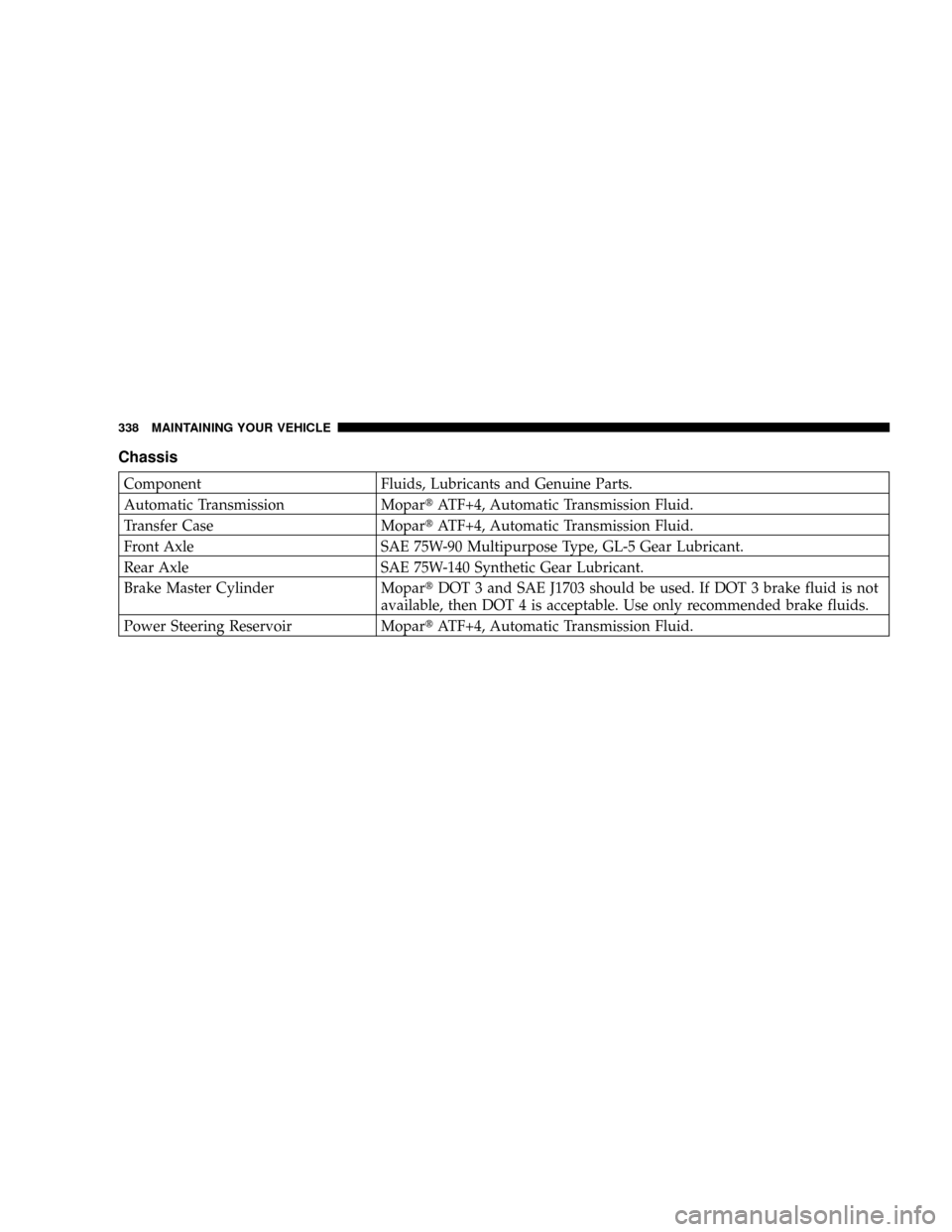
Chassis
Component Fluids, Lubricants and Genuine Parts.
Automatic Transmission MopartATF+4, Automatic Transmission Fluid.
Transfer Case MopartATF+4, Automatic Transmission Fluid.
Front Axle SAE 75W-90 Multipurpose Type, GL-5 Gear Lubricant.
Rear Axle SAE 75W-140 Synthetic Gear Lubricant.
Brake Master Cylinder MopartDOT 3 and SAE J1703 should be used. If DOT 3 brake fluid is not
available, then DOT 4 is acceptable. Use only recommended brake fluids.
Power Steering Reservoir MopartATF+4, Automatic Transmission Fluid.
338 MAINTAINING YOUR VEHICLE
Page 371 of 386

Axle Lubrication........................ 319
Ball Joints............................. 304
Battery............................... 300
Charging............................ 280
Emergency Starting..................... 280
Gas Caution.......................... 280
Keyless Transmitter Replacement............ 24
Saving Feature........................ 105
Belts, Drive............................ 297
Belts, Seat.............................. 29
Body Mechanism Lubrication............... 304
B-Pillar Location........................ 226
Brake Fluid............................ 338
Brake System........................218,313
Anti-Lock........................... 218
Disc Brakes.......................... 313
Fluid Check.......................... 313
Hoses.............................. 314Master Cylinder....................... 313
Parking............................. 217
Warning Light.....................149,151
Brakes............................... 218
Brake/Transmission Interlock............... 203
Break-In Recommendations, New Vehicle........ 62
Bulb Replacement....................... 327
Bulbs, Light............................ 327
Calibration, Compass..................... 124
Capacities, Fluid........................ 335
Caps, Filler
Power Steering........................ 303
Car Washes............................ 321
Carbon Monoxide Warning................. 248
Cargo ................................ 250
Catalytic Converter....................249,299
CD Player..........................155,161
Cellular Phone........................74,179
INDEX 371
10
Page 373 of 386

Daytime Running Lights................... 107
Dealer Service.......................... 291
Defroster, Rear Window................... 195
Defroster, Windshield................63,182,187
Delay Wipers........................... 110
Diagnostic System, Onboard................ 289
Dimmer Switch, Headlight................. 147
Dipsticks
Automatic Transmission................. 316
Oil (Engine).......................... 292
Power Steering........................ 303
Disarming, Theft System................... 25
Disc Brakes............................ 313
Disposal
Used Coolant......................... 308
Door Ajar Light......................... 151
Door Locks............................. 13
Door Opener, Garage..................... 126
Drive Belts............................ 297Drive Shaft Universal Joints................ 304
Electric Remote Mirrors.................... 72
Electrical Power Outlets................... 135
Electronic Speed Control................... 116
Emergency, In Case of
Freeing Vehicle When Stuck............... 221
Jacking............................. 275
Overheating.......................... 310
Towing............................. 282
Emission Control System Maintenance......... 340
Emission Related Components.............. 311
Engine
Air Cleaner.......................... 298
Block Heater......................... 202
Break-In Recommendations................ 62
Compartment......................287,288
Coolant..........................308,337
Cooling............................. 306
INDEX 373
10